How psychological time expands, contracts, and gives meaning to our lives.

Two Kinds of Time: Measured vs. Experienced
We often say, “Today felt so long” or “This week went by in a flash.”
Interestingly, these statements have nothing to do with physical time.
Physics tells us that time flows at a constant rate—24 hours a day, without exception.
Yet human beings do not live inside clocks.
We live inside perceived time, or what psychologist Daniel Zakay called “experienced time.”
Zakay distinguishes between:
- Measured time — the objective ticking of the clock
- Experienced time — the subjective feeling of duration shaped by attention, emotion, and memory
The gap between these two creates what we might call the texture of time.
This texture is not a mere feeling—it emerges from the brain’s information-processing, emotional state, and social environment.
In other words:
The quality of our time mirrors the quality of our perception.
When Time Slows Down
Some moments stretch endlessly: waiting for exam results, entering a new environment, or standing in an unfamiliar place. Slow time appears in three main situations:
1. Novelty — a world rich in unfamiliar details
The brain works harder to process new information, which creates the sensation of longer time.
A first-time trip feels longer than a daily commute because novelty increases mental recording.
2. Anxiety and hyper-awareness
Before an interview, during turbulence on a plane, or in moments of threat, the mind becomes highly alert.
This heightened attention makes even seconds feel elongated.
3. Waiting — the pressure of the expected future
Waiting is not an empty pause.
It is a psychological space where expectation and uncertainty weigh on the present.
This emotional tension stretches time.
In slow time, the brain is collecting more data—hence the long, heavy texture.
When Time Speeds Up
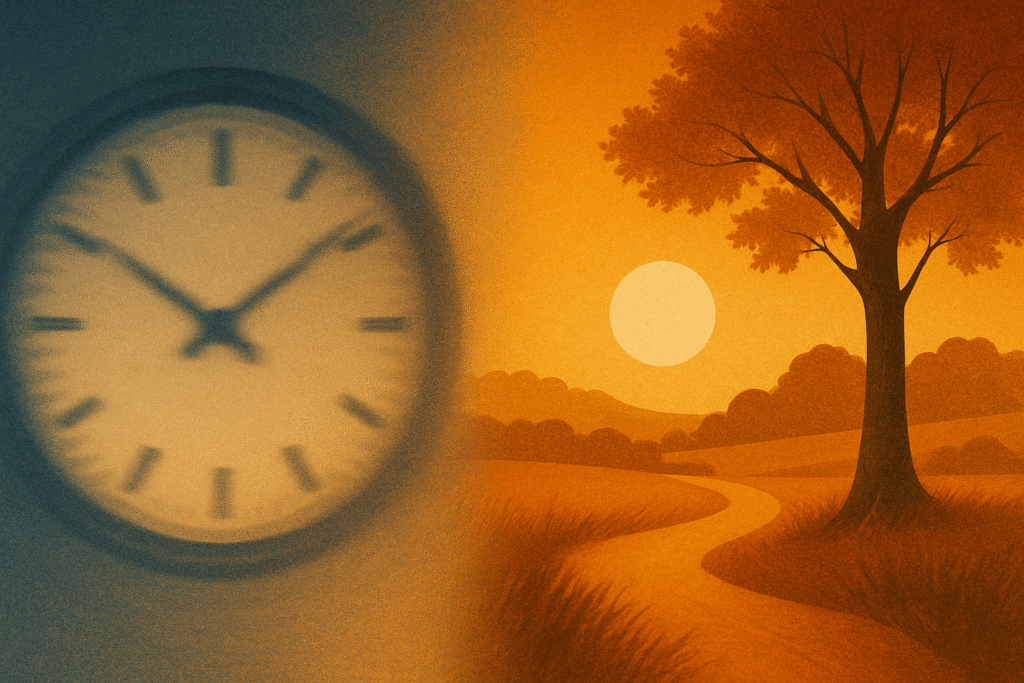
Other times, a whole day slips through our fingers before we notice.
1. Flow — when the self momentarily disappears
In deep concentration, the brain’s time-tracking function weakens.
Artists, athletes, and writers often describe the sensation of timelessness during full absorption.
2. Routine — the unrecorded hours
Repetition and familiarity reduce memory formation.
When the brain doesn’t “save” the moment, the duration feels shorter.
This explains why:
- Children experience long, expansive time (full of new stimuli)
- Adults feel time accelerating with age (reduced novelty = reduced memory density)
Fast time is not a sign of aging itself—it is a sign of decreased newness.
Time Is a Social Experience
Time is not only psychological—it is also social.
Sociologist Norbert Elias argued that time is a symbolic tool societies use to coordinate life.
1. Modern society demands speed
Efficiency has become a virtue, and the pressure to be fast creates a culture of urgency.
This accelerates our inner tempo.
2. The smartphone era fragments our time
Notifications, updates, and alerts constantly break our attention.
Our day becomes a series of small interruptions—fast, jagged, and thin.
3. The best days aren’t the busiest—they are the densest
A day feels meaningful not because it was filled with tasks,
but because it contained a memorable moment.
The value of time is measured not in quantity, but in density.
How to Change the Texture of Your Time
We cannot control time’s speed, but we can change how we experience it.
1. Create memorable moments — the art of novelty
Try a new café, walk a different street, listen to unfamiliar music.
Small variations build richer memories.
2. Practice intentional pauses — the art of stillness
A few minutes of silence, deep breathing, or opening a window resets the mind.
3. Record your experiences — the art of memory
Write, photograph, or journal.
Recorded moments gain texture and depth.
4. Cultivate flow — the art of immersion
Engage fully in one activity.
Flow compresses time but enriches meaning.
Conclusion: Time Is Not Managed—It Is Felt
Physical time flows steadily.
Psychological time flows according to meaning, emotion, and attention.
- Pleasant experiences pass quickly—but their resonance is long.
- Anxious moments drag—but leave shallow memory.
What truly matters is not how much time we have,
but how deeply we live inside the time we experience.
The texture of time is shaped by how we see, feel, and remember our days.
References
Zakay, D., & Block, R. (1997). Temporal Cognition. Annual Review of Psychology.
→ A foundational study explaining the difference between measured time and experienced time, and how attention and emotion shape time perception.
Csikszentmihalyi, M. (1990). Flow: The Psychology of Optimal Experience. Harper & Row.
→ Explores how deep immersion alters our sense of time and how flow enriches lived experience.
Bergson, H. (1911). Time and Free Will. Macmillan.
→ Introduces the concept of “duration,” distinguishing clock time from the qualitative, subjective dimension of psychological time.
Leave a Reply