Tag: mental wellbeing

  • Can Everyone Afford a Hobby?

    Can Everyone Afford a Hobby?

    The Hidden Cost of Leisure and Access

    For many people, hobbies are seen as simple pleasures — a way to relax after work, express creativity, or connect with others. Running in the park, playing music, painting, scuba diving, golfing, or horseback riding may all appear to belong to the same category: leisure.

    But in reality, not all hobbies are equally accessible.

    Some activities require expensive equipment, private facilities, professional coaching, or large amounts of free time. Others depend heavily on social networks and cultural exposure. As a result, hobbies can quietly reflect deeper inequalities within society.

    This raises an uncomfortable question:

    Can everyone truly enjoy leisure equally, or do hobbies also reveal economic and social privilege?

    In the modern world, where mental health, work-life balance, and self-expression are increasingly important, the accessibility of hobbies may become more than a lifestyle issue. It may become a question of cultural fairness.


    1. Expensive Hobbies and Invisible Economic Barriers

    exclusive hobbies and economic barriers

    When Leisure Requires Money

    Some hobbies demand significant financial investment from the very beginning.

    Golf, horseback riding, scuba diving, sailing, skiing, and classical music performance often require costly equipment, lessons, travel expenses, and membership fees. In some cases, simply entering the hobby community can feel financially overwhelming.

    Golf is a clear example. Beyond the cost of clubs and clothing, players may need to pay expensive course fees or private membership costs. In many countries, golf still carries the image of an upper-class activity associated with business networks and social status.

    Horseback riding presents similar barriers. Maintaining horses, renting facilities, purchasing riding gear, and paying training costs make the hobby inaccessible to many people. While riding culture is more common in some Western countries, it remains strongly associated with wealth in many parts of Asia.

    Even artistic hobbies can become economically exclusive. Learning classical instruments such as the violin or piano often requires years of private lessons and expensive instruments, creating a gap between those who can afford sustained artistic education and those who cannot.

    Hobbies as Class Signals

    As a result, hobbies that appear “personal” may actually reflect broader social inequality.


    2. Why Accessibility Matters Beyond Leisure

    Leisure as Emotional Well-Being

    At first glance, hobbies may seem less important than education, healthcare, or employment. However, leisure activities play a major role in emotional well-being and social participation.

    Hobbies help people reduce stress, build confidence, form relationships, and develop identity outside of work. In many cases, hobbies also create social networks that influence future opportunities.

    When access to hobbies becomes unequal, cultural experiences themselves become unequal.

    Cultural Capital and Social Opportunity

    French sociologist Pierre Bourdieu argued that taste and leisure are deeply connected to social class. According to his theory of “cultural capital,” people from wealthier backgrounds often gain access not only to material resources, but also to prestigious forms of culture and self-development.

    This means that hobbies are not always “free choices.” They are often shaped by economic conditions, education, and social environment.

    For younger generations facing rising housing costs, student debt, and unstable employment, expensive hobbies may feel increasingly unrealistic. Many young adults rely on low-cost or digital hobbies instead, not necessarily because they prefer them, but because they are financially accessible.

    Over time, this can create a society where leisure itself becomes stratified by class.


    3. Can Technology and Public Systems Reduce the Gap?
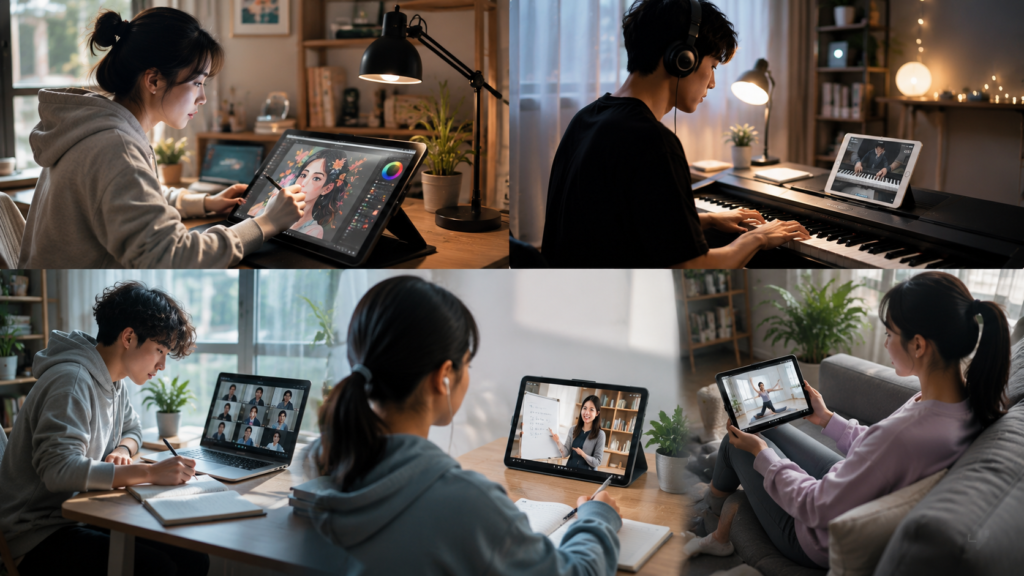
    online learning and accessible hobbies

    Despite these challenges, new approaches are making hobbies more accessible.

    Public Support and Shared Access

    Public infrastructure plays an important role. Some cities provide free sports facilities, public music programs, hiking trails, community workshops, or subsidized art classes. These programs help reduce financial barriers and encourage broader participation.

    The sharing economy has also changed how people experience hobbies. Instead of purchasing expensive equipment, individuals can rent cameras, golf clubs, musical instruments, camping gear, or bicycles at lower costs. Membership-based communities allow people to participate without owning everything themselves.

    Digital Learning as a New Doorway

    Digital platforms have expanded access even further.

    Online tutorials, virtual lessons, and educational platforms now allow people to learn photography, music, painting, coding, cooking, or languages from home at relatively low cost. A person who could never afford formal piano lessons may still learn basic music skills through digital keyboards and online instruction.

    Technology cannot completely eliminate inequality, but it can lower entry barriers and create new pathways into leisure culture.


    4. The Rise of Low-Cost and Meaningful Hobbies

    Interestingly, some of the most meaningful hobbies today are not necessarily the most expensive.

    Simple Hobbies, Deep Satisfaction

    Reading, jogging, drawing, gardening, chess, cooking, hiking, journaling, and DIY crafts continue to grow in popularity partly because they are emotionally rewarding without requiring extreme financial investment.

    In an era of economic uncertainty, many people are redefining leisure itself.

    From Status to Emotional Balance

    Instead of treating hobbies as symbols of status, some now value hobbies that promote mindfulness, simplicity, creativity, and emotional balance. This shift may represent a cultural reaction against consumerism and competitive lifestyles.

    The meaning of leisure is slowly changing from “displaying success” to “protecting mental well-being.”


    Conclusion

    inclusive leisure and everyday happiness

    Hobbies are often described as personal choices, but access to leisure is never entirely equal.

    Economic barriers, social class, cultural exposure, and technological access all influence which hobbies people can realistically pursue. As societies become more unequal, leisure itself may increasingly reflect privilege.

    At the same time, public programs, digital learning platforms, and sharing economies offer new possibilities for making hobbies more accessible to wider populations.

    The future of leisure may depend on an important cultural decision:

    Will hobbies remain symbols of status and exclusivity, or can they become spaces of inclusion, creativity, and human connection for everyone?

    In the end, a healthy society may not be one where everyone enjoys the same hobbies, but one where everyone has the genuine opportunity to discover what brings them joy.

    Reader Question

    Should hobbies remain symbols of status and wealth, or should every person have equal access to meaningful leisure and self-expression?

    Related Reading

    If AI and automation continue transforming work and everyday life, could leisure and hobbies eventually become one of the few remaining spaces where humans seek meaning and identity?
    In Will Hyper-Personalization Reshape the Future of Work?, we explore how technological change may alter labor, human roles, and the emotional structure of future society.

    If social class increasingly shapes not only wealth but also culture, taste, and lifestyle, how deeply does inequality influence the way people experience everyday happiness?
    In Can Happiness Ever Be Measured Objectively?, we examine how economics, culture, and personal experience interact in shaping human well-being and life satisfaction.


    References

    1. Amateurs, Professionals, and Serious Leisure
      This book explores the concept of “serious leisure” and explains how hobbies become meaningful parts of personal identity and social participation. It also highlights how access to leisure activities is often shaped by economic and social conditions.
    2. Distinction: A Social Critique of the Judgement of Taste
      Bourdieu analyzes how social class influences cultural taste, hobbies, and lifestyle choices. His theory of cultural capital remains one of the most influential frameworks for understanding inequality in leisure and culture.
    3. Bowling Alone
      Putnam examines the decline of social participation and community engagement in modern society. The book helps explain why accessible hobbies and shared leisure spaces are important for maintaining social connection.
    4. Flow: The Psychology of Optimal Experience
      This classic work explores how hobbies and creative activities can produce deep psychological satisfaction and emotional balance. It argues that meaningful leisure contributes significantly to human well-being.
    5. Hobbies: Leisure and the Culture of Work in America
      Gelber traces the historical development of hobby culture and explains how leisure activities became connected to identity, class, and modern work culture in contemporary society.

  • When Being Good Becomes Exhausting

    — Understanding Moral Fatigue

    “I stayed patient again.”
    “I gave in again.”
    “So why do I feel more tired?”

    Have you ever felt drained not because you did something wrong,
    but because you tried to do the right thing?

    In a culture that constantly praises kindness, empathy, and self-restraint,
    we often forget that goodness also requires energy.

    Psychologists refer to this state as moral fatigue
    a psychological exhaustion caused by sustained moral self-regulation.


    Person suppressing emotion in social situation

    1. The Cost of Staying Good

    Most people want to see themselves as morally decent.

    We hold doors open.
    We forgive.
    We stay silent to avoid conflict.
    We help even when inconvenient.

    But each act of self-control consumes mental energy.

    Over time, repeated self-restraint can lead to emotional depletion.

    Imagine someone who always volunteers for extra work.
    At first, they feel proud.
    Later, they begin to feel resentful.

    That quiet resentment is often moral fatigue.


    2. Self-Control Has Limits

    Emotional exhaustion from constant self-restraint

    Research on willpower suggests that self-regulation draws from finite cognitive resources.

    Repeatedly suppressing anger, prioritizing others, or making “ethical” choices
    requires ongoing internal effort.

    When that effort accumulates,
    small requests begin to feel overwhelming.

    This does not mean the person has become selfish.

    It means the emotional system is asking for rest.


    3. The Link to Compassion Fatigue

    Moral fatigue is closely related to compassion fatigue —
    a state often experienced by caregivers, teachers, medical workers, and helpers.

    When one is constantly responsible for being patient, understanding, and supportive,
    empathy itself becomes tiring.

    Ironically, the more responsible and caring a person is,
    the more vulnerable they may be to moral exhaustion.


    4. The Trap of the “Good Person” Identity

    Sometimes the fatigue does not come from action,
    but from identity.

    If someone feels they must always be the understanding one,
    the forgiving one,
    the mature one,

    they may begin to suppress their own needs.

    At that point, morality shifts from choice to obligation.

    And obligation drains faster than choice.


    5. Balancing Goodness and Well-Being

    How can we respond to moral fatigue?

    • Choose sustainable kindness over constant sacrifice.
    • Practice saying “no” without guilt.
    • Extend compassion inward, not only outward.

    Being good does not require self-erasure.

    Sometimes the most ethical act
    is protecting your own emotional boundaries.


    Conclusion: A Gentle Recalibration

    Setting healthy boundaries to prevent moral fatigue

    Moral fatigue is not proof of failure.

    It is proof that you have been trying.

    Perhaps the goal is not to stop being kind,
    but to redefine kindness
    so that it includes yourself.

    Goodness without rest becomes pressure.
    Goodness with boundaries becomes strength.

    Related Reading

    The emotional cost of constant kindness and blurred boundaries is further explored in The Many Faces of Self-Love: Where Healthy Self-Esteem Ends and Toxic Narcissism Begins, where the tension between self-respect and self-sacrifice is examined in depth.

    At a broader social level, the question of how environments silently shape behavior and inclusion is examined in Uncomfortable by Design: How Spaces Are Built to Exclude, where structural expectations and hidden norms reveal how pressure is embedded into everyday life.


    References

    1. Baumeister, R. F., & Tierney, J. (2011). Willpower: Rediscovering the Greatest Human Strength. Penguin Press.
    → This work explores self-control and ego depletion, explaining how repeated acts of regulation can drain psychological resources and lead to fatigue.

    2. Bloom, P. (2016). Against Empathy: The Case for Rational Compassion. HarperCollins.
    → Bloom argues that emotional empathy, when unchecked, can produce burnout and distorted moral decisions, advocating for balanced and sustainable compassion.

    3. Figley, C. R. (1995). Compassion Fatigue. Brunner/Mazel.
    → Figley analyzes how sustained caregiving and emotional labor lead to compassion fatigue, expanding understanding of moral exhaustion in professional and personal contexts.

  • Why It Feels Like Everyone Is Watching You: The Spotlight Effect

    Feeling watched in a public space despite no attention

    You get a new haircut, and suddenly it feels strange.
    You sit alone in a café and become aware of every movement.
    You stumble slightly on the subway and feel as if all eyes are on you.

    Have you ever had that feeling — that people around you are paying unusually close attention to you?

    Psychology has a name for this experience.
    It is called the spotlight effect, also known as self-relevance bias.


    1. We See the World From the Center of Ourselves

    1.1 The Natural Focus on the Self

    From birth, we experience the world from a first-person perspective.
    This makes self-awareness a natural part of being human.

    We constantly monitor how we look, how we sound, and how we appear to others. This sensitivity helps us navigate social life — but it also creates distortions.

    1.2 When Self-Awareness Becomes Overestimation

    Because we are so aware of ourselves, we often assume others are just as focused on us. In reality, this is rarely the case.

    The result is an illusion: we feel as if our actions and appearance stand out far more than they actually do.


    2. A Classic Experiment: “No One Noticed My Shirt”

    Overestimating others’ attention due to self-focus

    2.1 The Harvard T-Shirt Study

    In a well-known study conducted at Harvard University in 2000, participants were asked to wear an unattractive, embarrassing T-shirt into a classroom.

    Afterward, they were asked how many people they thought had noticed the shirt.

    On average, participants believed about 50% of others had noticed.
    In reality, only 10–15% actually did.

    2.2 The Gap Between Feeling and Reality

    This experiment clearly shows the gap between perceived attention and actual attention. We dramatically overestimate how much others notice us.

    What feels like a spotlight is often just a dim light.


    3. How the Bias Fuels Anxiety

    3.1 When the Effect Becomes Stronger

    The spotlight effect intensifies in situations such as:

    • Being in unfamiliar environments
    • Making mistakes
    • Feeling insecure about appearance or behavior
    • Being evaluated (presentations, interviews)

    3.2 From Awareness to Anxiety

    In these moments, excessive self-focus can lead to tension and withdrawal. In some cases, it contributes to social anxiety, making public spaces feel threatening rather than neutral.


    4. The Truth: Everyone Else Is Busy Being Themselves

    4.1 Others Are Not Watching — They Are Thinking

    The irony is simple: just as you are focused on yourself, others are absorbed in their own concerns.

    Your small mistake feels significant to you — but to others, it is often unnoticed or quickly forgotten.

    4.2 We Are All Main Characters in Our Own Stories

    Most people are not observers of your life.
    They are protagonists in their own.


    Conclusion

    People focused on their own thoughts, not others

    Feeling watched, judged, or remembered can be deeply uncomfortable.
    But most of the time, this feeling is not reality — it is the mind’s exaggeration of its own importance.

    People notice you far less than you imagine.
    Your mistakes rarely leave lasting impressions.

    So when that familiar anxiety appears, try this reminder:

    The spotlight is mostly in your head.

    And perhaps, that realization itself can be a quiet relief.

    Related Reading

    The psychology of subtle social perception is expanded in Social Attractiveness and the Psychology of Likeability, where unspoken cues shape interpersonal dynamics.

    The deeper philosophical question of withdrawal and presence is discussed in Is Solitude a Freedom of Self-Reflection, or a Risk of Social Disconnection? exploring the tension between connection and distance.


    References

    1.Gilovich, T., Medvec, V. H., & Savitsky, K. (2000). “The Spotlight Effect in Social Judgment: An Egocentric Bias in Estimates of the Salience of One’s Own Actions and Appearance.” Journal of Personality and Social Psychology, 78(2), 211–222.
    This seminal study introduced the concept of the spotlight effect, demonstrating experimentally that people greatly overestimate how much others notice them.

    2.Baumeister, R. F., & Bushman, B. J. (2021). Social Psychology and Human Nature (5th ed.). Boston: Cengage Learning.
    This textbook provides a comprehensive explanation of self-awareness, self-presentation, and cognitive biases, offering a broader framework for understanding self-relevance bias.

    3.Leary, M. R. (2007). The Curse of the Self: Self-Awareness, Egotism, and the Quality of Human Life. Oxford: Oxford University Press.
    Leary explores how excessive self-focus affects well-being, showing how heightened self-awareness can amplify social sensitivity and unnecessary anxiety.

  • The Texture of Time: How the Mind Shapes the Weight of Our Moments

    The Texture of Time: How the Mind Shapes the Weight of Our Moments

    How psychological time expands, contracts, and gives meaning to our lives.

    Some days seem to disappear before we can fully notice them.

    Others linger in our minds with surprising weight,
    stretching far beyond the limits of the clock.

    Perhaps time is not only something we measure—
    but something we emotionally experience.

    Abstract flowing ribbon of light symbolizing the texture of time.

    1.Two Kinds of Time: Measured vs. Experienced

    We often say, “Today felt so long” or “This week went by in a flash.”
    Interestingly, these statements have nothing to do with physical time.
    Physics tells us that time flows at a constant rate—24 hours a day, without exception.

    Yet human beings do not live inside clocks.
    We live inside perceived time, or what psychologist Daniel Zakay called “experienced time.”

    Zakay distinguishes between:

    • Measured time — the objective ticking of the clock
    • Experienced time — the subjective feeling of duration shaped by attention, emotion, and memory

    The gap between these two creates what we might call the texture of time.
    This texture is not a mere feeling—it emerges from the brain’s information-processing, emotional state, and social environment.

    In other words:

    The quality of our time mirrors the quality of our perception.


    2. When Time Slows Down

    Some moments stretch endlessly: waiting for exam results, entering a new environment, or standing in an unfamiliar place. Slow time appears in three main situations:

    Novelty — a world rich in unfamiliar details

    The brain works harder to process new information, which creates the sensation of longer time.
    A first-time trip feels longer than a daily commute because novelty increases mental recording.

    Anxiety and hyper-awareness

    Before an interview, during turbulence on a plane, or in moments of threat, the mind becomes highly alert.
    This heightened attention makes even seconds feel elongated.

    Waiting — the pressure of the expected future

    Waiting is not an empty pause.
    It is a psychological space where expectation and uncertainty weigh on the present.
    This emotional tension stretches time.

    In slow time, the brain is collecting more data—hence the long, heavy texture.


    3. When Time Speeds Up

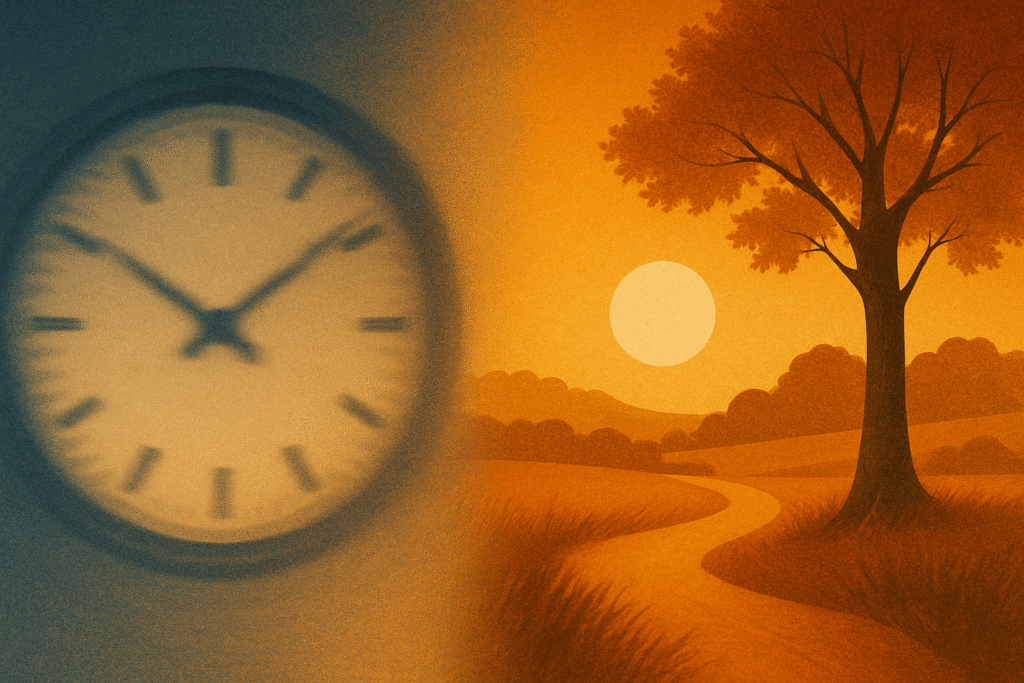
    Contrast of fast-blurred clock and slow-detailed landscape showing measured vs experienced time.

    Other times, a whole day slips through our fingers before we notice.

    Flow — when the self momentarily disappears

    In deep concentration, the brain’s time-tracking function weakens.
    Artists, athletes, and writers often describe the sensation of timelessness during full absorption.

    Routine — the unrecorded hours

    Repetition and familiarity reduce memory formation.
    When the brain doesn’t “save” the moment, the duration feels shorter.

    This explains why:

    • Children experience long, expansive time (full of new stimuli)
    • Adults feel time accelerating with age (reduced novelty = reduced memory density)

    Fast time is not a sign of aging itself—it is a sign of decreased newness.


    4. Time Is a Social Experience

    Time is not only psychological—it is also social.
    Sociologist Norbert Elias argued that time is a symbolic tool societies use to coordinate life.

    Modern society demands speed

    Efficiency has become a virtue, and the pressure to be fast creates a culture of urgency.
    This accelerates our inner tempo.

    The smartphone era fragments our time

    Notifications, updates, and alerts constantly break our attention.
    Our day becomes a series of small interruptions—fast, jagged, and thin.

    The best days aren’t the busiest—they are the densest

    A day feels meaningful not because it was filled with tasks,
    but because it contained a memorable moment.

    The value of time is measured not in quantity, but in density.


    5. How to Change the Texture of Your Time

    We cannot control time’s speed, but we can change how we experience it.

    Create memorable moments — the art of novelty

    Try a new café, walk a different street, listen to unfamiliar music.
    Small variations build richer memories.

    Practice intentional pauses — the art of stillness

    A few minutes of silence, deep breathing, or opening a window resets the mind.

    Record your experiences — the art of memory

    Write, photograph, or journal.
    Recorded moments gain texture and depth.

    Cultivate flow — the art of immersion

    Engage fully in one activity.
    Flow compresses time but enriches meaning.


    Conclusion: Time Is Not Managed—It Is Felt

    Hands gently holding a warm glowing moment symbolizing meaningful time.

    Physical time flows steadily.
    Psychological time flows according to meaning, emotion, and attention.

    • Pleasant experiences pass quickly—but their resonance is long.
    • Anxious moments drag—but leave shallow memory.

    What truly matters is not how much time we have,
    but how deeply we live inside the time we experience.

    The texture of time is shaped by how we see, feel, and remember our days.

    A Question for You

    Have you ever noticed that the most meaningful moments in life
    are not always the longest ones?

    Related Reading

    The relationship between memory and subjective reality is further explored in
    Is Memory a Container of Truth, or a Story Constantly Rewritten?,
    which examines how recollection reshapes the meaning of lived experience.

    The emotional pressure created by modern life and fragmented attention is also discussed in
    Is Freedom an Expansion of Choice — or an Expansion of Anxiety?,
    where modern freedom is linked to psychological overload and accelerated living.


    References

    Zakay, D., & Block, R. (1997). Temporal Cognition. Annual Review of Psychology.
    → A foundational study explaining the difference between measured time and experienced time, and how attention and emotion shape time perception.

    Csikszentmihalyi, M. (1990). Flow: The Psychology of Optimal Experience. Harper & Row.
    → Explores how deep immersion alters our sense of time and how flow enriches lived experience.

    Bergson, H. (1911). Time and Free Will. Macmillan.
    → Introduces the concept of “duration,” distinguishing clock time from the qualitative, subjective dimension of psychological time.