Tag: philosophy of time

  • Has the Past Really Passed?

    Has the Past Really Passed?

    Memory, Emotion, and the Time That Still Lives Within Us

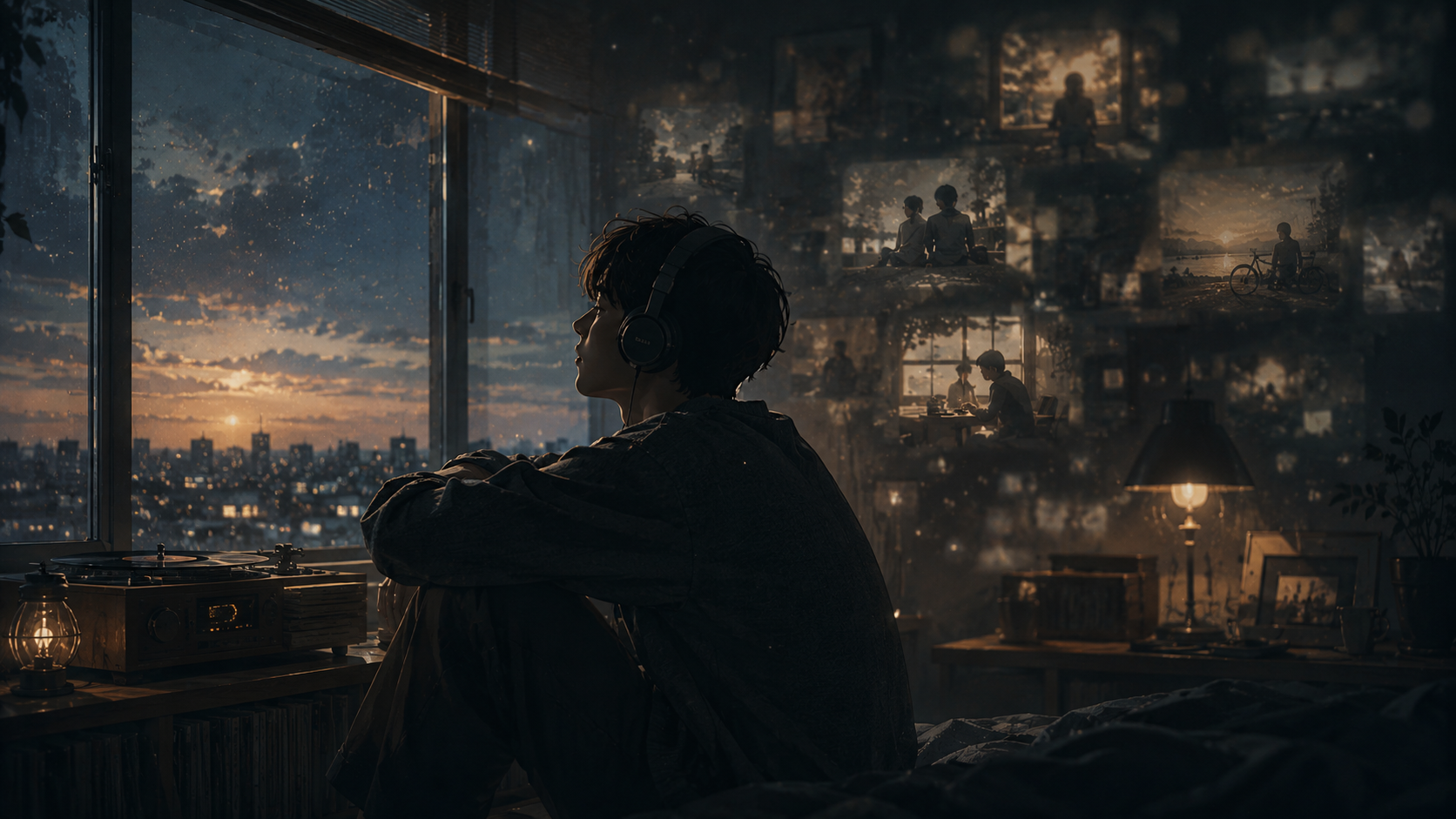
    A song you have not heard in years suddenly plays on the radio.

    A familiar scent passes by.

    A street, a face, a fragment of light—
    and for a moment, time returns.

    You thought that moment was gone.

    But suddenly, the feeling, the expression, the atmosphere of that time stands beside you again.

    The past seems distant on the calendar,
    yet strangely alive within you.

    So we begin with a quiet question:

    Has the past really passed?

    old music bringing back memories

    1. We Feel Safe When Time Moves Forward

    We usually understand time as a straight line.

    Past → present → future.

    This order helps us feel that life is moving forward.
    It tells us that what has passed should be left behind, and what lies ahead should be faced.

    We often say:

    “That is in the past.”
    “Move on.”
    “Look forward.”

    But perhaps this belief also protects us.

    If the past has truly passed, then pain can become distant.
    Regret can lose its power.
    Loss can become something we survived.

    Yet human experience is rarely that simple.

    The past may disappear from the calendar,
    but not always from the heart.

    2. Memory Brings Time Back Into the Present

    We return to the past many times a day.

    Through a photograph.
    Through someone’s voice.
    Through a place we did not expect to remember.

    Psychologists often describe memory not as playback,
    but as reconstruction.

    Memory is not a perfect recording stored in the mind.
    It is rebuilt each time we recall it.

    The person we are now reshapes the past we remember.

    This means that the past is never simply “behind” us.
    It continues to live inside the present, changing its meaning as we change.

    3. Emotion Does Not Follow the Calendar

    time frozen inside emotion

    Some wounds still hurt years later.

    A person may speak about something that happened long ago
    and suddenly cry as if it happened yesterday.

    Why?

    Because emotion does not obey chronological time.

    A memory may be old,
    but the feeling attached to it can remain immediate.

    In this sense, some moments do not pass completely.
    They remain suspended within us, waiting to be awakened.

    When a song brings back a lost season of life,
    it is not only memory returning.

    It is time becoming emotional again.

    4. The Past Is Not a Place We Leave Completely

    To say that the past remains alive does not mean we must live trapped inside it.

    There is a difference between being imprisoned by the past
    and carrying it with care.

    Some memories need distance.
    Some need forgiveness.
    Some need to be retold until they become less painful.

    But none of them vanish completely.

    They become part of the inner structure of who we are.

    The past shapes our fears, our hopes, our tenderness,
    and even the way we love.

    Conclusion: Time Flows on the Calendar, but Not Always in the Heart

    The past has passed in one sense.

    Dates move forward.
    Years accumulate.
    Life continues.

    But inside the human heart, time does not always move in a straight line.

    It returns.
    It trembles.
    It speaks again.

    Perhaps maturity is not about forgetting the past,
    but learning how to live with the time that still remains within us.

    The past is not simply gone.

    It is one of the quiet forces
    that continues to make us who we are.

    A Question for Readers

    Have you ever felt that a memory from long ago was suddenly alive again in the present?

    Related Reading

    The past often returns not only through memory, but through the pressure of comparison and the feeling that time is moving differently for everyone.
    In Am I Falling Behind? — How Comparison Distorts Our Sense of Time, the emotional experience of time reveals how memory, anxiety, and identity shape the way we experience the present.

    At the same time, memory is deeply connected to emotion and moral meaning.
    In Are Emotions a Barrier to Moral Judgment—or Its Foundation?, the relationship between emotion and human judgment shows why certain moments remain emotionally alive long after they are supposed to be “past.”

    References

    1. Bergson, H. (1910). Time and Free Will: An Essay on the Immediate Data of Consciousness. George Allen & Unwin.
      → Bergson distinguishes physical time from lived duration, showing how inner time can remain fluid and emotionally present rather than simply chronological.
    2. Heidegger, M. (1927/1962). Being and Time. Harper & Row.
      → Heidegger understands time not merely as sequence, but as part of how human beings experience existence, memory, and meaning.
    3. Ricoeur, P. (1984). Time and Narrative, Vol. 1. University of Chicago Press.
      → Ricoeur explains how humans organize time through narrative, suggesting that the past continues to live through the stories we tell about ourselves.
    4. Tulving, E. (1985). Memory and consciousness. Canadian Psychology, 26(1), 1–12.
      → Tulving’s work on episodic memory shows how remembering allows us to mentally travel through time and experience the past as part of present consciousness.
    5. Casey, E. S. (2000). Remembering: A Phenomenological Study. Indiana University Press.
      → Casey explores memory as an embodied and emotional experience, emphasizing how places, sensations, and feelings can bring the past back into the present.
  • The Rhythm of Wood, The Tempo of My Mind

    The Rhythm of Wood, The Tempo of My Mind

    How a Simple Metronome Taught Me About Time and Life

    A Quiet Machine on the Shelf

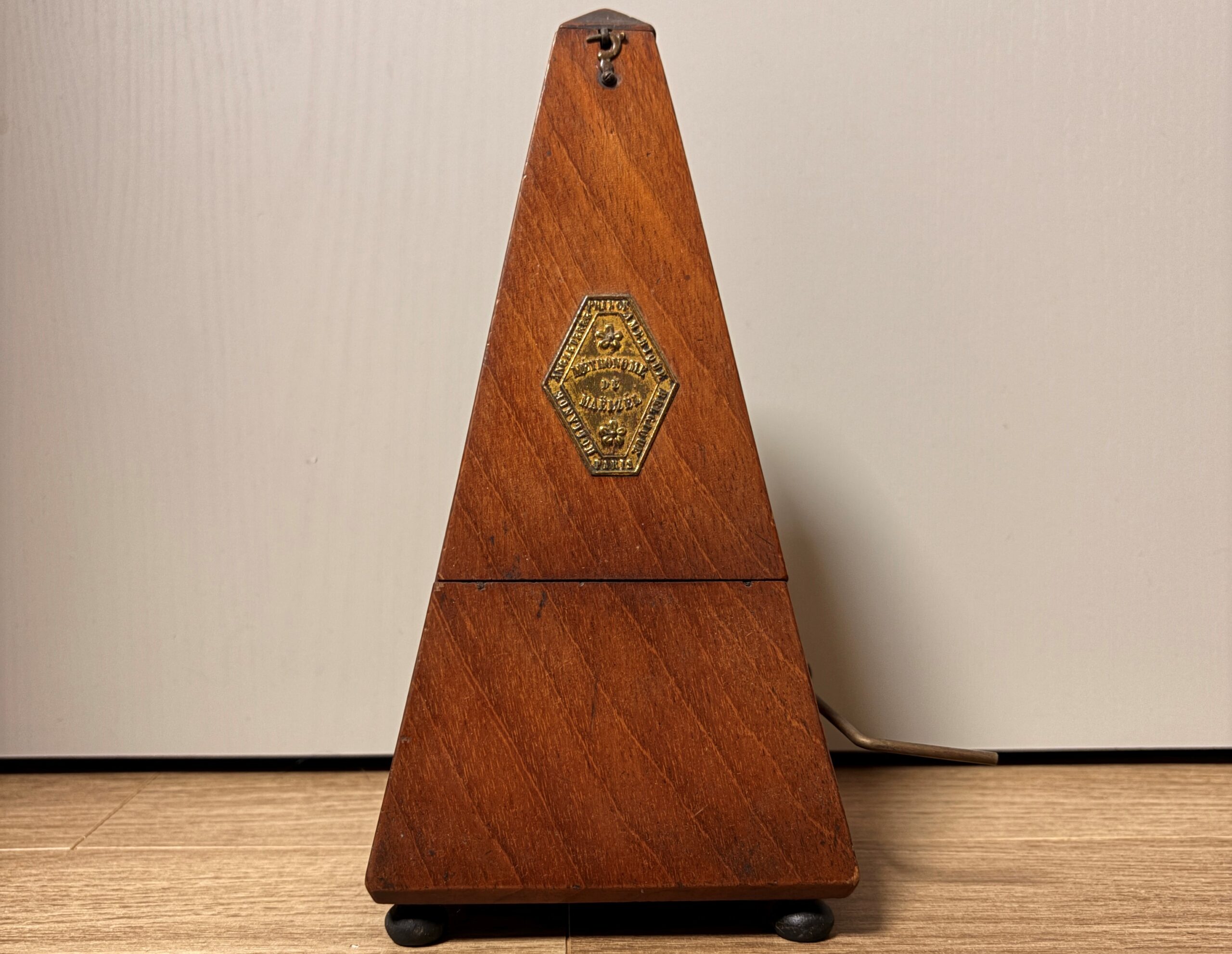
    On the corner of my bookshelf sits a small wooden object—
    about about 4 inches wide and 8.7 inches tall,
    shaped like a simple pyramid.

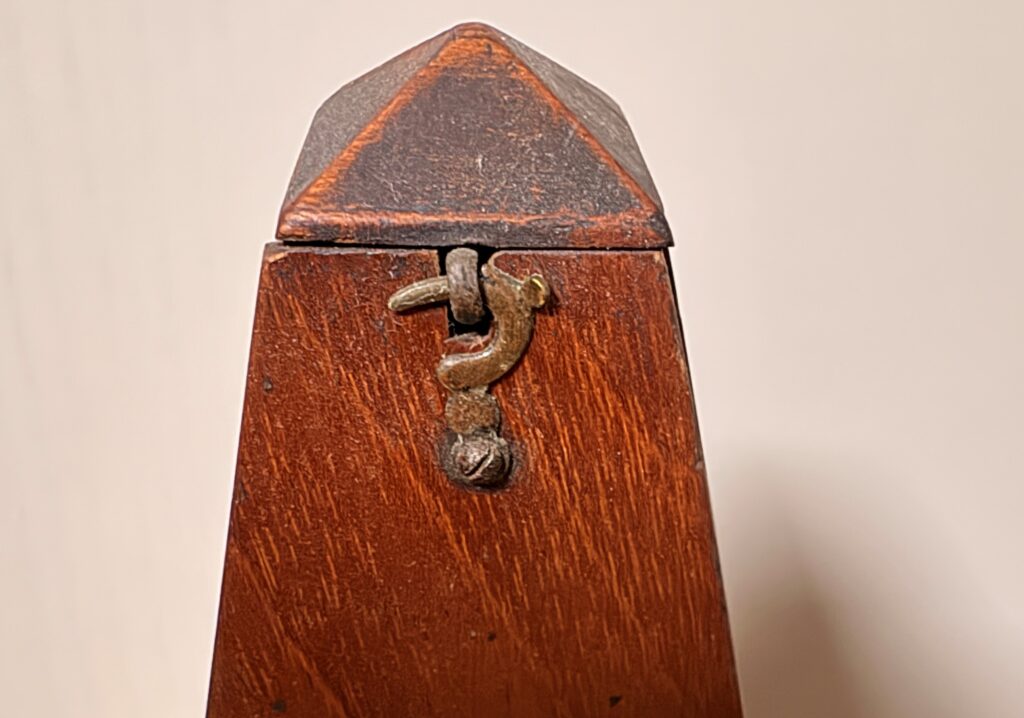
    It is a handmade mechanical metronome.

    I have kept it by my side for more than twenty years.

    metronome metal latch detail


    Learning to Follow Time

    When I first began learning the saxophone,
    I realized something unexpected—

    keeping time was harder than playing notes.

    I could read the sheet music,
    but my body was always slightly ahead or behind the rhythm.

    Whenever that happened,
    I would wind the metronome
    and watch the pendulum swing.

    Tick—tock.
    Tick—tock.

    Inside that small machine,
    there was nothing but balance and rhythm.


    Why I Chose Wood Over Precision

    Electronic metronomes are more precise,
    more convenient, and easier to use.

    But I always reached for this wooden one first.

    The sound was different.

    Not just a mechanical beat,
    but something softer—
    a resonance that seemed to linger in the air.

    That quiet repetition
    did not push me.

    It calmed me.


    A Small Ritual of Memory

    There was something else I loved about it—
    the delicate metal latch at the top.

    A small click,
    like opening a quiet, hidden box.

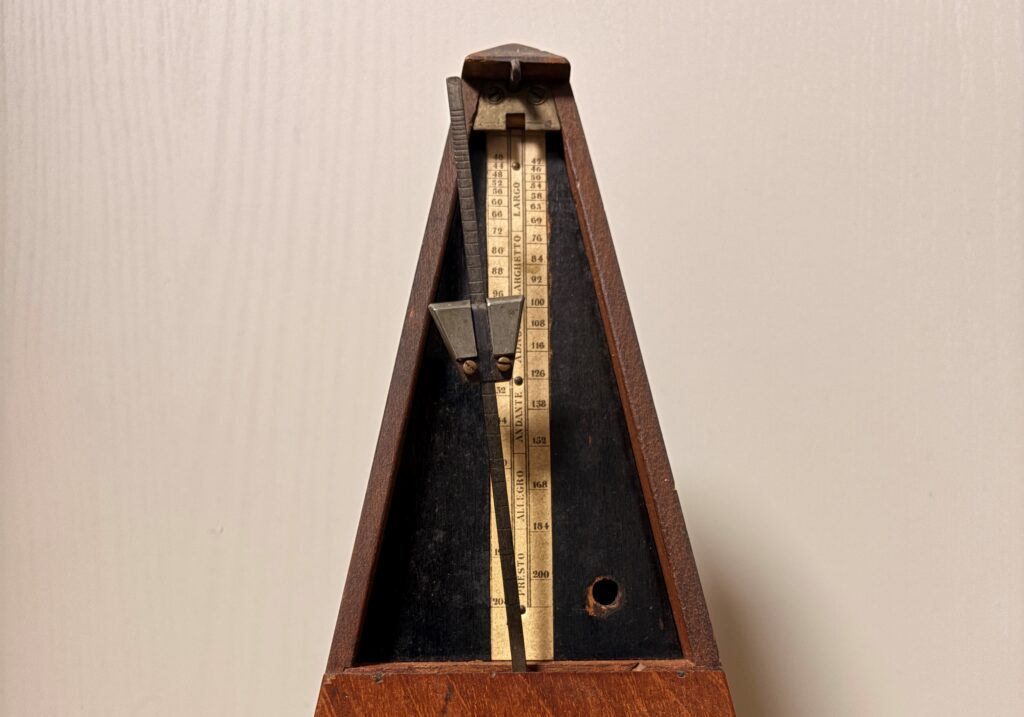
    Inside,
    a vertical scale marked in careful numbers,
    and a pendulum that could be adjusted up and down.

    Its structure was simple.
    Honest.

    Almost like a piece of time itself.


    metronome pendulum tempo scale

    The Tempo That Remains

    I no longer practice the saxophone every day.

    But the metronome is still there,
    on my desk.

    Sometimes,
    I wind it once or twice
    and let it move again.

    And in between those steady ticks,
    memories return—

    the tension in my fingers,
    the careful breath before each note,
    the quiet determination of learning something new.

    And I find myself thinking:

    “Rhythm is the time of music,
    and music is the time of life.”


    Conclusion – Finding Our Own Tempo

    What if our lives had a rhythm,
    like a metronome?

    Not too fast.
    Not too slow.

    Just enough to stay in harmony
    with ourselves.

    Like a small pendulum,
    moving back and forth—

    each of us
    keeping time
    in our own way.


    A Question for You

    When was the last time you truly followed your own rhythm,
    instead of trying to match the pace around you?

    Related Reading

    The idea of moving at your own pace is further explored in Am I Falling Behind? — How Comparison Distorts Our Sense of Time, where the pressure of comparison reshapes how we perceive progress and timing in life.

    A similar reflection on quiet inner strength can be found in A Pebble by the Sea – Seeing the Moon Within a Small Stone, where a simple object reveals how patience and time shape who we become.

  • The Texture of Time: How the Mind Shapes the Weight of Our Moments

    The Texture of Time: How the Mind Shapes the Weight of Our Moments

    How psychological time expands, contracts, and gives meaning to our lives.

    Some days seem to disappear before we can fully notice them.

    Others linger in our minds with surprising weight,
    stretching far beyond the limits of the clock.

    Perhaps time is not only something we measure—
    but something we emotionally experience.

    Abstract flowing ribbon of light symbolizing the texture of time.

    1.Two Kinds of Time: Measured vs. Experienced

    We often say, “Today felt so long” or “This week went by in a flash.”
    Interestingly, these statements have nothing to do with physical time.
    Physics tells us that time flows at a constant rate—24 hours a day, without exception.

    Yet human beings do not live inside clocks.
    We live inside perceived time, or what psychologist Daniel Zakay called “experienced time.”

    Zakay distinguishes between:

    • Measured time — the objective ticking of the clock
    • Experienced time — the subjective feeling of duration shaped by attention, emotion, and memory

    The gap between these two creates what we might call the texture of time.
    This texture is not a mere feeling—it emerges from the brain’s information-processing, emotional state, and social environment.

    In other words:

    The quality of our time mirrors the quality of our perception.


    2. When Time Slows Down

    Some moments stretch endlessly: waiting for exam results, entering a new environment, or standing in an unfamiliar place. Slow time appears in three main situations:

    Novelty — a world rich in unfamiliar details

    The brain works harder to process new information, which creates the sensation of longer time.
    A first-time trip feels longer than a daily commute because novelty increases mental recording.

    Anxiety and hyper-awareness

    Before an interview, during turbulence on a plane, or in moments of threat, the mind becomes highly alert.
    This heightened attention makes even seconds feel elongated.

    Waiting — the pressure of the expected future

    Waiting is not an empty pause.
    It is a psychological space where expectation and uncertainty weigh on the present.
    This emotional tension stretches time.

    In slow time, the brain is collecting more data—hence the long, heavy texture.


    3. When Time Speeds Up

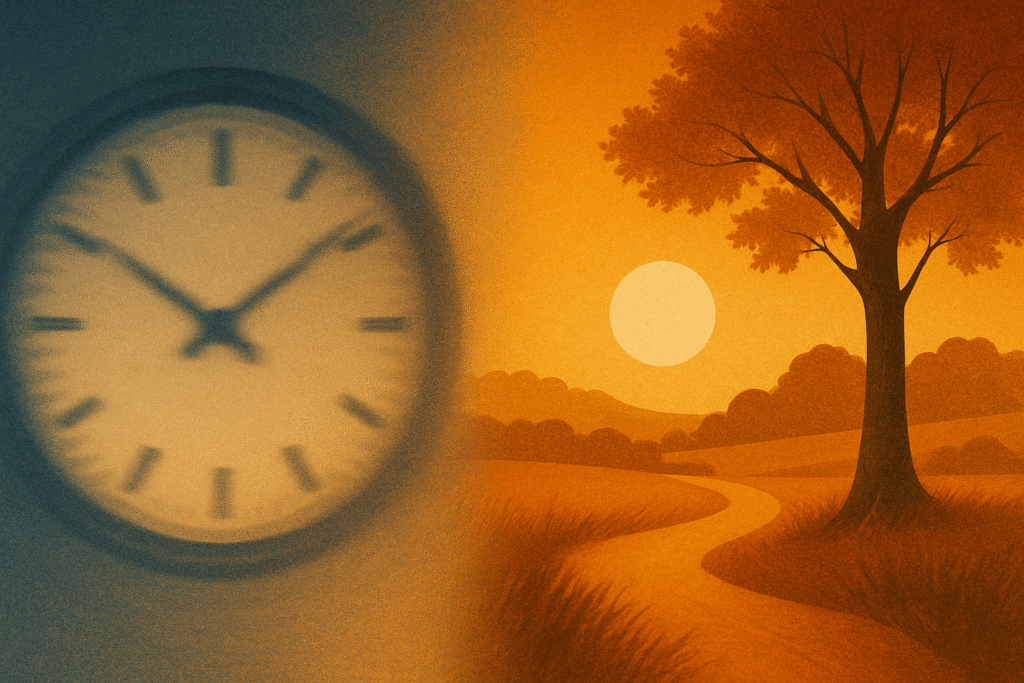
    Contrast of fast-blurred clock and slow-detailed landscape showing measured vs experienced time.

    Other times, a whole day slips through our fingers before we notice.

    Flow — when the self momentarily disappears

    In deep concentration, the brain’s time-tracking function weakens.
    Artists, athletes, and writers often describe the sensation of timelessness during full absorption.

    Routine — the unrecorded hours

    Repetition and familiarity reduce memory formation.
    When the brain doesn’t “save” the moment, the duration feels shorter.

    This explains why:

    • Children experience long, expansive time (full of new stimuli)
    • Adults feel time accelerating with age (reduced novelty = reduced memory density)

    Fast time is not a sign of aging itself—it is a sign of decreased newness.


    4. Time Is a Social Experience

    Time is not only psychological—it is also social.
    Sociologist Norbert Elias argued that time is a symbolic tool societies use to coordinate life.

    Modern society demands speed

    Efficiency has become a virtue, and the pressure to be fast creates a culture of urgency.
    This accelerates our inner tempo.

    The smartphone era fragments our time

    Notifications, updates, and alerts constantly break our attention.
    Our day becomes a series of small interruptions—fast, jagged, and thin.

    The best days aren’t the busiest—they are the densest

    A day feels meaningful not because it was filled with tasks,
    but because it contained a memorable moment.

    The value of time is measured not in quantity, but in density.


    5. How to Change the Texture of Your Time

    We cannot control time’s speed, but we can change how we experience it.

    Create memorable moments — the art of novelty

    Try a new café, walk a different street, listen to unfamiliar music.
    Small variations build richer memories.

    Practice intentional pauses — the art of stillness

    A few minutes of silence, deep breathing, or opening a window resets the mind.

    Record your experiences — the art of memory

    Write, photograph, or journal.
    Recorded moments gain texture and depth.

    Cultivate flow — the art of immersion

    Engage fully in one activity.
    Flow compresses time but enriches meaning.


    Conclusion: Time Is Not Managed—It Is Felt

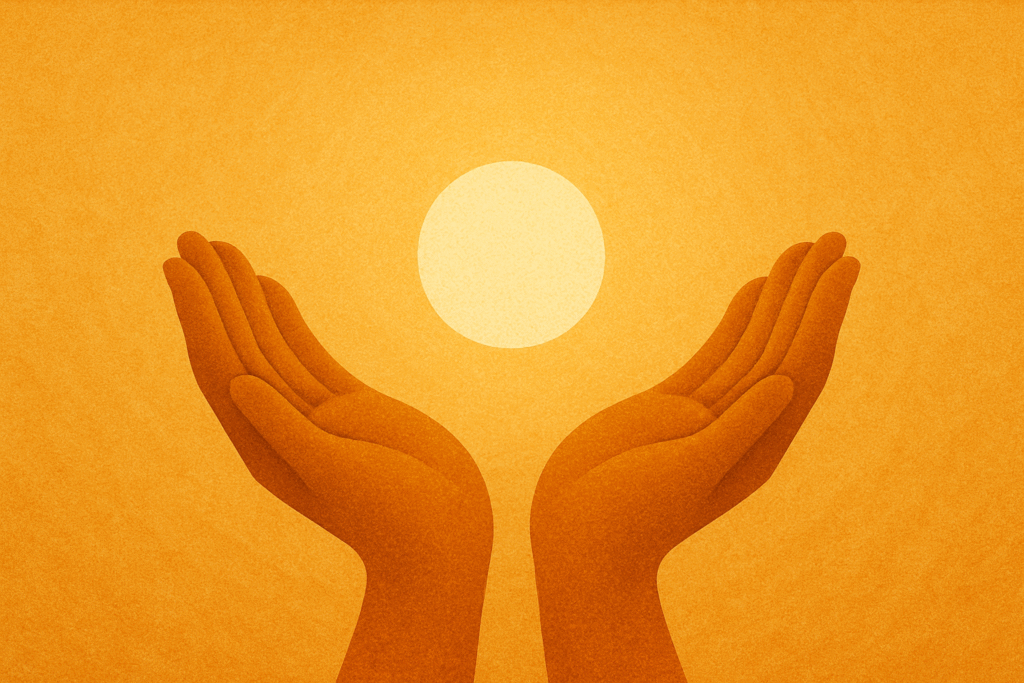
    Hands gently holding a warm glowing moment symbolizing meaningful time.

    Physical time flows steadily.
    Psychological time flows according to meaning, emotion, and attention.

    • Pleasant experiences pass quickly—but their resonance is long.
    • Anxious moments drag—but leave shallow memory.

    What truly matters is not how much time we have,
    but how deeply we live inside the time we experience.

    The texture of time is shaped by how we see, feel, and remember our days.

    A Question for You

    Have you ever noticed that the most meaningful moments in life
    are not always the longest ones?

    Related Reading

    The relationship between memory and subjective reality is further explored in
    Is Memory a Container of Truth, or a Story Constantly Rewritten?,
    which examines how recollection reshapes the meaning of lived experience.

    The emotional pressure created by modern life and fragmented attention is also discussed in
    Is Freedom an Expansion of Choice — or an Expansion of Anxiety?,
    where modern freedom is linked to psychological overload and accelerated living.


    References

    Zakay, D., & Block, R. (1997). Temporal Cognition. Annual Review of Psychology.
    → A foundational study explaining the difference between measured time and experienced time, and how attention and emotion shape time perception.

    Csikszentmihalyi, M. (1990). Flow: The Psychology of Optimal Experience. Harper & Row.
    → Explores how deep immersion alters our sense of time and how flow enriches lived experience.

    Bergson, H. (1911). Time and Free Will. Macmillan.
    → Introduces the concept of “duration,” distinguishing clock time from the qualitative, subjective dimension of psychological time.