
Work, Inequality, and the Future of Social Stability in the Age of Artificial Intelligence
Technology has always transformed human society.
The Industrial Revolution replaced manual labor with machines.
The computer revolution reshaped communication and information.
The internet changed how humans work, consume, and interact.
But the rise of artificial intelligence may create a transformation far larger than anything before it.
Today, AI systems are rapidly replacing tasks once believed to require uniquely human abilities. From manufacturing and customer service to law, finance, healthcare, and even creative work, automation is expanding into nearly every sector of society.
This raises a growing concern:
What happens when millions of people are no longer economically necessary?
For many researchers and political theorists, this is no longer simply a technological question.
It is a question about the future stability of society itself.
And perhaps an even more unsettling question follows:
Could AI and automation eventually trigger new forms of social revolution?
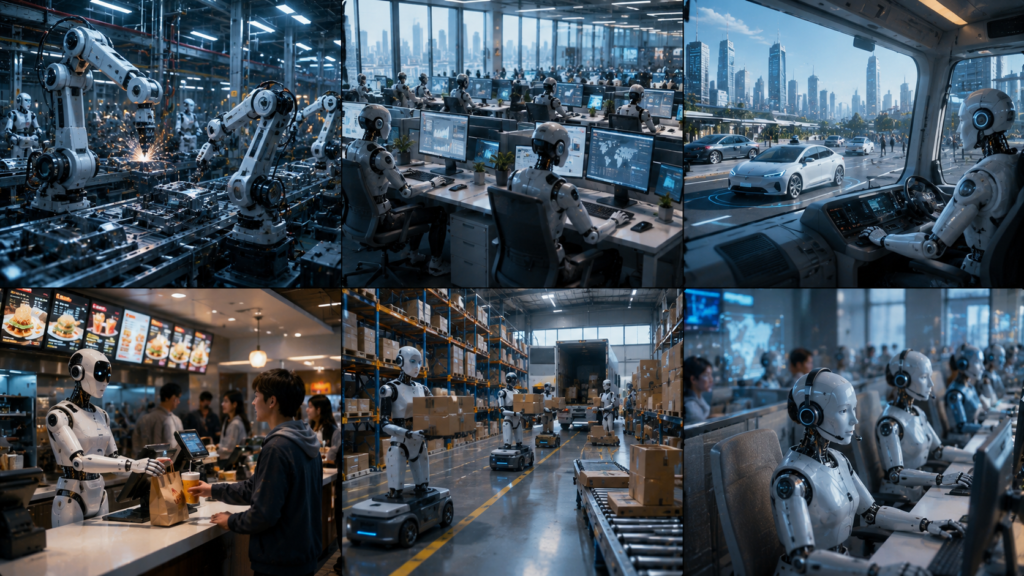
1. AI and Automation Are Reshaping Labor
Beyond Factory Work
Automation once mainly affected repetitive factory labor.
Today, however, AI increasingly performs:
- administrative work
- legal analysis
- financial calculations
- customer support
- medical diagnostics
- and even creative production
This means technological replacement is no longer limited to physical labor alone.
White-collar professions are increasingly vulnerable as well.
The Risk of Technological Unemployment
Many experts warn that AI could produce large-scale technological unemployment.
Manufacturing workers may be replaced by robotics systems capable of operating continuously without fatigue. AI chatbots increasingly handle customer service tasks once performed by human employees. Autonomous driving technologies threaten transportation and delivery industries, while AI-assisted legal and accounting systems reduce the need for routine office work.
As automation expands, economic inequality may deepen dramatically.
Those who own technological infrastructure may accumulate greater wealth, while displaced workers face increasing instability.
2. Universal Basic Income and the Search for Solutions
What Is Universal Basic Income?
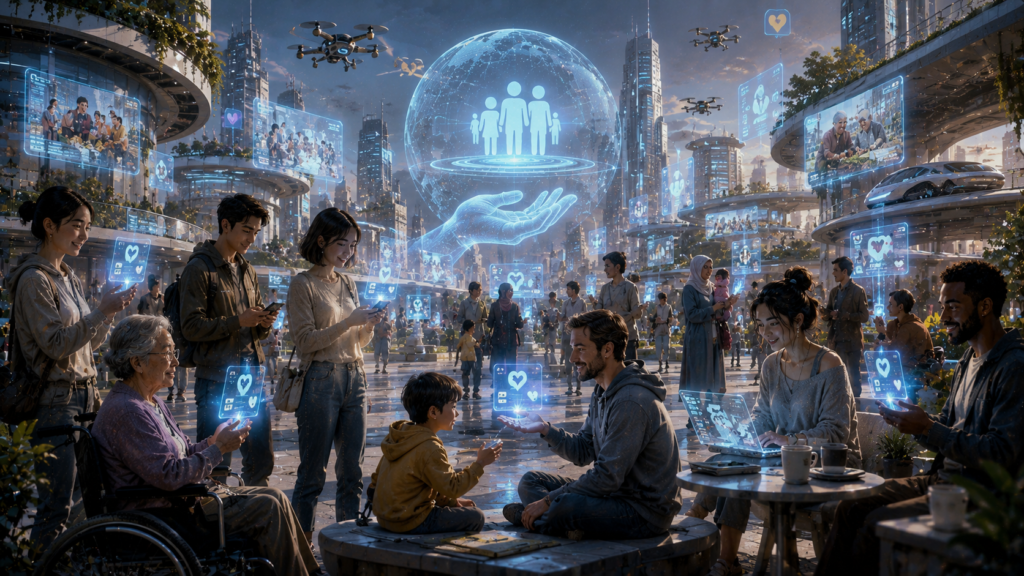
One proposed solution is Universal Basic Income (UBI).
Under this system, governments provide citizens with regular unconditional income regardless of employment status.
Supporters argue that UBI could protect people from economic collapse in an AI-driven economy where stable employment becomes less available.
Several countries and local governments, including experiments in Finland, Canada, and parts of the United States, have already tested versions of basic income programs.
Why the Debate Is Intensifying
Supporters of UBI argue that traditional welfare systems may become insufficient if automation eliminates large numbers of jobs simultaneously.
They also claim UBI could:
- reduce social instability
- soften inequality
- support creative and caregiving work
- and allow people to pursue education or innovation without extreme economic pressure
However, critics raise serious concerns.
Some argue that governments cannot financially sustain universal payments. Others fear basic income may reduce work motivation or become politically unsustainable.
As AI unemployment expands, these debates are likely to become even more politically intense.
3. Could AI Unemployment Lead to Social Unrest?
Historical Patterns of Economic Instability
History repeatedly shows that severe inequality and unemployment can destabilize societies.
The French Revolution emerged partly from extreme economic inequality between elites and ordinary citizens.
The Russian Revolution developed amid industrial exploitation and worker dissatisfaction.
More recently, the Arab Spring was fueled in part by unemployment, economic frustration, and social inequality.
Economic insecurity has often functioned as a catalyst for political upheaval.
The Possibility of AI-Driven Resistance
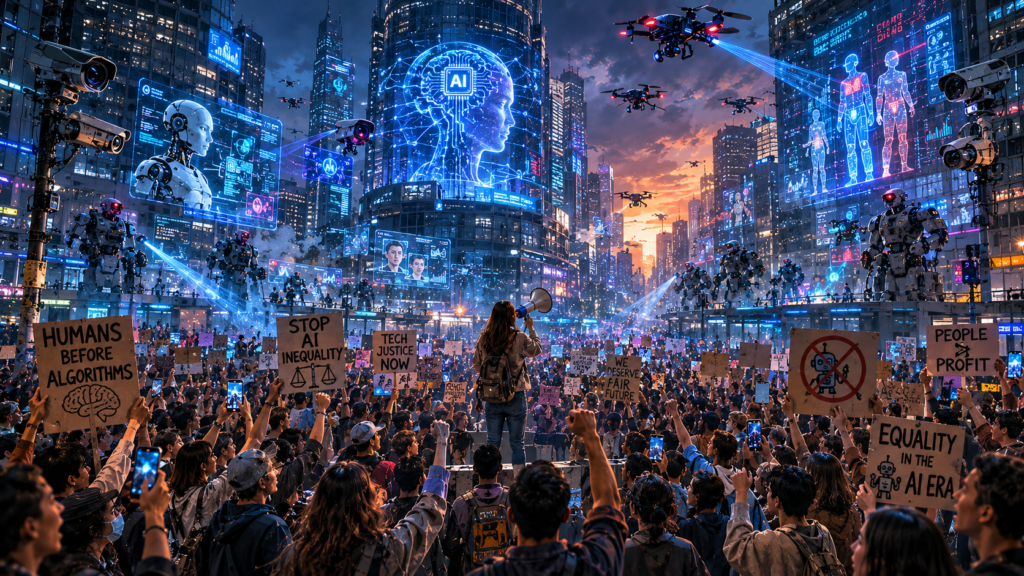
If AI eliminates large numbers of jobs while wealth becomes increasingly concentrated among technology companies and investors, social tension could intensify significantly.
Possible consequences may include:
- large-scale protests
- anti-technology movements
- populist political shifts
- radical economic reform demands
- and growing distrust toward institutions
Historically, societies experiencing technological disruption have sometimes reacted violently.
During the Industrial Revolution, workers known as the Luddites destroyed machinery they believed threatened their livelihoods.
Future resistance movements may not destroy machines physically—
But they may challenge the political and economic systems built around AI-driven inequality.
4. The Political Future of an Automated Society
Technology and Power Concentration
One major concern is that AI may centralize power in unprecedented ways.
Large technology corporations increasingly control:
- data
- algorithms
- infrastructure
- communication systems
- and digital labor platforms
As AI becomes essential to economic production, technological elites may gain enormous influence over society.
This could deepen existing inequality between:
- workers and corporations
- governments and tech companies
- wealthy nations and developing nations
Redefining Human Value
Automation may also force societies to reconsider how human worth is defined.
For centuries, employment has shaped:
- identity
- dignity
- income
- and social participation
But if machines perform most economically productive labor, societies may need new ways to understand meaning, contribution, and citizenship beyond traditional employment.
In this sense, the AI revolution is not only economic.
It is philosophical.
Conclusion: Will the AI Era Create Revolution—or Reinvention?
Artificial intelligence will undoubtedly increase productivity and technological capability.
However, it may also produce:
- mass unemployment
- severe inequality
- political instability
- and deep social anxiety
Whether future societies experience revolution or peaceful transformation may depend on how governments, corporations, and citizens respond to these challenges.
Technology alone does not determine the future.
Political decisions, ethical frameworks, and social solidarity matter just as much.
Ultimately, the most important question may not be whether AI becomes more intelligent than humans.
It may be this:
Can human societies remain fair, stable, and humane
in a world where human labor is no longer economically central?
The answer to that question could shape the future of civilization itself.
Reader Question
If artificial intelligence eventually performs most forms of labor more efficiently than humans—
How should society redefine human value, dignity, and economic fairness?
And if millions of people feel excluded from the future economy,
could technological progress itself become the cause of social unrest?
Related Reading
The broader relationship between technology and human agency is explored further in Do Humans Control Technology, or Does Technology Control Us?, which examines whether technological progress continues to serve human purposes or gradually begins to reshape the choices, values, and institutions that define society. This wider perspective provides an essential foundation for understanding whether AI and automation represent merely technological change—or the beginning of a deeper social revolution.
If economic systems and political structures are shaped by ideas that societies once considered “natural” or unquestionable, technological revolutions may also transform the meaning of identity and social order. Can Society Move Beyond the Gender Binary? explores how social norms evolve over time and how institutions influence the ways societies define identity, belonging, and power. Together, these discussions reveal that every major technological revolution is also a transformation of society itself.
References
- C. Challoumis (2024). From Automation to Innovation.
This research analyzes how AI-driven automation may simultaneously eliminate existing jobs while creating new forms of economic opportunity and innovation. - J. C. Bélisle-Pipon (2025). AI, Universal Basic Income, and Power.
This study critically examines debates surrounding universal basic income and questions whether technological elites frame UBI primarily as social protection or as a mechanism for maintaining power structures. - A. Pınar (2024). Technological Unemployment and the AI Revolution.
This work explores the macroeconomic consequences of AI-driven unemployment and discusses possible policy responses including UBI, retraining systems, and AI regulation. - S. A. Bell & Anton Korinek (2023). AI’s Economic Peril.
This article warns that AI may intensify wealth concentration and economic insecurity if governments fail to develop inclusive economic policies. - Joseph Stiglitz et al. (2021). Technological Progress, Artificial Intelligence, and Inclusive Growth.
This research investigates how AI and automation may influence long-term economic growth and proposes policy frameworks aimed at ensuring technological benefits are distributed more equitably.
Leave a Reply