Tag: future of work

  • Will Hyper-Personalization Reshape the Future of Work?

    Will Hyper-Personalization Reshape the Future of Work?

    How AI, Automation, and Personalized Systems Are Transforming Human Labor

    Modern technology no longer treats people as anonymous masses.

    Today’s digital systems increasingly analyze:

    • personal preferences
    • emotions
    • behaviors
    • health patterns
    • shopping habits
    • and even attention spans

    This process is known as hyper-personalization.

    Powered by artificial intelligence and big data, hyper-personalized systems now recommend what we should watch, buy, study, eat, and sometimes even think.

    These technologies make life more convenient and efficient.

    However, they also raise a difficult question about the future of work:

    If machines can understand individuals more precisely than humans can, what happens to human labor itself?

    As hyper-personalization combines with automation, many traditional jobs may disappear or fundamentally transform.

    At the same time, entirely new industries and professions may emerge.

    The future labor market may therefore become not simply more technological—

    But more deeply personalized than ever before.


    1. Hyper-Personalization Is Already Replacing Human Labor
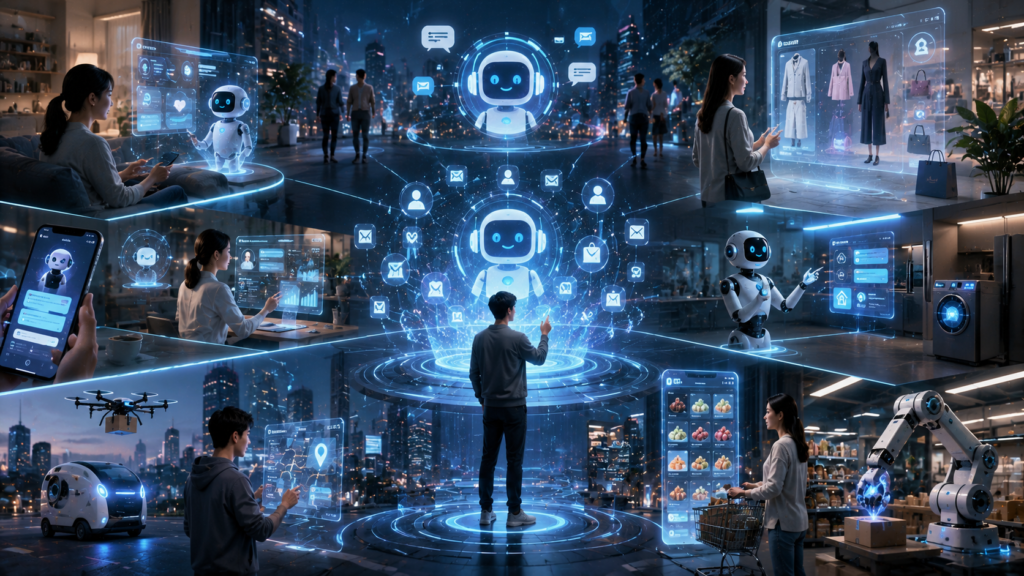
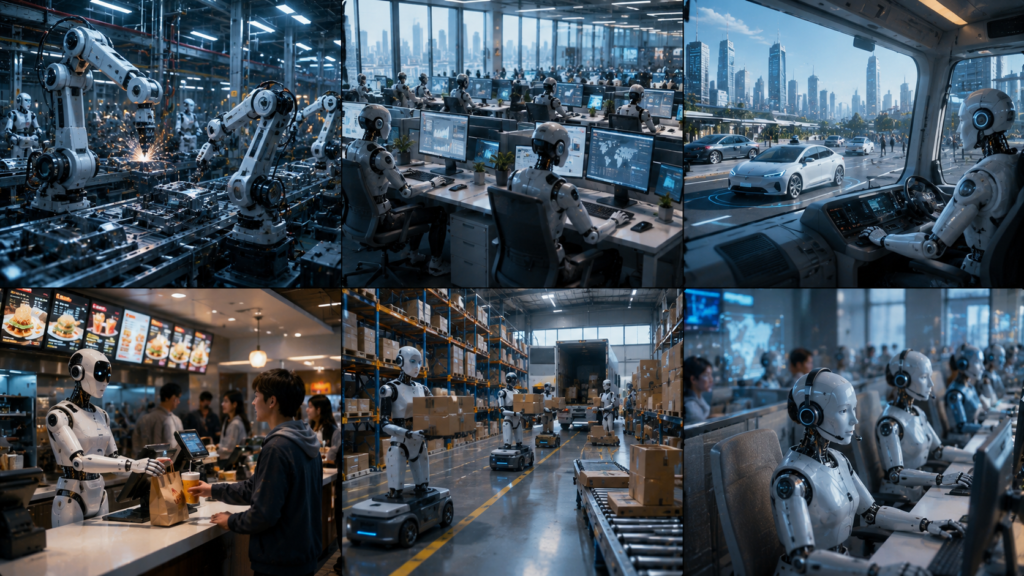
    AI personalized services and automation

    The Rise of Automated Personalized Services

    Hyper-personalization allows AI systems to perform tasks once handled by humans.

    For example:

    • AI chatbots increasingly replace customer service agents
    • recommendation algorithms replace parts of traditional sales work
    • automated learning systems personalize education without human tutors
    • AI diagnostic tools assist or partially replace medical screening processes

    Streaming platforms such as Netflix personalize entertainment recommendations based on user behavior.

    Online shopping platforms predict consumer preferences before customers even search for products.

    In many industries, personalized automation improves efficiency while reducing the need for repetitive human labor.


    Jobs Most Vulnerable to Hyper-Automation

    Some sectors are especially vulnerable to replacement.

    Retail work has already changed dramatically due to personalized advertising and digital shopping systems.

    Customer support increasingly depends on AI-powered conversational systems capable of responding instantly to individual users.

    Warehouses and logistics centers use predictive automation to optimize delivery patterns with minimal human intervention.

    Even professional fields once considered secure—
    such as finance, law, and healthcare—
    now face growing automation pressures through AI-assisted analysis systems.

    This suggests hyper-personalization may accelerate not only automation—

    But the fragmentation of traditional employment structures themselves.


    2. Could Hyper-Personalization Also Create New Jobs?

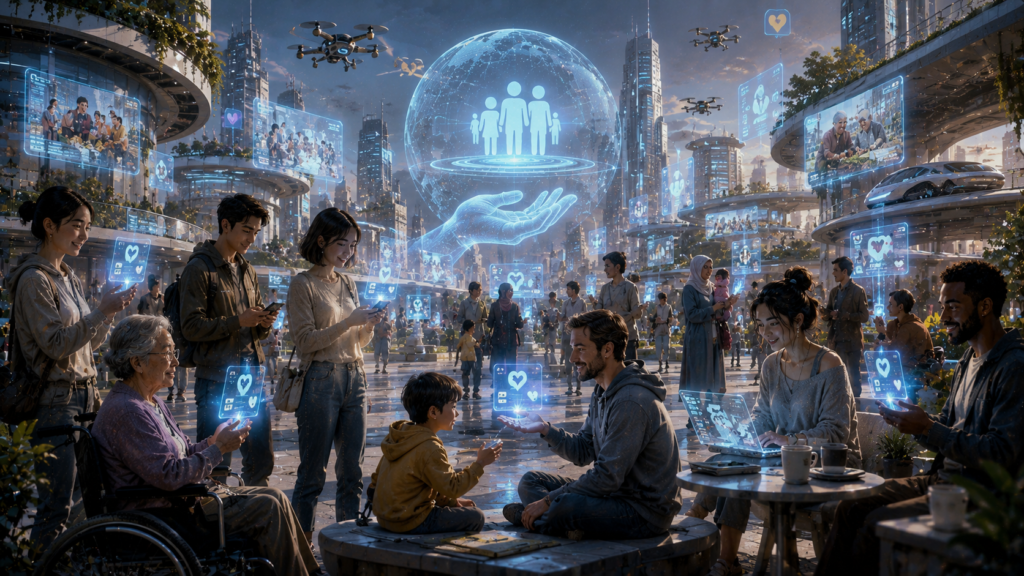
    people working in future AI-driven industries

    The Growth of AI and Data Careers

    Despite concerns about job loss, new technological systems also create entirely new forms of labor.

    As hyper-personalization expands, demand grows for:

    • AI engineers
    • machine learning specialists
    • cybersecurity experts
    • data analysts
    • algorithm designers
    • and digital ethics consultants

    These professionals design and maintain the systems that power personalized experiences.

    The future economy may therefore rely increasingly on workers capable of managing intelligent infrastructures rather than performing repetitive tasks.


    The Emergence of New Industries

    Hyper-personalization is also transforming industries themselves.

    In healthcare, personalized medicine and AI-based wellness systems are creating new careers related to individualized treatment planning.

    In education technology, adaptive learning systems require specialists who combine pedagogy with AI design.

    Smart cities, digital therapy platforms, and virtual environments are generating entirely new forms of employment that did not previously exist.

    This means technological change may not simply eliminate jobs—

    It may redefine what society considers valuable work.


    Existing Jobs Are Being Redesigned

    Many professions may survive not by resisting technology, but by adapting alongside it.

    Marketing professionals increasingly focus on data-driven personalization strategies rather than mass advertising.

    Doctors use AI-assisted diagnostics to improve precision rather than abandoning medical expertise altogether.

    Teachers increasingly act as mentors, facilitators, and emotional guides while AI handles repetitive instructional functions.

    In many cases, technology changes the role of workers rather than eliminating them entirely.


    3. The Human Challenges Behind Hyper-Personalized Labor

    The Growing Technology Gap

    One major concern is inequality.

    Workers without access to technological education may struggle to adapt to rapidly changing labor markets.

    As AI systems become more advanced, societies may experience a widening gap between:

    • highly skilled digital workers
      and
    • workers displaced by automation

    Without large-scale retraining systems, hyper-personalization could deepen economic instability.


    Ethical Automation and Human Dignity

    Another challenge involves how automation is implemented.

    If corporations prioritize efficiency alone, workers may become increasingly disposable.

    A humane transition requires:

    • retraining opportunities
    • stronger social safety nets
    • ethical labor policies
    • and protections against technological exclusion

    The future of work should not be determined solely by technological capability.

    It must also reflect social values.


    Why Human Skills May Become More Valuable

    Ironically, as machines become better at repetitive and predictive tasks, deeply human abilities may become more important.

    Skills such as:

    • empathy
    • creativity
    • emotional intelligence
    • ethical judgment
    • and human connection

    remain difficult to automate fully.

    Therapists, artists, caregivers, mentors, and creators may therefore gain renewed importance in hyper-automated societies.

    The future economy may ultimately reward not what humans do faster than machines—

    But what humans uniquely do better.


    Conclusion: What Kind of Work Will Remain Human?

    human connection in an AI-driven future

    Hyper-personalization is transforming the labor market in complex and contradictory ways.

    On one hand, automation threatens many traditional jobs by replacing repetitive and predictable forms of labor.

    On the other hand, new industries, professions, and creative opportunities continue to emerge alongside technological development.

    The real challenge may not simply be whether jobs disappear.

    It may be whether societies can redesign work in ways that preserve:

    • dignity
    • meaning
    • creativity
    • and human connection

    Technology itself is not destiny.

    Hyper-personalization is ultimately a tool.

    The future of labor will depend on how humanity chooses to use that tool—
    whether to maximize efficiency alone,
    or to build a more humane and balanced society.

    Perhaps the most important question is no longer:

    “Will machines replace humans?”

    But rather:

    What kinds of human experiences should never be replaced at all?

    Reader Question

    If AI systems can predict our preferences, emotions, and behaviors more accurately than ever before—

    Will future societies still value uniquely human skills such as empathy, creativity, and emotional connection?

    Or will efficiency gradually become more important than humanity itself?

    Related Reading

    If AI and automation continue replacing repetitive human labor, could technological inequality eventually trigger deeper social instability and economic unrest?
    In Will AI and Automation Trigger the Next Social Revolution?, we explore how mass automation may reshape social structures, inequality, and political resistance.


    If digital systems increasingly shape human identity, emotion, and behavior through algorithms, could hyper-personalization eventually influence not only work—but the way humans understand themselves?
    In Are Our Emotions Truly Ours—or Socially Constructed?, we examine how technology and social systems increasingly structure emotional experience and human identity.


    References

    1. Erik Brynjolfsson & Andrew McAfee (2014). The Second Machine Age.
      This book examines how AI and automation reshape labor markets while creating both economic opportunities and social disruption.
    2. Carl Benedikt Frey & Michael A. Osborne (2017). The Future of Employment.
      This influential study evaluates which professions are most vulnerable to automation and technological replacement.
    3. David H. Autor (2015). Why Are There Still So Many Jobs?
      Autor explores how automation simultaneously destroys certain jobs while generating entirely new categories of work.
    4. Thomas H. Davenport & Julia Kirby (2016). Only Humans Need Apply.
      This work investigates how smart technologies redefine human labor and why creativity and emotional intelligence remain essential.
    5. McKinsey Global Institute (2017). Jobs Lost, Jobs Gained.
      This report analyzes workforce transitions caused by automation and discusses the future balance between technological efficiency and employment.
  • Will AI and Automation Trigger the Next Social Revolution?

    Will AI and Automation Trigger the Next Social Revolution?

    Work, Inequality, and the Future of Social Stability in the Age of Artificial Intelligence

    Technology has always transformed human society.

    The Industrial Revolution replaced manual labor with machines.
    The computer revolution reshaped communication and information.
    The internet changed how humans work, consume, and interact.

    But the rise of artificial intelligence may create a transformation far larger than anything before it.

    Today, AI systems are rapidly replacing tasks once believed to require uniquely human abilities. From manufacturing and customer service to law, finance, healthcare, and even creative work, automation is expanding into nearly every sector of society.

    This raises a growing concern:

    What happens when millions of people are no longer economically necessary?

    For many researchers and political theorists, this is no longer simply a technological question.

    It is a question about the future stability of society itself.

    And perhaps an even more unsettling question follows:

    Could AI and automation eventually trigger new forms of social revolution?

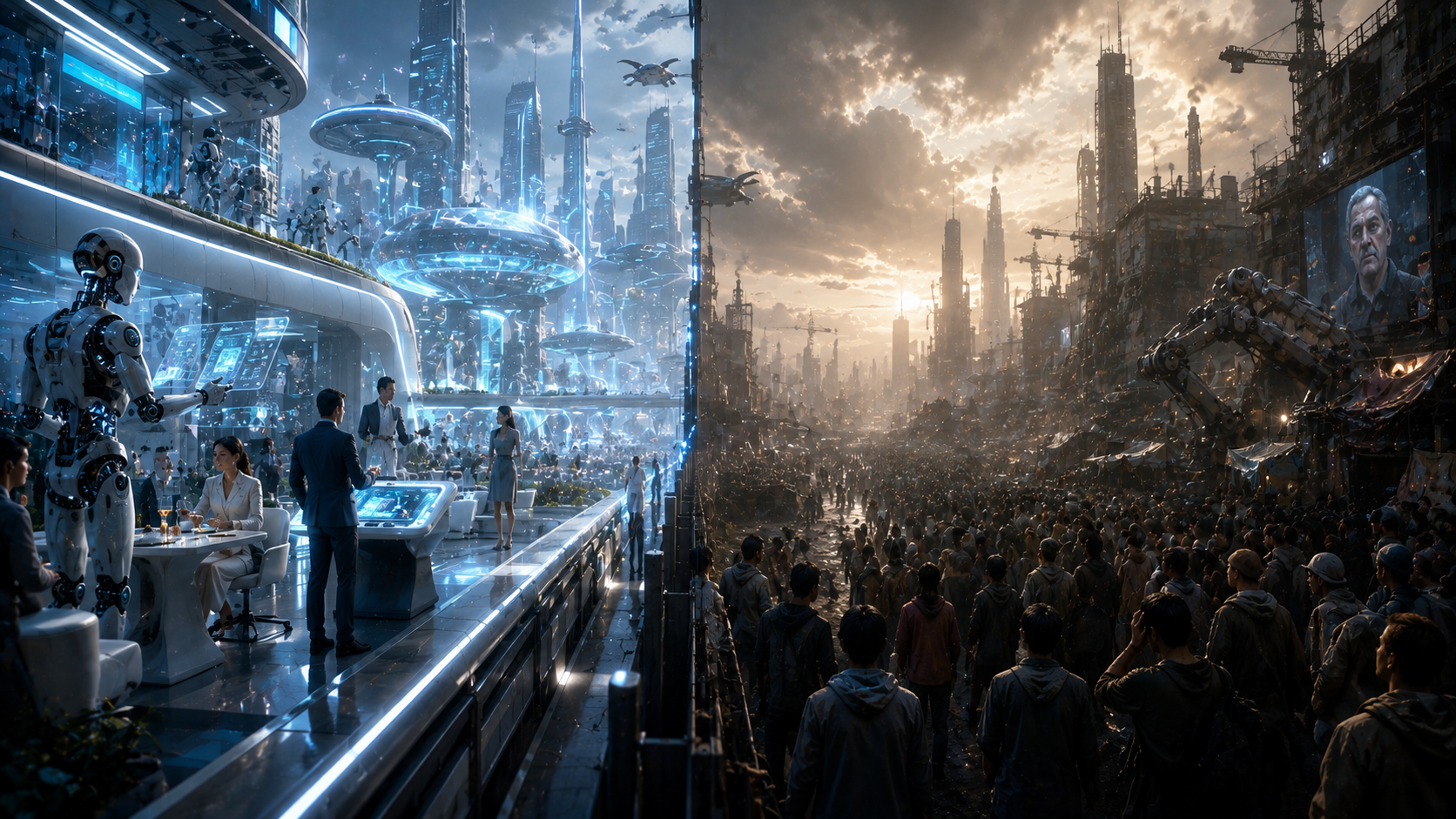
    AI replacing human workers in multiple industries

    1. AI and Automation Are Reshaping Labor

    Beyond Factory Work

    Automation once mainly affected repetitive factory labor.

    Today, however, AI increasingly performs:

    • administrative work
    • legal analysis
    • financial calculations
    • customer support
    • medical diagnostics
    • and even creative production

    This means technological replacement is no longer limited to physical labor alone.

    White-collar professions are increasingly vulnerable as well.


    The Risk of Technological Unemployment

    Many experts warn that AI could produce large-scale technological unemployment.

    Manufacturing workers may be replaced by robotics systems capable of operating continuously without fatigue. AI chatbots increasingly handle customer service tasks once performed by human employees. Autonomous driving technologies threaten transportation and delivery industries, while AI-assisted legal and accounting systems reduce the need for routine office work.

    As automation expands, economic inequality may deepen dramatically.

    Those who own technological infrastructure may accumulate greater wealth, while displaced workers face increasing instability.


    2. Universal Basic Income and the Search for Solutions

    future society debating universal basic income

    What Is Universal Basic Income?

    One proposed solution is Universal Basic Income (UBI).

    Under this system, governments provide citizens with regular unconditional income regardless of employment status.

    Supporters argue that UBI could protect people from economic collapse in an AI-driven economy where stable employment becomes less available.

    Several countries and local governments, including experiments in Finland, Canada, and parts of the United States, have already tested versions of basic income programs.


    Why the Debate Is Intensifying

    Supporters of UBI argue that traditional welfare systems may become insufficient if automation eliminates large numbers of jobs simultaneously.

    They also claim UBI could:

    • reduce social instability
    • soften inequality
    • support creative and caregiving work
    • and allow people to pursue education or innovation without extreme economic pressure

    However, critics raise serious concerns.

    Some argue that governments cannot financially sustain universal payments. Others fear basic income may reduce work motivation or become politically unsustainable.

    As AI unemployment expands, these debates are likely to become even more politically intense.


    3. Could AI Unemployment Lead to Social Unrest?

    Historical Patterns of Economic Instability

    History repeatedly shows that severe inequality and unemployment can destabilize societies.

    The French Revolution emerged partly from extreme economic inequality between elites and ordinary citizens.

    The Russian Revolution developed amid industrial exploitation and worker dissatisfaction.

    More recently, the Arab Spring was fueled in part by unemployment, economic frustration, and social inequality.

    Economic insecurity has often functioned as a catalyst for political upheaval.


    The Possibility of AI-Driven Resistance

    If AI eliminates large numbers of jobs while wealth becomes increasingly concentrated among technology companies and investors, social tension could intensify significantly.

    Possible consequences may include:

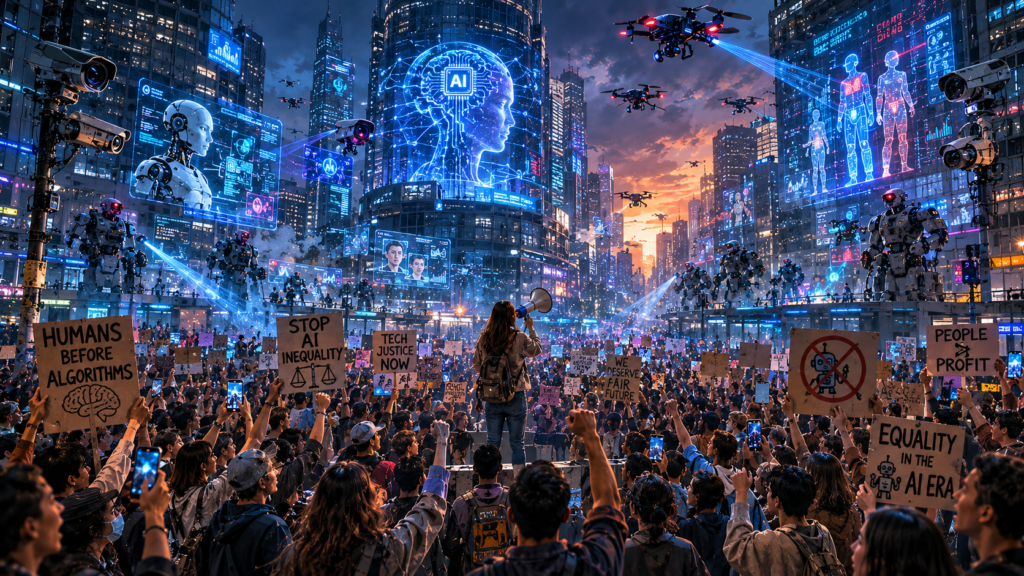
    • large-scale protests
    • anti-technology movements
    • populist political shifts
    • radical economic reform demands
    • and growing distrust toward institutions

    Historically, societies experiencing technological disruption have sometimes reacted violently.

    During the Industrial Revolution, workers known as the Luddites destroyed machinery they believed threatened their livelihoods.

    Future resistance movements may not destroy machines physically—

    But they may challenge the political and economic systems built around AI-driven inequality.


    4. The Political Future of an Automated Society

    Technology and Power Concentration

    One major concern is that AI may centralize power in unprecedented ways.

    Large technology corporations increasingly control:

    • data
    • algorithms
    • infrastructure
    • communication systems
    • and digital labor platforms

    As AI becomes essential to economic production, technological elites may gain enormous influence over society.

    This could deepen existing inequality between:

    • workers and corporations
    • governments and tech companies
    • wealthy nations and developing nations

    Redefining Human Value

    Automation may also force societies to reconsider how human worth is defined.

    For centuries, employment has shaped:

    • identity
    • dignity
    • income
    • and social participation

    But if machines perform most economically productive labor, societies may need new ways to understand meaning, contribution, and citizenship beyond traditional employment.

    In this sense, the AI revolution is not only economic.

    It is philosophical.


    Conclusion: Will the AI Era Create Revolution—or Reinvention?

    people protesting against inequality in AI society

    Artificial intelligence will undoubtedly increase productivity and technological capability.

    However, it may also produce:

    • mass unemployment
    • severe inequality
    • political instability
    • and deep social anxiety

    Whether future societies experience revolution or peaceful transformation may depend on how governments, corporations, and citizens respond to these challenges.

    Technology alone does not determine the future.

    Political decisions, ethical frameworks, and social solidarity matter just as much.

    Ultimately, the most important question may not be whether AI becomes more intelligent than humans.

    It may be this:

    Can human societies remain fair, stable, and humane
    in a world where human labor is no longer economically central?

    The answer to that question could shape the future of civilization itself.

    Reader Question

    If artificial intelligence eventually performs most forms of labor more efficiently than humans—

    How should society redefine human value, dignity, and economic fairness?

    And if millions of people feel excluded from the future economy,
    could technological progress itself become the cause of social unrest?

    Related Reading

    If technology increasingly shapes not only labor but also emotion, identity, and human relationships, are we entering a society where even our inner lives become structured by digital systems?
    In Are Our Emotions Truly Ours—or Socially Constructed?, we explore how modern societies regulate emotions through work, social expectations, and digital platforms.

    If economic systems and political structures are shaped by ideas that societies once considered “natural” or unquestionable, could technological revolutions also transform the meaning of human identity and social order itself?
    In Can Society Move Beyond the Gender Binary?, we examine how social norms evolve over time and how deeply institutions influence the way societies define identity, belonging, and power.


    References

    1. C. Challoumis (2024). From Automation to Innovation.
      This research analyzes how AI-driven automation may simultaneously eliminate existing jobs while creating new forms of economic opportunity and innovation.
    2. J. C. Bélisle-Pipon (2025). AI, Universal Basic Income, and Power.
      This study critically examines debates surrounding universal basic income and questions whether technological elites frame UBI primarily as social protection or as a mechanism for maintaining power structures.
    3. A. Pınar (2024). Technological Unemployment and the AI Revolution.
      This work explores the macroeconomic consequences of AI-driven unemployment and discusses possible policy responses including UBI, retraining systems, and AI regulation.
    4. S. A. Bell & Anton Korinek (2023). AI’s Economic Peril.
      This article warns that AI may intensify wealth concentration and economic insecurity if governments fail to develop inclusive economic policies.
    5. Joseph Stiglitz et al. (2021). Technological Progress, Artificial Intelligence, and Inclusive Growth.
      This research investigates how AI and automation may influence long-term economic growth and proposes policy frameworks aimed at ensuring technological benefits are distributed more equitably.
  • Robot Labor and Human Dignity

    Robot Labor and Human Dignity

    How the Meaning of Work Is Changing in the Age of Automation

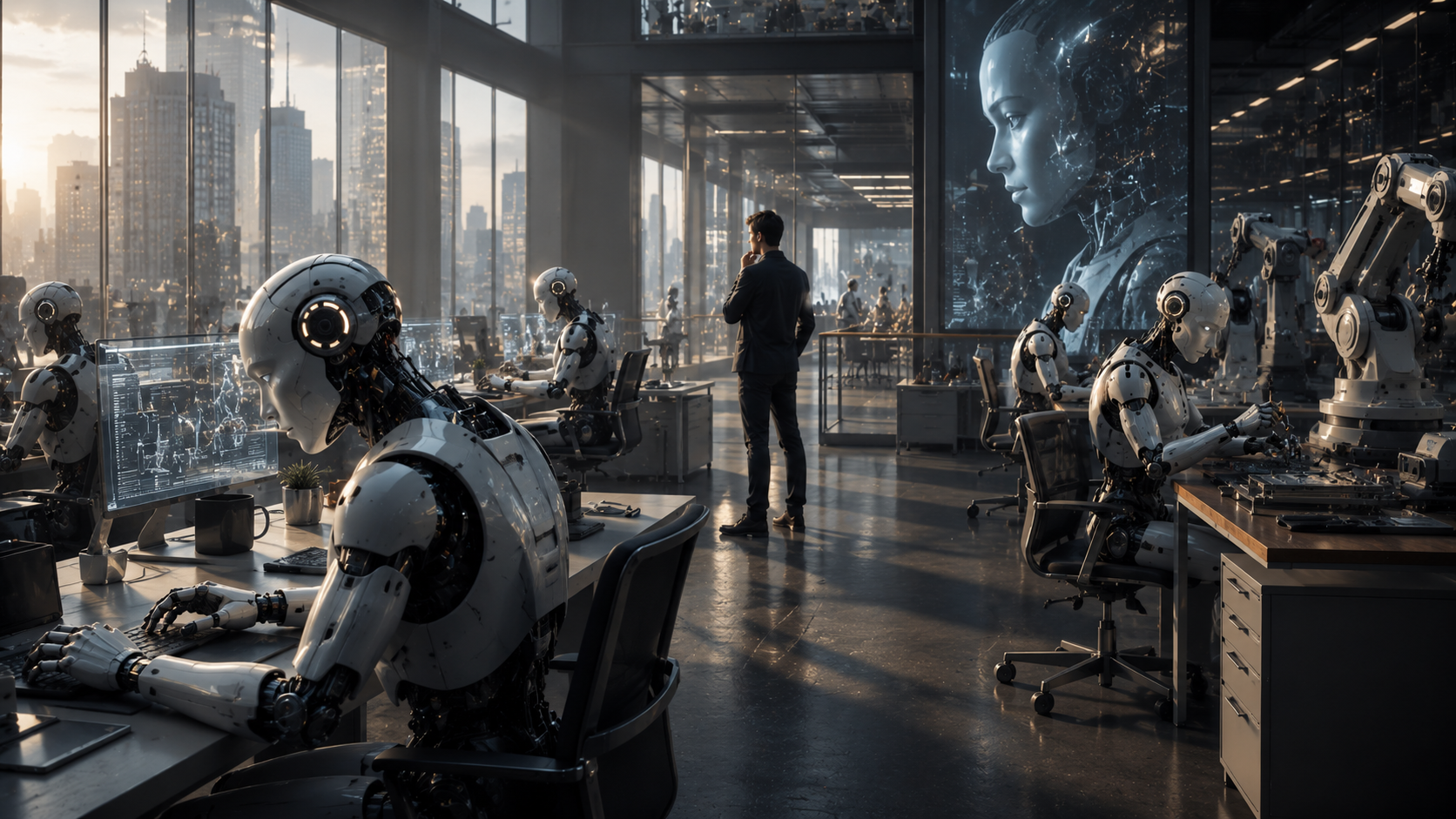
    Robots replacing human labor in modern workplace

    1. The Replacement of Labor — Toward a Workplace Without Humans

    What if a society emerges in which humans no longer need to work?
    As machines take over more tasks, efficiency rises—but at the same time, a deeper question begins to surface.

    Factory lines, logistics centers, cafés, even news article writing—
    robots and artificial intelligence are already at work.

    They do not tire, complain, or demand rest.
    They operate twenty-four hours a day with consistent productivity.

    According to a McKinsey report, up to 30 percent of global jobs may be automated by 2030.
    The more routine and rule-based the task, the faster it is replaced.

    Yet here lies the paradox of technological progress.
    As efficiency increases, the dignity attached to human labor begins to erode.

    When a job that once provided pride and identity is no longer “needed,”
    people experience more than economic unemployment.
    They confront an existential anxiety:

    Who am I, if my work no longer has a place in society?

    Work has never been merely a means of survival.
    It is how humans relate to society—and how they affirm their own value.


    2. Human–Robot Coexistence — Collaboration or Subordination?

    Human and robot collaboration showing workplace hierarchy

    As robots enter workplaces, humans are expected to collaborate with them.

    In factories, machines handle heavy or repetitive tasks,
    while humans become supervisors or assistants.

    On the surface, this looks like coexistence.
    In reality, a hierarchy quietly emerges.

    Robots are evaluated purely by efficiency,
    and humans are increasingly measured by the same standard.

    The “inefficient human” is gradually pushed to the margins.

    This creates a new pressure:
    humans must now outperform machines on machine-like terms.

    As a result, workplaces lose space for emotion, rest, and imperfection.

    The question inevitably arises:

    Do robots assist human labor—or do they redefine how humans are judged?


    3. Universal Basic Income — The Ethics of Living Without Work

    As automation expands, societies search for new institutional responses.

    One prominent proposal is Universal Basic Income (UBI)
    a system in which AI-generated wealth is shared,
    and every citizen receives a guaranteed income regardless of employment.

    Pilot programs have been tested in countries such as Finland, Canada, and Switzerland.

    Supporters argue that UBI can reduce inequality and allow people
    to focus on creative, social, and caring activities.

    Critics worry that it weakens the meaning of work
    and blurs the sense of social responsibility.

    UBI is not merely an economic policy.
    It is an ethical debate about the value of work and the meaning of life.

    Are we ready to accept a society where survival is detached from labor?


    4. A New Work Ethic — From Productivity to Meaning

    The industrial era celebrated diligence, discipline, and productivity.

    In the age of AI, these virtues are no longer absolute.

    Philosopher Byung-Chul Han argues in The Burnout Society
    that modern individuals become “achievement subjects,”
    endlessly exploiting themselves in the name of performance.

    If machines take over production, humans no longer need to exist
    solely as producers of measurable output.

    Instead, human labor can be reoriented toward
    creation, care, empathy, education, and reflection.

    The ethical center of work must shift
    from efficiency to human meaning.


    5. Redefining the Meaning of Work — Toward a Dignified Human Life

    Even in an era that speaks of the “end of work,”
    the meaning of work remains central to human life.

    It is not disappearing—it is transforming.

    If robots replace physical labor,
    humans must reclaim work as an activity of thinking, feeling, and relating.

    Caring for others, building social bonds,
    creating art, teaching, and nurturing communities—
    these forms of non-economic labor must be revalued.

    A society where humans do not have to work
    is not a society where work loses meaning.

    It is a society that must rediscover what work truly means.


    Conclusion — Human Dignity Still Resides in Work

    Human reflecting on dignity and meaning of work

    Even if robots and AI dominate the workplace,
    human dignity cannot be automated.

    Humans are not merely beings who work.
    They are beings who create meaning through work.

    The task ahead is not to exclude robots,
    but to ensure that technology and humanity together
    shape forms of labor worthy of human dignity.

    What we must protect is not jobs themselves,
    but the dignity that emerges through meaningful work.

    A society where one can live without working—
    yet still wants to work—
    that is a truly human society.

    A Question for You

    If technology eventually removes the necessity of human labor,
    what do you think will give life meaning and dignity?

    Related Reading

    As AI reshapes political systems, it also transforms the meaning of labor, participation, and human value.
    Automation of Politics: Can Democracy Survive AI Governance? explores how algorithmic systems may redefine human agency in society.

    The automation of labor risks creating new forms of exclusion for people unable to adapt to AI-driven systems.
    The New Inequality of the AI Age: The Rise of Digital Refugees examines how technological progress can deepen social inequality and marginalization.


    References

    1. Brynjolfsson, E., & McAfee, A. (2014). The Second Machine Age. New York: W. W. Norton & Company.
      This influential work analyzes how digital technologies transform labor and productivity, highlighting both economic growth and the risk of job displacement in automated societies.
    2. Srnicek, N., & Williams, A. (2015). Inventing the Future: Postcapitalism and a World Without Work. London: Verso.
      The authors explore post-work futures, automation, and basic income, offering a philosophical vision of how societies might reorganize labor beyond traditional employment.
    3. Frey, C. B., & Osborne, M. A. (2017). “The Future of Employment: How Susceptible Are Jobs to Computerisation?” Technological Forecasting and Social Change, 114, 254–280.
      This empirical study estimates the probability of job automation across occupations, providing a data-driven foundation for debates on technological unemployment.
    4. Han, B.-C. (2015). The Burnout Society. Stanford, CA: Stanford University Press.
      Han critiques contemporary performance-driven culture, arguing that excessive self-optimization erodes human dignity and leads to psychological exhaustion.
    5. Arendt, H. (1958). The Human Condition. Chicago: University of Chicago Press.
      Arendt’s classic distinction between labor, work, and action offers a philosophical framework for rethinking human dignity and meaningful activity in post-industrial societies.