Tag: universal basic income

  • Social Justice and the Welfare State: How Much Should Governments Reduce Economic Inequality?

    Social Justice and the Welfare State: How Much Should Governments Reduce Economic Inequality?

    Balancing Equality, Social Protection, and Individual Freedom

    Economic inequality exists in almost every society.

    Some people inherit wealth, receive excellent education, and grow up with access to strong social networks. Others begin life with fewer opportunities, unstable housing, limited healthcare, or financial insecurity.

    The existence of inequality alone, however, does not tell us what governments should do about it.

    Should the state redistribute income through taxation? Should healthcare and education be guaranteed regardless of income? Should governments provide generous unemployment benefits and pensions? Or can too much intervention weaken individual responsibility, economic freedom, and incentives to work and invest?

    These questions lie at the heart of the debate over social justice and the welfare state.

    Supporters of a strong welfare state argue that freedom means little without basic security and genuine opportunity. Critics warn that governments can go too far, creating excessive taxation, bureaucracy, dependency, or restrictions on individual choice.

    The real debate, therefore, is not simply whether inequality should exist.

    It is how much inequality a fair society should accept—and how far governments should go to reduce it.


    1. What Is a Welfare State?

    welfare state providing education, healthcare and social protection across different stages of life

    Social Protection as a Public Responsibility

    A welfare state is a system in which government assumes significant responsibility for protecting citizens against major social and economic risks.

    These risks may include illness, unemployment, disability, poverty, old age, and lack of access to education.

    Welfare states use different combinations of public healthcare, pensions, unemployment insurance, family support, housing assistance, education, and income transfers.

    Behind these policies lies an important idea about social justice:

    A person’s life chances should not depend entirely on wealth or circumstances of birth.

    Consider education.

    Two children may possess similar abilities and motivation. But if one grows up in a wealthy family with access to excellent schools while the other grows up in poverty with limited educational opportunities, can we say that their later successes and failures result entirely from individual effort?

    Supporters of welfare provision argue that society should provide a minimum foundation from which people can develop their abilities.

    The goal does not necessarily have to be equal outcomes.

    It can instead be meaningful equality of opportunity.

    But that immediately creates another question:

    How much government intervention is necessary to create that opportunity?


    2. Why Do Supporters Believe Welfare States Reduce Inequality?

    Security Can Make Freedom More Meaningful

    Supporters of welfare states argue that severe economic inequality can eventually undermine freedom itself.

    A person without access to healthcare may technically be free to seek treatment but unable to afford it.

    A talented student from a poor household may formally be free to attend university but lack the financial means to do so.

    Someone who loses a job may be legally free to search for another one, yet immediate poverty can severely restrict the choices available.

    From this perspective, social programs do not necessarily oppose freedom.

    They can create the conditions that make freedom usable.

    This argument helps explain the development of Nordic welfare systems.

    Countries such as Sweden, Denmark, Norway, and Finland combine market economies with comparatively extensive systems of taxation and social protection. Publicly supported healthcare, education, family policies, unemployment protection, and pensions are designed to reduce some of the risks individuals face throughout life.

    Supporters argue that such systems can reduce poverty, limit extreme inequality, and increase social mobility while allowing private enterprise and market competition to continue.

    The underlying principle is that markets can generate prosperity, while public institutions can help ensure that the risks and benefits of economic life are not distributed too unevenly.


    3. What Are the Arguments Against an Expanding Welfare State?

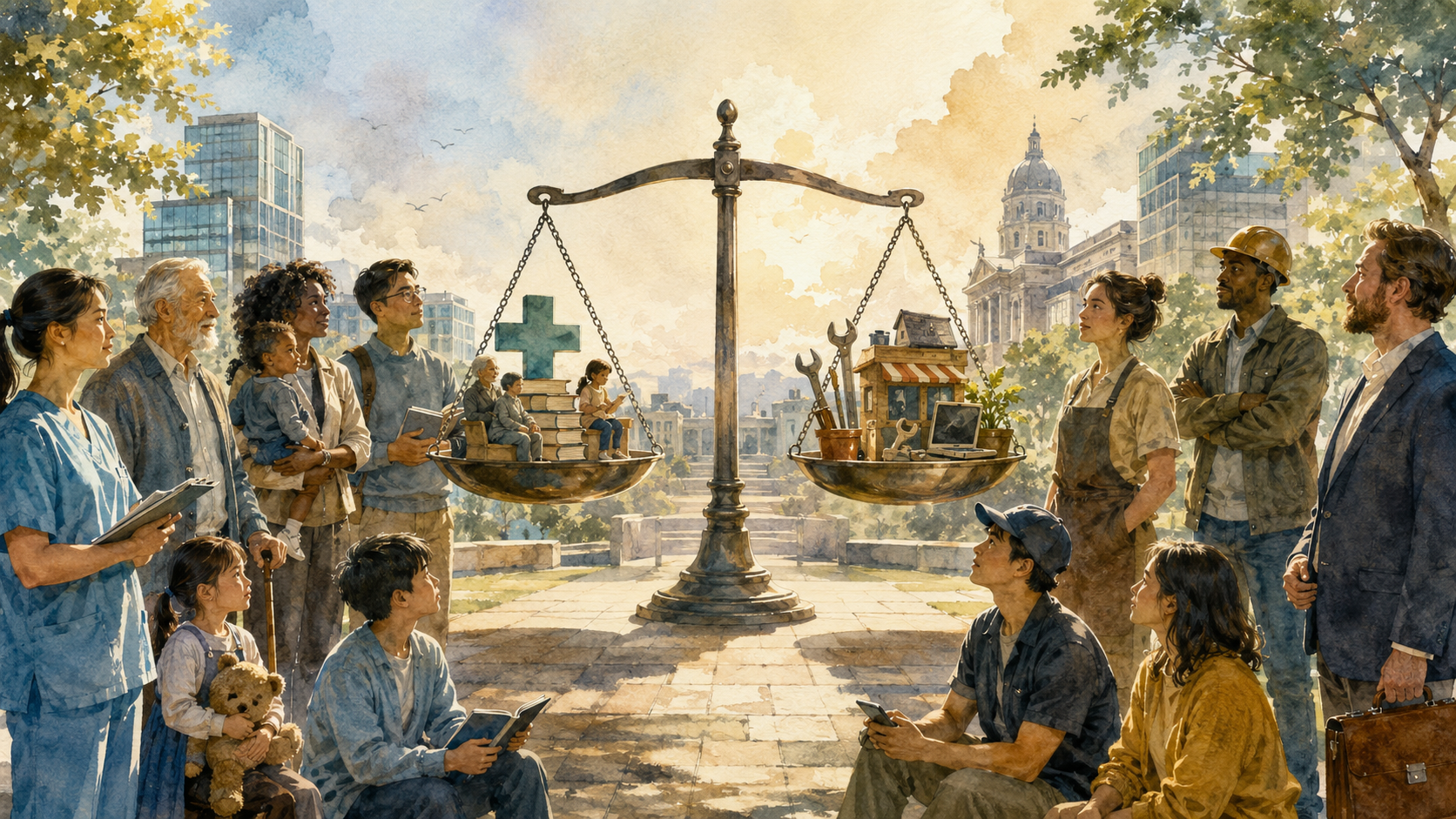
    debate between social protection and individual economic freedom in a welfare state

    Freedom, Incentives, and the Limits of Government

    Critics do not necessarily oppose every form of social protection.

    Their concern is often how far redistribution should go.

    High taxes can reduce the amount individuals control over the income they earn. Generous benefits, critics argue, may sometimes weaken incentives to work, save, or take economic risks. Large welfare systems can also become bureaucratically complex and financially difficult to sustain.

    There is also a philosophical objection.

    If individuals have legitimately earned income through work, investment, or entrepreneurship, how much of that income should the government be entitled to redistribute?

    From this perspective, social justice includes not only equality but also individual rights, personal responsibility, and economic autonomy.

    The United States provides a useful contrast with the Nordic model, although the difference should not be exaggerated.

    The United States operates major public programs—including Social Security, Medicare, Medicaid, and unemployment insurance—but relies more heavily than Nordic countries on private provision in several areas, particularly health insurance and retirement savings.

    This reflects, in part, a stronger historical emphasis on limited government and individual choice.

    The result illustrates the trade-off at the center of the debate.

    Greater individual responsibility may preserve more private choice, but it can also expose people to greater economic insecurity.


    4. Is There a Middle Ground Between Redistribution and Individual Freedom?

    Universal Basic Income and Other Alternatives

    The debate is not limited to a choice between a large welfare state and minimal government.

    Many policy proposals attempt to combine social security with individual autonomy.

    One of the most widely discussed is Universal Basic Income (UBI)—the idea that citizens should receive a regular cash payment without traditional means testing or work requirements.

    Supporters argue that UBI could provide a basic level of security while allowing individuals greater freedom to decide how the money should be used.

    Critics question its cost, whether payments should go to everyone regardless of need, and whether it would be more effective than targeted welfare programs.

    Finland’s basic-income experiment from 2017 to 2018 became an important real-world test.

    Two thousand unemployed participants received a monthly payment without the usual conditions attached to unemployment benefits.

    The results were nuanced.

    The experiment did not produce a dramatic transformation in employment, but recipients reported improvements in several measures of well-being and perceived economic security.

    The lesson is important because welfare policies should not be judged by only one outcome.

    Employment matters.

    But so do security, health, dignity, administrative simplicity, and people’s ability to make meaningful choices.


    5. How Much Inequality Should a Fair Society Accept?

    citizens discussing fairness, social responsibility and economic inequality

    Different Ideas of Justice Lead to Different Answers

    This may be the most difficult question of all.

    Few people argue that everyone must receive exactly the same income regardless of effort, responsibility, skill, or contribution.

    At the same time, few societies are comfortable with unlimited inequality—especially when some citizens cannot meet basic needs while others accumulate extraordinary wealth.

    The real disagreement concerns the space between those extremes.

    One influential approach, associated with philosopher John Rawls, asks us to imagine choosing the rules of society without knowing what position we ourselves would occupy within it.

    Would we design the same society if we did not know whether we would be born rich or poor, healthy or disabled, privileged or disadvantaged?

    Rawls did not argue that every inequality must disappear. Rather, inequalities require justification, particularly in relation to fair opportunity and the position of the least advantaged.

    A contrasting tradition, strongly associated with Robert Nozick, emphasizes individual rights and legitimate acquisition.

    From this perspective, justice cannot be judged simply by looking at how equal or unequal the final distribution of wealth appears. We must also ask whether property was acquired and transferred legitimately.

    The contrast reveals why welfare-state debates are so persistent.

    They are not merely disagreements about tax rates.

    They reflect different understandings of what fairness itself means.

    A Citizenship Perspective

    From the perspective of citizenship education, this debate is especially important because a welfare state is not simply a mechanism for distributing money.

    It also expresses a society’s understanding of the relationship between citizens and the state.

    What may citizens reasonably expect from their political community?

    What responsibilities do citizens have toward people whose circumstances are very different from their own?

    And when does helping fellow citizens become not merely charity, but a shared civic responsibility?

    These questions have long been central to discussions of citizenship because democracy involves more than individual rights. It also requires citizens to consider how the institutions they share should treat people with different needs, resources, and opportunities.

    Seen this way, debates over welfare are also debates over what kind of citizens we believe ourselves to be—and what we owe one another as members of the same society.


    6. The Challenge Is Different in Every Society

    There Is No Universal Welfare Model

    There is no single welfare-state model that can simply be copied everywhere.

    Countries differ in economic development, demographics, political institutions, taxation, public trust, family structures, and attitudes toward individual and collective responsibility.

    South Korea illustrates some of these tensions.

    Rapid economic development created extraordinary prosperity, but contemporary debates increasingly involve housing affordability, opportunities for younger generations, population aging, pensions, social protection, and the fiscal sustainability of future welfare programs.

    Similar pressures appear elsewhere in different forms.

    European countries face the financial implications of aging populations. The United States continues to debate healthcare costs, coverage, and access. Developing economies must often expand social protection while working with much smaller tax bases.

    Cultural expectations matter as well.

    In some societies, families have traditionally carried much of the responsibility for supporting children, older adults, or relatives facing economic hardship. In others, citizens expect government institutions to assume a larger role.

    As societies modernize, age, urbanize, and become more culturally diverse, these expectations can change.

    This suggests that the central policy question is not simply:

    “Should we have more welfare or less welfare?”

    A better question is:

    “Which forms of social protection expand opportunity and security without creating costs that future generations cannot sustain?”

    That question moves the debate away from ideological extremes and toward institutional design.


    Conclusion: Justice Requires More Than Equality

    The welfare state represents one of modern society’s most ambitious attempts to reconcile two powerful values:

    social protection and individual freedom.

    Without adequate social protection, economic disadvantage can become self-reinforcing. Poverty can restrict education, poor health can limit employment, and inherited disadvantage can pass from one generation to the next.

    But government intervention also has limits.

    Taxes impose costs. Welfare programs require sustainable financing. Poorly designed policies can create bureaucracy, unintended incentives, or dependency. And individual autonomy remains an important part of a free society.

    The challenge, therefore, is not to eliminate every economic difference.

    Nor is it to assume that markets alone will always produce socially acceptable outcomes.

    A just society must continually decide which inequalities reflect legitimate differences in choice and contribution—and which inequalities become barriers that prevent people from living with dignity or having meaningful opportunities.

    From a citizenship perspective, this decision cannot belong only to economists or governments. It is also a democratic question about the kind of society citizens are willing to build together.

    Different countries—and different generations—may answer it differently.

    Perhaps the deepest question behind the welfare-state debate is therefore not simply how much wealth governments should redistribute.

    It is this:

    How much inequality can a society tolerate before unequal resources become unequal freedom?

    Reader Question

    Economic inequality may reward effort and innovation, but extreme inequality can also restrict people’s opportunities.

    At what point should reducing inequality become a responsibility of the state—and how can governments do so without unnecessarily limiting individual freedom?

    Related Reading

    If a welfare state is built on shared responsibility among citizens, what happens when different generations disagree over who should contribute more and who should receive more?

    In Aging Society and Generational Divide we examine how pensions, healthcare, housing, and demographic change are reshaping the distribution of resources between younger and older generations.

    If economic inequality influences the opportunities available to citizens, we must also ask whether demographic change itself can reshape the structure of society.

    In Population and the Course of History?, we explore how population growth, decline, aging, and migration have influenced economic and social change throughout history.

    References

    1. Rawls, John. (1971). A Theory of Justice. Harvard University Press.

    Rawls develops the influential ideas of the original position, the veil of ignorance, and principles of justice designed without knowing one’s future social position. His work provides a philosophical foundation for examining equality of opportunity, inequality, and the obligations of social institutions toward the least advantaged.

    2. Nozick, Robert. (1974). Anarchy, State, and Utopia. Basic Books.

    Nozick presents a major libertarian critique of extensive redistribution and emphasizes individual rights, property, voluntary exchange, and limited government. His argument provides an important counterpoint to Rawls and helps explain why welfare-state debates involve competing definitions of justice rather than simply different economic policies.

    3. Esping-Andersen, Gøsta. (1990). The Three Worlds of Welfare Capitalism. Princeton University Press.

    Esping-Andersen compares different welfare-state systems and demonstrates that welfare capitalism does not follow a single model. His influential framework helps explain why countries organize social protection differently depending on institutions, political traditions, labor markets, and relationships between families, markets, and governments.

    4. OECD. Society at a Glance 2024: OECD Social Indicators. OECD Publishing, 2024.

    This report provides comparative evidence on social conditions across OECD countries, including income inequality, poverty, demographics, social spending, and other indicators of well-being. It is useful for placing philosophical debates about welfare and inequality within the realities of contemporary societies.

    5. Kangas, Olli, Signe Jauhiainen, Miska Simanainen, and Minna Ylikännö, eds. (2021). Experimenting with Unconditional Basic Income: Lessons from the Finnish BI Experiment 2017–2018. Edward Elgar Publishing.

    This volume examines Finland’s basic-income experiment and its effects on employment, economic security, and well-being. The findings illustrate why welfare policies need to be evaluated through multiple dimensions rather than employment outcomes alone.

  • Will AI and Automation Trigger the Next Social Revolution?

    Will AI and Automation Trigger the Next Social Revolution?

    Work, Inequality, and the Future of Social Stability in the Age of Artificial Intelligence

    Technology has always transformed human society.

    The Industrial Revolution replaced manual labor with machines.
    The computer revolution reshaped communication and information.
    The internet changed how humans work, consume, and interact.

    But the rise of artificial intelligence may create a transformation far larger than anything before it.

    Today, AI systems are rapidly replacing tasks once believed to require uniquely human abilities. From manufacturing and customer service to law, finance, healthcare, and even creative work, automation is expanding into nearly every sector of society.

    This raises a growing concern:

    What happens when millions of people are no longer economically necessary?

    For many researchers and political theorists, this is no longer simply a technological question.

    It is a question about the future stability of society itself.

    And perhaps an even more unsettling question follows:

    Could AI and automation eventually trigger new forms of social revolution?

    AI replacing human workers in multiple industries

    1. AI and Automation Are Reshaping Labor

    Beyond Factory Work

    Automation once mainly affected repetitive factory labor.

    Today, however, AI increasingly performs:

    • administrative work
    • legal analysis
    • financial calculations
    • customer support
    • medical diagnostics
    • and even creative production

    This means technological replacement is no longer limited to physical labor alone.

    White-collar professions are increasingly vulnerable as well.


    The Risk of Technological Unemployment

    Many experts warn that AI could produce large-scale technological unemployment.

    Manufacturing workers may be replaced by robotics systems capable of operating continuously without fatigue. AI chatbots increasingly handle customer service tasks once performed by human employees. Autonomous driving technologies threaten transportation and delivery industries, while AI-assisted legal and accounting systems reduce the need for routine office work.

    As automation expands, economic inequality may deepen dramatically.

    Those who own technological infrastructure may accumulate greater wealth, while displaced workers face increasing instability.


    2. Universal Basic Income and the Search for Solutions

    future society debating universal basic income

    What Is Universal Basic Income?

    One proposed solution is Universal Basic Income (UBI).

    Under this system, governments provide citizens with regular unconditional income regardless of employment status.

    Supporters argue that UBI could protect people from economic collapse in an AI-driven economy where stable employment becomes less available.

    Several countries and local governments, including experiments in Finland, Canada, and parts of the United States, have already tested versions of basic income programs.


    Why the Debate Is Intensifying

    Supporters of UBI argue that traditional welfare systems may become insufficient if automation eliminates large numbers of jobs simultaneously.

    They also claim UBI could:

    • reduce social instability
    • soften inequality
    • support creative and caregiving work
    • and allow people to pursue education or innovation without extreme economic pressure

    However, critics raise serious concerns.

    Some argue that governments cannot financially sustain universal payments. Others fear basic income may reduce work motivation or become politically unsustainable.

    As AI unemployment expands, these debates are likely to become even more politically intense.


    3. Could AI Unemployment Lead to Social Unrest?

    Historical Patterns of Economic Instability

    History repeatedly shows that severe inequality and unemployment can destabilize societies.

    The French Revolution emerged partly from extreme economic inequality between elites and ordinary citizens.

    The Russian Revolution developed amid industrial exploitation and worker dissatisfaction.

    More recently, the Arab Spring was fueled in part by unemployment, economic frustration, and social inequality.

    Economic insecurity has often functioned as a catalyst for political upheaval.


    The Possibility of AI-Driven Resistance

    If AI eliminates large numbers of jobs while wealth becomes increasingly concentrated among technology companies and investors, social tension could intensify significantly.

    Possible consequences may include:

    • large-scale protests
    • anti-technology movements
    • populist political shifts
    • radical economic reform demands
    • and growing distrust toward institutions

    Historically, societies experiencing technological disruption have sometimes reacted violently.

    During the Industrial Revolution, workers known as the Luddites destroyed machinery they believed threatened their livelihoods.

    Future resistance movements may not destroy machines physically—

    But they may challenge the political and economic systems built around AI-driven inequality.


    4. The Political Future of an Automated Society

    Technology and Power Concentration

    One major concern is that AI may centralize power in unprecedented ways.

    Large technology corporations increasingly control:

    • data
    • algorithms
    • infrastructure
    • communication systems
    • and digital labor platforms

    As AI becomes essential to economic production, technological elites may gain enormous influence over society.

    This could deepen existing inequality between:

    • workers and corporations
    • governments and tech companies
    • wealthy nations and developing nations

    Redefining Human Value

    Automation may also force societies to reconsider how human worth is defined.

    For centuries, employment has shaped:

    • identity
    • dignity
    • income
    • and social participation

    But if machines perform most economically productive labor, societies may need new ways to understand meaning, contribution, and citizenship beyond traditional employment.

    In this sense, the AI revolution is not only economic.

    It is philosophical.


    Conclusion: Will the AI Era Create Revolution—or Reinvention?

    people protesting against inequality in AI society

    Artificial intelligence will undoubtedly increase productivity and technological capability.

    However, it may also produce:

    • mass unemployment
    • severe inequality
    • political instability
    • and deep social anxiety

    Whether future societies experience revolution or peaceful transformation may depend on how governments, corporations, and citizens respond to these challenges.

    Technology alone does not determine the future.

    Political decisions, ethical frameworks, and social solidarity matter just as much.

    Ultimately, the most important question may not be whether AI becomes more intelligent than humans.

    It may be this:

    Can human societies remain fair, stable, and humane
    in a world where human labor is no longer economically central?

    The answer to that question could shape the future of civilization itself.

    Reader Question

    If artificial intelligence eventually performs most forms of labor more efficiently than humans—

    How should society redefine human value, dignity, and economic fairness?

    And if millions of people feel excluded from the future economy,
    could technological progress itself become the cause of social unrest?

    Related Reading

    The broader relationship between technology and human agency is explored further in Do Humans Control Technology, or Does Technology Control Us?, which examines whether technological progress continues to serve human purposes or gradually begins to reshape the choices, values, and institutions that define society. This wider perspective provides an essential foundation for understanding whether AI and automation represent merely technological change—or the beginning of a deeper social revolution.

    If economic systems and political structures are shaped by ideas that societies once considered “natural” or unquestionable, technological revolutions may also transform the meaning of identity and social order. Can Society Move Beyond the Gender Binary? explores how social norms evolve over time and how institutions influence the ways societies define identity, belonging, and power. Together, these discussions reveal that every major technological revolution is also a transformation of society itself.


    References

    1. C. Challoumis (2024). From Automation to Innovation.
      This research analyzes how AI-driven automation may simultaneously eliminate existing jobs while creating new forms of economic opportunity and innovation.
    2. J. C. Bélisle-Pipon (2025). AI, Universal Basic Income, and Power.
      This study critically examines debates surrounding universal basic income and questions whether technological elites frame UBI primarily as social protection or as a mechanism for maintaining power structures.
    3. A. Pınar (2024). Technological Unemployment and the AI Revolution.
      This work explores the macroeconomic consequences of AI-driven unemployment and discusses possible policy responses including UBI, retraining systems, and AI regulation.
    4. S. A. Bell & Anton Korinek (2023). AI’s Economic Peril.
      This article warns that AI may intensify wealth concentration and economic insecurity if governments fail to develop inclusive economic policies.
    5. Joseph Stiglitz et al. (2021). Technological Progress, Artificial Intelligence, and Inclusive Growth.
      This research investigates how AI and automation may influence long-term economic growth and proposes policy frameworks aimed at ensuring technological benefits are distributed more equitably.
  • Robot Labor and Human Dignity

    Robot Labor and Human Dignity

    How the Meaning of Work Is Changing in the Age of Automation

    Robots replacing human labor in modern workplace

    1. The Replacement of Labor — Toward a Workplace Without Humans

    What if a society emerges in which humans no longer need to work?
    As machines take over more tasks, efficiency rises—but at the same time, a deeper question begins to surface.

    Factory lines, logistics centers, cafés, even news article writing—
    robots and artificial intelligence are already at work.

    They do not tire, complain, or demand rest.
    They operate twenty-four hours a day with consistent productivity.

    According to a McKinsey report, up to 30 percent of global jobs may be automated by 2030.
    The more routine and rule-based the task, the faster it is replaced.

    Yet here lies the paradox of technological progress.
    As efficiency increases, the dignity attached to human labor begins to erode.

    When a job that once provided pride and identity is no longer “needed,”
    people experience more than economic unemployment.
    They confront an existential anxiety:

    Who am I, if my work no longer has a place in society?

    Work has never been merely a means of survival.
    It is how humans relate to society—and how they affirm their own value.


    2. Human–Robot Coexistence — Collaboration or Subordination?

    Human and robot collaboration showing workplace hierarchy

    As robots enter workplaces, humans are expected to collaborate with them.

    In factories, machines handle heavy or repetitive tasks,
    while humans become supervisors or assistants.

    On the surface, this looks like coexistence.
    In reality, a hierarchy quietly emerges.

    Robots are evaluated purely by efficiency,
    and humans are increasingly measured by the same standard.

    The “inefficient human” is gradually pushed to the margins.

    This creates a new pressure:
    humans must now outperform machines on machine-like terms.

    As a result, workplaces lose space for emotion, rest, and imperfection.

    The question inevitably arises:

    Do robots assist human labor—or do they redefine how humans are judged?


    3. Universal Basic Income — The Ethics of Living Without Work

    As automation expands, societies search for new institutional responses.

    One prominent proposal is Universal Basic Income (UBI)
    a system in which AI-generated wealth is shared,
    and every citizen receives a guaranteed income regardless of employment.

    Pilot programs have been tested in countries such as Finland, Canada, and Switzerland.

    Supporters argue that UBI can reduce inequality and allow people
    to focus on creative, social, and caring activities.

    Critics worry that it weakens the meaning of work
    and blurs the sense of social responsibility.

    UBI is not merely an economic policy.
    It is an ethical debate about the value of work and the meaning of life.

    Are we ready to accept a society where survival is detached from labor?


    4. A New Work Ethic — From Productivity to Meaning

    The industrial era celebrated diligence, discipline, and productivity.

    In the age of AI, these virtues are no longer absolute.

    Philosopher Byung-Chul Han argues in The Burnout Society
    that modern individuals become “achievement subjects,”
    endlessly exploiting themselves in the name of performance.

    If machines take over production, humans no longer need to exist
    solely as producers of measurable output.

    Instead, human labor can be reoriented toward
    creation, care, empathy, education, and reflection.

    The ethical center of work must shift
    from efficiency to human meaning.


    5. Redefining the Meaning of Work — Toward a Dignified Human Life

    Even in an era that speaks of the “end of work,”
    the meaning of work remains central to human life.

    It is not disappearing—it is transforming.

    If robots replace physical labor,
    humans must reclaim work as an activity of thinking, feeling, and relating.

    Caring for others, building social bonds,
    creating art, teaching, and nurturing communities—
    these forms of non-economic labor must be revalued.

    A society where humans do not have to work
    is not a society where work loses meaning.

    It is a society that must rediscover what work truly means.


    Conclusion — Human Dignity Still Resides in Work

    Human reflecting on dignity and meaning of work

    Even if robots and AI dominate the workplace,
    human dignity cannot be automated.

    Humans are not merely beings who work.
    They are beings who create meaning through work.

    The task ahead is not to exclude robots,
    but to ensure that technology and humanity together
    shape forms of labor worthy of human dignity.

    What we must protect is not jobs themselves,
    but the dignity that emerges through meaningful work.

    A society where one can live without working—
    yet still wants to work—
    that is a truly human society.

    A Question for You

    If technology eventually removes the necessity of human labor,
    what do you think will give life meaning and dignity?

    Related Reading

    The broader relationship between humanity and technological power is explored further in Do Humans Control Technology, or Does Technology Control Us?, which examines whether technology remains a tool serving human purposes or gradually becomes a force that reshapes human choices, values, and society. This wider perspective provides an essential context for understanding how automation challenges the meaning of work and human dignity.

    The social consequences of automation are explored further in The New Inequality of the AI Age: The Rise of Digital Refugees, which examines how rapid technological change can leave many people behind, creating new forms of inequality and exclusion. Together, these questions remind us that the future of work is not only about technological progress, but also about ensuring that human dignity remains at the center of social development.


    References

    1. Brynjolfsson, E., & McAfee, A. (2014). The Second Machine Age. New York: W. W. Norton & Company.
      This influential work analyzes how digital technologies transform labor and productivity, highlighting both economic growth and the risk of job displacement in automated societies.
    2. Srnicek, N., & Williams, A. (2015). Inventing the Future: Postcapitalism and a World Without Work. London: Verso.
      The authors explore post-work futures, automation, and basic income, offering a philosophical vision of how societies might reorganize labor beyond traditional employment.
    3. Frey, C. B., & Osborne, M. A. (2017). “The Future of Employment: How Susceptible Are Jobs to Computerisation?” Technological Forecasting and Social Change, 114, 254–280.
      This empirical study estimates the probability of job automation across occupations, providing a data-driven foundation for debates on technological unemployment.
    4. Han, B.-C. (2015). The Burnout Society. Stanford, CA: Stanford University Press.
      Han critiques contemporary performance-driven culture, arguing that excessive self-optimization erodes human dignity and leads to psychological exhaustion.
    5. Arendt, H. (1958). The Human Condition. Chicago: University of Chicago Press.
      Arendt’s classic distinction between labor, work, and action offers a philosophical framework for rethinking human dignity and meaningful activity in post-industrial societies.