CRISPR, Human Design, and the Ethics of Rewriting Life
Have you ever wondered—
do we have the right to design life itself?
To choose a child’s traits,
or to erase disease before birth?
In a near future where gene editing is possible,
these questions are no longer hypothetical.
They stand before us—
not as scientific curiosities,
but as ethical crossroads.
Today’s discussion unfolds as a stage of inquiry,
where one technology—CRISPR—
forces us to confront a deeper question:
Are we advancing life,
or overstepping its limits?
1. The Case Against: A Form of Hubris?
Critics argue that gene editing risks turning life into a tool—
and humans into its designers.
Interfering with Natural Order
Genes are the result of long evolutionary processes.
To alter them without full understanding may disrupt complex biological systems.
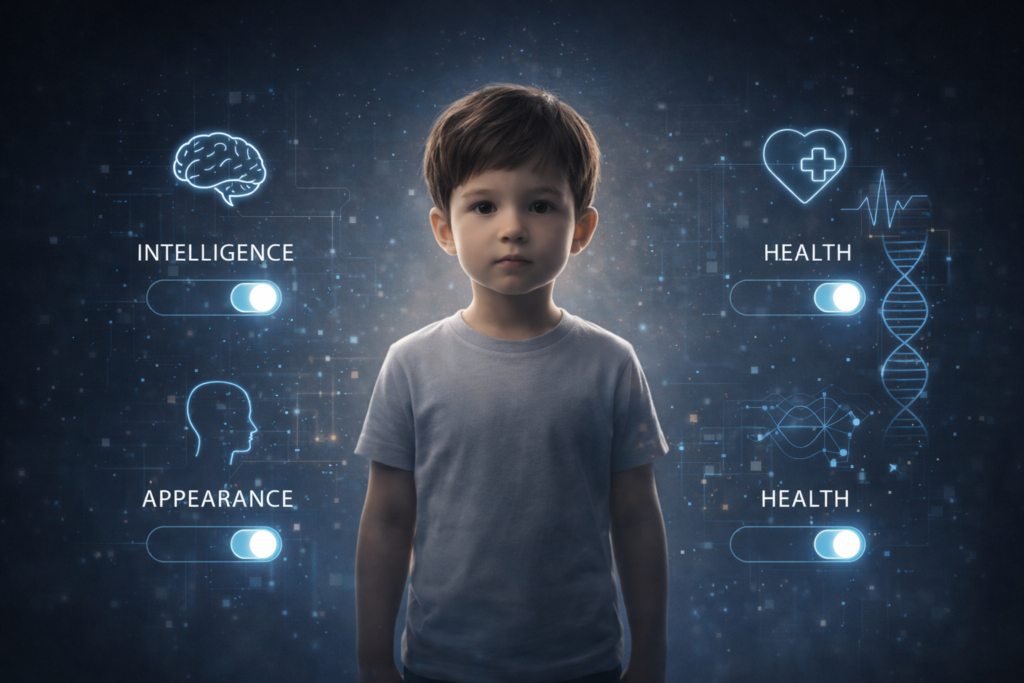
The Ethics of “Designer Babies”
Selecting traits risks commodifying human life—
reducing identity to preference.
Deepening Inequality
Access to genetic enhancement could create new social divisions—
not just economic, but biological.
Moral Desensitization
If life becomes editable,
its intrinsic value may begin to feel negotiable.
2. The Case For: A Step Toward Progress
Supporters respond:
the question is not whether we can use the technology—
but how.
Ending Genetic Suffering
Many severe diseases originate in genetic mutations.
CRISPR offers the possibility of addressing them at their source.
Is Nature Always Ethical?
Nature includes suffering, disease, and early death.
Intervening may not violate nature—but refine it.
The Role of Ethical Governance
Global frameworks and regulations can guide responsible use—
ensuring safety and fairness.
A Different View of Respect
Respecting life may not mean leaving it untouched,
but helping it flourish without unnecessary suffering.
3. Between Ethics and Innovation
Both perspectives reveal a truth.
One warns of unintended consequences.
The other highlights tangible benefits.
The challenge lies in the uncertainty—
where good intentions may still lead to unpredictable outcomes.
4. A Reflective Pause
Perhaps this is not a question that can be resolved
through a final verdict.
Gene editing is neither inherently good nor inherently harmful.
It reflects the intentions of those who wield it.
The deeper issue is not the technology itself—
but the values guiding its use.
Conclusion: A Shared Responsibility
Gene editing represents one of humanity’s most powerful tools.
It holds the promise to reduce suffering—
but also the risk of redefining what it means to be human.
The real question is not simply whether we should allow it,
but how we choose to engage with it.
Through reflection, regulation, and collective responsibility,
we must navigate this space carefully.
Because in the end,
the future of life is not written by technology alone—
but by the ethics we choose to uphold.
A Question for Readers
Do we have the right to redesign human life—
if it means reducing suffering?
Or are there limits we should never cross,
even in the name of progress?
Related Reading
The broader ethical debate over humanity’s authority to reshape life is explored further in Can Humans Be the Moral Standard?, which examines whether human beings should remain the ultimate source of moral judgment or whether ethical limits exist beyond human intention. This wider perspective provides an essential framework for evaluating the responsibilities that accompany powerful technologies such as gene editing.
The discussion continues in If We Can Design Life, Do We Become Creators?, which explores the ethical boundaries of synthetic biology, genetic engineering, and humanity’s growing ability to redesign living organisms. Together, these discussions ask not only what science makes possible, but also what humanity ought to do with that power.
References
1. Sandel, Michael J. (2007). The Case Against Perfection: Ethics in the Age of Genetic Engineering. Harvard University Press.
A leading philosophical examination of human enhancement and genetic engineering. Sandel argues that the pursuit of perfection through biotechnology raises profound ethical questions about humility, responsibility, and the meaning of being human.
2. Habermas, Jürgen. (2003). The Future of Human Nature. Polity Press.
Habermas explores how genetic intervention may alter human autonomy, equality, and moral responsibility, questioning whether engineered traits could reshape the ethical foundations of democratic society.
3. National Academies of Sciences, Engineering, and Medicine. (2017). Human Genome Editing: Science, Ethics, and Governance. National Academies Press.
A comprehensive scientific and ethical report examining the opportunities, risks, and governance principles surrounding human genome editing technologies such as CRISPR.
4. Nuffield Council on Bioethics. (2018). Genome Editing and Human Reproduction: Social and Ethical Issues.
A widely cited bioethics report discussing the ethical conditions under which heritable genome editing might be considered acceptable, emphasizing public interest, justice, and social responsibility.
5. UNESCO. (2005). Universal Declaration on Bioethics and Human Rights.
An international declaration establishing ethical principles for biomedical research and biotechnology, highlighting human dignity, equality, informed consent, and social responsibility.
Leave a Reply