Tag: bioethics

  • If We Can Design Life, Do We Become Creators?

    If We Can Design Life, Do We Become Creators?

    Synthetic Biology and the Ethical Limits of Human Power

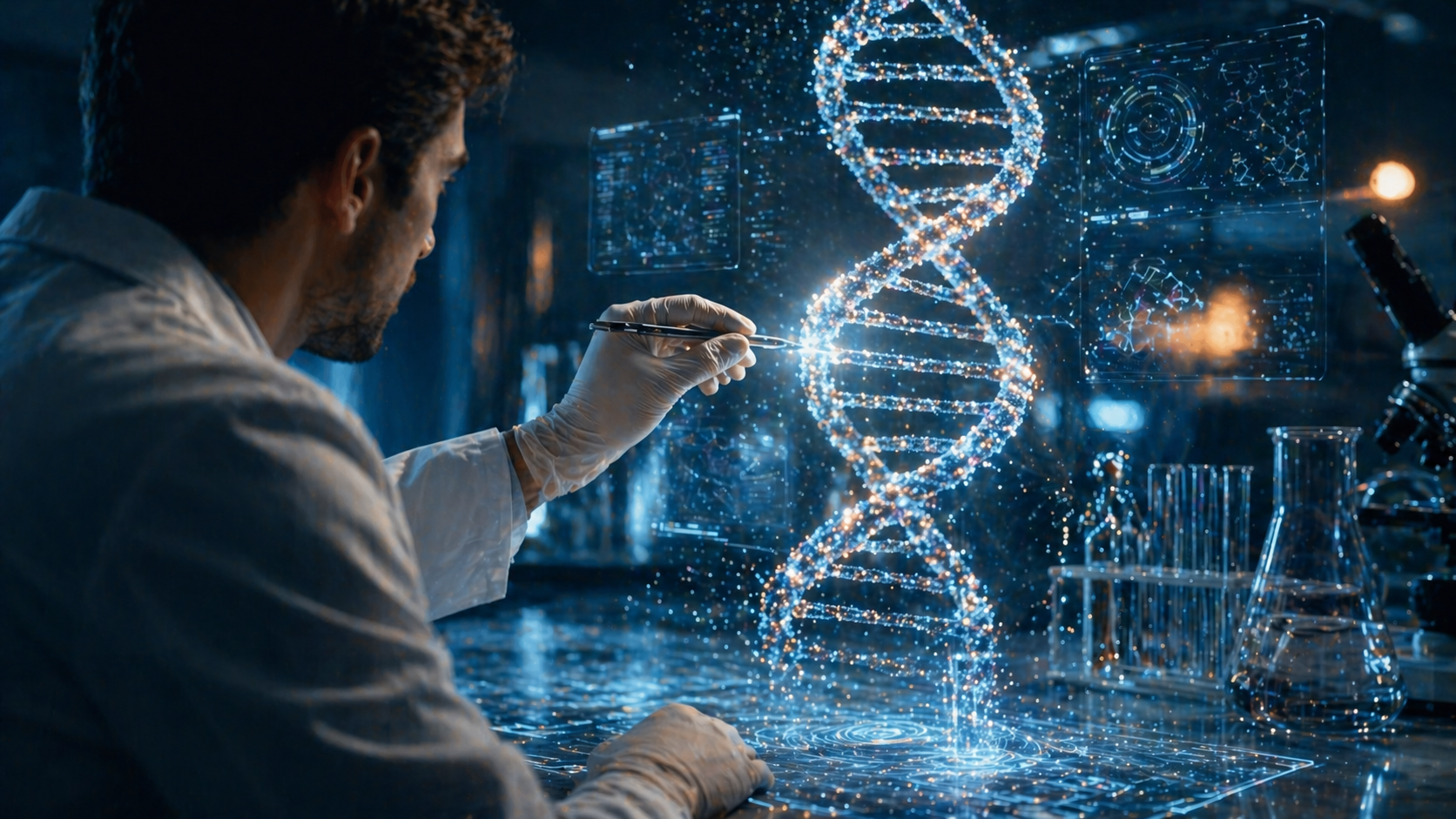
    A scientist sits in a laboratory, not just editing DNA—
    but designing an entirely new form of life.

    Not discovered in nature.
    Not evolved over millions of years.
    But written, assembled, and activated by human hands.

    This is no longer science fiction.

    With the rise of synthetic biology,
    we are entering an era where life is not only read—
    but written.

    And that leads us to an unsettling question:

    If we can create life…

    Do we become creators?

    Or something else entirely?


    human holding DNA ethical control

    1. A World Where Life Can Be Designed

    Synthetic biology goes beyond traditional genetic engineering.

    It does not simply modify existing organisms.
    It aims to construct life itself.

    Scientists are already developing:

    • bacteria that break down toxic waste
    • engineered microbes that target cancer cells
    • mosquitoes designed not to carry diseases

    These innovations hold enormous promise.

    But they also force us to ask:

    What kinds of life should we create?

    And are there forms of life we should never create at all?


    2. Is Life Just Code—or Something Sacred?

    conceptual artificial microorganism

    Synthetic biology treats life as something programmable.

    A sequence of genetic instructions.
    A system that can be edited, optimized, and redesigned.

    But is that all life is?

    Or is life something more—
    a web of meaning, relationships, and experience
    that cannot be reduced to code?

    The danger lies here:

    If we begin to see life only as a technical object,
    we risk losing the sense of reverence that has historically guided human ethics.

    Can we truly claim to understand life—
    simply because we can manipulate it?


    3. Humans as Creators—and Managers

    Human history has always been a story of creation.

    We built tools.
    We shaped environments.
    We created machines.

    Now, we are beginning to create life.

    This, in itself, is not necessarily arrogance.

    The real question is responsibility.

    What happens when:

    • engineered organisms evolve unpredictably?
    • ecosystems are disrupted?
    • artificial life escapes our control?

    Creation without responsibility is not progress.

    A true creator must also be a guardian.


    4. The Ethical Weight of Creating Life

    The more powerful the technology becomes,
    the more urgent the ethical questions grow.

    • What should we create?
    • Who decides?
    • And most importantly:
      Just because we can create life—does that mean we should?

    Synthetic biology is not just a scientific frontier.

    It is a moral one.

    It forces us to reconsider what it means to respect life,
    not as something we own—
    but as something we participate in.


    Conclusion: Creator or Steward?

    human holding glowing artificial life

    The ability to design life presents both extraordinary possibility
    and profound responsibility.

    Are we becoming creators?

    Or are we being invited into a deeper role—
    that of a steward?

    Technology always moves forward.

    But ethics determines its direction.

    If we have reached the point where we can create life,
    then the real question is no longer can we

    It is:

    What kind of beings do we choose to become in the process?

    Reader Question

    If humans can design life itself—

    Where should we draw the line between creation and responsibility?

    Related Reading

    If we can design life by rewriting genetic code, are we truly understanding life—or simply manipulating its outer structure?
    In Is There a Single Historical Truth, or Many Narratives?, we explore how what we consider “truth” is often shaped by interpretation and perspective—raising a deeper question: are we discovering reality, or constructing it?

    If life can be engineered and intelligence can be simulated, are the boundaries we once believed to be absolute—between nature and design, human and machine—beginning to dissolve?
    In If AI Could Dream, Would It Be Imagination—or Calculation?, we examine whether artificial intelligence can transcend computation and approach something like imagination—and what that implies for creativity, consciousness, and the limits of human uniqueness.


    References

    1. George Church & Ed Regis (2012). Regenesis.
    This book introduces the foundations and future potential of synthetic biology, exploring how genome design may redefine life itself and directly connect to the question of humans as creators.

    2. Joachim Boldt & Oliver Müller (2008). “Newton of the leaves of grass.”
    This paper reflects on the philosophical implications of designing life, offering a critical lens on whether life can truly be engineered without losing its deeper meaning.

    3. Gregory E. Kaebnick & Thomas H. Murray (2013). Synthetic Biology and Morality.
    This collection analyzes the ethical boundaries of creating artificial life, questioning the moral responsibilities that come with technological creation.

    4. Jürgen Habermas (2003). The Future of Human Nature.
    Habermas explores how genetic intervention may affect human dignity and self-understanding, providing a crucial ethical framework for evaluating synthetic biology.

    5. Lori B. Andrews & Dorothy Nelkin (2001). Body Bazaar.
    This work critiques the commodification of biological materials, highlighting the societal risks of treating life as a designable and tradable object.

  • Is Gene Editing a Leap Forward—or a Dangerous Overreach?

    Is Gene Editing a Leap Forward—or a Dangerous Overreach?

    CRISPR, Human Design, and the Ethics of Rewriting Life

    Have you ever wondered—
    do we have the right to design life itself?

    To choose a child’s traits,
    or to erase disease before birth?

    In a near future where gene editing is possible,
    these questions are no longer hypothetical.

    They stand before us—
    not as scientific curiosities,
    but as ethical crossroads.

    Today’s discussion unfolds as a stage of inquiry,
    where one technology—CRISPR—
    forces us to confront a deeper question:

    Are we advancing life,
    or overstepping its limits?

    scientist editing DNA sequence

    1. The Case Against: A Form of Hubris?

    Critics argue that gene editing risks turning life into a tool—
    and humans into its designers.

    1.1 Interfering with Natural Order

    Genes are the result of long evolutionary processes.
    To alter them without full understanding may disrupt complex biological systems.

    1.2 The Ethics of “Designer Babies”

    Selecting traits risks commodifying human life—
    reducing identity to preference.

    1.3 Deepening Inequality

    Access to genetic enhancement could create new social divisions—
    not just economic, but biological.

    1.4 Moral Desensitization

    If life becomes editable,
    its intrinsic value may begin to feel negotiable.


    2. The Case For: A Step Toward Progress

    child with selectable genetic traits

    Supporters respond:
    the question is not whether we can use the technology—
    but how.

    2.1 Ending Genetic Suffering

    Many severe diseases originate in genetic mutations.
    CRISPR offers the possibility of addressing them at their source.

    2.2 Is Nature Always Ethical?

    Nature includes suffering, disease, and early death.
    Intervening may not violate nature—but refine it.

    2.3 The Role of Ethical Governance

    Global frameworks and regulations can guide responsible use—
    ensuring safety and fairness.

    2.4 A Different View of Respect

    Respecting life may not mean leaving it untouched,
    but helping it flourish without unnecessary suffering.


    3. Between Ethics and Innovation

    Both perspectives reveal a truth.

    One warns of unintended consequences.
    The other highlights tangible benefits.

    The challenge lies in the uncertainty—
    where good intentions may still lead to unpredictable outcomes.


    4. A Reflective Pause

    Perhaps this is not a question that can be resolved
    through a final verdict.

    Gene editing is neither inherently good nor inherently harmful.
    It reflects the intentions of those who wield it.

    The deeper issue is not the technology itself—
    but the values guiding its use.


    Conclusion: A Shared Responsibility

    person choosing path ethical crossroads

    Gene editing represents one of humanity’s most powerful tools.

    It holds the promise to reduce suffering—
    but also the risk of redefining what it means to be human.

    The real question is not simply whether we should allow it,
    but how we choose to engage with it.

    Through reflection, regulation, and collective responsibility,
    we must navigate this space carefully.

    Because in the end,
    the future of life is not written by technology alone—
    but by the ethics we choose to uphold.

    A Question for Readers

    Do we have the right to redesign human life—
    if it means reducing suffering?

    Or are there limits we should never cross,
    even in the name of progress?


    Related Reading

    The ethical tension between innovation and responsibility becomes even more complex when we consider how far technology should shape human existence.
    In If AI Could Dream, Would It Be Imagination—or Calculation?, the boundary between human uniqueness and technological capability challenges our assumptions about creativity, consciousness, and what should remain beyond design.

    At the same time, questions about human enhancement extend beyond biology into everyday life and identity.
    In Can What You Wear Change Your Mind?, the subtle ways external design influences human behavior suggest that even small forms of “engineering” can reshape how we think, act, and define ourselves.

  • Children Born in Laboratories?

    The Ethics and Controversies of Artificial Wombs

    Artificial womb technology redefining human birth

    1. What Is an Artificial Womb?

    Technology Crossing the Boundary of Life

    An artificial womb (ectogenesis) is a system designed to sustain embryonic or fetal development outside the human body, reproducing essential physiological functions such as oxygen exchange and nutrient delivery.

    Once considered a miracle of nature, human birth is now approaching a technological threshold.
    Recent experiments in Japan and the United States have sustained animal fetuses in artificial wombs, raising the possibility that gestation may no longer be confined to the human body. While researchers emphasize medical benefits—especially for extremely premature infants—this shift introduces a deeper ethical question:

    If human life can begin in a laboratory, who—or what—decides that life should exist?

    This question signals a transformation of birth itself—from a biological event to a social, ethical, and political decision shaped by technology.

    2. Reproductive Rights Revisited

    Parental Choice or Social Authority?

    Reproductive rights have long been tied to bodily autonomy, especially that of women.
    Debates over abortion, IVF, and surrogacy have centered on one question:

    Who has the right to decide whether life begins?

    Artificial wombs radically alter this framework.
    Gestation no longer requires a pregnant body.
    As a result, reproduction may be separated from physical vulnerability altogether.

    This could expand reproductive possibilities—for infertile individuals, same-sex couples, or single parents.
    But it also raises a troubling possibility: does the right to have a child become a right to produce a child?

    When reproduction is technologically mediated, life risks becoming a project of desire, efficiency, or entitlement rather than responsibility.

    Ethical decision making in artificial gestation

    3. State and Corporate Power

    Is Life a Public Good or a Managed Resource?

    If artificial wombs become viable at scale, who controls them?

    Governments may intervene in the name of safety and regulation.
    Corporations may dominate through patents, infrastructure, and pricing.
    In either case, control over birth may concentrate in the hands of those who control the technology.

    Imagine a future in which:

    • Access to artificial wombs depends on cost or eligibility,
    • Certain embryos are prioritized over others,
    • Reproduction becomes subject to institutional approval.

    In such a world, birth risks shifting from a human right to a managed resource.

    When life becomes trackable, optimizable, and governable, it may lose its moral inviolability and become another system output.


    4. A New Ethical Question

    Is Life “Given,” or Is It “Made”?

    Artificial wombs force us to confront a fundamental moral dilemma:

    Is it ethically permissible for humans to manufacture the conditions of life?

    Natural birth involves contingency, vulnerability, and unpredictability.
    Ectogenesis replaces chance with planning, and emergence with design.

    Life becomes not something received, but something produced.

    This challenges traditional ethical concepts such as the sanctity of life.
    Some argue that technological power demands a new ethics of responsibility:
    If humans can create life, they must also bear full moral responsibility for its consequences.

    Technology expands possibility—but ethics must decide restraint.


    5. Conclusion

    Who Chooses That a Life Should Begin?

    Artificial wombs represent humanity’s first attempt to fully externalize gestation.
    They promise reduced physical risk, expanded reproductive options, and medical progress.

    Yet they also carry the danger of turning life into an object of control, ownership, and optimization.

    Ultimately, the debate is not only about technology.
    It is about meaning.

    Is human life something we design, or something we are obligated to protect precisely because it is not designed?

    Questioning who decides human life

    As technology accelerates, society must ensure that ethical reflection moves faster—not slower—than innovation.


    References

    1. Gelfand, S., & Shook, J. (2006). Ectogenesis: Artificial Womb Technology and the Future of Human Reproduction. Amsterdam: Rodopi.
      → A foundational philosophical analysis of artificial womb technology, examining how ectogenesis reshapes concepts of birth, agency, and responsibility.
    2. Scott, R. (2002). Rights, Duties and the Body: Law and Ethics of the Maternal-Fetal Conflict. Oxford: Hart Publishing.
      → Explores legal and ethical tensions between bodily autonomy and fetal interests, offering critical insights into reproductive technologies.
    3. Kendal, E. S. (2022). “Form, Function, Perception, and Reception: Visual Bioethics and the Artificial Womb.” Yale Journal of Biology and Medicine, 95(3), 371–377.
      → Analyzes how the visual representation of artificial wombs shapes public ethical perception of life and technology.
    4. De Bie, F., Kingma, E., et al. (2023). “Ethical Considerations Regarding Artificial Womb Technology for the Fetonate.” The American Journal of Bioethics, 23(5), 67–78.
      → A contemporary ethical assessment focusing on responsibility, care, and social implications of ectogenesis.
    5. Romanis, E. C. (2018). “Artificial Womb Technology and the Frontiers of Human Reproduction.” Medical Law Review, 26(4), 549–572.
      → Discusses legal and moral boundaries of artificial gestation, especially the shifting definition of pregnancy and parenthood.
  • Reversing Aging: Is Eternal Youth a Blessing or a Curse for Humanity?

    Human silhouette questioning aging reversal and time

    If Humans Never Aged

    Until the late twentieth century, “anti-aging” was little more than a marketing phrase in cosmetic advertisements.
    Today, however, advances in biotechnology and artificial intelligence have brought the idea of reversing aging out of the realm of imagination and into scientific reality.

    Genetic reprogramming that restores aged cells, regenerative medicine capable of repairing damaged organs, and even attempts to digitally preserve neural patterns—humanity is steadily pulling its ancient dream of conquering death into the laboratory.

    As science accelerates, a deeper question quietly emerges:

    If aging could be reversed, would eternal youth truly make us happier?
    And if humans no longer grew old, what would become of the meaning of life itself?

    We may believe we are chasing youth, but in truth, we may be redefining what it means to be human.


    1. Mapping Immortality: How Science Reimagines Aging

    Cellular aging and biotechnology research illustration

    Aging is no longer treated as an unavoidable destiny, but increasingly as a treatable biological condition.

    Research institutions such as Altos Labs, Google-backed Calico, and longevity startups funded by figures like Elon Musk and Jeff Bezos focus on cellular reprogramming—switching aged cells back into a youthful state.

    A landmark breakthrough came from Japanese scientist Shinya Yamanaka, whose discovery of the Yamanaka factors demonstrated that mature cells could revert to pluripotent stem cells. Alongside this, researchers explore telomere extension, suppression of senescence-associated secretory phenotypes (SASP), and molecular repair of age-related damage.

    The goal is singular: to halt or reverse aging itself.

    Yet as scientific possibility expands, so too does the ethical weight of what such power implies.


    2. The Case for Blessing: Health, Knowledge, and Human Potential

    Supporters of age-reversal technologies view them as a profound advance in human welfare.

    2.1 Extending Healthy Lifespans

    The promise is not merely longer life, but longer healthy life. Reductions in age-related diseases such as dementia, cardiovascular illness, and cancer could ease healthcare burdens while improving overall well-being.

    2.2 Accumulated Wisdom

    Longer lifespans allow individuals to accumulate deeper knowledge and experience, potentially transforming society into one guided by long-term insight rather than short-term urgency.

    2.3 Liberation from Biological Limits

    From this perspective, overcoming aging is framed as the ultimate expression of human progress—liberation from suffering, decay, and biological constraint.


    3. The Case for Curse: Inequality, Stagnation, and Emptiness

    Critics argue that eternal youth may carry consequences far darker than its promise.

    3.1 Longevity Inequality

    Life-extension technologies are likely to remain expensive and exclusive, creating a new class divide based not on wealth alone, but on lifespan itself. In such a world, life becomes a commodity—and dignity risks becoming conditional.

    3.2 Frozen Generations

    If humans live for centuries, social renewal may stall. Power structures could calcify, innovation slow, and younger generations struggle to find space in a world ruled by the perpetually young.

    3.3 Loss of Meaning

    Mortality gives urgency to human life. Without death, the pressure that gives meaning to choice, love, and responsibility may quietly dissolve—replacing purpose with endless repetition.

    Eternal life, critics warn, may ultimately become eternal fatigue.


    4. Philosophical Reflections: Does Immortality Humanize Us?

    Philosopher Martin Heidegger described humans as beings toward death (Sein-zum-Tode). Death, in his view, is not merely an end, but the condition that makes authentic living possible.

    Similarly, Hans Jonas warned that technological mastery over life demands an ethics of responsibility. Just because something can be done does not mean it should be done.

    From this perspective, age reversal is not simply a medical innovation—it is an existential experiment that reshapes the boundary between life and death itself.


    5. Humanity’s Choice: Desire Versus Responsibility

    The ability to reverse aging is both a scientific marvel and a moral trial.

    Technology can reduce suffering, but it can also erode our understanding of limits. Extending life is meaningful only if we also preserve the wisdom required to live it well.

    Without that wisdom, humanity risks becoming not immortal—but endlessly exhausted.


    Conclusion — What Truly Matters More Than Eternal Life

    Age-reversal technologies symbolize extraordinary medical progress. Yet progress alone does not guarantee happiness.

    What humans may ultimately seek is not infinite time, but meaningful time—a finite life lived with depth, urgency, and care.

    More important than a body that never ages
    may be a mind that can still accept aging.

    Human reflection on longevity and aging ethics

    Related Reading

    The ethical and existential implications of redesigning the human body are further explored in AI Beauty Standards and Human Diversity – Does Algorithmic Beauty Threaten Us? , where technological norms begin to redefine what it means to be human.

    At a psychological level, the experience of aging and the perception of time are deepened in The Texture of Time: How the Mind Shapes the Weight of Our Moments which reflects on how lived experience gives meaning to the passage of time.

    References

    Yamanaka, S. (2012). Induced Pluripotent Stem Cells: Past, Present, and Future. Cell Stem Cell, 10(6), 678–684.
    → Foundational research demonstrating the biological possibility of cellular rejuvenation through reprogramming.

    de Grey, A. (2007). Ending Aging: The Rejuvenation Breakthroughs That Could Reverse Human Aging in Our Lifetime. New York: St. Martin’s Press.
    → A comprehensive exploration of life-extension science alongside its ethical implications.

    Jonas, H. (1984). The Imperative of Responsibility: In Search of an Ethics for the Technological Age. University of Chicago Press.
    → A philosophical framework emphasizing ethical restraint in the face of powerful technologies.

    Kass, L. R. (2003). Ageless Bodies, Happy Souls: Biotechnology and the Pursuit of Perfection. The New Atlantis, 1, 9–28.
    → A critical examination of how biotechnology challenges human dignity and meaning.