Tag: debate and issues

  • Are Emotions a Barrier to Moral Judgment—or Its Foundation?

    Are Emotions a Barrier to Moral Judgment—or Its Foundation?

    Reason, Feeling, and the Ethics of Human Decision-Making

    Imagine seeing someone ignore an elderly person in need.

    You feel anger.

    Then you watch someone offer help to a stranger—
    and you feel something entirely different.

    These reactions come before any deliberate reasoning.

    They raise a fundamental question:

    Are emotions obstacles that distort moral judgment—
    or are they the very source of it?

    person showing empathy helping

    1. Kant: Morality Without Emotion

    Immanuel Kant argued that morality must be grounded in reason alone.

    For him, actions driven by emotion—such as sympathy or compassion—
    lack true moral worth.

    Only actions performed out of duty, guided by rational principles,
    can be considered genuinely moral.

    Emotion, in this view, is unreliable.
    It fluctuates, biases judgment, and risks distorting universal principles.

    A promise should be kept—not because we feel sympathy,
    but because it is rationally right.


    2. Hume and Nussbaum: Emotion as the Core of Morality

    David Hume famously reversed this logic.

    “Reason is the slave of the passions,” he argued.

    According to Hume, moral judgments arise not from abstract reasoning,
    but from feelings—especially empathy.

    Martha Nussbaum extends this idea in modern philosophy.
    She argues that emotions are not irrational forces,
    but forms of intelligent judgment about what matters to us.

    Compassion, in this sense, is not weakness—
    it is a recognition of another’s humanity.


    3. Neuroscience: The Emotional Brain Decides

    person making logical decision

    Contemporary neuroscience offers powerful insight.

    Research by Antonio Damasio shows that individuals with impaired emotional processing
    struggle to make even simple decisions.

    Moral reasoning, too, activates emotional regions of the brain.

    This suggests that emotion is not a disturbance to judgment—
    but a necessary condition for making decisions at all.

    Without emotion, there may be logic—
    but no direction.


    4. When Emotion Distorts—and When It Deepens

    Emotion can both enrich and distort moral judgment.

    A jury overwhelmed by anger may deliver unjust punishment.
    In such cases, emotion undermines fairness.

    But purely emotionless systems—such as algorithmic decision-making—
    can produce outcomes that feel cold, detached, and unjust.

    Justice without empathy risks becoming inhuman.

    The challenge is not to eliminate emotion—
    but to understand and guide it.


    5. Beyond the Dichotomy: Toward Integration

    Modern ethical thought increasingly rejects the strict divide between reason and emotion.

    John Rawls suggests that fairness requires both rational structure
    and sensitivity to others’ experiences.

    Virtue ethics emphasizes the cultivation of emotional character—
    not its suppression.

    Emotion and reason are not enemies.

    They are partners that must be trained to work together.


    Conclusion: Morality Needs Both Mind and Heart

    balance between emotion and reason

    Emotion can mislead—but it can also awaken us.

    It is through emotion that we feel injustice,
    recognize suffering,
    and choose to act.

    Moral judgment may begin in the mind—
    but it does not move forward without the heart.

    So the question remains:

    Can morality exist without emotion—
    or does it only become real when we feel it?

    A Question for Readers

    Think about a moment when you judged something as “right” or “wrong.”

    Was it your reasoning that led you there—
    or your feelings?

    And if the two ever conflicted,
    which one did you choose to trust?

    Related Reading

    Our moral judgments are shaped not only by logic, but also by how we interpret reality itself.
    In Is There a Single Historical Truth—or Many Narratives?, the role of interpretation reveals how perspective and bias influence what we believe to be true and just.

    At the same time, the instability of memory reminds us that our judgments are not fixed.
    In If Memory Can Be Manipulated, What Can We Really Trust?, the reconstructive nature of memory shows how both emotion and reasoning can be influenced—and sometimes distorted—over time.

  • Can You Truly Love an AI?

    Can You Truly Love an AI?

    Emotion, Reciprocity, and the Limits of Artificial Relationships

    In the near future, millions of people form emotional bonds with artificial intelligence.

    These systems remember your words,
    respond with care,
    and say exactly what you need to hear.

    “Are you okay?”
    “You did great today.”

    Sometimes, they feel more attentive than humans.

    But this raises a deeper question:

    If something can perfectly simulate love—
    does that make it real?

    person comforted by AI at night

    1. Can Love Be Simulated?

    AI can analyze millions of conversations—
    confessions, breakups, expressions of care—
    and reproduce responses that feel emotionally precise.

    To many, this creates a sense of connection
    that feels indistinguishable from real affection.

    Yet love is not just correct responses.
    It is shaped by unpredictability, vulnerability, and growth.

    What AI offers may resemble love—
    but does it truly experience anything at all?


    2. Is Reciprocity Essential to Love?

    AI simulating emotional responses

    We often think of love as something shared.

    But AI does not feel.
    It does not receive love—only generates responses.

    This raises a fundamental question:

    Can love exist without mutual experience?

    Some argue that love, like art or faith,
    can exist as a one-sided emotional reality.

    But whether such a connection can form a relationship—
    remains uncertain.


    3. What Makes Love “Real”?

    When AI says, “I miss you,”
    there is no actual longing behind the words.

    And yet, people still feel comfort.

    This creates a paradox:

    If the feeling we receive is real,
    does it matter that its source is not?

    Perhaps love is not defined by what is said—
    but by what is shared and built over time.


    4. A Substitute—or a New Form?

    AI relationships can reduce loneliness,
    offer emotional stability,
    and even help people rebuild trust.

    For some, they are not replacements—
    but stepping stones back to human connection.

    But if they become a refuge from real relationships,
    they may encourage avoidance rather than growth.

    In that case, what appears to be love
    may become a form of emotional convenience.


    Conclusion: What Are We Really Loving?

    person choosing human or AI relationship

    The question may not be whether AI can love—
    but what it means for us to love.

    Is love defined by what we feel,
    or by the existence of another who truly feels in return?

    If the other is not conscious,
    not vulnerable,
    not alive—

    can the relationship still be called love?

    Perhaps the answer lies not in the technology,
    but in how it reshapes us.

    Because in the end,
    love may not be about perfect responses—

    but about becoming a certain kind of human
    through the act of loving.

    A Question for Readers

    If an artificial intelligence could understand you, comfort you,
    and never hurt you—

    would you still choose a human relationship?

    Or does love require something imperfect,
    unpredictable, and real?

    Related Reading

    Our understanding of love is deeply tied to how we define the self.
    In If Memory Can Be Manipulated, What Can We Really Trust?, the fragility of memory reveals how identity—and emotional attachment—can be shaped or distorted.

    At a deeper level, the question of whether artificial systems can truly “feel” connects to how we define consciousness itself.
    In If AI Could Dream, Would It Be Imagination—or Calculation?, the boundary between human imagination and machine processing challenges what we consider authentic experience.

    References

    Turkle, S. (2011). Alone Together: Why We Expect More from Technology and Less from Each Other. New York: Basic Books.
    → Turkle examines how relationships with technology reshape human connection, showing how emotional attachment to machines can feel real—even without true reciprocity.

    Coeckelbergh, M. (2010). Robot rights? Towards a social-relational justification of moral consideration. Ethics and Information Technology, 12(3), 209–221.
    → This paper explores whether emotional relationships with artificial agents can carry moral significance, emphasizing the importance of relational experience over internal states.

    Gunkel, D. J. (2018). Robot Rights. Cambridge, MA: MIT Press.
    → Gunkel questions whether machines could be considered moral subjects, challenging traditional assumptions about emotion, agency, and ethical responsibility.

    Levy, D. (2007). Love and Sex with Robots: The Evolution of Human-Robot Relationships. New York: Harper Perennial.
    → Levy presents a provocative exploration of future human-AI relationships, including emotional and romantic bonds between humans and machines.

    Yampolskiy, R. V., & Fox, J. (2013). Safety Engineering for Artificial General Intelligence. Topoi, 32, 217–226.
    → This work discusses the ethical and safety implications of advanced AI systems, including how emotional simulation may affect human dependence on artificial agents.

  • How Much Surveillance Is Too Much?

    How Much Surveillance Is Too Much?

    Technology, Privacy, and the Future of Civil Liberties

    Every day, we trade privacy for convenience.

    Our phones track where we go.
    Our purchases reveal what we want.
    Cameras record how we move through the world.

    It all feels efficient—almost invisible.

    But this raises a deeper question:

    Are we becoming more free through technology—
    or more closely watched than ever before?

    smartphone tracking user data

    1. Technology Is Not Neutral

    1.1. It Depends on Who Uses It

    Technology itself is neither good nor bad—
    but its use is never neutral.

    Facial recognition can help find missing persons
    or prevent crime.

    Yet the same system can track everyday movements,
    monitor expressions, and build detailed personal profiles.


    1.2. Infrastructure or Control System?

    Smart cities promise efficiency—
    better traffic flow, optimized energy use, safer streets.

    But they also risk becoming invisible surveillance networks,
    where control is embedded into daily life.

    At its core, the question is not just about technology—
    but about who holds power.


    2. The Evolution of Privacy

    2.1. “I Have Nothing to Hide”

    Many people say,
    “I have nothing to hide, so surveillance doesn’t matter.”

    But surveillance is not only about detecting wrongdoing—
    it is about predicting and shaping behavior.


    2.2. From Observation to Influence

    Data collected from searches, purchases, and social media
    can reveal political views, emotional states, and personal habits.

    Over time, surveillance shifts from watching behavior
    to influencing it.

    Privacy, then, is not just about secrecy—
    but about freedom of thought.


    3. Surveillance Capitalism and Democracy

    facial recognition tracking people

    3.1. Data as a Commodity

    Scholar Shoshana Zuboff describes this system
    as “surveillance capitalism.”

    Personal data is extracted, analyzed,
    and transformed into predictive models.


    3.2. The Democratic Risk

    This creates two major tensions:

    • Self-censorship:
      When people feel watched, they may limit expression.
    • Power imbalance:
      Governments and tech companies accumulate data,
      while individuals lose control over their own information.

    This imbalance can quietly erode democratic systems.


    4. Where Should We Draw the Line?

    4.1. The Expansion of Surveillance

    AI-powered monitoring, real-time tracking,
    and predictive algorithms are rapidly expanding.

    The question is no longer whether surveillance exists—
    but how far we allow it to go.


    4.2. Citizens, Not Just Users

    In this context, people are not just users of technology—
    they are citizens with rights.

    The challenge is to move from passive acceptance
    to active questioning.

    Who watches?
    Who is watched?
    And who holds the watchers accountable?


    Conclusion: Progress Without Losing Freedom

    person choosing between surveillance and freedom

    Technological progress is inevitable.
    But the erosion of rights should not be.

    The true measure of a society
    is not how efficiently it processes data—
    but how carefully it protects human dignity.

    Convenience can be seductive.
    But freedom, once lost, is difficult to recover.

    If we do not question surveillance today,
    we may one day find that the choice has already been made for us.


    A Question for Readers

    How much surveillance are you willing to accept
    in exchange for safety and convenience?


    Related Reading

    The tension between surveillance and individual autonomy becomes even more complex when we consider how transparency itself can reshape society.
    In The Transparency Society: Foundation of Trust or Culture of Surveillance?, the idea of openness reveals how visibility can both strengthen trust and expand mechanisms of control.

    At a deeper level, the influence of technology extends beyond observation to cognition itself.
    In How Search Boxes Shape the Way We Think, the role of algorithms highlights how digital systems not only monitor behavior but subtly guide how we form thoughts and decisions.


    References


    1. Zuboff, S. (2019). The Age of Surveillance Capitalism. New York: PublicAffairs.
    → Zuboff analyzes how digital platforms extract and monetize personal data, revealing how surveillance becomes an economic system that reshapes autonomy and privacy.

    2. Cohen, J. E. (2012). Configuring the Networked Self. New Haven: Yale University Press.
    → Cohen explores how legal and technological systems shape individual identity, arguing that privacy is essential for maintaining personal agency.

    3. Solove, D. J. (2008). Understanding Privacy. Cambridge: Harvard University Press.
    → Solove provides a comprehensive framework for understanding privacy, emphasizing its role in protecting freedom and dignity in modern societies.

    4. Nissenbaum, H. (2009). Privacy in Context. Stanford: Stanford University Press.
    → Nissenbaum introduces the concept of contextual integrity, explaining how privacy depends on appropriate information flow within social contexts.

    5. Morozov, E. (2011). The Net Delusion. New York: PublicAffairs.
    → Morozov critiques the assumption that technology inherently promotes freedom, highlighting its potential use in surveillance and authoritarian control.

  • Is Gene Editing a Leap Forward—or a Dangerous Overreach?

    Is Gene Editing a Leap Forward—or a Dangerous Overreach?

    CRISPR, Human Design, and the Ethics of Rewriting Life

    Have you ever wondered—
    do we have the right to design life itself?

    To choose a child’s traits,
    or to erase disease before birth?

    In a near future where gene editing is possible,
    these questions are no longer hypothetical.

    They stand before us—
    not as scientific curiosities,
    but as ethical crossroads.

    Today’s discussion unfolds as a stage of inquiry,
    where one technology—CRISPR—
    forces us to confront a deeper question:

    Are we advancing life,
    or overstepping its limits?

    scientist editing DNA sequence

    1. The Case Against: A Form of Hubris?

    Critics argue that gene editing risks turning life into a tool—
    and humans into its designers.

    1.1 Interfering with Natural Order

    Genes are the result of long evolutionary processes.
    To alter them without full understanding may disrupt complex biological systems.

    1.2 The Ethics of “Designer Babies”

    Selecting traits risks commodifying human life—
    reducing identity to preference.

    1.3 Deepening Inequality

    Access to genetic enhancement could create new social divisions—
    not just economic, but biological.

    1.4 Moral Desensitization

    If life becomes editable,
    its intrinsic value may begin to feel negotiable.


    2. The Case For: A Step Toward Progress

    child with selectable genetic traits

    Supporters respond:
    the question is not whether we can use the technology—
    but how.

    2.1 Ending Genetic Suffering

    Many severe diseases originate in genetic mutations.
    CRISPR offers the possibility of addressing them at their source.

    2.2 Is Nature Always Ethical?

    Nature includes suffering, disease, and early death.
    Intervening may not violate nature—but refine it.

    2.3 The Role of Ethical Governance

    Global frameworks and regulations can guide responsible use—
    ensuring safety and fairness.

    2.4 A Different View of Respect

    Respecting life may not mean leaving it untouched,
    but helping it flourish without unnecessary suffering.


    3. Between Ethics and Innovation

    Both perspectives reveal a truth.

    One warns of unintended consequences.
    The other highlights tangible benefits.

    The challenge lies in the uncertainty—
    where good intentions may still lead to unpredictable outcomes.


    4. A Reflective Pause

    Perhaps this is not a question that can be resolved
    through a final verdict.

    Gene editing is neither inherently good nor inherently harmful.
    It reflects the intentions of those who wield it.

    The deeper issue is not the technology itself—
    but the values guiding its use.


    Conclusion: A Shared Responsibility

    person choosing path ethical crossroads

    Gene editing represents one of humanity’s most powerful tools.

    It holds the promise to reduce suffering—
    but also the risk of redefining what it means to be human.

    The real question is not simply whether we should allow it,
    but how we choose to engage with it.

    Through reflection, regulation, and collective responsibility,
    we must navigate this space carefully.

    Because in the end,
    the future of life is not written by technology alone—
    but by the ethics we choose to uphold.

    A Question for Readers

    Do we have the right to redesign human life—
    if it means reducing suffering?

    Or are there limits we should never cross,
    even in the name of progress?


    Related Reading

    The ethical tension between innovation and responsibility becomes even more complex when we consider how far technology should shape human existence.
    In If AI Could Dream, Would It Be Imagination—or Calculation?, the boundary between human uniqueness and technological capability challenges our assumptions about creativity, consciousness, and what should remain beyond design.

    At the same time, questions about human enhancement extend beyond biology into everyday life and identity.
    In Can What You Wear Change Your Mind?, the subtle ways external design influences human behavior suggest that even small forms of “engineering” can reshape how we think, act, and define ourselves.

  • Sleep: A Fundamental Human Right or a Tool for Productivity?

    A person resting peacefully at night, symbolizing sleep as a fundamental human right

    A question raised in the age of efficiency

    Global temperatures are not the only thing rising in modern society—so are working hours, performance pressure, and expectations of constant availability.
    In this context, sleep is no longer taken for granted. It is measured, optimized, shortened, and often sacrificed.

    This raises a fundamental question:
    Is sleep a natural human right, or merely a tool for maximizing productivity?

    This tension is not new. More than a century ago, the Swiss philosopher and legal scholar Karl Hilty (1833–1909) warned against a life dominated by relentless activity and efficiency. His reflections on sleep offer a powerful lens through which to examine our present condition.


    1. Karl Hilty and the philosophical meaning of sleep

    1.1 Sleep as a foundation of moral life

    Karl Hilty, best known for his writings on happiness and practical wisdom, believed that a meaningful life begins with respecting fundamental human needs.
    For him, sleep was not a mere biological function. It was a moral and spiritual necessity.

    Hilty argued that without sufficient rest, human beings lose emotional balance, ethical clarity, and inner freedom. Fatigue, in his view, dulls moral judgment and erodes character.

    1.2 A growing tension in modern society

    In contrast, contemporary society treats sleep as something to be managed rather than respected.
    Smartwatches track sleep cycles, apps quantify sleep quality, and individuals are encouraged to function on minimal rest while maintaining peak performance.

    In this shift, sleep becomes caught between two competing interpretations:

    • a natural human right, or
    • a resource to be optimized for productivity.

    2. Hilty’s position: Sleep as a natural right

    Hilty famously described sleep as “one of God’s greatest gifts to humanity.”
    This perspective frames sleep not as indulgence, but as an essential condition for a dignified human life.

    2.1 Physical and psychological restoration

    Adequate sleep restores both body and mind.
    Hilty warned that chronic sleep deprivation leads not only to physical illness but also to irritability, poor judgment, and ethical decline.

    2.2 Inner peace and spiritual balance

    For Hilty, nighttime rest allowed the human soul to regain equilibrium. Sleep prepared individuals for reflection, self-control, and moral responsibility.

    2.3 An inalienable human right

    From this standpoint, sleep cannot be subordinated to economic or social demands.
    It is a natural right, inseparable from human dignity and therefore not subject to negotiation.


    3. The modern view: Sleep as a tool of productivity

    Smart devices measuring sleep, representing productivity-driven sleep management

    In contemporary capitalist societies, however, sleep is increasingly framed as a variable to be controlled.

    3.1 The ideology of performance

    Popular narratives suggest that “successful people sleep less.”
    Wakefulness is celebrated as discipline, while sleep is portrayed as inefficiency.

    This logic transforms sleep into a sacrifice rather than a right.

    3.2 The rise of the sleep industry

    Ironically, as sleep is shortened, it has also become commodified.
    Sleep medications, tracking devices, and optimization programs turn rest into a marketable product—one that must be purchased back.

    3.3 Self-optimization culture

    Morning routines, productivity hacks, and biohacking trends reinforce the idea that sleep exists primarily to fuel work.
    Rest becomes valuable only insofar as it enhances output.


    4. The core conflict: Right versus instrument

    At the heart of this debate lies a philosophical clash:

    • Rights-based view:
      Sleep is essential to moral agency, mental health, and human dignity.
    • Instrumental view:
      Sleep is a means to economic efficiency and personal achievement.

    The question is unavoidable:
    Do we respect sleep as part of what it means to be human, or do we treat it as a tool to be engineered?


    5. Contemporary implications

    5.1 Sleep as a social responsibility

    Organizations such as the International Labour Organization (ILO) and the World Health Organization (WHO) warn that chronic sleep deprivation violates basic human rights.
    Long working hours and insufficient rest are increasingly recognized as structural, not individual, problems.

    5.2 The need for balance

    Productivity cannot be ignored. Yet reducing human beings to machines optimized for output risks erasing what makes life meaningful.

    5.3 Hilty’s enduring question

    Hilty’s philosophy leaves us with a profound inquiry:
    Do we sleep merely to work better tomorrow, or to live more deeply today?

    An individual standing between rest and work, symbolizing the ethical debate on sleep

    Conclusion: Sleep at the crossroads of humanity

    Karl Hilty’s reflections remind us that sleep is not a luxury, nor a weakness.
    It is a cornerstone of ethical life and inner freedom.

    Modern society, however, increasingly treats sleep as a tool to be managed in service of productivity.

    The question therefore remains open—and urgent:

    Is sleep a fundamental human right, or a resource to be optimized?

    How we answer this question will shape not only our sleeping habits, but our understanding of what it means to be human.


    Related Reading

    The culture of acceleration and digital exhaustion is analyzed in Digital Aging: When Technology Moves Faster Than We Do, reflecting on how technological tempo alters human rhythms.

    The existential dimension of rest and reflection emerges in A Night Sky Narrative — A Quiet Story Told by Starlight, where slowing down becomes a philosophical act.

    References

    1. Hilty, K. (1901/2002). Happiness: Essays on the Meaning of Life. Kessinger Publishing.
      → A foundational text outlining Hilty’s philosophy of simplicity, rest, and moral life, offering deep insight into his view of sleep as a human necessity.
    2. Williams, S. J. (2011). Sleep and Society: Sociological Ventures into the (Un)known. Routledge.
      → Examines sleep as a social and cultural phenomenon, exploring its transformation from a private need into a managed social practice.
    3. Wolf-Meyer, M. J. (2012). The Slumbering Masses: Sleep, Medicine, and Modern American Life. University of Minnesota Press.
      → Analyzes how sleep has become medicalized and regulated in modern society, contrasting sharply with humanistic perspectives like Hilty’s.
    4. Kushida, C. A. (Ed.). (2007). Sleep Deprivation: Clinical Issues, Pharmacology, and Sleep Loss Effects. CRC Press.
      → Provides scientific evidence on the physical and psychological consequences of sleep deprivation, supporting arguments for sleep as a fundamental right.
    5. Crary, J. (2013). 24/7: Late Capitalism and the Ends of Sleep. Verso Books.
      → A critical examination of how late capitalism erodes sleep, framing rest as one of the last frontiers of resistance against total productivity.
  • Nietzsche’s Übermensch

    A Path to Redemption or a Descent into Nihilism?

    Symbolic illustration of the collapse of absolute values after the death of God

    After the Death of God

    In an age shaped by artificial intelligence, misinformation, and moral fragmentation, one unsettling question keeps resurfacing:
    Are there still any absolute standards left in the world?

    Friedrich Nietzsche confronted this question long before our digital age.
    In the nineteenth century, he famously declared, “God is dead.”
    With this statement, Nietzsche did not simply reject religion. He diagnosed a civilizational crisis: the collapse of the metaphysical, moral, and religious foundations that had long given meaning to human life.

    If the traditional sources of value have vanished, what—or who—can take their place?
    Nietzsche’s answer was radical and provocative: the Übermensch, often translated as the Overman or Superhuman.

    But what does this figure truly represent today?
    Is the Übermensch a path toward redemption in a godless world, or does it lead us deeper into the swamp of nihilism?


    1. The Death of God and the Crisis of Meaning

    1.1. What Does “God Is Dead” Really Mean?

    Nietzsche’s declaration that “God is dead” is not a triumphalist slogan.
    It is a diagnosis of loss. The shared moral horizon that once guided human judgment has dissolved.

    At this moment of collapse, Nietzsche implicitly raises a question that still haunts us today:
    If there is no longer an absolute authority, what grounds our values, our truths, and our responsibilities?

    Without new foundations, humanity risks falling into nihilism—a condition in which life appears meaningless, directionless, and empty.

    1.2. The Übermensch as a Response to Nihilism

    The Übermensch is Nietzsche’s attempt to respond to this crisis.
    This figure is not a muscular hero or a biological superior being. Rather, the Übermensch is a creator of values.

    Where old moral systems collapse, the Übermensch does not despair.
    Instead, this figure affirms life by generating new standards from within, refusing to rely on inherited authorities.


    2. The Übermensch as a Creator of New Values

    Conceptual illustration of Nietzsche’s Übermensch as a figure of self-overcoming

    2.1. Active Nihilism and Self-Transcendence

    Nietzsche distinguishes between passive nihilism, which merely negates old values, and active nihilism, which destroys in order to create.

    The Übermensch embodies this active form. Three core traits define this ideal:

    • Self-overcoming: The Übermensch transcends inherited norms and continually reshapes the self through reflection and struggle.
    • Affirmation of life: Pain, uncertainty, and suffering are not rejected but embraced as essential to growth.
    • Creative existence: Life itself becomes a work of art, shaped rather than obeyed.

    2.2. Eternal Recurrence and Radical Affirmation

    Nietzsche’s idea of eternal recurrence—the thought that one must will the repetition of one’s life endlessly—serves as a test of affirmation.

    The Übermensch is the one who can say “yes” to life so completely that even infinite repetition becomes acceptable.
    In this sense, the Übermensch represents Nietzsche’s most radical attempt to overcome nihilism.


    3. The Shadow of Nihilism: Critical Perspectives

    Despite its ambition, the concept of the Übermensch has drawn serious criticism.

    3.1. The Risk of Deeper Relativism

    If all values are self-created, can any value claim lasting legitimacy?
    Critics argue that Nietzsche’s solution risks replacing one form of nihilism with another, where all meaning becomes arbitrary.

    3.2. Elitism and the Problem of the “Herd”

    Nietzsche often contrasts the Übermensch with the “herd.”
    This has led to accusations of elitism, suggesting that only a select few are capable of value creation, while the majority are dismissed as passive followers.

    Such implications raise concerns about social equality and solidarity.

    3.3. The Problem of Practical Realization

    The Übermensch may be philosophically compelling, but is it achievable?
    Many argue that it remains an abstract ideal—seductive in theory, yet unreachable in lived reality.

    From this perspective, the Übermensch risks becoming not a cure for nihilism, but merely its most refined expression.


    4. The Übermensch in Contemporary Contexts

    4.1. Self-Improvement and Performance Culture

    Modern self-help and productivity discourses often reinterpret the Übermensch as relentless self-optimization.
    Yet this translation can distort Nietzsche’s intent, turning creative self-overcoming into capitalist pressure and burnout.

    4.2. Art, Innovation, and Creative Resistance

    In contrast, artists, thinkers, and innovators continue to draw inspiration from Nietzsche’s vision.
    Here, the Übermensch survives as a symbol of creative rebellion against conformity and stagnation.

    4.3. Ethics and Community

    The most difficult question remains unresolved:
    How can radical individual creativity coexist with ethical responsibility and communal life?

    The Übermensch stands at the center of this unresolved tension.

    Abstract illustration showing the tension between redemption and nihilism

    Conclusion: Between Redemption and Nihilism

    Nietzsche’s Übermensch is one of the boldest figures in modern philosophy.
    It represents both an attempt to overcome nihilism and a risky experiment that flirts with it.

    Is the Übermensch a path to redemption or a descent into meaninglessness?
    The answer depends not on Nietzsche alone, but on how we interpret and live his challenge.

    If the Übermensch is reduced to a fantasy of superiority, it collapses into nihilistic parody.
    But if it is understood as a call to responsibility, creativity, and self-overcoming, it may still illuminate a fragile path forward in a world without absolute guarantees.


    References

    Nietzsche, F. (1883–1885). Thus Spoke Zarathustra. Leipzig: Ernst Schmeitzner.
    → Nietzsche’s foundational work introducing the Übermensch, eternal recurrence, and the declaration of the death of God, presenting them as responses to nihilism.

    Nietzsche, F. (1887). On the Genealogy of Morals. Leipzig: C. G. Naumann.
    → A critical examination of moral values that reveals why traditional ethical systems collapse and why new forms of valuation become necessary.

    Kaufmann, W. (1974). Nietzsche: Philosopher, Psychologist, Antichrist. Princeton: Princeton University Press.
    → A classic interpretation emphasizing Nietzsche’s concern with creativity and self-overcoming rather than brute power.

    Heidegger, M. (1961). Nietzsche (Vols. 1–2). Neske Verlag.
    → A profound analysis situating Nietzsche as the culmination of Western metaphysics, highlighting the unresolved tension between nihilism and transcendence.

    Ansell-Pearson, K. (1994). An Introduction to Nietzsche as Political Thinker: The Perfect Nihilist. Cambridge: Cambridge University Press.
    → A political and critical reading that questions whether the Übermensch truly overcomes nihilism or merely transforms it.

  • Can Humans Be the Moral Standard?

    Rethinking Anthropocentrism in a Changing World

    1. Can Humans Alone Be the Measure of All Things?

    Human-centered worldview with nature and technology marginalized

    For centuries, human dignity, reason, and rights have stood at the center of philosophy, science, politics, and art.
    The modern world, in many ways, was built on the assumption that humans occupy a unique and privileged position in the moral universe.

    Yet today, that assumption feels increasingly fragile.

    Artificial intelligence imitates emotional expression.
    Animals demonstrate pain, memory, and cooperation.
    Ecosystems collapse under human-centered development.
    Even the possibility of extraterrestrial life forces us to question long-held hierarchies.

    At the heart of these shifts lies a single question:
    Is anthropocentrism—a human-centered worldview—still ethically defensible?


    2. The Critical View: Anthropocentrism as an Exclusive and Risky Framework

    2.1 Ecological Consequences

    The planet is not a human possession.
    Yet history shows that humans have treated land, oceans, and non-human life primarily as resources for extraction.

    Mass extinctions, deforestation, polluted seas, and climate crisis are not accidental outcomes.
    They are the logical consequences of placing human interests above all else.

    From this perspective, anthropocentrism appears less like moral leadership and more like systemic neglect of interdependence.

    2.2 Reason as a Dangerous Monopoly

    Human exceptionalism has often rested on language and rationality.
    But today, AI systems calculate, predict, and even create.
    Non-human animals—such as dolphins, crows, and primates—use tools, learn socially, and exhibit emotional bonds.

    If rationality alone defines moral worth, the boundary of “the human” becomes unstable.
    Anthropocentrism risks turning non-human beings into mere instruments rather than moral participants.

    2.3 The Fragility of “Human Dignity”

    Even within humanity, dignity has never been evenly distributed.
    The poor, the sick, the elderly, children, and people with disabilities have repeatedly been treated as morally secondary.

    This internal hierarchy raises an uncomfortable question:
    If anthropocentrism struggles to secure equal dignity among humans, can it credibly claim moral authority over all other beings?

    Questioning anthropocentrism through human, animal, and AI coexistence

    3. The Defense: Anthropocentrism as the Foundation of Moral Responsibility

    3.1 Humans as Moral Agents

    Only humans, so far, have developed moral languages, legal systems, and ethical institutions.
    We are the ones who debate responsibility, regulate technology, and attempt to reduce suffering.

    Without a human-centered framework, it becomes unclear who is accountable for ethical decision-making.

    Anthropocentrism, in this view, is not about superiority—but about responsibility.

    3.2 Responsibility, Not Domination

    A human-centered ethic does not necessarily imply exclusion.
    On the contrary, environmental protection, animal welfare, and AI regulation have all emerged within anthropocentric moral reasoning.

    Humans protect others not because we are above them, but because we recognize our capacity to cause harm—and our obligation to prevent it.

    3.3 An Expanding Moral Horizon

    History shows that the category of “the human” has never been fixed.
    Once limited to a narrow group, it gradually expanded to include women, children, people with disabilities, and non-Western populations.

    Today, that expansion continues—toward animals, ecosystems, and potentially artificial intelligences.

    Anthropocentrism, then, may not be a closed doctrine, but an evolving moral platform.


    4. Voices from the Ethical Frontier

    An Ecological Philosopher

    “We have long classified the world using human language and values.
    Yet countless silent others remain. Ethics begins when we learn how to listen.”

    An AI Ethics Researcher

    “The key issue is not whether non-humans ‘feel’ like us,
    but whether we are prepared to take responsibility for the systems we create.”


    Conclusion: From Human-Centeredness to Responsibility-Centered Ethics

    Human responsibility within interconnected ethical relationships

    Anthropocentrism has shaped human civilization for millennia.
    It enabled rights, laws, and moral reflection.

    But it has also justified exclusion, exploitation, and ecological collapse.

    The challenge today is not to abandon anthropocentrism entirely,
    but to redefine it—from a doctrine of human superiority into a language of responsibility.

    When we question whether humans should remain the moral standard,
    we are already stepping beyond ourselves.

    And perhaps, in that very act of self-questioning,
    we come closest to what it truly means to be human.

    References

    1. Singer, P. (2009). The Expanding Circle: Ethics, Evolution, and Moral Progress. Princeton, NJ: Princeton University Press.

    This book traces how moral concern has gradually expanded beyond kin and tribe to include all humanity and, potentially, non-human beings. It provides a key framework for understanding ethical progress beyond strict anthropocentrism.


    2. Singer, P. (1975). Animal Liberation. New York: HarperCollins.

    A foundational work in animal ethics, this book challenges human-centered morality by arguing that the capacity to suffer—not species membership—should guide ethical consideration. It remains central to debates on anthropocentrism and moral inclusion.


    3. Haraway, D. (2003). The Companion Species Manifesto: Dogs, People, and Significant Otherness. Chicago, IL: University of Chicago Press.

    Haraway rethinks human identity through interspecies relationships, arguing that ethics emerges from co-existence rather than human superiority. The work offers a relational alternative to traditional human-centered worldviews.


    4. Malabou, C. (2016). Before Tomorrow: Epigenesis and Rationality. Cambridge: Polity Press.

    This philosophical work critiques the dominance of rationality as the defining human trait and explores how biological and cognitive plasticity reshape ethical responsibility. It supports a reconsideration of human exceptionalism in contemporary thought.


    5. Braidotti, R. (2013). The Posthuman. Cambridge: Polity Press.

    Braidotti presents a systematic critique of anthropocentrism and proposes posthuman ethics grounded in responsibility, interdependence, and ecological awareness. The book is essential for understanding ethical frameworks beyond human-centered paradigms.

  • Children Born in Laboratories?

    The Ethics and Controversies of Artificial Wombs

    Artificial womb technology redefining human birth

    1. What Is an Artificial Womb?

    Technology Crossing the Boundary of Life

    An artificial womb (ectogenesis) is a system designed to sustain embryonic or fetal development outside the human body, reproducing essential physiological functions such as oxygen exchange and nutrient delivery.

    Once considered a miracle of nature, human birth is now approaching a technological threshold.
    Recent experiments in Japan and the United States have sustained animal fetuses in artificial wombs, raising the possibility that gestation may no longer be confined to the human body. While researchers emphasize medical benefits—especially for extremely premature infants—this shift introduces a deeper ethical question:

    If human life can begin in a laboratory, who—or what—decides that life should exist?

    This question signals a transformation of birth itself—from a biological event to a social, ethical, and political decision shaped by technology.

    2. Reproductive Rights Revisited

    Parental Choice or Social Authority?

    Reproductive rights have long been tied to bodily autonomy, especially that of women.
    Debates over abortion, IVF, and surrogacy have centered on one question:

    Who has the right to decide whether life begins?

    Artificial wombs radically alter this framework.
    Gestation no longer requires a pregnant body.
    As a result, reproduction may be separated from physical vulnerability altogether.

    This could expand reproductive possibilities—for infertile individuals, same-sex couples, or single parents.
    But it also raises a troubling possibility: does the right to have a child become a right to produce a child?

    When reproduction is technologically mediated, life risks becoming a project of desire, efficiency, or entitlement rather than responsibility.

    Ethical decision making in artificial gestation

    3. State and Corporate Power

    Is Life a Public Good or a Managed Resource?

    If artificial wombs become viable at scale, who controls them?

    Governments may intervene in the name of safety and regulation.
    Corporations may dominate through patents, infrastructure, and pricing.
    In either case, control over birth may concentrate in the hands of those who control the technology.

    Imagine a future in which:

    • Access to artificial wombs depends on cost or eligibility,
    • Certain embryos are prioritized over others,
    • Reproduction becomes subject to institutional approval.

    In such a world, birth risks shifting from a human right to a managed resource.

    When life becomes trackable, optimizable, and governable, it may lose its moral inviolability and become another system output.


    4. A New Ethical Question

    Is Life “Given,” or Is It “Made”?

    Artificial wombs force us to confront a fundamental moral dilemma:

    Is it ethically permissible for humans to manufacture the conditions of life?

    Natural birth involves contingency, vulnerability, and unpredictability.
    Ectogenesis replaces chance with planning, and emergence with design.

    Life becomes not something received, but something produced.

    This challenges traditional ethical concepts such as the sanctity of life.
    Some argue that technological power demands a new ethics of responsibility:
    If humans can create life, they must also bear full moral responsibility for its consequences.

    Technology expands possibility—but ethics must decide restraint.


    5. Conclusion

    Who Chooses That a Life Should Begin?

    Artificial wombs represent humanity’s first attempt to fully externalize gestation.
    They promise reduced physical risk, expanded reproductive options, and medical progress.

    Yet they also carry the danger of turning life into an object of control, ownership, and optimization.

    Ultimately, the debate is not only about technology.
    It is about meaning.

    Is human life something we design, or something we are obligated to protect precisely because it is not designed?

    Questioning who decides human life

    As technology accelerates, society must ensure that ethical reflection moves faster—not slower—than innovation.


    References

    1. Gelfand, S., & Shook, J. (2006). Ectogenesis: Artificial Womb Technology and the Future of Human Reproduction. Amsterdam: Rodopi.
      → A foundational philosophical analysis of artificial womb technology, examining how ectogenesis reshapes concepts of birth, agency, and responsibility.
    2. Scott, R. (2002). Rights, Duties and the Body: Law and Ethics of the Maternal-Fetal Conflict. Oxford: Hart Publishing.
      → Explores legal and ethical tensions between bodily autonomy and fetal interests, offering critical insights into reproductive technologies.
    3. Kendal, E. S. (2022). “Form, Function, Perception, and Reception: Visual Bioethics and the Artificial Womb.” Yale Journal of Biology and Medicine, 95(3), 371–377.
      → Analyzes how the visual representation of artificial wombs shapes public ethical perception of life and technology.
    4. De Bie, F., Kingma, E., et al. (2023). “Ethical Considerations Regarding Artificial Womb Technology for the Fetonate.” The American Journal of Bioethics, 23(5), 67–78.
      → A contemporary ethical assessment focusing on responsibility, care, and social implications of ectogenesis.
    5. Romanis, E. C. (2018). “Artificial Womb Technology and the Frontiers of Human Reproduction.” Medical Law Review, 26(4), 549–572.
      → Discusses legal and moral boundaries of artificial gestation, especially the shifting definition of pregnancy and parenthood.
  • Is Freedom an Expansion of Choice — or an Expansion of Anxiety?

    Is Freedom an Expansion of Choice — or an Expansion of Anxiety?

    The Paradox of Modern Freedom and Its Psychological Burden

    Person standing at crossroads facing multiple choices

    Every day begins with choices.

    What to wear.
    What to eat.
    What to watch.
    What to pursue.

    Modern society tells us:

    The more choices we have, the freer we become.

    Yet strangely, as our options expand, so does something else—

    a quiet, persistent anxiety.

    1. When More Choice Feels Like Less Freedom

    We often assume that freedom increases with the number of available options.

    But lived experience suggests otherwise.

    The more choices we face:

    • the harder it becomes to decide
    • the more we question our decisions
    • the less satisfied we feel afterward

    What appears as freedom may actually be:

    the expansion of responsibility.


    2. Why Choice Produces Anxiety

    2.1 Responsibility Without Refuge

    Every choice carries an implicit message:

    “The outcome is entirely your responsibility.”

    In a system where success and failure are individualized,
    choice becomes less liberating—and more burdensome.


    2.2 The Fear of Missing Out

    Before choosing, we worry:

    “What if there’s a better option?”

    After choosing, we wonder:

    “Did I make the wrong decision?”

    This is the logic of FOMO.

    We are trapped between:

    • anticipation
    • regret

    Choice does not resolve uncertainty.

    It amplifies it.

    Overwhelming digital choices creating social pressure

    2.3 The Market Logic Behind Choice

    Choice is not neutral.

    In modern economies, diversity of options often serves a function:

    it shifts responsibility from systems to individuals.

    When everything is framed as personal choice:

    • dissatisfaction becomes personal failure
    • regret becomes individual responsibility

    What looks like freedom may conceal
    a redistribution of accountability.


    2.4 Social Media and the Amplification of Comparison

    In digital spaces, choice is never private.

    We constantly encounter others who appear to have chosen better:

    • better careers
    • better lifestyles
    • better experiences

    As comparison intensifies,

    freedom turns into pressure.


    3. The Philosophical Weight of Freedom

    3.1 Jean-Paul Sartre: “Freedom Is Heavy”

    Sartre famously wrote:

    “We are condemned to be free.”

    Freedom is not comfort.

    It is obligation.

    To choose is to define oneself—
    and to bear the consequences.


    3.2 Zygmunt Bauman: Freedom as Anxiety Structure

    Bauman argued that modern society systematically individualizes responsibility.

    Institutions retreat.

    Individuals are left to navigate uncertainty alone.

    The result:

    freedom expands,
    but stability weakens.


    3.3 Isaiah Berlin: Two Forms of Freedom

    Berlin distinguished:

    • Negative freedom → freedom from constraints
    • Positive freedom → the ability to live meaningfully

    Modern society expands negative freedom.

    But without positive freedom,

    more options do not create more freedom—
    they create confusion.


    4. Freedom Is Not About Choice—But About Criteria

    We often ask:

    “What should I choose?”

    But a deeper question is:

    “By what criteria do I choose?”


    Without internal standards:

    • more options → more anxiety
    • more freedom → less direction

    True freedom does not come from:

    the number of choices

    But from:

    the clarity of one’s values


    Conclusion: Freedom Begins Within

    Quiet reflection on inner criteria and freedom

    Modern society promises:

    “More choice means more freedom.”

    But reality suggests something else.

    As choices expand:

    • anxiety deepens
    • comparison intensifies
    • stability erodes

    Freedom is not found in abundance.

    It is found in orientation.

    Choice belongs to the external world.
    Freedom belongs to the inner one.


    In an age of limitless options,

    the most important question is not
    “What can I choose?”

    but

    “Who am I when I choose?”

    A Question for You

    If you had fewer choices—

    would you feel less free,
    or more at peace?


    Related Reading

    The social pressure created by comparison and curated lifestyles is explored in
    When Experience Becomes Competition — From Personal Moments to Social Currency,
    where experiences themselves become objects of evaluation and status.

    A deeper exploration of perception and internal judgment can be found in
    If Memory Can Be Manipulated, What Can We Really Trust?,
    which questions whether our sense of reality is as stable as we believe.


    References

    1. Schwartz, B. (2004). The Paradox of Choice: Why More Is Less. New York: HarperCollins.
      Schwartz argues that an excess of choice increases anxiety and regret rather than freedom. His work provides a foundational psychological explanation for why modern societies experience the paradox of choice.
    2. Fromm, E. (1941). Escape from Freedom. New York: Farrar & Rinehart.
      Fromm explains that freedom involves responsibility and fear, leading individuals to flee from it. His analysis offers deep insight into why expanded choice can generate insecurity rather than empowerment.
    3. Bauman, Z. (2000). Liquid Modernity. Cambridge: Polity Press.
      Bauman describes a social condition where constant change undermines stable identity. His concept of liquid modernity explains how freedom and anxiety become structurally intertwined.
    4. Han, B.-C. (2010). The Burnout Society. Berlin: Matthes & Seitz.
      Han critiques modern society’s culture of unlimited possibility, arguing that excessive self-choice leads to exhaustion and self-exploitation rather than liberation.
    5. Taylor, C. (1989). Sources of the Self. Cambridge, MA: Harvard University Press.
      Taylor explores how modern identity is formed through moral frameworks and self-interpretation. His work clarifies why freedom cannot be reduced to mere choice, but must involve meaningful self-orientation.
  • Automation of Politics: Can Democracy Survive AI Governance?

    If AI can govern more efficiently than humans, does democracy still need human judgment?

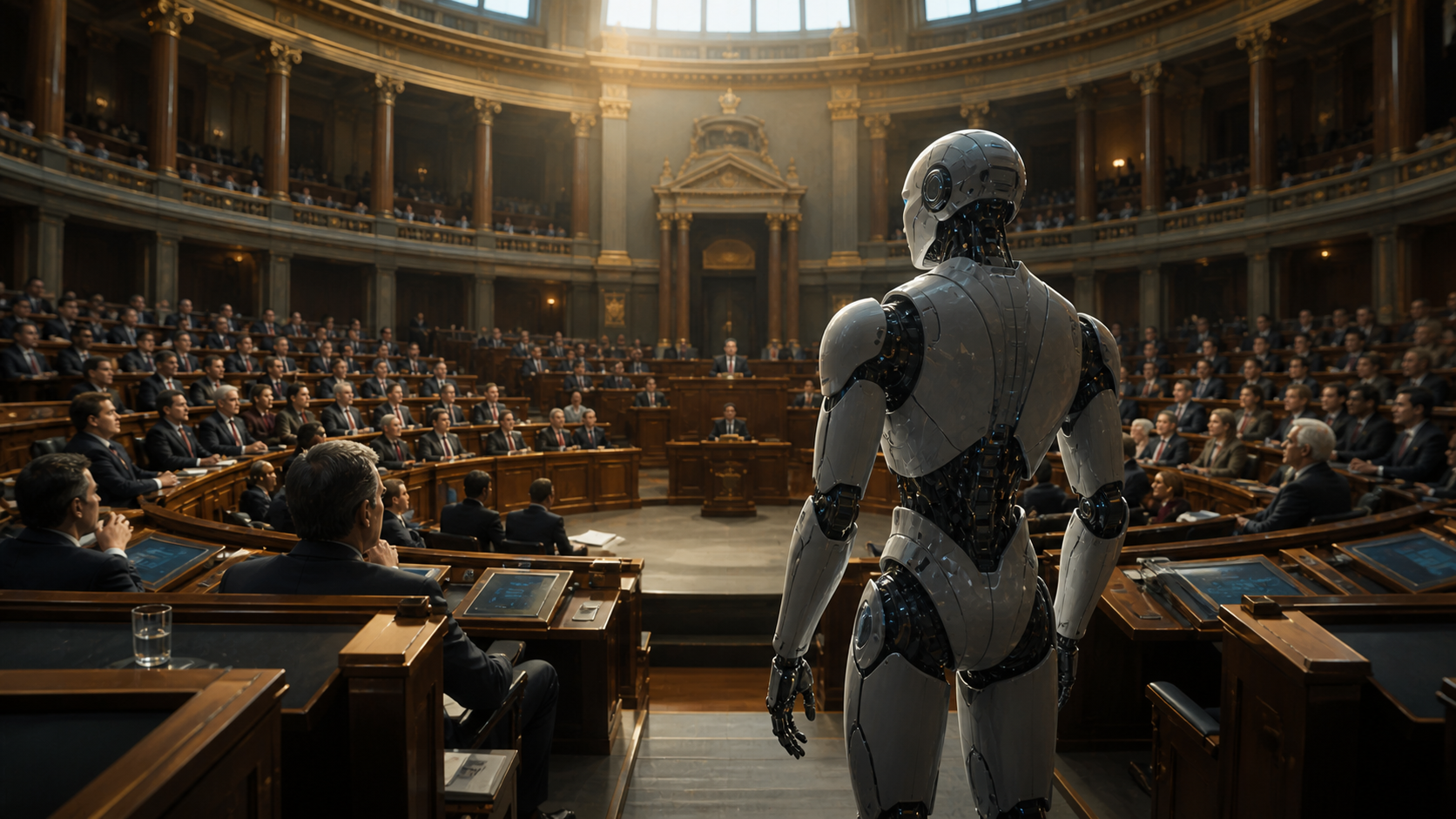
    AI hologram standing in an empty parliament chamber

    As artificial intelligence advances, the idea of automated governance is no longer science fiction.

    From policy prediction to algorithmic decision-making, technology is gradually entering the core of political systems.

    But this raises a fundamental question:

    Can democracy survive when decisions are no longer made by humans?

    1. The Temptation of Automated Politics

    In recent years, a curious sentiment has become increasingly common on social media:
    “Perhaps an AI president would be better.”

    As frustration with corruption, inefficiency, and political dishonesty deepens, many people begin to imagine an alternative—one in which algorithms replace politicians, and data replaces debate. In such a vision, democracy appears faster, cleaner, and more rational. Voting feels slow; a click feels immediate.

    This is the quiet temptation of what might be called automated politics—a form of governance that promises decisions faster than ballots and calculations more precise than deliberation.

    In practice, artificial intelligence is already embedded in the machinery of the state. Governments analyze public opinion through social media data, predict the outcomes of policy proposals, optimize welfare distribution, and even experiment with algorithmic sentencing tools in judicial systems.

    At first glance, the advantages seem undeniable.
    Human bias and emotional judgment appear to fade, replaced by “objective” data-driven decisions. Declining voter participation and distorted public opinion seem less threatening when algorithms promise accuracy and efficiency.

    Yet beneath this efficiency lies a heavier question.

    If politics becomes merely a technology for producing correct outcomes, where does political freedom reside?
    If algorithms calculate every decision in advance, do citizens remain thinking participants—or do they become residents of a pre-decided society?


    Humans and AI debating governance in a modern conference room

    2. Technology and the New Political Order

    Under the banner of data democracy, AI has become an active political actor.

    Algorithms map public sentiment more quickly than opinion polls, forecast electoral behavior, and design policy simulations that claim to minimize risk. Administrative systems increasingly rely on “policy algorithms” to distribute resources, while predictive models guide policing and judicial decisions.

    On the surface, this appears to resolve a long-standing crisis of political trust. Technology presents itself as a neutral solution to flawed human governance.

    But technology is never neutral.

    Algorithms learn from historical data—data shaped by social inequality, exclusion, and bias. A welfare optimization model may quietly exclude marginalized groups in the name of efficiency. Crime prediction systems may reinforce existing prejudices by labeling entire communities as “high risk.”

    In such cases, objectivity becomes a mask.
    Under the language of rational calculation, political power risks transforming into a new form of invisible domination—one that is harder to contest precisely because it claims to be impartial.


    3. Can Rationality Replace Justice?

    The logic of automated governance rests on rational optimization: calculating the best possible outcome among countless variables.

    Yet democracy is not sustained by efficiency alone.

    As Jürgen Habermas argued, democratic legitimacy arises from communicative rationality—from public reasoning, debate, and mutual justification. Democracy depends not only on outcomes, but on the process through which decisions are reached.

    Automated politics bypasses this process.
    Human emotions, ethical dilemmas, historical memory, and moral disagreement are pushed outside the domain of calculation.

    When laws are enforced by algorithms, taxes distributed by models, and policies generated by data systems, citizens risk becoming passive recipients of technical decisions rather than active participants in political life.

    Hannah Arendt famously described politics as the space where humans appear before one another. Politics begins not with calculation, but with plurality—with the unpredictable presence of others.

    No matter how accurate an algorithm may be, the ethical weight of its decisions must still be borne by humans.


    4. The Crisis of Representation and Post-Human Politics

    Automated politics introduces a deeper structural rupture: the erosion of representation.

    Democracy rests on the premise that someone speaks on behalf of others. But when AI systems aggregate the data of millions and generate policies automatically, representatives appear unnecessary.

    Politics shifts from dialogue to administration—governance without conversation.

    Political philosopher Pierre Rosanvallon described this condition as the paradox of transparency: a society in which everything is visible, yet no one truly speaks. All opinions are collected, but none are articulated as meaningful political voices.

    In such a system, dissent becomes statistical noise.
    Ethical resistance, moral imagination, and collective protest lose their place.

    The automation of politics risks reducing moral autonomy to computational output—an experiment not merely in governance, but in redefining humanity’s political existence.


    Conclusion – Politics Without Humans Is Not Democracy

    A young person reflecting on democracy at sunset

    The pace at which AI enters political systems is accelerating.
    But democracy is not measured by speed.

    Its foundation lies in responsibility, empathy, and shared judgment. Political decision-making is not simply information processing—it is an ethical act grounded in understanding human vulnerability.

    AI may help govern a state.
    But can it govern a society worth living in?

    Politics is not merely a technique for managing populations.
    It is an art of understanding people.

    Artificial intelligence is a tool, not a political subject.
    What we must prepare for is not the arrival of AI politics, but the challenge of remaining human political beings in an age of automation.


    A Question for You

    If an AI could make more efficient and accurate decisions than humans,
    would you still want to participate in democracy?

    Related Reading

    The transformation of human judgment under intelligent systems is further explored in
    The Paradox of AI Education,
    which questions whether meaning can survive when decisions and learning are automated.

    The tension between freedom and technological control is also examined in
    If AI Can Predict Human Desire, Is Free Will an Illusion?,
    highlighting how human autonomy may be reshaped in algorithmic systems.

    References

    Arendt, H. (1958). The Human Condition. Chicago, IL: University of Chicago Press.
    → Explores political action as a uniquely human domain, emphasizing responsibility and plurality beyond technical governance.

    Danaher, J. (2019). Automation and Utopia. Cambridge, MA: Harvard University Press.
    → Philosophically examines how automation reshapes human autonomy, meaning, and governance.

    Morozov, E. (2013). To Save Everything, Click Here. New York: PublicAffairs.
    → Critiques technological solutionism and warns against reducing democracy to data efficiency.

    Rosanvallon, P. (2008). Counter-Democracy: Politics in an Age of Distrust. Cambridge: Cambridge University Press.
    → Analyzes representation, surveillance, and the erosion of political voice in modern democracies.

    Floridi, L. (2014). The Fourth Revolution: How the Infosphere Is Reshaping Human Reality. Oxford: Oxford University Press.
    → Discusses the ethical implications of information technologies for political and civic life.