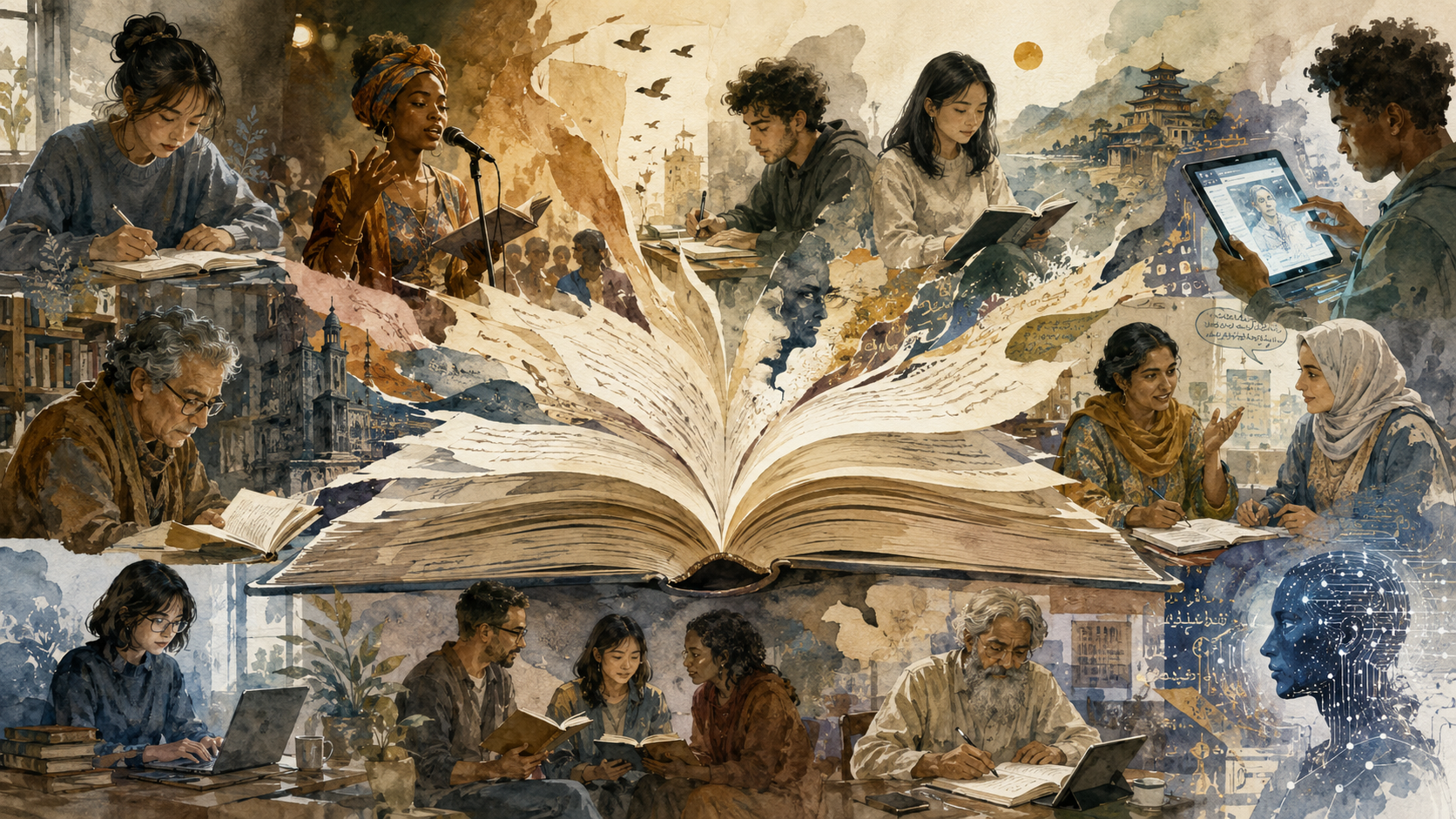
From Hybrid Forms and Fragmented Narratives to New Voices, Social Questions, and Digital Storytelling
Literature has never stood still.
Every generation of writers inherits familiar forms—poetry, the novel, the short story—and then finds new ways to challenge them. Writers change language, break conventions, combine genres, experiment with perspective, and respond to the social questions of their time.
Contemporary literature is especially difficult to define because there is no single dominant style. A poem may resemble an essay or visual artwork. A novel may move backward and forward through time, alternate between several narrators, or blur the boundary between realism and fantasy. Very short fiction can tell a story in only a few paragraphs, while digital platforms are creating entirely new relationships between writers and readers.
At the same time, contemporary literature increasingly crosses national and linguistic borders. Translation allows a Korean novel to become a global literary phenomenon, while writers from communities once marginalized by traditional publishing are reaching international audiences.
So what distinguishes contemporary poetry and fiction?
Perhaps its most important characteristic is not one particular style, but a willingness to ask:
What else can literature become?
1. How Is Contemporary Poetry Breaking Traditional Boundaries?
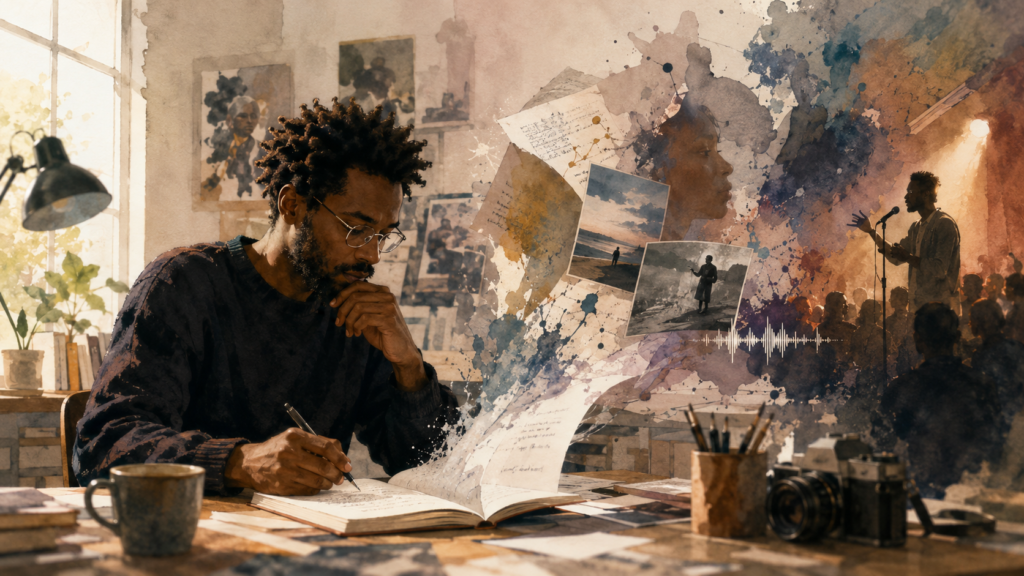
Poetry was never limited to rhyme, but contemporary poets have expanded the possibilities of poetic form particularly dramatically.
Many poets combine techniques associated with prose, memoir, performance, visual art, music, and digital media. The boundaries separating literary genres have consequently become increasingly flexible.
Poetry and Prose
One important example is the prose poem.
Instead of using conventional line breaks, prose poetry may appear on the page like a paragraph. Yet it relies on compression, rhythm, imagery, ambiguity, and other qualities associated with poetry.
Other writers combine poetry with memoir, essay, documentary material, or personal testimony.
These hybrid forms challenge the familiar question:
Is this poetry or prose?
For many contemporary writers, that distinction is less important than what the form allows them to express.
Poetry and Visual Form
Poetry can also interact with visual space.
The arrangement of words on a page may become part of a poem’s meaning. Some poets combine text with photographs, illustrations, typography, or other visual elements.
Digital environments extend these possibilities further. Poetry can now interact with animation, sound, video, and performance.
The poem is no longer necessarily something that exists only as lines printed on a page.
It can become an experience involving several senses at once.
Poetry as a Social and Political Voice
Poetry has long responded to political and social conflict. Contemporary poetry continues that tradition while expanding the range of voices and experiences represented in literary culture.
Poets write about climate change, migration, war, racism, gender, inequality, colonial history, identity, displacement, and technological change.
These poems do not simply explain social problems.
Poetry can make abstract issues personal.
Statistics may tell us how many people have been displaced by war. A poem may ask us to imagine what it feels like to leave a home behind.
Scientific reports can describe environmental destruction. Poetry can transform that knowledge into grief, memory, fear, or responsibility.
This emotional dimension gives literature a different kind of power.
Langston Hughes: An Earlier Voice That Still Resonates
Langston Hughes should not be classified as a contemporary poet in the chronological sense. He was one of the central literary figures of the Harlem Renaissance of the 1920s.
Yet his work provides an important historical foundation for understanding socially engaged poetry today.
In I, Too, Hughes challenged racial exclusion while asserting African American belonging within the idea of America. The poem appeared in his first collection, The Weary Blues, in 1926.
His importance lies not only in what he wrote about but in the larger principle his work represents: poetry can be both artistic expression and a claim to social recognition.
Contemporary poets continue to explore that possibility in new historical circumstances.
2. How Is the Contemporary Novel Changing Its Structure?
The traditional novel often appears to promise something straightforward:
A story begins, events unfold, and eventually the story ends.
Contemporary fiction frequently challenges this expectation.
Nonlinear Narratives
Some novels move repeatedly between past, present, and imagined futures.
Memories interrupt current events. Different timelines intersect. Information may be deliberately withheld until later.
The reader must actively reconstruct the story.
This can resemble assembling a puzzle, but nonlinear storytelling is more than a literary game.
Human memory itself is rarely chronological. Trauma, nostalgia, regret, and anticipation can make past and present coexist psychologically.
A fragmented narrative can therefore sometimes represent human experience more convincingly than a perfectly ordered timeline.
Multiple Perspectives
Contemporary novels also frequently tell stories through several perspectives.
The same event may appear completely different depending on who describes it.
This technique challenges the idea that a story has only one authoritative version.
It also reflects something fundamental about social life: people experience the same world differently because of their identities, histories, relationships, and positions within society.
The reader must therefore become an interpreter rather than a passive recipient of information.
3. Why Are Writers Experimenting With Language and Reality?
Contemporary writers do not experiment only with narrative structure.
They also experiment with language itself.
Some deliberately disrupt grammar, punctuation, syntax, or conventional storytelling. Others mix registers, dialects, languages, documentary materials, messages, lists, or fragments of everyday communication.
The purpose is not necessarily to make literature difficult.
Sometimes conventional language seems inadequate for unconventional experiences.
A fractured experience may require fractured language.
Between Reality and Fantasy
Contemporary fiction also frequently refuses to draw a clear boundary between the realistic and the fantastic.
Dreams, myths, supernatural events, speculative futures, and ordinary life may coexist without clear explanation.
This approach can be especially powerful when writers explore experiences that straightforward realism struggles to represent.
Fantasy can become a way of talking about political violence.
A dystopian future can reveal something about the present.
A strange transformation of the human body can express psychological or social conflict.
In such works, the unreal does not necessarily take us away from reality.
Sometimes it helps us see reality more clearly.
4. How Do Contemporary Writers Create New Ways of Telling Stories?
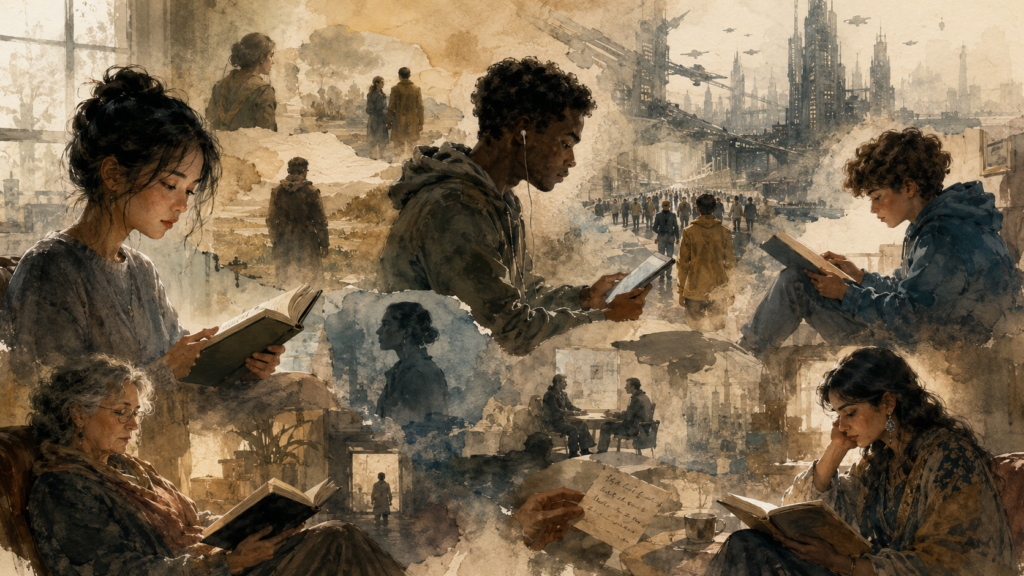
The innovations of contemporary literature become clearer when we look at individual writers.
Some experiment with perspective. Others test how short a story can become. Still others construct imaginary worlds in order to question the societies in which we actually live.
Han Kang, Lydia Davis, and Margaret Atwood offer three very different examples.
Han Kang’s The Vegetarian: When Perspective Becomes Meaning
Han Kang’s The Vegetarian offers an important example of how contemporary literature can combine psychological intensity, social critique, and unusual narrative perspective.
The novel begins when Yeong-hye decides to stop eating meat. What initially appears to be a personal dietary decision gradually becomes a profound conflict involving the body, family expectations, violence, desire, and social conformity.
Yet one of the novel’s most striking features is how the story is told.
Yeong-hye is the central figure, but the novel does not simply give readers direct and continuous access to her perspective. Its three sections approach her through other characters and relationships.
The result creates distance.
Readers observe Yeong-hye, interpret her, and sometimes fail to understand her—much as the people around her do.
The structure therefore becomes part of the novel’s meaning.
The Vegetarian also illustrates the increasingly global circulation of contemporary literature. Written originally in Korean, the novel reached a much wider international readership through Deborah Smith’s English translation and won the 2016 International Booker Prize.
Han Kang’s subsequent receipt of the 2024 Nobel Prize in Literature further demonstrates how literature written within a particular linguistic and cultural context can become part of a global literary conversation.
Lydia Davis: How Short Can a Story Be?
Not every literary experiment involves greater complexity or length.
Sometimes innovation comes through radical compression.
Lydia Davis is widely associated with extremely short fiction, including stories that may occupy only a page—or considerably less.
Such writing asks a fascinating question:
How little does a writer need in order to create a story?
Traditional fiction may establish characters, settings, conflicts, and resolutions over hundreds of pages.
Flash fiction often cannot.
Instead, it depends on implication.
A sentence, observation, misunderstanding, or ordinary moment may suggest an entire relationship or history without explicitly describing it.
The reader must supply what is missing.
This makes brevity not simply a limitation but an artistic technique.
In a culture saturated with short-form digital communication, such forms may seem especially contemporary. Yet their literary value does not come merely from being short.
It comes from how much meaning can be created through what is left unsaid.
Margaret Atwood: Fiction as Social Criticism
Another powerful feature of contemporary and late twentieth-century fiction is its ability to transform social concerns into speculative worlds.
Margaret Atwood’s The Handmaid’s Tale is an influential example.
The novel imagines Gilead, an authoritarian society in which women’s bodies, reproduction, language, and social roles are subjected to extreme political control.
Its world is fictional.
Its questions are not.
Who controls the body?
How can political systems restrict individual freedom?
How does language normalize power?
What happens when rights once considered secure disappear?
This is one reason dystopian fiction remains influential. By exaggerating certain tendencies, it creates enough distance for readers to examine their own societies differently.
Speculative fiction therefore does not necessarily predict the future.
Often, it uses an imagined future to interrogate the present.
5. Is Contemporary Literature Becoming More Global?
One of the most significant developments in today’s literary world is not simply a new writing technique.
It is the expansion of whose stories circulate internationally.
Translation, international publishing, literary prizes, migration, and digital communication have made literature increasingly transnational.
Readers can encounter novels and poetry from cultures they may never physically visit.
This changes both readers and literary institutions.
The traditional idea of a literary “center” becomes harder to maintain when important works can emerge from Seoul, Lagos, Buenos Aires, Tokyo, Beirut, or countless other places and rapidly enter global conversations.
Han Kang’s international reception is one prominent example, but the larger development extends far beyond any single writer.
Translation as Cultural Interpretation
Translation is central to this process.
A translated work does not cross linguistic borders unchanged. Translation itself involves interpretation, rhythm, cultural context, and difficult choices about meaning.
A translator must decide not only what words mean but how voices, emotions, cultural references, humor, ambiguity, and literary rhythms can travel between languages.
The growing visibility of translated literature therefore reminds us that contemporary literature is not simply becoming more international.
It is becoming a conversation between languages and cultures.
This process also gives readers an opportunity to encounter experiences outside their familiar cultural frameworks.
Literature can never provide a complete understanding of another society, but it can open a window through which unfamiliar histories, emotions, conflicts, and ways of seeing the world become more accessible.
In this sense, the globalization of literature is not simply about books traveling farther.
It is also about readers learning to see beyond the boundaries of their own cultural experience.
6. What Happens When Literature Meets Digital Culture?
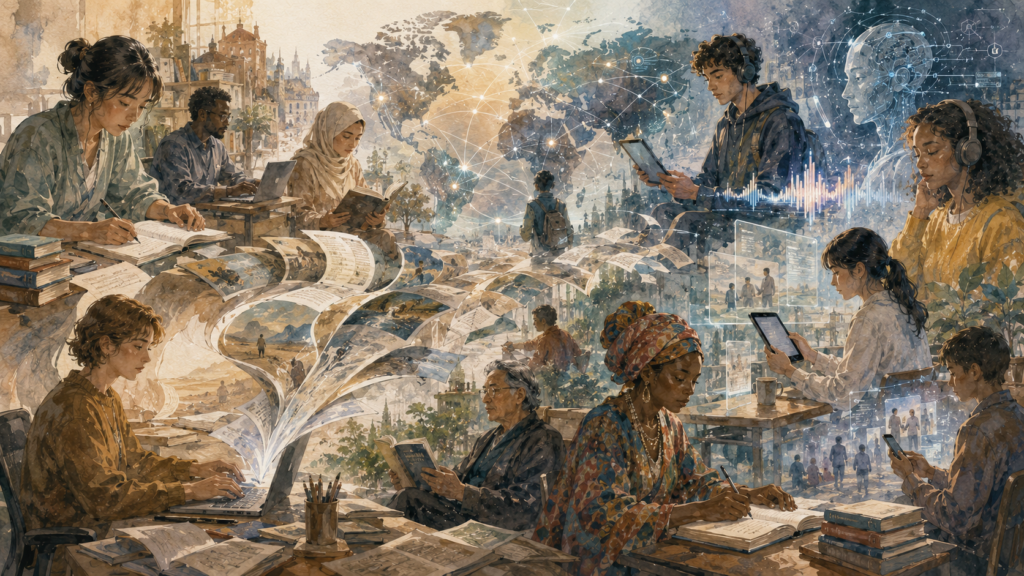
The digital age is changing not only how literature is distributed but also how it is created and experienced.
Writers publish through online magazines, newsletters, social platforms, and independent digital communities. Readers discuss books across national borders almost instantly.
Poetry can become performance video.
Stories can incorporate hyperlinks or interactive elements.
Audiobooks return literature to an oral dimension, while podcasts and spoken-word platforms blur boundaries among writing, voice, performance, and conversation.
These developments do not necessarily mean that printed books are disappearing.
Instead, literature is expanding into different media.
A poem can exist simultaneously as printed text, a live performance, an audio recording, and a digital video. A novel can generate online communities in which readers from different countries exchange interpretations almost immediately after reading it.
The relationship between writer, text, and reader is consequently becoming more fluid.
Literature in the Age of Artificial Intelligence
Artificial intelligence introduces an even newer question:
What does authorship mean when machines can generate language?
For centuries, literature has been closely associated with the idea of a human author—a person whose imagination, memory, experience, and choices give a work its distinctive voice.
Generative AI complicates that assumption.
If a machine can produce poems, stories, dialogue, or stylistic imitations, readers may increasingly ask what makes literary creation meaningful.
Is it the beauty of the language?
The originality of the form?
The intention behind the work?
Or does literature matter partly because another human being has attempted to communicate an experience through words?
These questions do not necessarily make human literature obsolete.
They may instead make questions of voice, experience, intention, originality, and interpretation more important.
Technology changes the tools available to writers.
But literature has always been about more than the tool.
It is about what humans attempt to understand through language.
Conclusion: Literature Changes Because Human Experience Changes
Contemporary poetry and fiction cannot be reduced to a single movement or style.
Their most interesting characteristic may be their openness.
Poetry crosses into prose, visual art, and performance. Novels fragment time and multiply perspectives. Writers experiment with language and blur the boundaries between reality and imagination. Short fiction discovers meaning through compression, while speculative literature turns social anxieties into imagined worlds.
At the same time, contemporary literature is crossing other boundaries. Translation carries stories between languages and cultures, while digital technologies create new spaces for writing, reading, listening, and interpretation.
Yet beneath all these innovations lies something remarkably old.
Human beings continue to use stories and poems to ask who we are, how we should live, how societies should change, and how we can understand lives different from our own.
The forms change because the world changes.
But the need for literature remains.
New literary forms do not replace the human desire for stories; they give that desire new ways to speak.
A Question for Readers
Contemporary literature is crossing boundaries between poetry and prose, reality and imagination, languages and cultures—and now even between human and machine-generated writing.
Which of these changes do you think will have the greatest influence on the future of literature, and what should remain uniquely human about storytelling?
Related Reading
Contemporary literature often blurs the boundary between the real and the imagined, using fantasy, myth, and the supernatural to explore experiences that ordinary realism may struggle to express. This relationship between imagination and our understanding of reality is explored further in Supernatural Phenomena in Pop Culture: Where Reality Meets Imagination, which examines why supernatural ideas continue to fascinate us and how popular culture transforms them into stories through which we interpret the world.
Experiments in contemporary literature also raise a deeper question about what it means to create something original, especially when writers reinterpret familiar forms, styles, and cultural materials. This question is explored from another artistic perspective in Parody in Art: Can Imitation Become Original Art?, which considers whether borrowing and imitation can be transformed through humor, criticism, and reinterpretation into genuinely new creative expression.
References
1. David Damrosch. What Is World Literature? Princeton University Press, 2003.
Damrosch examines how literary works acquire new meanings as they circulate beyond the cultures and languages in which they were originally written. This is particularly relevant to the article’s discussion of translation, global literary circulation, and the growing difficulty of understanding contemporary literature through a single national tradition.
2. Marjorie Perloff. Unoriginal Genius: Poetry by Other Means in the New Century. University of Chicago Press, 2010.
Perloff explores changing ideas of originality and authorship in contemporary poetry, particularly in an age shaped by digital information and the reuse of existing language. The book provides useful context for understanding why contemporary poetry increasingly crosses traditional boundaries of form, medium, and authorship.
3. Brian McHale. Postmodernist Fiction. Routledge, 1987.
Although primarily concerned with postmodern fiction rather than the entire contemporary period, McHale’s influential study helps explain literary techniques that remain important today, including fragmented realities, unconventional narrative structures, and the destabilization of boundaries between fictional worlds and reality.
4. N. Katherine Hayles. Electronic Literature: New Horizons for the Literary. University of Notre Dame Press, 2008.
Hayles examines literature created within digital environments and asks how electronic media change the relationship among text, author, reader, and technology. It provides a strong foundation for the final section of the article on digital storytelling, multimedia literature, and the changing meaning of literary form.
5. Lydia Davis. The Collected Stories of Lydia Davis. Farrar, Straus and Giroux, 2009.
Davis’s collection provides a direct literary example of radical compression and experimentation with the boundaries between story, observation, essay, and fragment. Her work demonstrates the article’s argument that literary innovation does not always require greater length or complexity; sometimes it emerges through what a writer deliberately leaves unsaid.
Leave a Reply