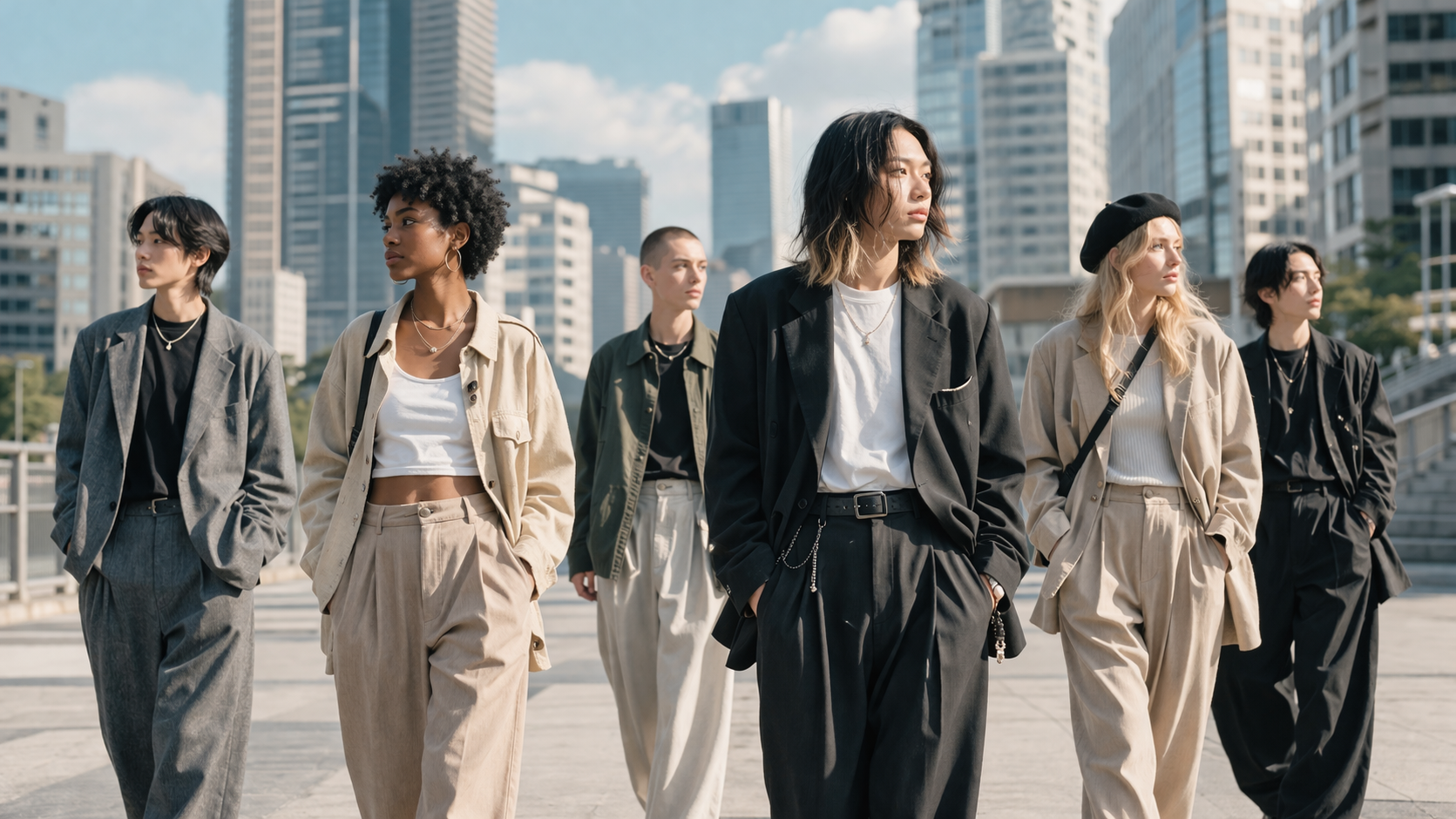
From Corsets to Genderless Style
If a single pair of pants can symbolize liberation,
then clothing is never just about appearance.
Every day, we get dressed.
But what we wear is not simply a matter of style.
Clothing reflects the expectations of our society—
especially the roles assigned to gender.
For centuries, fashion has reinforced ideas of what is “feminine” or “masculine.”
Yet today, those boundaries are beginning to blur.
The rise of gender-neutral fashion invites us to ask a deeper question:
Do clothes express who we are—
or who society expects us to be?
1. Why Did Women Wear Dresses and Men Wear Suits?

Fashion has long been a visual language of gender roles.
The Corset: Clothing That Restrained the Body
In 19th-century Europe, women wore corsets and elaborate dresses
as symbols of elegance and femininity.
But these garments were not merely aesthetic.
They reflected social expectations:
that women should embody grace, restraint, and obedience.
Clothing, in this sense, was a tool of control.
Men’s Clothing: Function, Authority, and Rationality
In contrast, men’s fashion emphasized practicality and power.
Suits, jackets, and ties became symbols of modern industry,
authority, and rationality.
Men’s clothing prioritized movement and function,
while women’s clothing emphasized decoration.
Fashion visually encoded gender roles—
making them appear natural and unquestionable.
2. Women in Pants: Fashion as Resistance
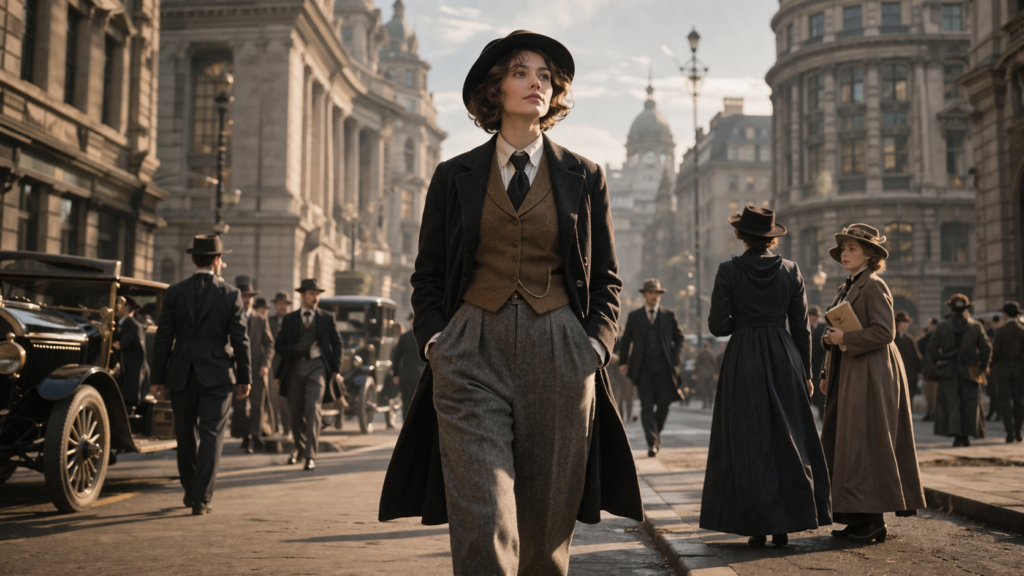
The moment women began wearing pants,
fashion became a site of resistance.
“Pants as Liberation”
In the early 20th century, women who wore trousers
were often mocked or criticized.
However, as women entered the workforce—especially during World War II—
pants became associated with practicality and independence.
Gradually, they came to symbolize freedom.
Coco Chanel and the Redefinition of Femininity
Coco Chanel played a crucial role in this transformation.
She introduced garments that allowed women to move freely—
challenging restrictive silhouettes.
Her designs were not just fashion innovations,
but statements against rigid gender norms.
Changing clothing meant changing how society perceived women.
3. Genderless Fashion: Blurring the Boundaries
Today, fashion is entering a new phase.
Is Genderless Clothing Possible?
The rise of gender-neutral fashion challenges the idea
that clothing must belong to a specific gender.
Instead of defining identity through biological categories,
it emphasizes personal expression.
Cultural Icons and Public Debate
When Harry Styles appeared on the cover of Vogue wearing a dress,
the reaction was immediate and divided.
Some praised his boldness.
Others criticized him for disrupting traditional masculinity.
This reaction reveals something important:
Clothing is still deeply tied to social expectations.
Runway as a Space of Experimentation
Fashion brands like Gucci, Thom Browne, and JW Anderson
have embraced gender-fluid designs.
Men in skirts, women in suits—
these are no longer shocking within the fashion world.
The runway has become a space where norms are questioned
and reimagined.
4. Fashion Reflects Norms—But It Can Also Change Them
Fashion is not neutral.
Learning Gender Through Clothing
From childhood, we are taught what to wear.
“Girls wear skirts.”
“Boys don’t wear pink.”
These repeated messages shape our understanding of identity.
Clothing becomes a way of internalizing social rules.
The Possibility of Change
Yet norms are not fixed.
Women wearing pants was once controversial—
now it is completely ordinary.
In the same way, today’s “unusual” styles
may become tomorrow’s norm.
Genderless fashion is not just a trend.
It is an experiment in freedom—
an invitation to redefine identity beyond traditional categories.

Conclusion
What we consider “fashionable”
is often what society allows us to see as normal.
But fashion has always been more than clothing.
It is a cultural language—
one that can reinforce norms or challenge them.
Perhaps the more important question is not:
“Why are you wearing that?”
But rather:
“How free do you feel in what you wear?”
Fashion is not just a choice.
It can be a quiet form of resistance.
Question for Readers
Do your clothes reflect who you truly are—or what society expects you to be?
Related Reading
The broader discussion of identity, social recognition, and gender diversity is explored further in Gender and Identity: Can Society Move Beyond the Binary?, which examines how changing understandings of gender continue to reshape social norms, self-expression, and belonging. This wider perspective provides an essential framework for understanding why clothing has become a powerful language of identity rather than merely a matter of appearance.
The relationship between clothing and identity extends beyond gender to broader cultural meaning. How Did Blue Jeans Conquer the World? explores how a single garment evolved into a global symbol of individuality, resistance, and social change, illustrating how fashion communicates values as well as personal identity.
Questions about appearance and identity are also shaped by technological influences. AI Beauty Standards and Human Diversity examines how algorithmic ideals affect perceptions of beauty, normality, and inclusion. Together, these discussions show that fashion is not only a form of personal expression but also a reflection of the social standards that define identity in contemporary society.
References
- Steele, V. (2001). The Corset: A Cultural History. Yale University Press.
This book examines how the corset functioned as both a fashion item and a tool of social control, shaping women’s bodies according to cultural ideals. It provides deep insight into how clothing reflects power structures and gender expectations in historical contexts. - Crane, D. (2000). Fashion and Its Social Agendas: Class, Gender, and Identity in Clothing. University of Chicago Press.
Crane analyzes clothing as a social code that communicates class, gender, and identity. The book highlights how fashion visually constructs gender norms and how these norms evolve across time and culture. - Butler, J. (1990). Gender Trouble: Feminism and the Subversion of Identity. Routledge.
Butler’s theory of gender performativity offers a critical framework for understanding how identity is constructed through repeated actions, including clothing. This perspective is essential for interpreting the rise of genderless fashion as a challenge to fixed gender categories.
Leave a Reply