Tag: positive psychology

  • Why Emotions Matter

    Why Emotions Matter

    How Feelings Shape the Way We Think, Decide, and Live

    Emotions are among the most fundamental aspects of being human. From the moment we wake up until we fall asleep, our lives are guided by a constantly changing landscape of feelings—joy, sadness, fear, anger, surprise, gratitude, love, disappointment, and hope.

    For centuries, emotions were often viewed as obstacles to clear thinking. Today, however, psychology and neuroscience tell a different story. Emotions are not simply irrational reactions that interfere with reason. They are essential biological and psychological signals that help us survive, build relationships, make decisions, and understand ourselves.

    Whether pleasant or uncomfortable, every emotion carries valuable information. Learning to recognize and understand our emotions is one of the most important steps toward living a healthier, wiser, and more meaningful life.


    1. What Are Emotions?

    An emotion is our mind and body’s immediate response to an event, situation, or experience. It involves not only thoughts but also physical changes such as increased heart rate, facial expressions, hormonal responses, and behavioral reactions.

    Imagine hearing a loud noise behind you while walking alone at night. Before you consciously analyze the situation, your heart begins beating faster and your muscles become tense. This rapid response is an emotion preparing your body to react.

    Psychologists often distinguish between emotions, feelings, and moods.

    An emotion is an immediate biological and psychological response to a stimulus.

    A feeling is our conscious awareness and interpretation of that emotional response.

    A mood is a more general emotional state that may last for hours or even days without a single obvious cause.

    Although these terms are often used interchangeably in everyday conversation, understanding their differences helps us better understand ourselves.

    Emotions are not random events. They evolved because they improved our ancestors’ chances of survival and social cooperation.


    2. Basic and Complex Emotions

    people expressing basic human emotions

    Researchers have identified several basic emotions that appear across cultures.

    Psychologist Paul Ekman proposed six universal emotions:

    • Happiness
    • Sadness
    • Fear
    • Anger
    • Surprise
    • Disgust

    These emotions appear early in life and are recognized through similar facial expressions across many cultures.

    Each serves an important purpose.

    Fear encourages us to avoid danger.

    Anger motivates us to defend ourselves against injustice or threats.

    Sadness helps us process loss and encourages support from others.

    Joy reinforces behaviors that improve our well-being and strengthen social bonds.

    Surprise prepares us to pay attention to unexpected events.

    Disgust protects us from contamination and harmful substances.

    As people mature, emotions become increasingly complex.

    Feelings such as guilt, pride, jealousy, embarrassment, gratitude, nostalgia, and compassion combine multiple emotional experiences with personal values and social understanding.

    For example, guilt often combines sadness with responsibility, while jealousy may involve fear, sadness, and anger simultaneously.

    These complex emotions play essential roles in maintaining relationships and navigating society.


    3. Why Positive and Negative Emotions Both Matter

    Many people naturally prefer positive emotions.

    Happiness, love, gratitude, curiosity, and hope make life enjoyable and strengthen psychological well-being.

    Research in positive psychology shows that positive emotions broaden our thinking, improve creativity, strengthen resilience, and encourage cooperation with others.

    When people regularly experience gratitude or optimism, they often become more flexible in solving problems and more capable of adapting to life’s challenges.

    Positive emotions also contribute to better physical health by reducing stress and supporting the immune system.

    However, this does not mean negative emotions are harmful or unnecessary.

    Fear warns us about danger.

    Anger signals that something feels unfair or threatens our values.

    Sadness gives us time to recover after disappointment or loss.

    Even anxiety can encourage careful preparation before important events.

    Modern psychology increasingly views emotions as information rather than labels of “good” or “bad.”

    Every emotion asks a different question.

    Fear asks,

    “Am I safe?”

    Anger asks,

    “Has something crossed an important boundary?”

    Sadness asks,

    “What have I lost?”

    Joy asks,

    “What makes life meaningful?”

    Understanding these messages is often more valuable than trying to suppress them.


    4. How Emotions Shape Our Daily Lives

    human emotions influencing everyday life and relationships

    Whether we realize it or not, emotions influence almost every decision we make.

    They affect how we interpret situations, communicate with others, solve problems, and remember important experiences.

    A person who feels confident before an interview is more likely to communicate clearly.

    Someone overwhelmed by anxiety may struggle to think objectively even when fully prepared.

    Emotions also influence memory.

    Events connected with strong emotions—such as graduation, marriage, the birth of a child, or the loss of a loved one—often remain vivid for many years.

    This close relationship between emotion and memory helps explain why emotionally meaningful experiences shape our personal identities.

    Relationships are also deeply influenced by emotions.

    Empathy, trust, compassion, and forgiveness allow people to build meaningful social connections.

    Without emotional understanding, even excellent communication skills become less effective.

    Our emotional lives shape not only how we experience the world but also how we connect with one another.


    5. Emotional Intelligence: Understanding Rather Than Controlling Emotions

    Many people believe emotional maturity means never becoming angry, sad, or afraid.

    In reality, emotional intelligence is something quite different.

    Psychologist Daniel Goleman describes emotional intelligence as the ability to recognize, understand, manage, and appropriately express emotions while also understanding the emotions of others.

    Emotionally intelligent people do not eliminate negative emotions.

    Instead, they learn how to respond wisely.

    Rather than reacting impulsively, they pause, reflect, and choose actions that align with their long-term values.

    Simple habits can strengthen emotional intelligence.

    Taking a few moments to identify what we are feeling, listening carefully to others, practicing gratitude, and reflecting before reacting all help us build healthier emotional habits.

    Emotional intelligence is therefore less about controlling emotions than about learning from them.


    6. Every Emotion Has Something to Teach Us

    One of the greatest misconceptions about emotions is that some should be welcomed while others should be avoided.

    In reality, every emotion serves a purpose.

    Without fear, we might ignore genuine dangers.

    Without sadness, we might never fully appreciate love or meaningful relationships.

    Without anger, injustice might go unchallenged.

    Without joy, life would lose much of its motivation and hope.

    Emotions are not obstacles to wisdom.

    They are guides that help us understand both ourselves and the world around us.

    The challenge is not to eliminate difficult emotions but to respond to them thoughtfully.

    When we become curious about our emotions instead of judging them, they become valuable teachers rather than overwhelming enemies.


    Conclusion: Listening to What Our Emotions Tell Us

    person reflecting on emotions and personal growth

    Emotions are far more than temporary feelings. They influence our decisions, shape our relationships, and help define how we experience the world. Whether joyful or painful, every emotion offers valuable insight into our needs, values, and experiences.

    Learning to understand our emotions does not mean avoiding sadness, fear, or anger. Instead, it means recognizing that every emotion has a purpose and learning how to respond with awareness rather than impulse.

    Perhaps emotional well-being is not about feeling happy all the time. It is about learning to listen to what our emotions are trying to tell us—and allowing that understanding to guide us toward wiser decisions, stronger relationships, and a richer, more meaningful life.

    A Question for Readers

    Think about an emotion you experienced recently—whether it was joy, anger, fear, or sadness.

    Instead of asking whether it was a “good” or “bad” emotion, what might it have been trying to teach you about yourself or your situation?


    Related Reading

    Our emotions influence not only how we feel but also how we remember our experiences and build our identity over time. This connection is explored further in Can AI Remember Like Humans?, which examines how human memory is shaped by emotion, experience, and meaning in ways that differ fundamentally from artificial intelligence.

    At the same time, emotions also affect the way we interpret information and make important decisions. This psychological perspective continues in Confirmation Bias in Investing, which shows how feelings, past experiences, and cognitive biases often shape our judgments more than we realize.

    References

    1. Goleman, Daniel. Emotional Intelligence: Why It Can Matter More Than IQ. Bantam Books, 1995.

    A groundbreaking book that introduced the concept of emotional intelligence (EQ) to a global audience. Goleman explains how recognizing and managing emotions contributes to better decision-making, stronger relationships, and greater success in both personal and professional life.


    2. Ekman, Paul. Emotions Revealed: Recognizing Faces and Feelings to Improve Communication and Emotional Life. 2nd ed., Times Books, 2007.

    Ekman explores the science of universal human emotions and facial expressions. His research demonstrates that basic emotions are shared across cultures and play essential roles in communication and survival.


    3. Fredrickson, Barbara L. Positivity. Crown Publishers, 2009.

    Based on the Broaden-and-Build Theory, Fredrickson explains how positive emotions expand our thinking, strengthen resilience, and improve creativity, relationships, and long-term psychological well-being.


    4. Damasio, Antonio. Descartes’ Error: Emotion, Reason, and the Human Brain. G. P. Putnam’s Sons, 1994.

    Damasio challenges the traditional belief that reason and emotion operate separately. Through neuroscience, he demonstrates that emotions are essential for rational thinking and effective decision-making.


    5. Barrett, Lisa Feldman. How Emotions Are Made: The Secret Life of the Brain. Houghton Mifflin Harcourt, 2017.

    Barrett presents a modern view of emotion, arguing that emotions are actively constructed by the brain rather than simply triggered automatically. The book offers a fresh perspective on how emotions influence perception, memory, and behavior.


  • The Future of Happiness

    The Future of Happiness

    How Will We Define Happiness in the Age of AI and Climate Change?

    For thousands of years, philosophers, religious thinkers, scientists, and ordinary people have asked the same question: What does it mean to live a happy life?

    The answers have never remained the same. Every generation has redefined happiness according to its own social values, economic conditions, technological progress, and cultural beliefs.

    Today, humanity stands at another turning point. Artificial intelligence is transforming work, digital technology is reshaping relationships, and climate change is altering how we think about the future. These forces are raising an important question: Will future generations define happiness differently from us?

    Perhaps happiness will no longer depend primarily on wealth or personal achievement. Instead, it may increasingly involve digital well-being, environmental sustainability, meaningful human relationships, and the ability to adapt to constant change.


    1. Happiness Has Always Evolved

    changing ideas of happiness across different historical periods

    Changing Ideas Across History

    Ideas about happiness have never been fixed.

    Aristotle described happiness (eudaimonia) as living a virtuous and meaningful life rather than pursuing temporary pleasure. Epicurus emphasized peace of mind, friendship, and freedom from unnecessary desire.

    Centuries later, industrial societies increasingly associated happiness with economic success, stable employment, and family security.

    Modern psychology has shifted attention toward subjective well-being, emphasizing emotional health, life satisfaction, resilience, and positive relationships.

    Each period reflects the priorities of its own society.

    Why the Definition Continues to Change

    As societies change, so do people’s expectations.

    Longer life expectancy, globalization, technological innovation, and environmental uncertainty are reshaping what people value most. Happiness is becoming less about accumulating possessions and more about achieving balance, purpose, and sustainability.


    2. Artificial Intelligence and the Automation of Happiness

    AI technology supporting everyday life while preserving human relationships

    Technology as a Source of Well-Being

    Artificial intelligence already helps people organize daily life, monitor health, recommend entertainment, and automate repetitive work.

    Personalized healthcare, intelligent assistants, and smart homes may reduce stress while giving people more time for creativity, learning, and relationships.

    Technology could become a powerful tool for improving quality of life.

    When Convenience Replaces Meaning

    However, greater convenience does not automatically produce greater happiness.

    If algorithms make every decision, people may gradually lose opportunities to develop independence, overcome challenges, and experience personal growth.

    Many psychologists argue that genuine happiness often emerges from effort, purpose, and meaningful achievement—not simply from comfort.


    3. Digital Well-Being in a Virtual Society

    A New Definition of Human Connection

    Virtual reality, augmented reality, and digital communities will likely become increasingly important parts of everyday life.

    People may attend concerts, classrooms, workplaces, and even family gatherings in immersive digital environments.

    These technologies could expand access to experiences previously limited by geography or physical ability.

    The Risk of Digital Isolation

    Yet digital life also creates new challenges.

    Excessive dependence on virtual experiences may weaken face-to-face relationships, increase loneliness, and blur the boundary between authentic and simulated experiences.

    The future of happiness may depend not on rejecting technology but on using it wisely.


    4. Climate Change and the Meaning of Well-Being

    Living Well on a Changing Planet

    Climate change is no longer only an environmental issue—it is increasingly becoming a psychological and social one.

    Extreme weather, ecological uncertainty, and concerns about future generations influence how people think about security and happiness.

    As environmental awareness grows, many people are redefining success in terms of sustainability rather than consumption.

    From Consumption to Sustainability

    Communities around the world are investing in green cities, renewable energy, and nature-based lifestyles.

    Rather than asking, “How much can we own?” future generations may increasingly ask, “How can we live well while protecting the planet?”


    5. Measuring Happiness Beyond Economic Growth

    Lessons from Bhutan

    Bhutan’s concept of Gross National Happiness (GNH) challenged the assumption that economic growth alone defines national success.

    The model considers psychological well-being, environmental conservation, cultural preservation, good governance, and community vitality alongside economic development.

    Many researchers believe future societies may adopt broader measures of human flourishing instead of relying solely on GDP.

    Smart Cities and Human-Centered Innovation

    Cities such as Singapore increasingly integrate digital technology with environmental planning to improve quality of life.

    Smart transportation, efficient energy systems, public green spaces, and digital public services demonstrate how technology can support—not replace—human well-being.


    Conclusion

    people enjoying a sustainable smart city where technology and nature coexist

    The future of happiness will likely become more complex than ever before.

    Artificial intelligence may make life easier, but not necessarily more meaningful. Digital technology may connect people globally while simultaneously increasing loneliness. Climate change may threaten traditional lifestyles while encouraging societies to rediscover sustainability and community.

    Ultimately, happiness will continue evolving because humanity itself continues evolving.

    Perhaps the most important challenge is not asking whether technology will make us happier, but asking what kind of life we believe is worth living in the first place.

    In the future, happiness may be measured less by what we possess and more by how wisely we balance innovation, relationships, purpose, and responsibility toward one another and the planet.

    Reader Question

    As AI becomes increasingly capable of improving convenience and solving everyday problems, do you think future happiness will depend more on technology—or on meaningful human relationships?

    If society eventually measures success by well-being rather than economic growth alone, what do you think should be included in the definition of a truly happy life?

    Related Reading

    If artificial intelligence and digital technologies increasingly influence how we live, work, and connect with others, can they also redefine what it truly means to be happy?

    In Can Experiences in Dreams Become Real Knowledge?, we explore how emerging technologies, virtual experiences, and human perception may reshape our understanding of reality—and perhaps even our definition of happiness.


    If happiness is shaped not only by personal choices but also by society, culture, and the people around us, how much of our emotional well-being truly belongs to us?

    In Are Our Emotions Truly Ours—or Socially Constructed?, we examine how social norms, cultural expectations, and collective experiences influence human emotions and our pursuit of a meaningful life.

    References

    1. Aristotle. (2009). Nicomachean Ethics (Translated by W. D. Ross). Oxford University Press.

    One of the foundational works in Western philosophy, Nicomachean Ethics introduces the concept of eudaimonia, describing happiness as living a life of virtue, purpose, and human flourishing rather than pursuing temporary pleasure. It remains central to modern discussions of well-being.


    2. Seligman, M. E. P. (2011). Flourish: A Visionary New Understanding of Happiness and Well-being. Free Press.

    Martin Seligman expands positive psychology beyond happiness alone, introducing the PERMA model—Positive Emotion, Engagement, Relationships, Meaning, and Accomplishment. The book argues that genuine well-being is multidimensional and extends beyond momentary pleasure.


    3. World Happiness Report. (2024). World Happiness Report 2024. Sustainable Development Solutions Network.

    The annual World Happiness Report examines how income, social support, health, freedom, generosity, and trust influence life satisfaction across countries. It demonstrates that strong relationships and social trust consistently contribute more to happiness than economic wealth alone.


    4. Schwab, K. (2016). The Fourth Industrial Revolution. World Economic Forum.

    Klaus Schwab explores how artificial intelligence, robotics, biotechnology, and digital technologies are transforming work, society, and human life. He argues that technological progress should ultimately serve human well-being rather than becoming an end in itself.


    5. United Nations. (2015). Transforming Our World: The 2030 Agenda for Sustainable Development. United Nations.

    The UN’s Sustainable Development Goals (SDGs) connect human well-being with environmental sustainability, social inclusion, and economic development. The report highlights that future prosperity depends on balancing technological innovation with responsibility toward people and the planet.

  • Can Happiness Ever Be Measured Objectively?

    Can Happiness Ever Be Measured Objectively?

    The Relativity of Happiness in Psychology, Culture, and Modern Society

    Almost everyone wants happiness.

    Governments pursue it through economic growth. Individuals search for it through relationships, success, health, or personal meaning. Entire industries are built around helping people become happier.

    But despite humanity’s obsession with happiness, one difficult question remains:

    Can happiness actually be measured objectively?

    Today, international organizations publish happiness rankings comparing countries around the world. Psychologists analyze subjective well-being through surveys and behavioral studies. Economists attempt to connect happiness with income and social stability.

    Yet happiness often resists measurement.

    Some people living in wealthy societies feel emotionally exhausted and disconnected. Others living in difficult circumstances still report deep satisfaction and meaning in life.

    This suggests that happiness may not simply be a measurable condition.

    It may be something far more relative, cultural, emotional, and deeply human.

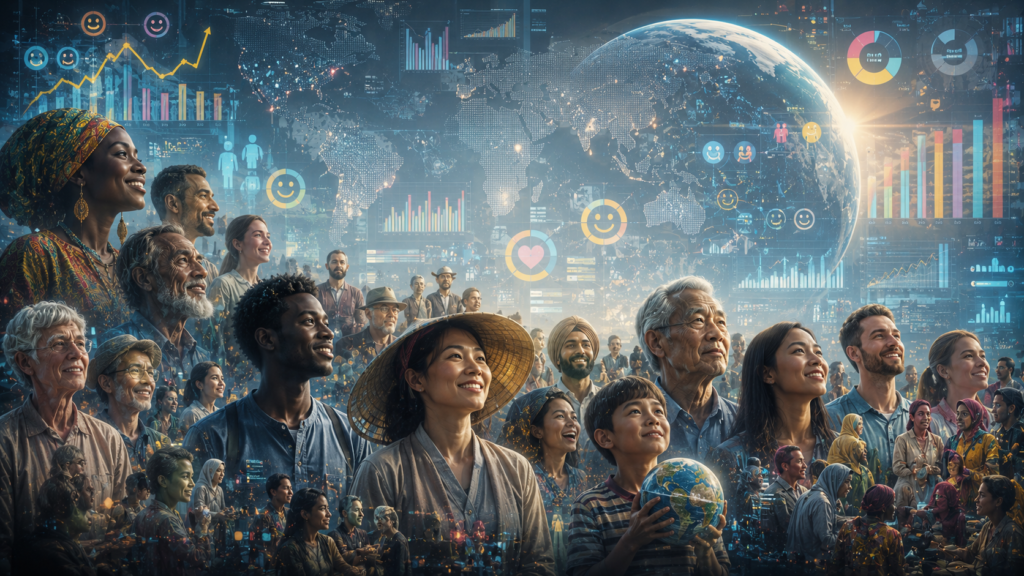
    global happiness measurement and human emotion

    1. Can Happiness Be Objectively Measured?

    The Rise of Happiness Indexes

    One of the most widely known attempts to measure happiness is the United Nations World Happiness Report.

    This report evaluates national well-being using factors such as:

    • income levels
    • social support
    • life expectancy
    • political freedom
    • trust in institutions
    • and perceptions of corruption

    Countries such as Finland, Denmark, and Switzerland frequently rank near the top due to strong welfare systems and social stability.

    These rankings suggest happiness can be analyzed scientifically.

    But the reality may be more complicated.


    The Gap Between Statistics and Experience

    Economic stability certainly affects well-being.

    However, happiness is not determined by material conditions alone.

    Some people living in affluent societies experience:

    • loneliness
    • anxiety
    • burnout
    • and emotional emptiness

    Meanwhile, others living in financially difficult environments may still find happiness through:

    • family relationships
    • spirituality
    • community belonging
    • or personal meaning

    This reveals an important limitation of happiness indexes:

    Objective conditions and subjective experience do not always match.


    2. Culture Changes How Humans Understand Happiness

    Individual Happiness vs Collective Harmony

    Different cultures define happiness differently.

    In many Western societies, happiness is often associated with:

    • personal achievement
    • freedom of choice
    • self-expression
    • and individual fulfillment

    In many East Asian cultures, however, happiness may be more strongly connected to:

    • social harmony
    • family relationships
    • emotional balance
    • and collective stability

    As a result, people from different cultures may answer happiness surveys very differently—even when living under similar conditions.


    Cultural Bias in Measuring Well-Being

    Researchers also note that cultural communication styles affect self-reporting.

    For example, people in countries such as South Korea or Japan may understate their happiness due to cultural norms emphasizing modesty and emotional restraint.

    In contrast, cultures encouraging emotional openness may produce higher self-reported happiness scores.

    This means happiness measurement is never fully culturally neutral.

    Even the language used to ask “Are you happy?” may carry different meanings across societies.


    3. Happiness Changes Across Time

    person reflecting on happiness across time

    Why the Past Often Feels Happier

    Humans frequently remember the past more positively than it actually was.

    Psychologists call this tendency retrospective bias.

    People often soften painful memories while preserving emotionally meaningful moments.

    A difficult childhood may later feel nostalgic because memories of family warmth or emotional connection become more emotionally powerful over time.

    This explains why happiness is not simply experienced—

    It is also reconstructed through memory.


    The Hedonic Treadmill

    Humans also tend to sacrifice the present while pursuing future happiness.

    Students may believe happiness will arrive after entering university. Workers may postpone rest while chasing financial success. Many people assume happiness exists somewhere ahead of them.

    However, psychology suggests people rapidly adapt to improved circumstances.

    This phenomenon is known as the hedonic treadmill.

    After reaching one goal, humans often normalize it and begin pursuing another.

    As a result, happiness can become an endless moving target.


    4. Is Happiness a Number—or a Meaning?

    Beyond Economic Measurement

    Modern societies often attempt to quantify happiness through:

    • productivity
    • income
    • health statistics
    • and social indicators

    These measurements are useful.

    But they cannot fully capture:

    • emotional meaning
    • inner peace
    • love
    • purpose
    • grief
    • or spiritual fulfillment

    Some of the most meaningful human experiences resist numerical evaluation entirely.


    Happiness as a Human Relationship

    Perhaps happiness is not something humans possess individually.

    It may emerge through relationships:

    • with other people
    • with memory
    • with meaning
    • and with the present moment itself

    In this sense, happiness may be less like a measurable object—

    And more like an ongoing human process.


    Conclusion: The Difficulty of Measuring Human Happiness

    people sharing meaningful moments together

    Happiness indexes and psychological studies can reveal important patterns about well-being.

    However, no system can fully measure the complexity of human happiness.

    People interpret happiness differently across:

    • cultures
    • generations
    • emotional histories
    • and personal values

    Humans also distort happiness through memory, expectation, and comparison.

    This means happiness may never become entirely objective.

    And perhaps that is not a weakness.

    Perhaps the impossibility of perfectly measuring happiness reflects something essential about being human.

    Ultimately, the most important question may not be:

    “How happy are we?”

    But rather:

    What kind of life feels meaningful enough
    to be experienced as happiness at all?

    The answer may differ for every individual—

    And that diversity itself may be part of what makes human happiness meaningful.

    Reader Question

    If happiness can be measured through statistics, income, health, and social stability—

    Why do some people still feel emotionally empty despite living in “successful” societies?

    And perhaps more importantly:

    Are we spending too much time trying to measure happiness,
    instead of asking what kind of life truly feels meaningful to us?

    Related Reading

    If emotions are shaped not only by individuals but also by social expectations and digital environments, could happiness itself also be socially constructed rather than purely personal?
    In Are Our Emotions Truly Ours—or Socially Constructed?, we examine how modern societies influence emotional behavior, emotional expression, and collective emotional norms.


    If humans constantly sacrifice the present while chasing future success, are modern societies redefining happiness as endless achievement rather than meaningful existence?
    In Will AI and Automation Trigger the Next Social Revolution?, we explore how productivity, work, technology, and economic systems increasingly shape human identity and life satisfaction.


    References

    1. Ed Diener et al. (2018). Advances in Subjective Well-Being Research.
      This work explores the concept of subjective well-being and analyzes the gap between objective indicators of happiness and personal emotional experience.
    2. Daniel Kahneman & Alan B. Krueger (2006). Developments in the Measurement of Subjective Well-Being.
      This study examines various methods of measuring happiness and explains why traditional economic indicators alone cannot fully capture human well-being.
    3. John F. Helliwell et al. (2023). World Happiness Report 2023.
      This global report analyzes how income, health, trust, freedom, and social relationships contribute to national happiness levels.
    4. Daniel Gilbert (2006). Stumbling on Happiness.
      Gilbert investigates how humans predict future happiness and why people often misjudge what will actually make them happy.
    5. Richard Easterlin (1974). Does Economic Growth Improve the Human Lot?
      This influential work introduced the “Easterlin Paradox,” arguing that increased income does not always produce proportional increases in happiness.