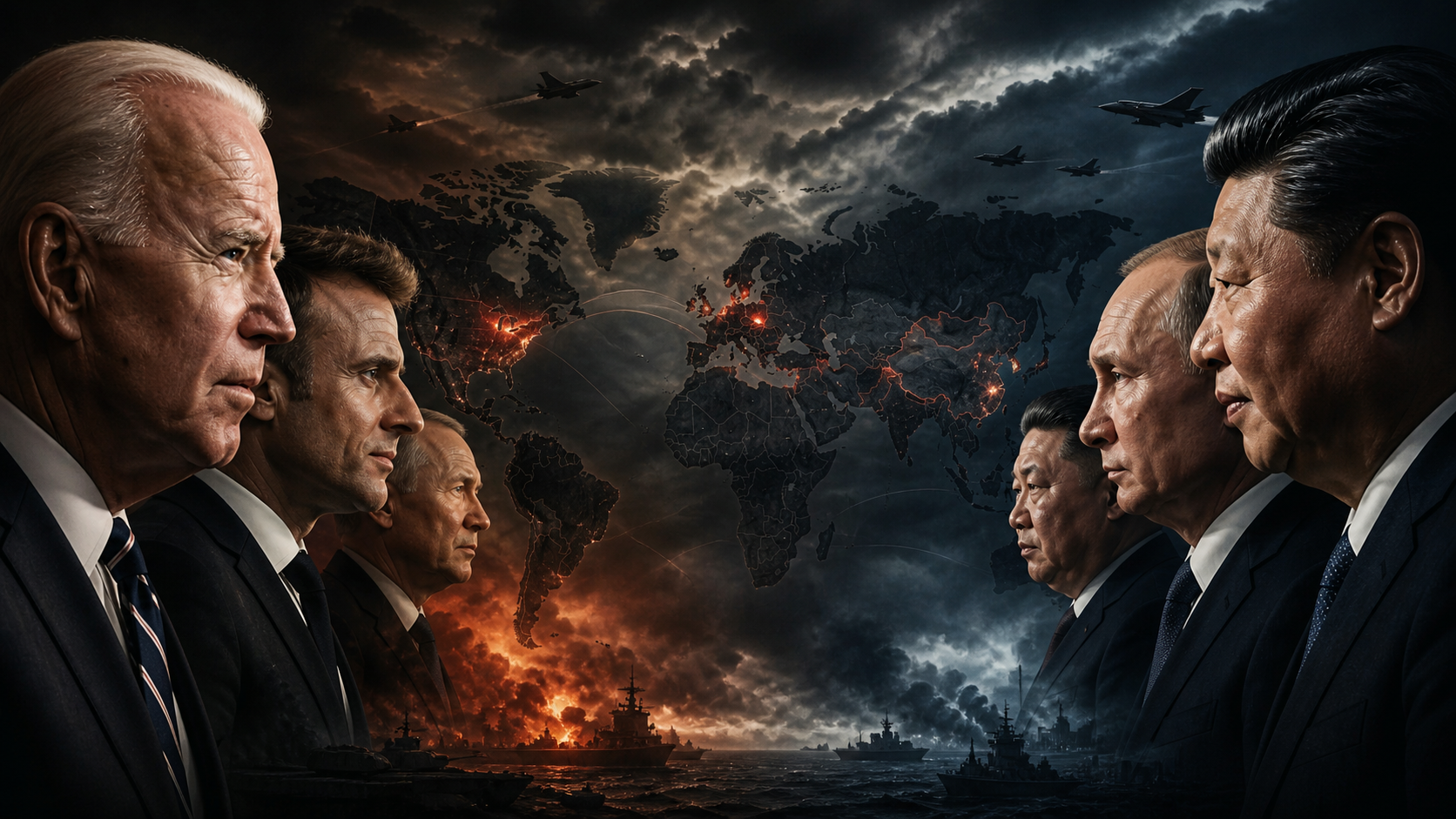
Rational Strategy, Fear, and the Paradox of Violence
Across the world, conflicts continue—
in regions like Ukraine and the Middle East,
war remains a recurring reality.
Lives are lost.
Economies collapse.
And yet, despite the cost,
nations still choose war.
This raises a difficult question:
In an age of reason and progress,
why does violence remain a rational option?
This article focuses mainly on war between states. Civil wars and other forms of organized violence can involve additional dynamics that require separate examination.
Here, “rational” means that decision-makers may see force as a way to pursue their goals under uncertainty. It does not mean that war is morally justified, legally permissible, or beneficial to the people who suffer its consequences. A leader’s calculation can also be based on false information or unrealistic expectations.
1. Is War Irrational—or Strategic?
War is often seen as the result of anger or hatred.
But from the perspective of international politics,
war is frequently a calculated decision.
States consider war for strategic reasons:
- Securing national security
- Accessing resources
- Expanding influence
- Stabilizing domestic politics
In this sense, war is not always a breakdown of reason—
but sometimes an extension of it.
What appears irrational on the surface
may, under certain conditions, be seen as a rational strategy.
But strategic goals alone do not explain why war occurs. If fighting is costly, why can opponents not reach an agreement that avoids those costs?
Political scientist James Fearon identifies two important obstacles. First, governments may possess private information about their capabilities or willingness to fight and have incentives to exaggerate them. Negotiations can fail when neither side can reliably assess the other.
Second, a settlement may lack credible guarantees. Even if both sides prefer an agreement today, one may fear that the other will become stronger and abandon its promises tomorrow.
These problems help explain how costly wars can emerge from strategic interaction. They do not imply that every war is carefully calculated or that negotiation will always succeed.
2. The Role of Fear: The Security Dilemma
International relations are shaped by uncertainty.
One state’s defensive action—
such as military expansion—
can be interpreted by others as a threat.
This creates what is known as the security dilemma.
Even without aggressive intentions,
states may escalate tensions out of fear.
In such situations, mistrust can contribute to escalation even when neither side initially seeks war. However, the security dilemma is not an explanation for every conflict. Some leaders pursue expansion or coercion deliberately, and describing mutual fear should not erase differences in conduct or responsibility.
The practical challenge is to distinguish defensive precautions from preparations for attack. Communication, verification, and credible limits on military activities can sometimes reduce uncertainty, although they cannot guarantee peace.
3. War as a Tool of Domestic Politics
Domestic politics can shape decisions about external conflict. Leaders may hope that confrontation will rally supporters, redirect attention from political failures, or strengthen their position against rivals.
This possibility is often discussed as diversionary conflict. However, domestic trouble does not automatically produce war. Research finds that the relationship depends on political institutions, the type of dispute, and the risks leaders face.
An external crisis may generate support, but military failure, casualties, or rising costs can also weaken a government. Evidence that a leader benefited politically from a conflict is not, by itself, proof that the conflict was initiated for that purpose.
A careful explanation must therefore distinguish the interests of leaders from those of the wider population—and examine evidence of motives rather than assuming them.
4. Philosophical Perspectives on Violence
Thomas Hobbes: Insecurity Without a Common Authority
Hobbes’s account of the state of nature emphasizes insecurity where no common authority can provide reliable protection. His conception of war includes an enduring readiness for conflict, not only actual fighting.
Applied cautiously to relations between states, this perspective helps explain why uncertainty and self-protection matter. It does not establish that people are always violent or that the absence of a world government makes every war inevitable.
Carl von Clausewitz: War as an Instrument of Policy
Clausewitz connects war to political purposes. This means that military action must be understood in relation to the objectives it is supposed to serve.
It does not mean that war is simply another name for diplomacy, or that using force is necessarily wise. Violence, uncertainty, chance, and resistance can disrupt the plans of those who initiate it. A political objective does not guarantee that war will achieve it at an acceptable cost.
Hannah Arendt: Power Is Not the Same as Violence
Arendt distinguishes power, which depends on people acting together, from violence, which relies on instruments of coercion. The ability to compel obedience should not be confused with durable political support.
Her distinction helps us question whether a display of force reflects secure authority or difficulty sustaining it. It is a lens for examining political violence, not a universal explanation of why every war begins.
A Citizenship Perspective: Examining the Case for Force
From a citizenship education perspective, understanding war requires more than identifying national interests. Citizens also need to examine how leaders define threats, present evidence, and justify the use of force.
Useful questions include: What is the stated objective? What evidence supports the threat assessment? Which alternatives have been considered? Who is likely to bear the costs? What would count as success, and how could the conflict end?
These questions should not turn civilians on opposing sides into abstractions. Recognizing their vulnerability can coexist with careful judgments about aggression, defense, and responsibility.
Public scrutiny cannot prevent every war. But it can challenge exaggerated certainty, expose weak arguments, and make decisions about force more accountable.
Conclusion: Choice—or Structure?
War can emerge from strategic ambition, fear, failed bargaining, domestic incentives, and decisions made under uncertainty. No single explanation fits every conflict, and the importance of each factor must be assessed in context.
These pressures constrain choices, but they do not eliminate agency or responsibility. Explaining why leaders considered war attractive is different from concluding that they had no alternative.
Preventing war requires attention to both incentives and institutions: reducing dangerous uncertainty, making agreements more credible, scrutinizing claims about threats, and sustaining channels for negotiation.
The value of understanding war is not to make it appear normal or unavoidable. It is to identify where decisions, institutions, and public accountability might interrupt the path toward violence.
Reader Question
When leaders argue that military action is necessary, what evidence should citizens expect—and which alternatives should be examined before that claim is accepted?
How can we recognize genuine security threats while still questioning whether the proposed use of force will achieve its stated goals?
Related Reading
The difficulty of preventing war raises questions about how independent states can build credible rules and commitments. In Is National Sovereignty Absolute? The Biggest Barrier to a World Government, we examine the possibilities and limits of shared authority—and why international cooperation requires accountability as well as agreement.
Military technology can also change the conditions under which leaders calculate the risks of conflict. In Is the AI Arms Race the Beginning of a New Cold War?, we explore how automation, accelerated decision-making, and competition over military AI may complicate human control and create new pressures for international cooperation.
References
1. Fearon, J. D. (1995). “Rationalist Explanations for War.” International Organization, 49(3), 379–414.
Fearon asks why states engage in costly wars when negotiated agreements might leave both sides better off. His analysis examines private information, incentives to misrepresent capabilities or resolve, and difficulties making credible commitments. It provides the foundation for the article’s distinction between identifying strategic goals and explaining why bargaining fails.
Stanford University — Rationalist Explanations for War
2. Jervis, R. (1978). “Cooperation under the Security Dilemma.” World Politics, 30(2), 167–214.
Jervis examines how measures taken to improve one state’s security can increase the insecurity of others. He also considers conditions that make cooperation more feasible, including whether defensive preparations can be distinguished from offensive ones. The article supports an explanation of escalation through uncertainty without treating conflict as inevitable.
Cambridge University Press — Cooperation under the Security Dilemma
3. Tir, J. (2010). “Territorial Diversion: Diversionary Theory of War and Territorial Conflict.” The Journal of Politics, 72(2), 413–425.
Tir investigates whether politically vulnerable leaders are more likely to initiate territorial confrontations. The study finds support for a specific territorial mechanism while addressing the difficulty of establishing broad claims about diversionary conflict. It helps explain why domestic political incentives must be examined in context rather than assumed to cause war automatically.
The Journal of Politics — Territorial Diversion
4. Hobbes, T. (1651). Leviathan. Chapter XIII.
Hobbes describes insecurity where no common authority can provide reliable protection. His account of war includes a continuing disposition toward conflict, not only actual battle. This provides a philosophical starting point for examining fear and uncertainty, while requiring caution when applied to relations between modern states.
Iowa State University — Leviathan, Chapters XIII–XV
5. Clausewitz, C. von. (1832). On War. Book I, Chapter 1.
Clausewitz connects war with political purposes while also recognizing the roles of violence, uncertainty, and chance. His account supports the article’s discussion of war as a political instrument without implying that military action is necessarily wise, successful, or equivalent to diplomacy.
Clausewitz Studies — On War, Book I, Chapter 1 (1873 English Translation)
6. Arendt, H. (1969). “A Special Supplement: Reflections on Violence.” The New York Review of Books, February 27.
Arendt distinguishes power grounded in collective action from violence exercised through coercive instruments. Her essay provides a basis for questioning whether the ability to compel obedience should be equated with lasting political support. It informs the article’s philosophical discussion without offering a single explanation for all wars.