Tag: debate and issues

  • Automation of Politics: Can Democracy Survive AI Governance?

    Automation of Politics: Can Democracy Survive AI Governance?

    If AI can govern more efficiently than humans, does democracy still need human judgment?

    As artificial intelligence advances, the idea of automated governance is no longer science fiction.

    From policy prediction to algorithmic decision-making, technology is gradually entering the core of political systems.

    But this raises a fundamental question:

    Can democracy survive when decisions are no longer made by humans?
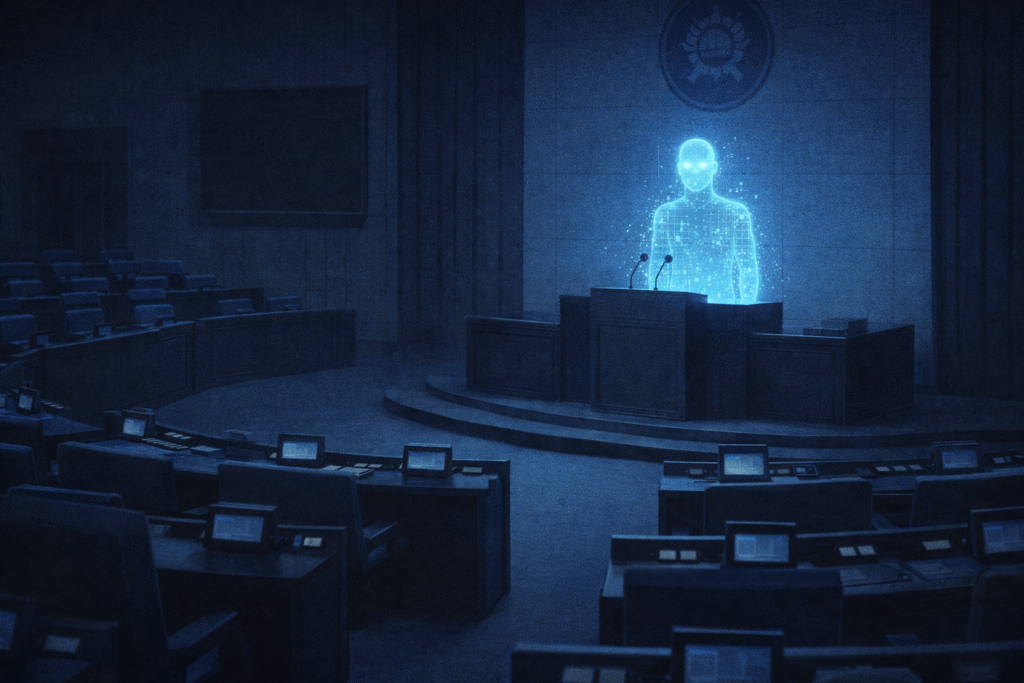
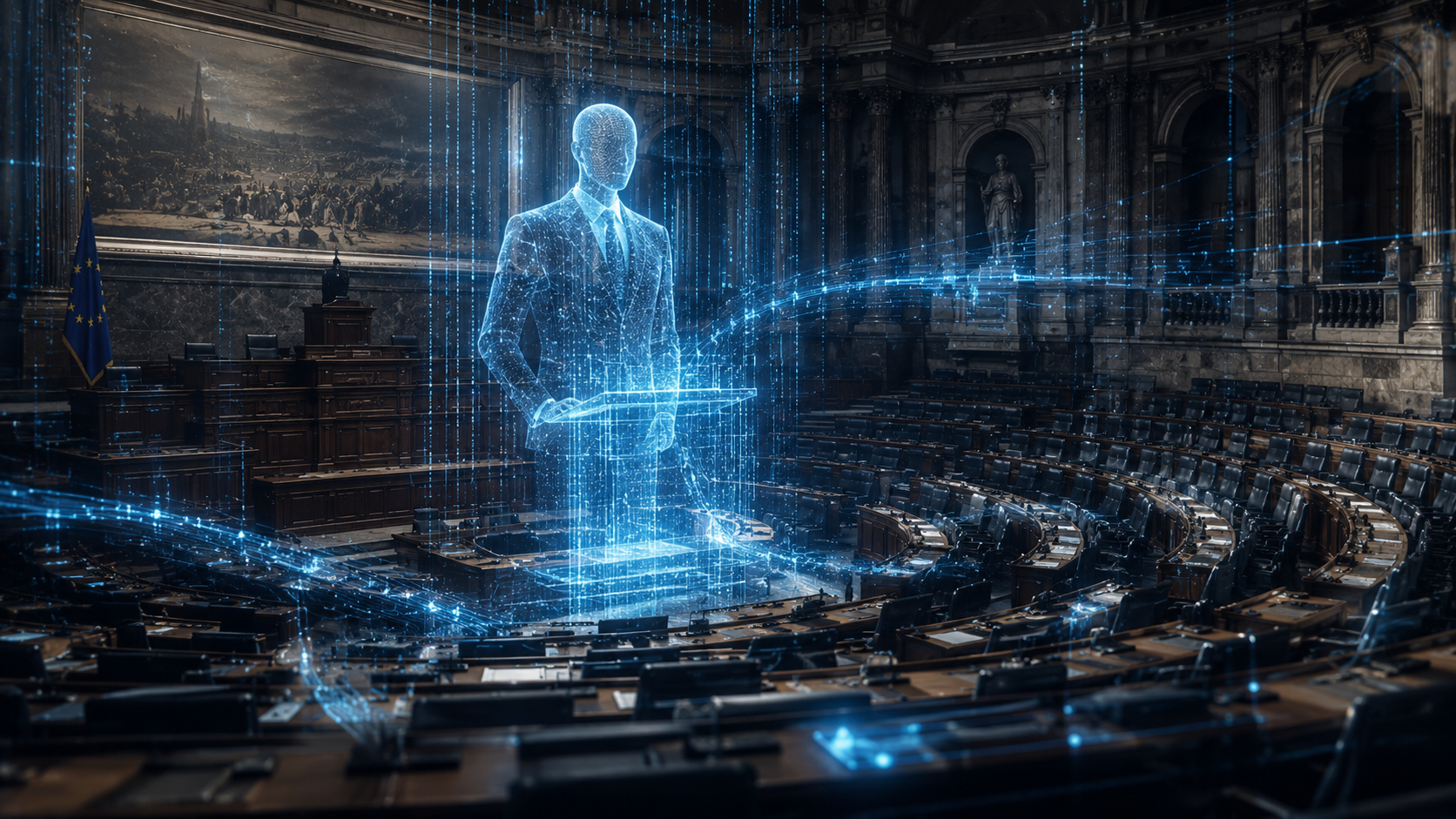
    AI hologram standing in an empty parliament chamber

    1. The Temptation of Automated Politics

    In recent years, a curious sentiment has become increasingly common on social media:
    “Perhaps an AI president would be better.”

    As frustration with corruption, inefficiency, and political dishonesty deepens, many people begin to imagine an alternative—one in which algorithms replace politicians, and data replaces debate. In such a vision, democracy appears faster, cleaner, and more rational. Voting feels slow; a click feels immediate.

    This is the quiet temptation of what might be called automated politics—a form of governance that promises decisions faster than ballots and calculations more precise than deliberation.

    In practice, artificial intelligence is already embedded in the machinery of the state. Governments analyze public opinion through social media data, predict the outcomes of policy proposals, optimize welfare distribution, and even experiment with algorithmic sentencing tools in judicial systems.

    At first glance, the advantages seem undeniable.
    Human bias and emotional judgment appear to fade, replaced by “objective” data-driven decisions. Declining voter participation and distorted public opinion seem less threatening when algorithms promise accuracy and efficiency.

    Yet beneath this efficiency lies a heavier question.

    If politics becomes merely a technology for producing correct outcomes, where does political freedom reside?
    If algorithms calculate every decision in advance, do citizens remain thinking participants—or do they become residents of a pre-decided society?


    Humans and AI debating governance in a modern conference room

    2. Technology and the New Political Order

    Under the banner of data democracy, AI has become an active political actor.

    Algorithms map public sentiment more quickly than opinion polls, forecast electoral behavior, and design policy simulations that claim to minimize risk. Administrative systems increasingly rely on “policy algorithms” to distribute resources, while predictive models guide policing and judicial decisions.

    On the surface, this appears to resolve a long-standing crisis of political trust. Technology presents itself as a neutral solution to flawed human governance.

    But technology is never neutral.

    Algorithms learn from historical data—data shaped by social inequality, exclusion, and bias. A welfare optimization model may quietly exclude marginalized groups in the name of efficiency. Crime prediction systems may reinforce existing prejudices by labeling entire communities as “high risk.”

    In such cases, objectivity becomes a mask.
    Under the language of rational calculation, political power risks transforming into a new form of invisible domination—one that is harder to contest precisely because it claims to be impartial.


    3. Can Rationality Replace Justice?

    The logic of automated governance rests on rational optimization: calculating the best possible outcome among countless variables.

    Yet democracy is not sustained by efficiency alone.

    As Jürgen Habermas argued, democratic legitimacy arises from communicative rationality—from public reasoning, debate, and mutual justification. Democracy depends not only on outcomes, but on the process through which decisions are reached.

    Automated politics bypasses this process.
    Human emotions, ethical dilemmas, historical memory, and moral disagreement are pushed outside the domain of calculation.

    When laws are enforced by algorithms, taxes distributed by models, and policies generated by data systems, citizens risk becoming passive recipients of technical decisions rather than active participants in political life.

    Hannah Arendt famously described politics as the space where humans appear before one another. Politics begins not with calculation, but with plurality—with the unpredictable presence of others.

    No matter how accurate an algorithm may be, the ethical weight of its decisions must still be borne by humans.


    4. The Crisis of Representation and Post-Human Politics

    Automated politics introduces a deeper structural rupture: the erosion of representation.

    Democracy rests on the premise that someone speaks on behalf of others. But when AI systems aggregate the data of millions and generate policies automatically, representatives appear unnecessary.

    Politics shifts from dialogue to administration—governance without conversation.

    Political philosopher Pierre Rosanvallon described this condition as the paradox of transparency: a society in which everything is visible, yet no one truly speaks. All opinions are collected, but none are articulated as meaningful political voices.

    In such a system, dissent becomes statistical noise.
    Ethical resistance, moral imagination, and collective protest lose their place.

    The automation of politics risks reducing moral autonomy to computational output—an experiment not merely in governance, but in redefining humanity’s political existence.


    Conclusion – Politics Without Humans Is Not Democracy

    A young person reflecting on democracy at sunset

    The pace at which AI enters political systems is accelerating.
    But democracy is not measured by speed.

    Its foundation lies in responsibility, empathy, and shared judgment. Political decision-making is not simply information processing—it is an ethical act grounded in understanding human vulnerability.

    AI may help govern a state.
    But can it govern a society worth living in?

    Politics is not merely a technique for managing populations.
    It is an art of understanding people.

    Artificial intelligence is a tool, not a political subject.
    What we must prepare for is not the arrival of AI politics, but the challenge of remaining human political beings in an age of automation.


    A Question for You

    If an AI could make more efficient and accurate decisions than humans,
    would you still want to participate in democracy?

    Related Reading

    The broader debate over political authority in the age of technology is explored further in Is the State a Guardian of Freedom—or a Leviathan of Control?, which examines whether governments should embrace expanding technological power or remain firmly accountable to the protection of individual liberty. This wider perspective provides an essential framework for understanding how artificial intelligence may reshape democratic institutions without undermining democratic principles.

    The future of democracy depends not only on artificial intelligence but also on how citizens participate in digital public life. Clicktivism in Digital Democracy: Participation or Illusion? explores whether online political engagement strengthens democratic participation or merely creates the appearance of civic action. Together, these discussions highlight that the survival of democracy ultimately depends on both technological governance and active human citizenship.

    References

    1. Arendt, H. (1958). The Human Condition. Chicago, IL: University of Chicago Press.
    Explores political action as a uniquely human domain, emphasizing responsibility and plurality beyond technical governance.

    2. Danaher, J. (2019). Automation and Utopia. Cambridge, MA: Harvard University Press.
    Philosophically examines how automation reshapes human autonomy, meaning, and governance.

    3. Morozov, E. (2013). To Save Everything, Click Here. New York: PublicAffairs.
    Critiques technological solutionism and warns against reducing democracy to data efficiency.

    4. Rosanvallon, P. (2008). Counter-Democracy: Politics in an Age of Distrust. Cambridge: Cambridge University Press.
    Analyzes representation, surveillance, and the erosion of political voice in modern democracies.

    5. Floridi, L. (2014). The Fourth Revolution: How the Infosphere Is Reshaping Human Reality. Oxford: Oxford University Press.
    Discusses the ethical implications of information technologies for political and civic life.

  • The Paradox of AI Education

    The Paradox of AI Education

    Can Learning Exist Without a Human Teacher?

    As artificial intelligence rapidly enters the classroom, education is undergoing a quiet transformation.

    Learning is becoming faster, more personalized, and more efficient than ever before.

    But beneath this progress lies a deeper question:

    Can learning still be meaningful if it no longer involves human connection?

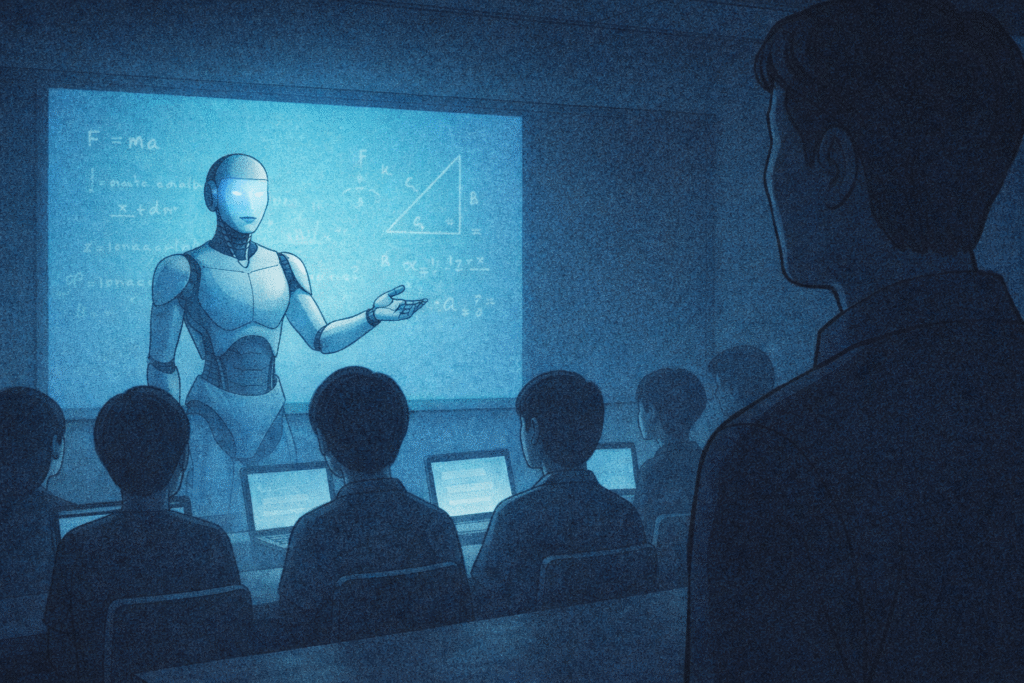
    AI-led classroom with human teacher observing students

    1. A Classroom Without Teachers — What Is Missing?

    Children now sit in front of AI tutors, asking questions and receiving answers faster and more accurately than any textbook ever could.
    Artificial intelligence explains formulas, corrects mistakes instantly, and adapts lessons to each student’s level with remarkable precision.

    The students say they understand.

    Yet something quietly lingers beneath that confidence.
    Beyond the correct answers and optimized learning paths, a deeper question remains — whether learning can truly be complete in a classroom without human teachers, and why we learn at all in the first place.

    If learning were merely the efficient transfer of knowledge, AI might already be the ideal instructor.
    But education has never been only about knowing what is correct. It has always been about understanding why something matters, how it connects to one’s life, and who one becomes through the process of learning.

    In a classroom guided entirely by algorithms, knowledge may be delivered flawlessly, yet meaning does not automatically follow.
    This gap — between information and formation — marks the starting point of the paradox at the heart of AI education.

    2. The Nature of Learning: Knowledge and Teaching as Relationship

    Educational philosopher Paulo Freire famously argued that education is not a one-way transfer of information, but a dialogical process.

    Learning, in this sense, is not the movement of knowledge but the formation of relationships.

    AI can study millions of textbooks,
    but it cannot read anxiety in a student’s eyes,
    nor can it sense why understanding failed in the first place.

    Human learning involves more than knowledge acquisition; it requires the internalization of meaning.
    Knowledge becomes real only when it connects to one’s own life.

    No matter how accurate AI may be,
    if its teaching does not resonate, it remains information — not understanding.


    3. The Advantages of AI Education: Access and Opportunity

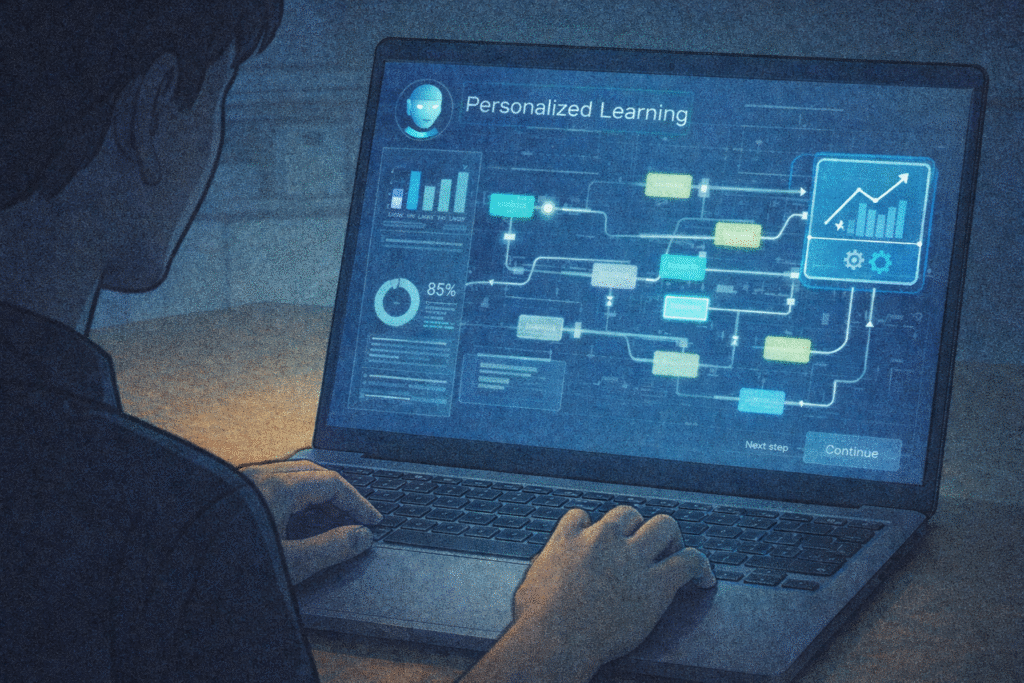
    Student using personalized AI learning system

    Students engaging in personalized AI-based learning — representing adaptive education.

    It would be unfair to deny the benefits of AI in education.

    Personalized Learning

    By analyzing learning data, AI can tailor educational paths to each student’s pace and level of understanding. This overcomes the limitations of one-size-fits-all instruction.

    Reducing Educational Inequality

    AI expands access to high-quality educational content regardless of geography or socioeconomic status. Students in underserved regions or difficult home environments gain new learning opportunities.

    Reducing Teachers’ Administrative Burden

    By automating grading, diagnostics, and basic feedback, AI allows teachers to focus on relational guidance and creative lesson design.

    AI can democratize education —
    but in doing so, it also risks overshadowing the human role of teachers.


    4. The Paradox: More Knowledge, Less Learning

    AI-driven education has dramatically increased the amount of accessible knowledge.
    Paradoxically, students’ capacity for deep thinking, concentration, and empathy is often declining.

    When knowledge becomes too easily available,
    the process of inquiry disappears,
    and learning shifts toward results rather than exploration.

    AI tells us what is correct,
    but it does not invite us to ask why.

    This is the core paradox of AI education:

    Learning increases,
    yet learners become increasingly passive.

    The true purpose of education is not to create humans who know answers,
    but humans who can ask meaningful questions.

    And the ability to question cannot be acquired through data training alone.

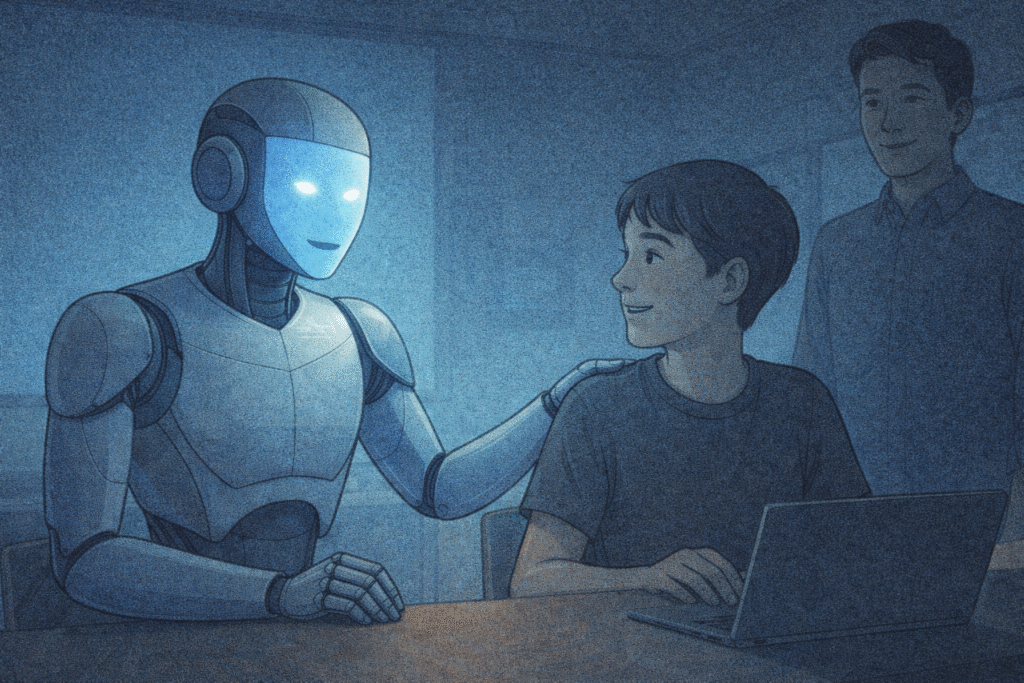
    Human teacher and AI supporting student learning together

    5. Why Teachers Still Matter: Learning Through Relationship

    No matter how advanced AI becomes,
    the role of teachers cannot be reduced to information delivery.

    Teachers help students discover why learning matters.
    They encourage students not to fear failure and explore how knowledge functions within real life.

    A teacher is not simply someone who knows the answer,
    but someone who thinks alongside the learner.

    AI provides answers.
    Teachers provide context.

    Within that context, students grow not as information consumers, but as agents of learning.


    Conclusion: Machine Knowledge and Human Meaning

    An AI teacher and students in dialogue, while a human teacher observes warmly — symbolizing cooperation between human wisdom and technology.

    AI is undeniably transforming education.
    But it cannot replace the meaning of human teachers.

    At its core, education remains a human encounter —
    a space where growth, uncertainty, and emotional transformation occur.

    AI can teach knowledge.
    Only humans can teach why learning matters.

    The classroom of the future should not be a choice between AI and teachers,
    but a model of collaboration.

    Machines handle information.
    Humans cultivate meaning.

    Only then does learning become whole.

    A Question for You

    If AI can teach everything correctly,
    do we still need someone to help us understand why learning matters?

    Related Reading

    The evolving relationship between technology and human understanding is explored in
    How Search Boxes Shape the Way We Thinking,
    which examines how digital systems subtly influence the way we perceive and process knowledge.

    The deeper question of autonomy and decision-making in an AI-driven world is examined in
    If AI Can Predict Human Desire, Is Free Will an Illusion?,
    which challenges whether human agency can remain intact under intelligent systems.

    References

    1. Freire, P. (1970). Pedagogy of the Oppressed. New York: Continuum.
      Freire conceptualizes education as a dialogical and emancipatory process rather than a one-way transmission of knowledge. His work provides a critical foundation for understanding why AI-driven instruction, focused on efficiency and information delivery, may fall short in fostering critical consciousness and human agency.
    2. Biesta, G. (2013). The Beautiful Risk of Education. Boulder, CO: Paradigm Publishers.
      Biesta argues that genuine education involves uncertainty, relational encounters, and the formation of subjectivity. This perspective challenges AI-centered educational models that prioritize predictability, optimization, and measurable outcomes over human development.
    3. Han, Byung-Chul. (2015). The Burnout Society. Stanford, CA: Stanford University Press.
      Han analyzes how contemporary societies driven by performance and optimization exhaust individuals psychologically and emotionally. His critique is highly relevant to AI education, where constant efficiency and self-management risk transforming learners into passive performers rather than reflective thinkers.
    4. Noddings, N. (2005). The Challenge to Care in Schools. New York: Teachers College Press.
      Noddings emphasizes care, empathy, and relational ethics as the core of meaningful education. Her work highlights why human teachers remain irreplaceable in cultivating emotional understanding and moral growth—dimensions that algorithmic systems cannot fully replicate.
    5. Postman, N. (1995). Technopoly: The Surrender of Culture to Technology. New York: Vintage Books.
      Postman warns against societies in which technology becomes an unquestioned authority rather than a tool. His analysis offers a critical lens for examining how AI in education may redefine not only how we learn, but what we believe education is for.