How culture determines whether animals become companions or commodities?

1. Introduction: How Culture Draws the Line Between Animals
The animals we live alongside often fall into two broad categories.
Some share our homes and emotional lives, while others provide food, labor, or materials essential for survival.
At first glance, this difference seems purely functional.
However, culture plays a far greater role than biology alone.
In many societies, people treat the same animal as a beloved companion,
while in others, they raise it as livestock.
As a result, animals do not carry fixed meanings by nature.
Instead, humans assign them value through social norms and cultural choices.
In this sense, the distinction between companion animals and farm animals reveals the cultural meaning of pets and livestock, shaped not by biology, but by social values.
2. Companion Animals: Animals as Family Members
In many contemporary societies, companion animals—especially dogs and cats—are treated as members of the family rather than as property.
2.1 Emotional Bonds
Companion animals offer emotional comfort, reduce loneliness, and contribute to psychological well-being.
Numerous studies show that interaction with pets lowers stress hormones and increases feelings of happiness and security.
2.2 Social Identity
For some people, the type of animal they keep—and even the animal’s personality—becomes a way of expressing their own identity and lifestyle.
In this sense, companion animals function as an extension of the self.
2.3 Legal and Institutional Change
In several countries, animals are no longer legally defined as mere property, but as living beings deserving protection.
This shift reflects changing moral attitudes toward animals and their place in society.
3. Livestock: The Foundation of Survival and Economy
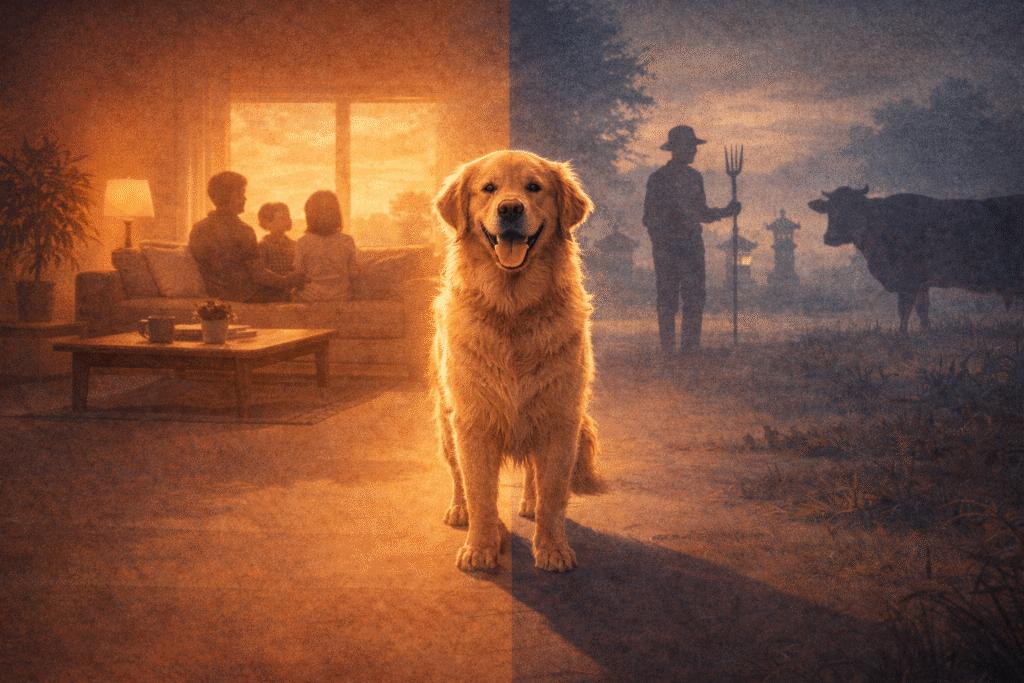
Livestock, by contrast, have played a central role in the development of human civilization.
3.1 Food Production
Animals such as cattle, pigs, and chickens have long served as vital sources of protein, forming the backbone of agricultural societies.
3.2 Labor and Energy
Before industrialization, animals like horses, oxen, and donkeys were essential sources of labor—plowing fields, transporting goods, and powering economies.
3.3 Materials for Daily Life
Wool, leather, milk, and other animal-derived resources have shaped clothing, housing, and everyday necessities.
Livestock have historically been valued for their productivity and economic function. Yet even this meaning is now being questioned and reshaped.
4. Blurred Boundaries: One Animal, Different Cultures
One of the most revealing aspects of human–animal relationships is how dramatically meanings shift across cultures.
4.1 Dogs
In many Western societies, dogs are celebrated as “humanity’s best friend.”
In other regions, they have historically been raised for food.
4.2 Rabbits
In parts of Europe, rabbits exist simultaneously as pets, food animals, and storybook characters—occupying multiple symbolic roles at once.
4.3 Cattle
In India, cows are sacred and protected. Elsewhere, they are central livestock animals raised primarily for meat and dairy.
These examples illustrate a crucial point: animals do not carry fixed meanings. Culture assigns their status.
5. Contemporary Shifts: Rethinking the Boundary
In modern societies, the line between companion animals and livestock is increasingly unstable.
5.1 Animal Welfare Movements
There is growing recognition that livestock are sentient beings capable of suffering.
“Animal welfare farming” reflects an effort to balance production with ethical responsibility.
5.2 New Forms of Companionship
Animals once considered strictly livestock—such as pigs or chickens—are now sometimes kept as companions, especially in urban settings.
5.3 Ethical Consumption
As emotional bonds with companion animals deepen, some people begin questioning the moral implications of consuming other animals.
This has contributed to the rise of vegetarian and vegan lifestyles.
Human–animal relationships are no longer merely practical—they are ethical and philosophical.
6. Conclusion: Animals as Cultural Mirrors

The distinction between companion animals and livestock is not rooted in the animals themselves, but in human culture, values, and historical context.
Some animals become friends.
Some become resources.
Some occupy both roles at once.
As societies evolve, so do these categories.
Today, we are increasingly called to reconsider what it means to live alongside animals—not only as users of their labor or bodies, but as co-inhabitants of a shared world.
When we encounter a dog on the street or a cow on a farm, we are not simply seeing an animal.
We are seeing a reflection of our own culture, ethics, and choices.
References
Serpell, J. (1996). In the Company of Animals: A Study of Human–Animal Relationships. Cambridge: Cambridge University Press.
→ Explores the historical and cultural diversity of human–animal relationships, offering a foundational framework for understanding why animals occupy different social roles.
Digard, J.-P. (1988). L’homme et les animaux domestiques: Anthropologie d’une passion. Paris: Fayard.
→ An anthropological study of domestication, emphasizing that animals hold symbolic and social meanings beyond their economic functions.
Franklin, A. (1999). Animals and Modern Cultures: A Sociology of Human–Animal Relations in Modernity. London: SAGE Publications.
→ Examines how modern societies assign animals different statuses—companions, livestock, or commodities—within changing cultural contexts.
Leave a Reply