From Odysseus to Algorithms, What an Ancient Myth Can Teach Us About Desire, Self-Control, and Freedom
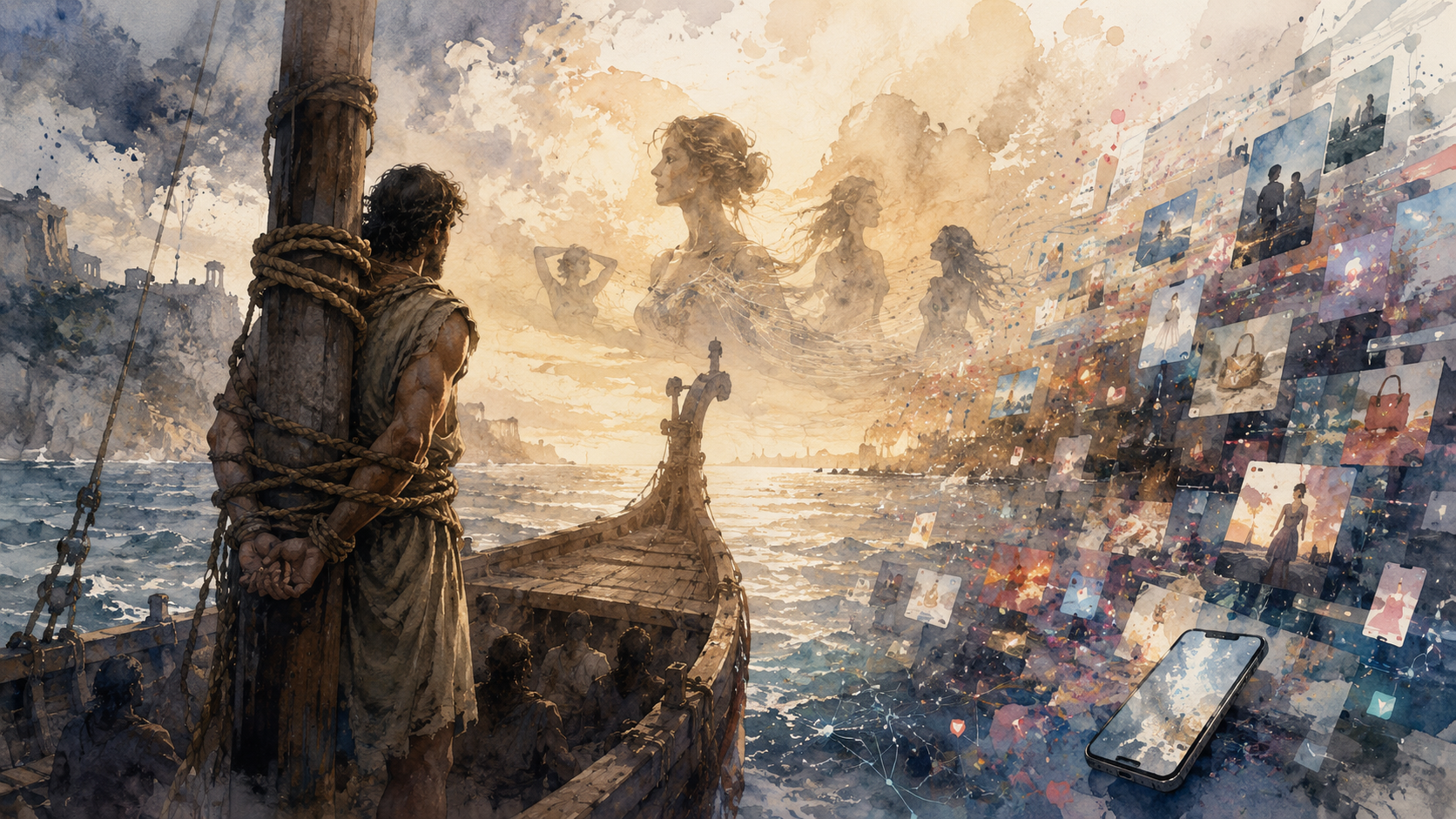
Thousands of years ago, Odysseus faced a problem that feels surprisingly modern.
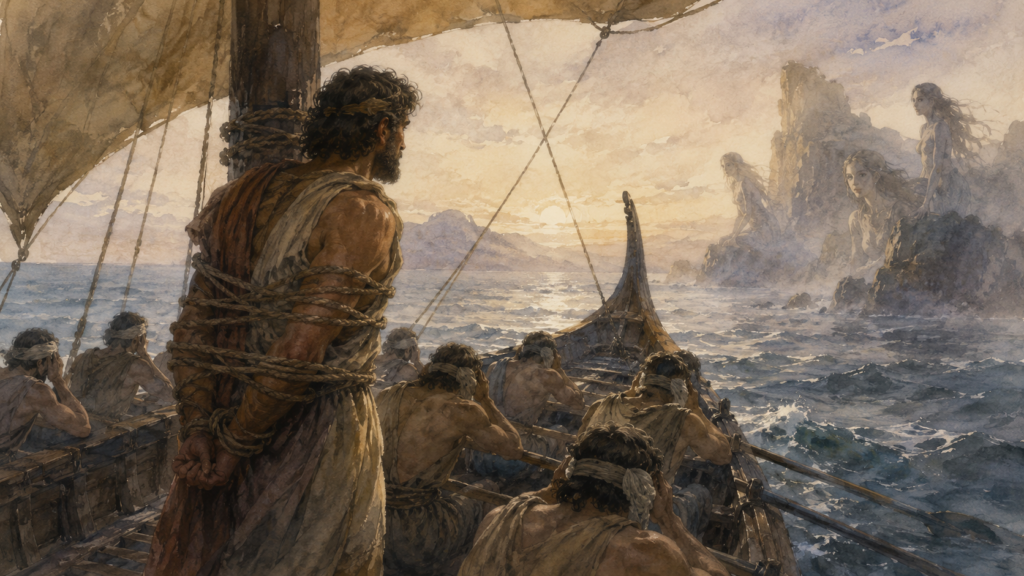
As his ship approached the Sirens in Homer’s Odyssey, he knew their beautiful song could overwhelm anyone who heard it. Sailors drawn toward the sound would lose control and sail toward destruction.
Odysseus wanted to hear the song.
But he also knew that once he heard it, he might no longer be capable of making a rational decision.
So he devised an unusual solution.
His crew blocked their ears with wax, while Odysseus ordered them to tie him tightly to the ship’s mast. No matter how desperately he later begged to be released, they were not to obey him.
The paradox is striking:
Odysseus restricted his own freedom in order to preserve it.
Today, few of us need to worry about mythical creatures singing from distant islands.
Our Sirens are closer.
They are in our pockets.
1. Why Did Odysseus Tie Himself to the Mast?
Odysseus understood something uncomfortable about human nature.
Knowing that something is dangerous does not necessarily make us capable of resisting it.
He did not trust his future self.
Before hearing the Sirens, he could reason clearly. He knew what would happen and created a rule that his future, tempted self would be unable to break.
Modern life is full of similar strategies.
We put our phones in another room when we need to concentrate.
We disable notifications.
We set limits on social media use.
We delete shopping apps to prevent impulsive purchases.
We avoid keeping certain foods at home because we know we will eat them.
In each case, we voluntarily reduce our immediate choices because we believe doing so will protect a more important goal.
We create our own mast.
This raises a fascinating question about freedom.
If freedom means having as many choices as possible, self-restriction appears to reduce freedom.
But if freedom means being able to live according to our deeper intentions rather than our strongest momentary impulses, self-restraint may actually increase freedom.
Odysseus therefore presents us with a paradox that remains unresolved thousands of years later:
Can limiting ourselves sometimes make us more free?
2. Where Are the Modern Sirens?
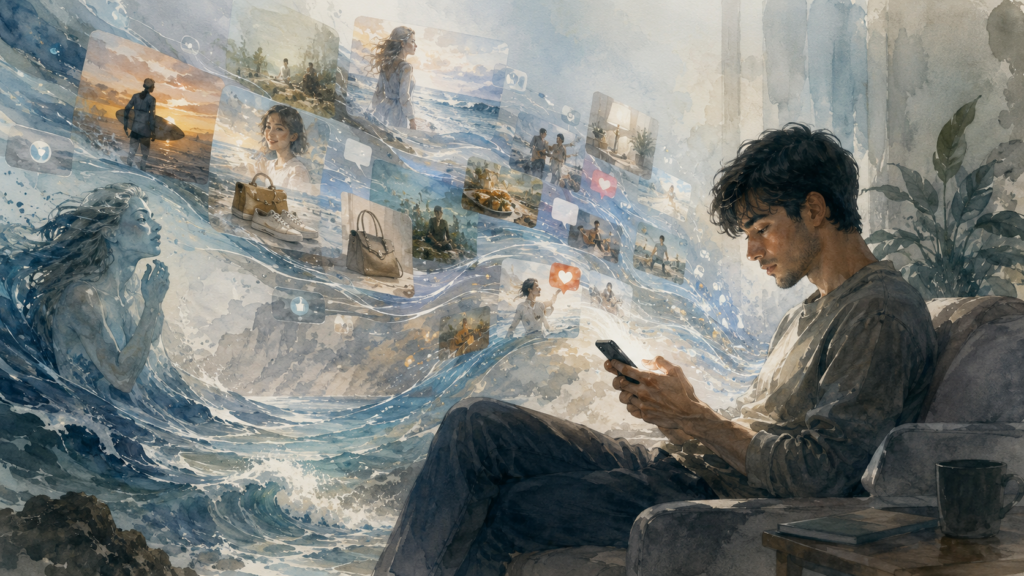
The modern Siren rarely says, “Sail toward destruction.”
Her message is much friendlier.
You might like this video.
People who bought this also bought…
Only a few items left.
Your friend just posted something new.
Don’t miss what everyone is talking about.
Social media feeds, short-form videos, shopping recommendations, games, streaming platforms, and smartphone notifications continually compete for our attention.
Yet there is an important difference between Homer’s Sirens and ours.
The ancient Sirens waited for sailors to pass by.
Digital Sirens come looking for us.
More importantly, they do not sing the same song to everyone.
Digital platforms can learn from what we click, watch, search for, purchase, pause over, and return to. Recommendation systems can then present content increasingly aligned with our previous behavior.
One person sees travel videos.
Another sees political commentary.
Another sees luxury watches, fitness content, cosmetics, food, celebrity news, or investment advice.
The song becomes personalized.
The modern temptation is therefore not merely persistent.
It can become increasingly adapted to the individual being tempted.
3. Are Our Desires Really Our Own?
This brings us to a more difficult question.
Where do our desires come from?
Suppose you suddenly want a new smartphone.
Perhaps you genuinely need one.
But perhaps you have watched reviews, encountered advertisements, seen influencers using the device, and repeatedly viewed photographs of it in your social-media feed.
At what point did information become desire?
The same question applies to travel.
We may believe we independently discovered a beautiful destination, only to realize that we have seen the same location repeatedly on social media.
Fashion, food, music, beauty, lifestyles, and even political opinions can follow similar patterns.
This does not mean that algorithms secretly control everything we want.
Human desire has always been influenced by other people, culture, status, advertising, and imitation.
But digital technology introduces an important change in scale and precision.
We now live in an environment capable of observing aspects of our behavior and continuously adjusting what it places before us.
That complicates the traditional idea of consumer freedom.
Having more choices does not necessarily mean being more autonomous if external systems are increasingly effective at influencing which choices we come to desire.
The central question of freedom therefore shifts.
It is no longer only:
“Am I free to choose?”
It is also:
“How did I come to want what I am choosing?”
4. What Did Adorno and Horkheimer See in the Sirens?
Theodor Adorno and Max Horkheimer gave the episode of Odysseus and the Sirens an influential philosophical interpretation in Dialectic of Enlightenment.
For them, Odysseus represents more than a clever hero escaping danger.
He also symbolizes a form of modern subjectivity built through discipline and self-control.
Odysseus does not eliminate desire.
He listens.
He experiences the beauty of the Sirens’ song, but his body has been prevented from acting upon it.
Survival requires restraint.
Civilization, in this interpretation, develops partly through our ability to control immediate impulses in pursuit of longer-term goals.
We work rather than play.
We save rather than spend.
We study rather than seek immediate entertainment.
We suppress some desires because we believe doing so will make another kind of life possible.
Yet this achievement contains a paradox.
The modern individual becomes autonomous through self-control—but can also become imprisoned by endless self-discipline.
A person who obeys every impulse may not be free.
But neither is someone who must constantly suppress every desire.
The question is not simply whether we possess self-control.
It is what our self-control is serving.
5. Why Does Consumer Society Need Us to Keep Wanting More?
Sociologist Zygmunt Bauman offers another way to understand the modern Siren.
Consumer societies depend not only on satisfying desires but also on continually producing new ones.
Imagine a consumer who buys a phone and remains completely satisfied with it for twenty years.
From the consumer’s perspective, that might be excellent.
From the perspective of an economy dependent on repeated consumption, it is less useful.
Products change.
Styles change.
Trends change.
A newer version appears.
The previous object may still function perfectly well, yet somehow it begins to feel old.
Digital culture accelerates this process.
There is always another video.
Another recommendation.
Another product.
Another trend.
Another piece of news.
The next object of attention is waiting before satisfaction with the previous one has even disappeared.
The modern Siren therefore makes an unusual promise:
“One more, and you will be satisfied.”
But the song works only if complete satisfaction never arrives.
6. Does Technology Discover Our Desires—or Help Create Them?
This is where the ancient metaphor becomes particularly relevant to the digital economy.
Shoshana Zuboff’s analysis of surveillance capitalism draws attention to the economic value of behavioral data and to systems designed not only to predict behavior but potentially to influence it.
Digital platforms do not need to control us completely for this to matter.
Even small influences can become economically powerful when applied across millions or billions of decisions.
What will we watch next?
Which product will we click?
How long will we remain on a platform?
Which notification will bring us back?
This creates a feedback loop.
We reveal our preferences through our behavior.
Platforms learn from those preferences.
They show us content based on what they have learned.
Our responses provide more data.
The system then learns again.
The boundary between discovering desire and shaping desire becomes increasingly difficult to see.
And this makes the Siren metaphor even more powerful.
The danger is not simply that someone is trying to persuade us.
Advertising has done that for centuries.
The deeper issue is that persuasion can now be continuous, personalized, measurable, and responsive to our behavior.
7. Is Doing Whatever We Want Really Freedom?

We often define freedom as the ability to do what we want.
But that definition assumes that our desires are sufficiently our own.
What if some of those desires are amplified by systems designed to capture attention and encourage consumption?
Then another conception of freedom becomes possible.
Perhaps freedom also involves the ability to encounter a desire and say:
“No.”
Not because desire itself is wrong.
Not because pleasure should be rejected.
But because a free person may need the capacity to distinguish between an impulse and a decision.
This is what makes Odysseus so interesting.
He does not destroy the Sirens.
He does not demand silence.
He does not pretend that he is immune to temptation.
He recognizes his own vulnerability and designs an environment in which a temporary impulse cannot overturn a deeper intention.
Today, that might mean disabling notifications.
Leaving a phone outside the bedroom.
Setting spending limits.
Removing an addictive app.
Taking a day away from social media.
These actions may look like restrictions.
But they can also be understood as attempts to reclaim attention and agency.
Conclusion: What Is Our Modern Mast?
We live in an age of extraordinary choice.
We can choose what to watch, buy, read, eat, listen to, follow, and believe from possibilities that would have been unimaginable to earlier generations.
Yet more choice does not automatically produce more freedom.
The systems competing for our attention have also become extraordinarily sophisticated.
This means that freedom in a digital consumer society may require more than the freedom to choose.
It may also require the freedom not to choose.
Not to click.
Not to buy.
Not to continue scrolling.
Not to follow the recommendation.
Not to respond immediately simply because something has demanded our attention.
Odysseus understood that being human meant being vulnerable to temptation.
His solution was not to become immune to desire.
It was to recognize that some decisions are easier to make before temptation arrives.
Perhaps that is why an ancient story about a sailor tied to a mast still feels strangely familiar in the age of smartphones and algorithms.
Our Sirens have changed.
Our masts have changed.
But the fundamental problem remains.
True freedom may not mean escaping every temptation. It may mean retaining the power to decide where we are going even while the Sirens are singing.
Reader Question
Digital platforms give us more choices than ever before, but they also become increasingly sophisticated at predicting what will capture our attention and stimulate our desires.
If our desires can be shaped by algorithms, advertising, and consumer culture, is freedom the ability to choose whatever we want—or the ability to decide which desires are worth following?
Related Reading
If digital tools make everyday life easier while also becoming increasingly difficult to live without, at what point does convenience begin to reduce our autonomy?
In Travel and Digital Dependence: The Dilemma Between Convenience and Autonomy, we explore how smartphones and digital services can expand our possibilities while also raising questions about dependence, attention, and how much control we retain over our own choices.
Algorithms, however, do more than compete for our attention. What happens when the systems filtering information and recommendations also influence what we see, consider, and ultimately decide?
In Algorithmic Bias, we examine how algorithmic systems can reproduce hidden assumptions and shape outcomes, raising a broader question about how much influence we should allow automated systems to have over human judgment.
References
1. Homer. (2018). The Odyssey. Translated by Emily Wilson. W. W. Norton & Company.
Homer’s Odyssey provides the original story of Odysseus and the Sirens that serves as the central metaphor of this article. Odysseus’s decision to bind himself to the mast offers a powerful way to think about temptation, self-restraint, and the paradox of limiting immediate freedom in order to preserve deeper autonomy.
2. Horkheimer, M., & Adorno, T. W. (2002). Dialectic of Enlightenment: Philosophical Fragments. Stanford University Press.
Horkheimer and Adorno interpret the encounter between Odysseus and the Sirens as a symbolic episode in the development of modern rationality and self-discipline. Their analysis raises the deeper question of whether freedom achieved through constant control of desire can itself become another form of constraint.
3. Bauman, Z. (2007). Consuming Life. Polity.
Bauman examines a consumer society in which satisfaction is continually replaced by new desires. His analysis helps explain why modern consumption depends not simply on fulfilling what people want, but on repeatedly generating new wants, making the Sirens an especially useful metaphor for contemporary consumer culture.
4. Zuboff, S. (2019). The Age of Surveillance Capitalism: The Fight for a Human Future at the New Frontier of Power. PublicAffairs.
Zuboff analyzes how digital platforms collect behavioral data and use it to predict and influence human behavior. Her work provides an important framework for understanding how personalized digital environments complicate the distinction between discovering what people want and actively shaping what they come to desire.
5. Eyal, N. (2014). Hooked: How to Build Habit-Forming Products. Portfolio.
Eyal describes the “Hook Model,” a framework for understanding how triggers, actions, rewards, and investment can encourage repeated engagement with digital products. The book is useful for examining why notifications, feeds, and other digital features can become difficult to resist in everyday life.
Leave a Reply