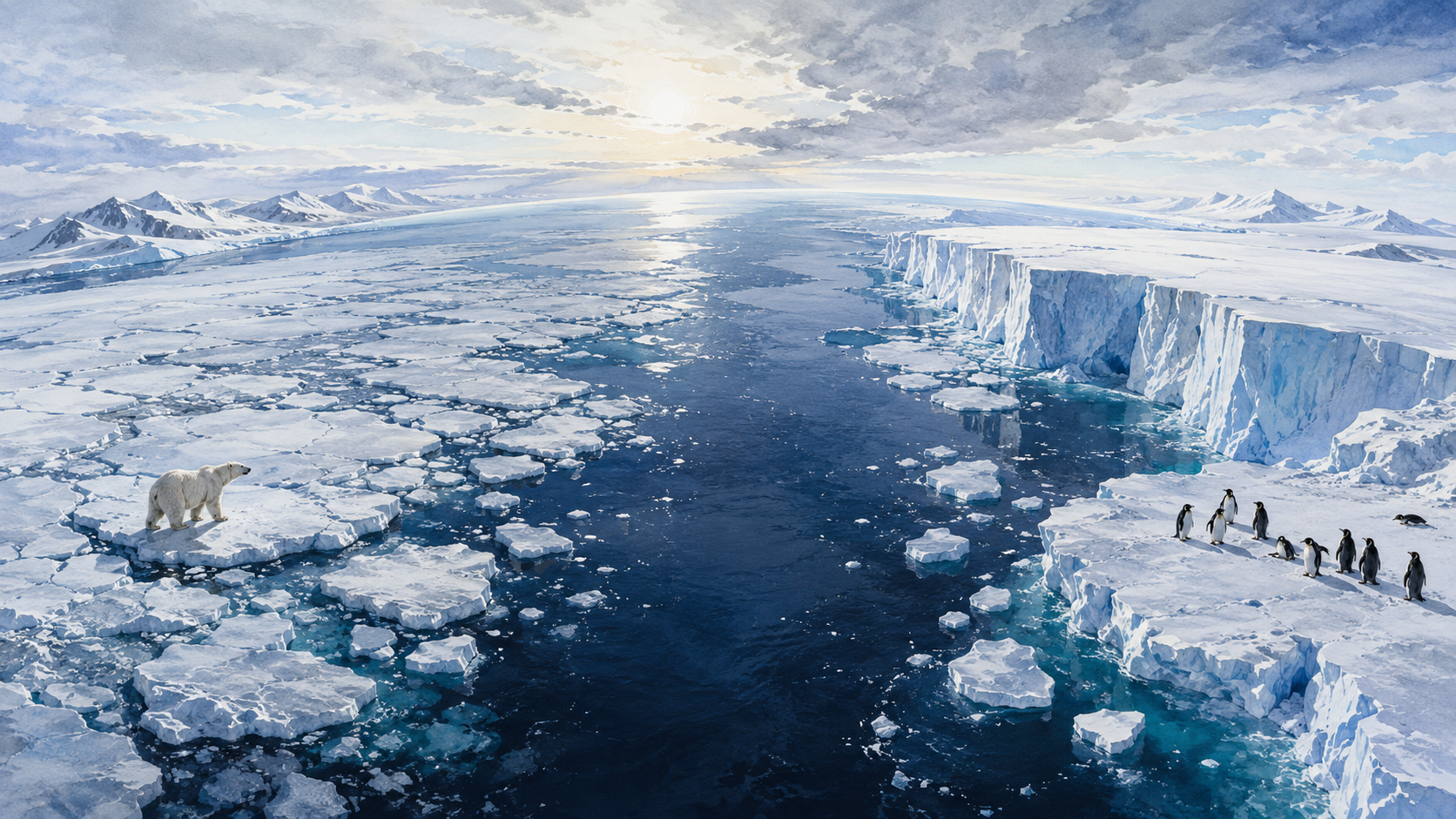
How Melting Ice at Earth’s Poles Can Affect Sea Levels, Climate, and Ecosystems Worldwide
The Arctic and Antarctica may seem remote from everyday life. Yet these frozen regions are deeply connected to the climate system that supports life across the planet.
They reflect sunlight, influence ocean and atmospheric circulation, store enormous quantities of freshwater, and provide habitats for highly specialized ecosystems. What happens at the poles, therefore, does not necessarily stay at the poles.
Today, both regions are undergoing significant changes as the planet warms. But the Arctic and Antarctica are not identical. The Arctic is largely an ocean surrounded by continents, while Antarctica is a continent covered by a vast ice sheet and surrounded by ocean.
Understanding this difference is essential to understanding why polar ice loss matters—and why its consequences can reach far beyond the frozen ends of the Earth.
1. What Is Happening to Arctic Ice?
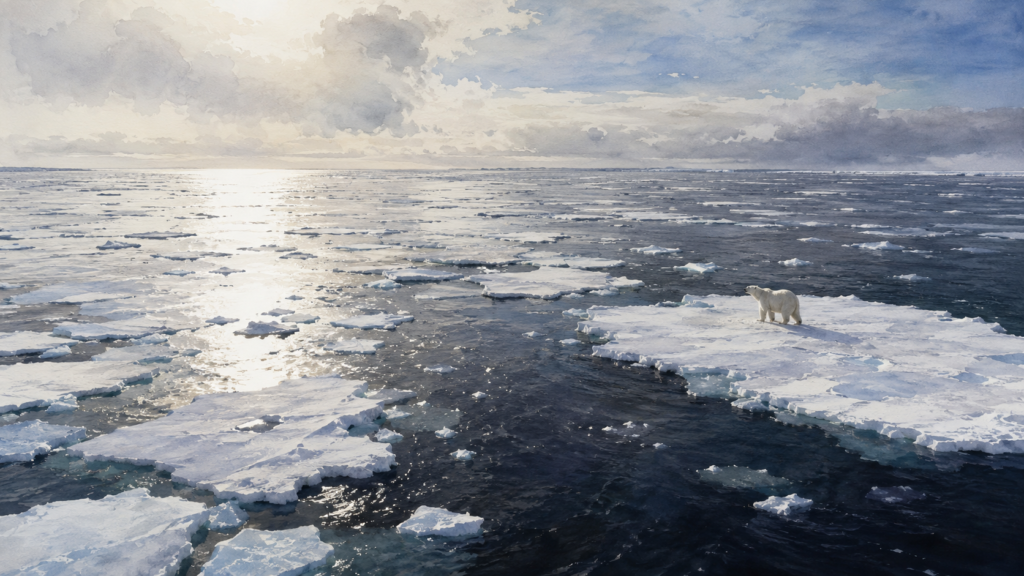
Arctic Sea Ice Is Shrinking
Much of the Arctic Ocean is covered by sea ice, which expands during winter and retreats during summer.
Satellite observations since 1979 have revealed a clear long-term decline, especially during the late-summer minimum. NASA currently estimates that September Arctic sea-ice extent has been decreasing by about 12.2 percent per decade relative to the 1981–2010 average.
The decline is not simply about the area covered by ice. Older, thicker multiyear ice has also become less common, leaving more of the Arctic covered by younger and thinner ice that is more vulnerable to summer melting.
The Arctic is therefore becoming a different physical environment from the one observed only a few decades ago.
Why Is the Arctic Warming So Quickly?
The Arctic is warming substantially faster than the planet as a whole, a phenomenon known as Arctic amplification.
One important mechanism behind this process is the ice-albedo feedback. Bright snow and ice reflect much of the Sun’s energy back into space. When sea ice disappears, darker ocean water is exposed. The ocean absorbs more solar energy, warms further, and can contribute to additional melting.
Recent assessments indicate that, after accounting for natural variability, Arctic temperatures have been rising roughly three times faster than the global average since 1980, although estimates vary depending on the period and method used.
Why Does Arctic Ice Loss Matter?
One important distinction is often misunderstood: melting floating sea ice does not significantly raise global sea level, just as melting ice already floating in a glass does not substantially raise the water level.
However, Arctic warming still has major global consequences.
Loss of reflective sea ice allows the ocean to absorb more heat, reinforcing regional warming. Changes in sea ice also transform habitats used by polar bears, seals, walruses, seabirds, and other species.
Meanwhile, the Arctic also includes large amounts of land ice, most importantly the Greenland Ice Sheet. Unlike floating sea ice, melting land ice adds new water to the ocean and therefore contributes directly to global sea-level rise.
2. What Is Happening in Antarctica?
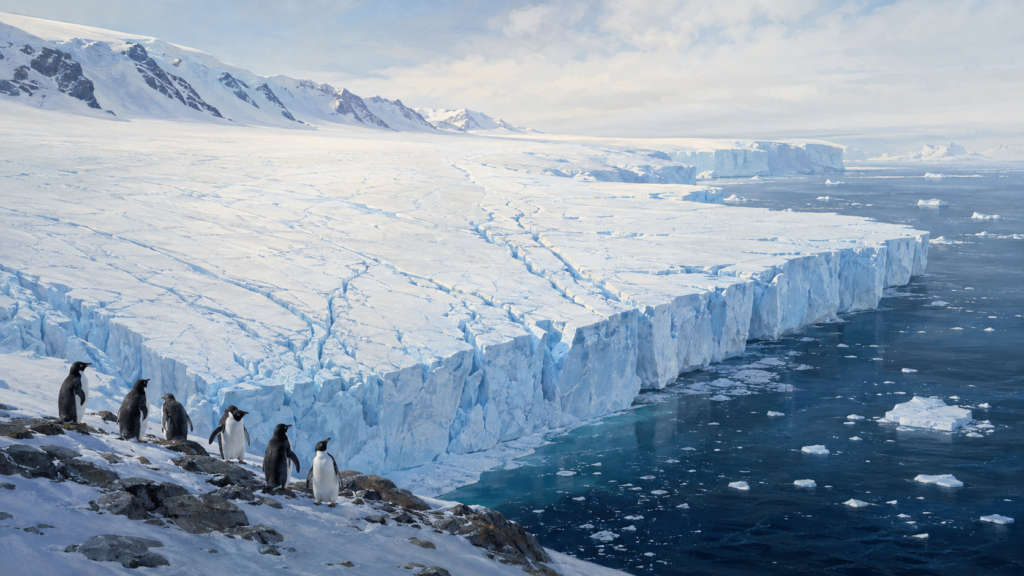
Antarctica Is Fundamentally Different from the Arctic
Antarctica is not primarily an ice-covered ocean. It is a continent covered by an enormous land-based ice sheet.
This distinction makes Antarctic ice loss especially important for future sea levels.
The Antarctic Ice Sheet contains enough frozen water to raise global mean sea level by approximately 58 meters (190 feet) if it were to melt completely. Such total melting is not a near-term scenario, but the figure demonstrates the enormous amount of water stored there.
Scientists are therefore closely monitoring even comparatively small changes in Antarctica’s ice mass.
Why Is West Antarctica a Major Concern?
Antarctica does not respond uniformly to climate change.
Some of the greatest concerns involve West Antarctica, where glaciers are particularly vulnerable to warming ocean water. Many glaciers there rest on bedrock below sea level, allowing relatively warm seawater to reach beneath floating ice shelves.
Ice shelves themselves already float and therefore do not directly cause substantial sea-level rise when they melt. However, they can act like buttresses that slow the movement of glaciers behind them.
When an ice shelf thins or retreats, land-based ice can flow more rapidly toward the ocean. That process can increase Antarctica’s contribution to global sea-level rise. NASA estimates that the Antarctic Ice Sheet has recently been losing on average around 150 billion metric tons of ice per year.
Antarctic Ecosystems Are Changing Too
The consequences extend beyond ice and sea level.
Antarctic ecosystems have evolved under extremely specialized environmental conditions. Penguins, seals, krill, seabirds, and other organisms depend directly or indirectly on sea ice, ocean temperature, and seasonal cycles.
When the timing or extent of ice changes, feeding grounds and breeding habitats can also change.
This reminds us that polar climate change is not merely a story about frozen water. It is also a story about interconnected living systems.
3. How Can Changes at the Poles Affect the Rest of the World?
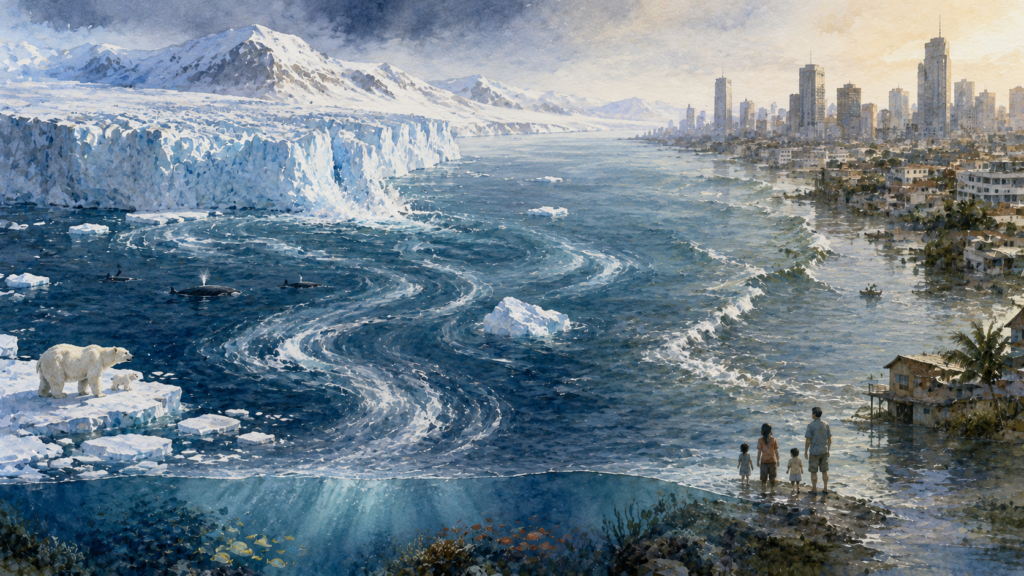
Rising Sea Levels
Perhaps the clearest global connection is sea-level rise.
Again, the distinction between floating and land-based ice matters. Melting Arctic sea ice itself contributes little directly to sea-level rise. By contrast, ice lost from Greenland, Antarctica, and mountain glaciers adds water to the world’s oceans.
For coastal cities, islands, deltas, and low-lying communities, even relatively modest increases in average sea level can make storm surges and coastal flooding more damaging.
The future of distant ice sheets is therefore directly connected to the future of human settlements thousands of kilometers away.
Changes in the Climate System
The polar regions are also part of a much larger system of atmospheric and ocean circulation.
Changes in Arctic temperature gradients, sea ice, and ocean conditions can interact with weather patterns at lower latitudes. Researchers continue to investigate precisely how Arctic change influences phenomena such as the jet stream and extreme weather, and some proposed connections remain scientifically debated.
Antarctic changes can likewise affect Southern Ocean circulation and the exchange of heat and carbon between the ocean and atmosphere.
The safest conclusion is not that every unusual weather event is caused by melting polar ice. Rather, it is that rapid polar change alters important components of the global climate system.
4. What Happens to Polar Wildlife?
For animals adapted to life around ice, climate change can mean the transformation of the habitat on which they depend.
In the Arctic, sea-ice loss can affect species that use ice for hunting, resting, breeding, or escaping predators. Polar bears are perhaps the best-known example, but the ecological consequences extend through marine food webs.
In Antarctica, changes in sea ice and ocean conditions can affect krill and the animals that depend on them, including penguins, seals, whales, and seabirds.
Not every species will respond in the same way. Some populations may decline, others may move, and some may temporarily benefit from changing conditions.
What matters is that rapid environmental change can disrupt relationships that evolved over very long periods.
5. Why Should People Far from the Poles Care?
It is easy to think of melting polar ice as a distant environmental problem.
It is not.
The poles help regulate Earth’s energy balance, influence oceans and atmosphere, store enormous quantities of freshwater, and support ecosystems found nowhere else.
Their transformation can eventually be felt through rising seas, changing ecosystems, economic costs, and greater pressure on coastal communities.
Polar change also demonstrates an important feature of climate change: environmental systems are connected across enormous distances.
A change beginning in a remote glacier or ice sheet can eventually become relevant to a family living beside an ocean thousands of kilometers away.
Conclusion: The Poles Are Part of Our World
The Arctic and Antarctica are very different places, and their ice behaves in different ways. Yet both reveal how rapidly Earth’s climate system is changing.
Declining Arctic sea ice is reducing one of the planet’s great reflective surfaces and transforming Arctic ecosystems. The loss of land-based ice from Greenland and Antarctica is contributing directly to rising global sea levels. Antarctica’s enormous ice reserves make its long-term stability especially important for future generations.
Protecting the polar regions therefore does not mean protecting distant landscapes that have little connection to us.
It means recognizing that Earth is one interconnected system.
The changing poles are not simply warning signs at the edges of the planet. They are part of a global story—and the consequences of that story will ultimately reach far beyond the ice.
Reader Question
The Arctic and Antarctica may feel distant from our everyday lives, yet changes in these regions can eventually affect sea levels, ecosystems, and climate systems around the world.
Does knowing how closely the polar regions are connected to the rest of the planet change the way you think about climate change—and our responsibility to respond to it?
Related Reading
Changes in the polar regions remind us that ecosystems far from our daily lives can still play an essential role in maintaining the stability of the planet. A related perspective appears in Why Wetlands Matter, which explores how wetlands support biodiversity, regulate water, reduce flood risks, and contribute to the resilience of natural systems in a changing climate.
Understanding climate change also requires us to look beyond environmental science and consider who bears the costs of responding to it. This broader social dimension is explored in The Unequal Cost of Going Green, which examines how the transition toward a low-carbon economy can affect communities differently and why climate action is increasingly connected to questions of fairness and climate justice.
References
1. Serreze, Mark C. Brave New Arctic: The Untold Story of the Melting North. Princeton University Press, 2018.
Serreze explains how the Arctic has shifted from a relatively stable frozen environment toward a rapidly warming climate system. Drawing on decades of polar research, the book is particularly useful for understanding Arctic amplification, declining sea ice, and why changes in the far north matter beyond the Arctic itself.
2. Moon, Twila. What the Ice Gets: Shackleton, the Antarctic, and the Geography of Ice. W. W. Norton & Company, 2024.
Moon explores ice not simply as frozen water but as a dynamic part of Earth’s environmental system. Her perspective helps readers understand how glaciers and ice sheets interact with landscapes, oceans, climate, and human understanding of the polar world.
3. Alley, Richard B. The Two-Mile Time Machine: Ice Cores, Abrupt Climate Change, and Our Future. Princeton University Press, 2000.
Alley explains how scientists use ancient ice cores to reconstruct Earth’s climate history. The book demonstrates why polar ice is also a record of past atmospheric and climatic conditions, helping us understand current warming within a much longer history of climate change.
4. Rignot, Eric. Ice and Climate. Cambridge University Press, 2024.
This work examines the relationship between glaciers, ice sheets, oceans, and the changing climate. It is especially relevant to understanding why the loss of land-based ice in Greenland and Antarctica contributes to sea-level rise and why scientists closely monitor the stability of major ice sheets.
5. Nielsen, Henry, and Kristian H. Nielsen. Camp Century: The Untold Story of America’s Secret Arctic Military Base Under the Greenland Ice. Columbia University Press, 2017.
Although centered on the history of Camp Century in Greenland, the book also reveals how scientific exploration of the Greenland Ice Sheet contributed to our understanding of past climates. It offers an interesting connection between polar history, ice-core science, geopolitics, and modern climate research.
Leave a Reply