
How the Meaning of Work Is Changing in the Age of Automation
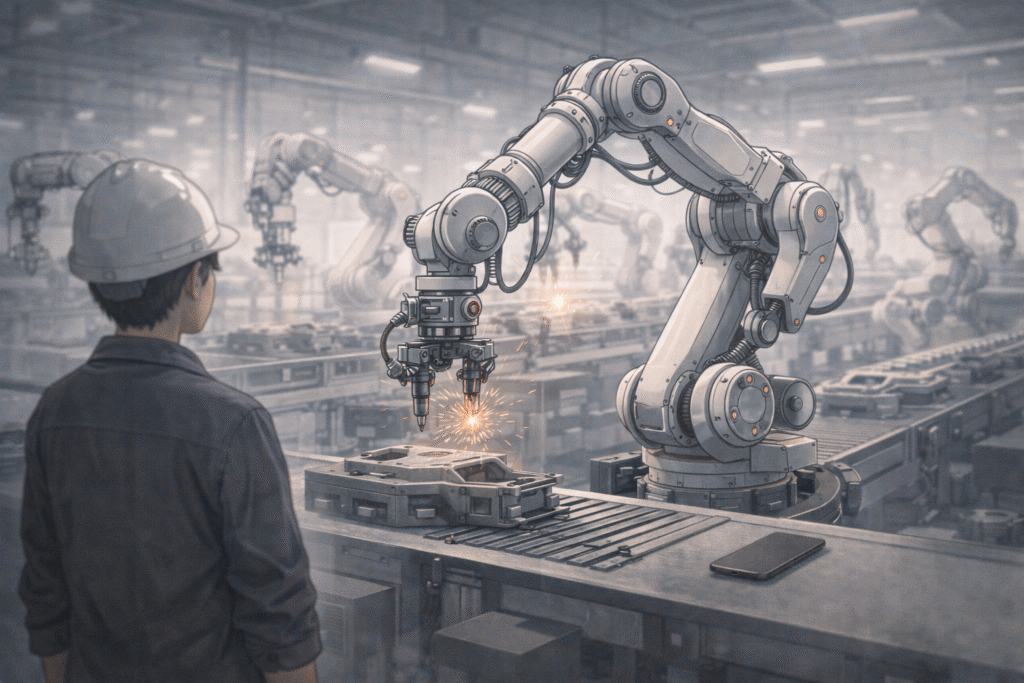
1. The Replacement of Labor — Toward a Workplace Without Humans
What if a society emerges in which humans no longer need to work?
As machines take over more tasks, efficiency rises—but at the same time, a deeper question begins to surface.
Factory lines, logistics centers, cafés, even news article writing—
robots and artificial intelligence are already at work.
They do not tire, complain, or demand rest.
They operate twenty-four hours a day with consistent productivity.
According to a McKinsey report, up to 30 percent of global jobs may be automated by 2030.
The more routine and rule-based the task, the faster it is replaced.
Yet here lies the paradox of technological progress.
As efficiency increases, the dignity attached to human labor begins to erode.
When a job that once provided pride and identity is no longer “needed,”
people experience more than economic unemployment.
They confront an existential anxiety:
Who am I, if my work no longer has a place in society?
Work has never been merely a means of survival.
It is how humans relate to society—and how they affirm their own value.
2. Human–Robot Coexistence — Collaboration or Subordination?
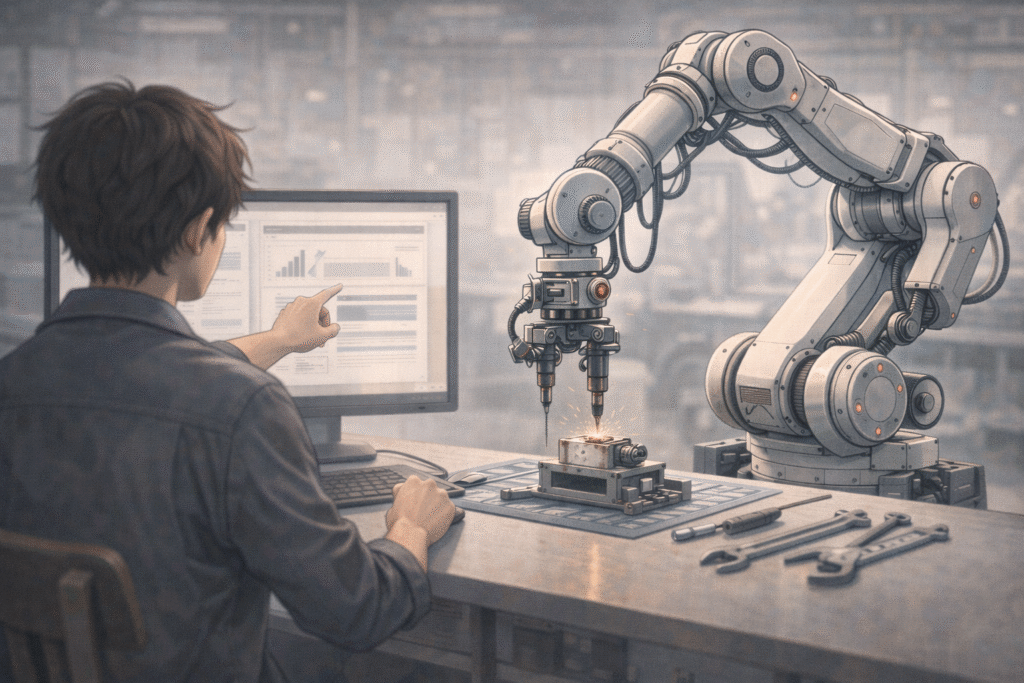
As robots enter workplaces, humans are expected to collaborate with them.
In factories, machines handle heavy or repetitive tasks,
while humans become supervisors or assistants.
On the surface, this looks like coexistence.
In reality, a hierarchy quietly emerges.
Robots are evaluated purely by efficiency,
and humans are increasingly measured by the same standard.
The “inefficient human” is gradually pushed to the margins.
This creates a new pressure:
humans must now outperform machines on machine-like terms.
As a result, workplaces lose space for emotion, rest, and imperfection.
The question inevitably arises:
Do robots assist human labor—or do they redefine how humans are judged?
3. Universal Basic Income — The Ethics of Living Without Work
As automation expands, societies search for new institutional responses.
One prominent proposal is Universal Basic Income (UBI)—
a system in which AI-generated wealth is shared,
and every citizen receives a guaranteed income regardless of employment.
Pilot programs have been tested in countries such as Finland, Canada, and Switzerland.
Supporters argue that UBI can reduce inequality and allow people
to focus on creative, social, and caring activities.
Critics worry that it weakens the meaning of work
and blurs the sense of social responsibility.
UBI is not merely an economic policy.
It is an ethical debate about the value of work and the meaning of life.
Are we ready to accept a society where survival is detached from labor?
4. A New Work Ethic — From Productivity to Meaning
The industrial era celebrated diligence, discipline, and productivity.
In the age of AI, these virtues are no longer absolute.
Philosopher Byung-Chul Han argues in The Burnout Society
that modern individuals become “achievement subjects,”
endlessly exploiting themselves in the name of performance.
If machines take over production, humans no longer need to exist
solely as producers of measurable output.
Instead, human labor can be reoriented toward
creation, care, empathy, education, and reflection.
The ethical center of work must shift
from efficiency to human meaning.
5. Redefining the Meaning of Work — Toward a Dignified Human Life
Even in an era that speaks of the “end of work,”
the meaning of work remains central to human life.
It is not disappearing—it is transforming.
If robots replace physical labor,
humans must reclaim work as an activity of thinking, feeling, and relating.
Caring for others, building social bonds,
creating art, teaching, and nurturing communities—
these forms of non-economic labor must be revalued.
A society where humans do not have to work
is not a society where work loses meaning.
It is a society that must rediscover what work truly means.
Conclusion — Human Dignity Still Resides in Work

Even if robots and AI dominate the workplace,
human dignity cannot be automated.
Humans are not merely beings who work.
They are beings who create meaning through work.
The task ahead is not to exclude robots,
but to ensure that technology and humanity together
shape forms of labor worthy of human dignity.
What we must protect is not jobs themselves,
but the dignity that emerges through meaningful work.
A society where one can live without working—
yet still wants to work—
that is a truly human society.
A Question for You
If technology eventually removes the necessity of human labor,
what do you think will give life meaning and dignity?
Related Reading
The broader relationship between humanity and technological power is explored further in Do Humans Control Technology, or Does Technology Control Us?, which examines whether technology remains a tool serving human purposes or gradually becomes a force that reshapes human choices, values, and society. This wider perspective provides an essential context for understanding how automation challenges the meaning of work and human dignity.
The social consequences of automation are explored further in The New Inequality of the AI Age: The Rise of Digital Refugees, which examines how rapid technological change can leave many people behind, creating new forms of inequality and exclusion. Together, these questions remind us that the future of work is not only about technological progress, but also about ensuring that human dignity remains at the center of social development.
References
- Brynjolfsson, E., & McAfee, A. (2014). The Second Machine Age. New York: W. W. Norton & Company.
This influential work analyzes how digital technologies transform labor and productivity, highlighting both economic growth and the risk of job displacement in automated societies. - Srnicek, N., & Williams, A. (2015). Inventing the Future: Postcapitalism and a World Without Work. London: Verso.
The authors explore post-work futures, automation, and basic income, offering a philosophical vision of how societies might reorganize labor beyond traditional employment. - Frey, C. B., & Osborne, M. A. (2017). “The Future of Employment: How Susceptible Are Jobs to Computerisation?” Technological Forecasting and Social Change, 114, 254–280.
This empirical study estimates the probability of job automation across occupations, providing a data-driven foundation for debates on technological unemployment. - Han, B.-C. (2015). The Burnout Society. Stanford, CA: Stanford University Press.
Han critiques contemporary performance-driven culture, arguing that excessive self-optimization erodes human dignity and leads to psychological exhaustion. - Arendt, H. (1958). The Human Condition. Chicago: University of Chicago Press.
Arendt’s classic distinction between labor, work, and action offers a philosophical framework for rethinking human dignity and meaningful activity in post-industrial societies.
Leave a Reply