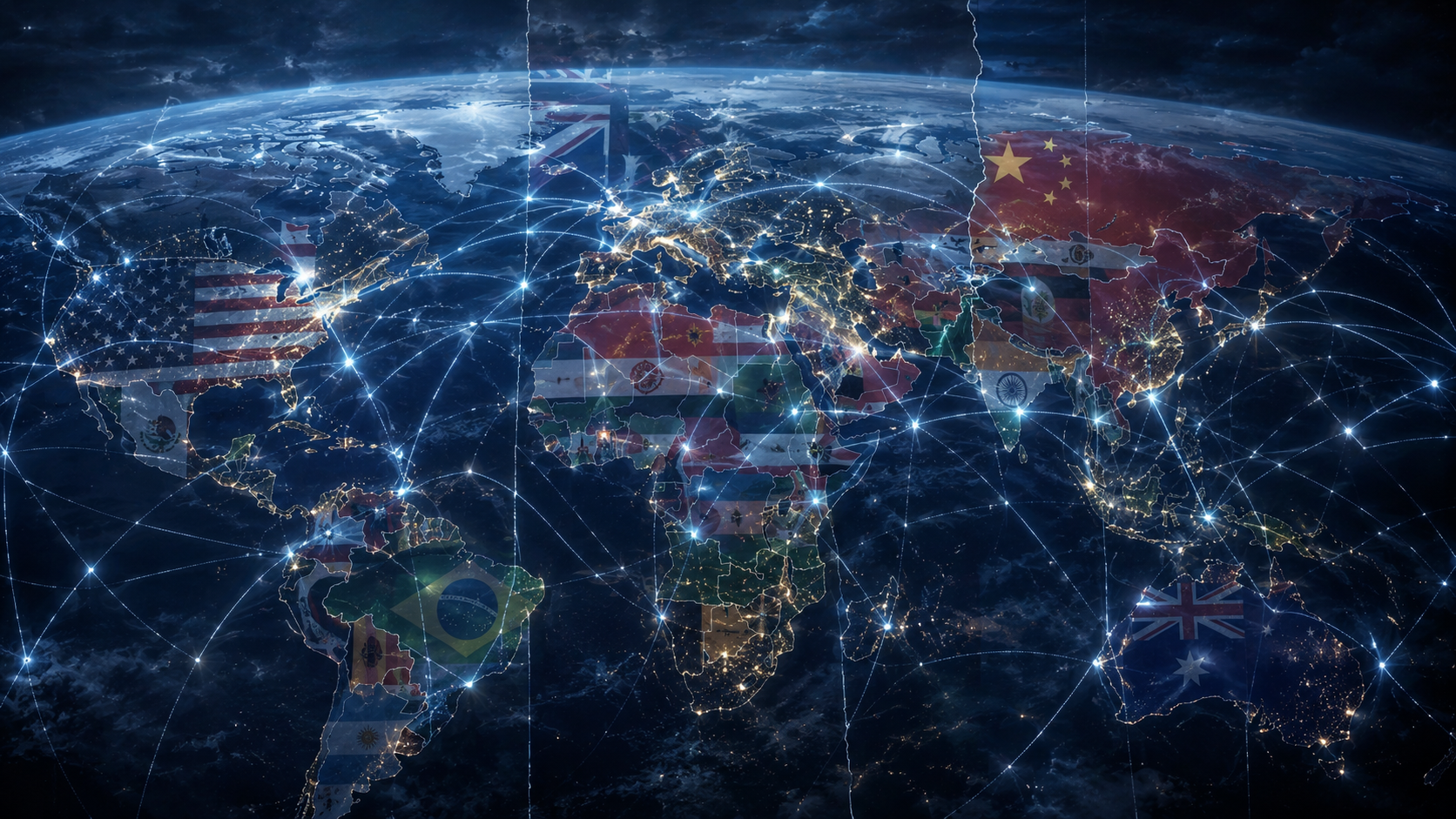
Why Nations Resist Global Authority in an Increasingly Connected World
The world has never been more connected.
Global trade links economies.
Climate change crosses borders.
Pandemics spread internationally within days.
And digital technology allows billions of people to communicate instantly.
Because of this, some people ask an ambitious question:
Should humanity eventually create a world government?
At first glance, the idea sounds reasonable.
A unified global authority could potentially:
- reduce war
- coordinate climate action
- manage global crises more efficiently
Yet despite globalization, the world is not moving toward political unity.
In fact, conflicts over national sovereignty are becoming even stronger.
Why?
Because sovereignty remains one of the most powerful ideas in modern politics.
Before examining this tension, we need to distinguish world government from global governance. A world government would involve a political authority above individual states with powers of its own. Global governance is broader: it includes treaties, international organizations, and other arrangements through which countries address shared problems without forming a single government.
Supporting international cooperation does not necessarily mean supporting world government. The central question is how much authority should be exercised beyond the state, for what purposes, and under whose control.
1. What Is Sovereignty?
The Meaning of Sovereignty
Sovereignty concerns a state’s authority within its territory and its independence in relations with other states. It is a foundational principle of the international system, but it does not give governments unlimited freedom to act.
The UN Charter combines the sovereign equality of states with obligations, including the peaceful settlement of disputes and restrictions on the threat or use of force. Sovereignty and international legal responsibility therefore coexist.
In simple terms, sovereignty means:
- controlling national territory
- governing citizens
- creating laws independently
- resisting outside control
Without sovereignty, a nation risks losing political autonomy and identity.
Sovereignty as National Identity
However, sovereignty is not only a legal concept.
It is also emotional.
For many societies, sovereignty represents:
- historical survival
- cultural identity
- political dignity
As a result, giving up sovereignty often feels like giving up part of the nation itself.
2. Why Nations Resist Global Authority
The Protection of Self-Determination
Most countries strongly defend the idea of self-determination.
The belief is simple:
“Our country should decide its own future.”
This principle remains deeply influential in global politics.
The Fear of External Control
More importantly, sovereignty is connected to power.
Governments may accept international rules while resisting arrangements that reduce their control over sensitive areas such as defense, taxation, or immigration.
Their concerns are not always simply a refusal to cooperate. They may ask whether international decisions reflect domestic democratic choices, whether powerful countries will dominate the rules, and whether commitments can be revised when circumstances change.
The dispute is therefore about both the scope of shared authority and the legitimacy of those who exercise it.
3. Is Sovereignty Negotiable?
Shared Sovereignty in Practice
In reality, sovereignty is not always absolute.
Countries frequently negotiate or partially share sovereignty when cooperation provides mutual benefits.
The European Union provides an important example. Its member states have conferred authority on common institutions in specified areas, including a common commercial policy. Countries participating in the euro also share monetary policy.
However, authority is distributed differently across policy fields. Member states retain major responsibilities in foreign affairs and defense, while also participating in the EU’s Common Foreign and Security Policy. Many decisions in this field require unanimity.
The EU therefore illustrates neither complete national independence nor a single centralized state. It shows how countries can organize common authority while retaining substantial national powers.
International Agreements and Cooperation
Countries also limit parts of their sovereignty through international treaties.
Examples include:
- climate agreements
- human rights conventions
- trade organizations
In these cases, nations accept certain restrictions in exchange for broader collective goals.
Therefore, sovereignty often functions less like an absolute right
and more like a negotiated balance.
4. The Debate Between Nations and Humanity
The Appeal of a World Government
Supporters of global governance argue that many modern problems are transnational.
Climate change, cybercrime, pandemics, and nuclear weapons cannot be solved by one country alone.
A stronger global political structure could theoretically:
- coordinate international responses
- reduce conflict
- promote global equality
For this reason, some thinkers view world government as a long-term necessity.
The Risks of Global Centralization
However, critics remain skeptical.
A world government could become:
- overly centralized
- dominated by powerful nations
- dismissive of cultural diversity
Many fear that global authority could evolve into a system of large-scale political control rather than genuine cooperation.
As a result, tension continues between:
- national sovereignty
- global responsibility
And that tension may define international politics for decades to come.
5. Real-World Examples of Sovereignty Conflicts
The International Criminal Court (ICC)
The International Criminal Court addresses individual criminal responsibility for genocide, crimes against humanity, war crimes, and, under specific jurisdictional conditions, the crime of aggression.
It is not a court with unrestricted authority over every person or conflict. Its jurisdiction depends on the Rome Statute’s conditions, and it is intended to complement national criminal justice systems. A central question is whether the relevant state is genuinely investigating or prosecuting the case.
Debates over the ICC therefore concern more than a choice between sovereignty and justice. They also involve the reach of international jurisdiction, the adequacy of domestic proceedings, and whether accountability is applied consistently.
This makes the Court an example of limited international authority rather than a world government.
Climate Agreements and National Interests
Climate policy provides another example.
The Paris Agreement requires international cooperation to reduce emissions.
However, domestic political and economic priorities often conflict with global commitments.
The United States illustrates how international commitments can change with domestic political leadership. Its first withdrawal from the Paris Agreement took effect in November 2020, followed by re-entry in February 2021. A second withdrawal took effect on January 27, 2026.
These reversals show the difficulty of sustaining cooperation across changes of government. The issue is not simply whether a country may withdraw under a treaty’s rules, but how other countries can plan around commitments that may be reversed.
A Citizenship Perspective: Who Controls Shared Authority?
From a citizenship education perspective, the question is not only whether international institutions can solve problems efficiently. It is also whether people can understand, influence, and challenge the decisions made in their name.
A proposal for stronger global authority should face several tests: Are its powers clearly limited? Do smaller states and affected communities have a meaningful voice? Are decisions transparent? What remedies exist when authority is abused?
Representation also creates a difficult tension. Giving every state an equal vote protects smaller countries, while representation based on population gives greater weight to individuals in more populous societies. Neither principle automatically resolves every question of fairness.
These issues make democratic accountability central to the debate. Moving power beyond national borders does not remove the need to justify and constrain it.
Conclusion: Is Sovereignty Absolute?
Sovereignty is not a blanket exemption from international obligations. The more useful question is which decisions states should make independently, which require cooperation, and how shared authority can remain accountable.
As the world becomes increasingly interconnected, humanity faces a difficult task:
How can nations preserve independence
while also cooperating on problems that no country can solve alone?
Perhaps the future will not involve a single world government.
Instead, it may require something more realistic:
A balance between national identity and global responsibility.
Because sovereignty may protect nations—
But cooperation may ultimately protect humanity itself.
Reader Question
Choose a problem that crosses borders—climate change, military AI, or international crime. Which decisions should remain with national governments, and which should be shared internationally?
What safeguards would make that shared authority both effective and democratically accountable?
Related Reading
The tension between national autonomy and collective security becomes especially clear in debates over military technology. In Is the AI Arms Race the Beginning of a New Cold War?, we examine how competition over military AI can intensify international rivalry while making shared rules on human control and accountability increasingly important.
Questions about legitimate authority also arise within national borders. In Social Justice and the Welfare State: How Much Should Governments Reduce Economic Inequality?, we explore how freedom, fairness, and shared responsibility shape the powers citizens entrust to government. These debates provide a useful starting point for considering which responsibilities might also be shared internationally.
References
1. United Nations. (1945). Charter of the United Nations. Chapter I, Article 2.
Article 2 combines the sovereign equality of states with obligations concerning good-faith compliance, peaceful dispute settlement, and restrictions on the threat or use of force. It provides the legal foundation for explaining why sovereignty does not exempt states from international responsibilities.
United Nations — Charter, Article 2(1)–(5)
2. Krasner, S. D. (1999). Sovereignty: Organized Hypocrisy. Princeton University Press.
Krasner examines the gap between principles of sovereignty and the behavior of political leaders. His analysis distinguishes different dimensions of sovereignty and shows how external authority has been resisted, accepted, or imposed in different historical circumstances. The book helps explain why sovereignty cannot be understood simply as an unchanging condition of complete independence.
Stanford University — Sovereignty: Organized Hypocrisy
3. Council of the European Union. (2026). “Unanimity.”
This official explanation identifies policy areas in which Council decisions require unanimity, including much of the Common Foreign and Security Policy. It supports the article’s account of the European Union as a system in which common institutions coexist with substantial national control over sensitive decisions.
Council of the European Union — Unanimity
4. International Criminal Court. (n.d.). “How the Court Works.”
This institutional overview explains the Court’s remit, jurisdiction, and relationship with national criminal justice systems. It supports the distinction between a court exercising limited international criminal jurisdiction and a political authority with general powers over states.
International Criminal Court — How the Court Works
5. United Nations. (2025). Paris Agreement: United States of America—Withdrawal. Depositary Notification C.N.71.2025.TREATIES-XXVII.7.d, January 27.
This official notification records the United States’ withdrawal notification of January 27, 2025, and specifies January 27, 2026, as its effective date under Article 28 of the Paris Agreement. It provides the primary documentary source for the article’s discussion of the second U.S. withdrawal and the difficulty of sustaining international commitments across changes of government.
United Nations Treaty Collection — United States Withdrawal Notification
Leave a Reply