
Tag: well-being

  • The Future of Happiness

    The Future of Happiness

    How Will We Define Happiness in the Age of AI and Climate Change?

    For thousands of years, philosophers, religious thinkers, scientists, and ordinary people have asked the same question: What does it mean to live a happy life?

    The answers have never remained the same. Every generation has redefined happiness according to its own social values, economic conditions, technological progress, and cultural beliefs.

    Today, humanity stands at another turning point. Artificial intelligence is transforming work, digital technology is reshaping relationships, and climate change is altering how we think about the future. These forces are raising an important question: Will future generations define happiness differently from us?

    Perhaps happiness will no longer depend primarily on wealth or personal achievement. Instead, it may increasingly involve digital well-being, environmental sustainability, meaningful human relationships, and the ability to adapt to constant change.


    1. Happiness Has Always Evolved

    changing ideas of happiness across different historical periods

    Changing Ideas Across History

    Ideas about happiness have never been fixed.

    Aristotle described happiness (eudaimonia) as living a virtuous and meaningful life rather than pursuing temporary pleasure. Epicurus emphasized peace of mind, friendship, and freedom from unnecessary desire.

    Centuries later, industrial societies increasingly associated happiness with economic success, stable employment, and family security.

    Modern psychology has shifted attention toward subjective well-being, emphasizing emotional health, life satisfaction, resilience, and positive relationships.

    Each period reflects the priorities of its own society.

    Why the Definition Continues to Change

    As societies change, so do people’s expectations.

    Longer life expectancy, globalization, technological innovation, and environmental uncertainty are reshaping what people value most. Happiness is becoming less about accumulating possessions and more about achieving balance, purpose, and sustainability.


    2. Artificial Intelligence and the Automation of Happiness

    AI technology supporting everyday life while preserving human relationships

    Technology as a Source of Well-Being

    Artificial intelligence already helps people organize daily life, monitor health, recommend entertainment, and automate repetitive work.

    Personalized healthcare, intelligent assistants, and smart homes may reduce stress while giving people more time for creativity, learning, and relationships.

    Technology could become a powerful tool for improving quality of life.

    When Convenience Replaces Meaning

    However, greater convenience does not automatically produce greater happiness.

    If algorithms make every decision, people may gradually lose opportunities to develop independence, overcome challenges, and experience personal growth.

    Many psychologists argue that genuine happiness often emerges from effort, purpose, and meaningful achievement—not simply from comfort.


    3. Digital Well-Being in a Virtual Society

    A New Definition of Human Connection

    Virtual reality, augmented reality, and digital communities will likely become increasingly important parts of everyday life.

    People may attend concerts, classrooms, workplaces, and even family gatherings in immersive digital environments.

    These technologies could expand access to experiences previously limited by geography or physical ability.

    The Risk of Digital Isolation

    Yet digital life also creates new challenges.

    Excessive dependence on virtual experiences may weaken face-to-face relationships, increase loneliness, and blur the boundary between authentic and simulated experiences.

    The future of happiness may depend not on rejecting technology but on using it wisely.


    4. Climate Change and the Meaning of Well-Being

    Living Well on a Changing Planet

    Climate change is no longer only an environmental issue—it is increasingly becoming a psychological and social one.

    Extreme weather, ecological uncertainty, and concerns about future generations influence how people think about security and happiness.

    As environmental awareness grows, many people are redefining success in terms of sustainability rather than consumption.

    From Consumption to Sustainability

    Communities around the world are investing in green cities, renewable energy, and nature-based lifestyles.

    Rather than asking, “How much can we own?” future generations may increasingly ask, “How can we live well while protecting the planet?”


    5. Measuring Happiness Beyond Economic Growth

    Lessons from Bhutan

    Bhutan’s concept of Gross National Happiness (GNH) challenged the assumption that economic growth alone defines national success.

    The model considers psychological well-being, environmental conservation, cultural preservation, good governance, and community vitality alongside economic development.

    Many researchers believe future societies may adopt broader measures of human flourishing instead of relying solely on GDP.

    Smart Cities and Human-Centered Innovation

    Cities such as Singapore increasingly integrate digital technology with environmental planning to improve quality of life.

    Smart transportation, efficient energy systems, public green spaces, and digital public services demonstrate how technology can support—not replace—human well-being.


    Conclusion
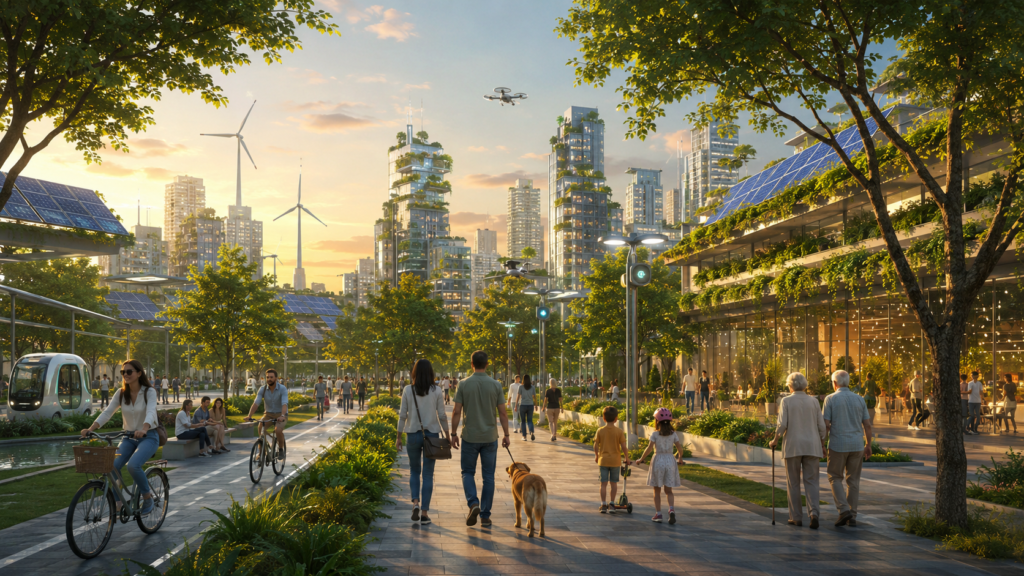
    people enjoying a sustainable smart city where technology and nature coexist

    The future of happiness will likely become more complex than ever before.

    Artificial intelligence may make life easier, but not necessarily more meaningful. Digital technology may connect people globally while simultaneously increasing loneliness. Climate change may threaten traditional lifestyles while encouraging societies to rediscover sustainability and community.

    Ultimately, happiness will continue evolving because humanity itself continues evolving.

    Perhaps the most important challenge is not asking whether technology will make us happier, but asking what kind of life we believe is worth living in the first place.

    In the future, happiness may be measured less by what we possess and more by how wisely we balance innovation, relationships, purpose, and responsibility toward one another and the planet.

    Reader Question

    As AI becomes increasingly capable of improving convenience and solving everyday problems, do you think future happiness will depend more on technology—or on meaningful human relationships?

    If society eventually measures success by well-being rather than economic growth alone, what do you think should be included in the definition of a truly happy life?

    Related Reading

    If artificial intelligence and digital technologies increasingly influence how we live, work, and connect with others, can they also redefine what it truly means to be happy?

    In Can Experiences in Dreams Become Real Knowledge?, we explore how emerging technologies, virtual experiences, and human perception may reshape our understanding of reality—and perhaps even our definition of happiness.


    If happiness is shaped not only by personal choices but also by society, culture, and the people around us, how much of our emotional well-being truly belongs to us?

    In Are Our Emotions Truly Ours—or Socially Constructed?, we examine how social norms, cultural expectations, and collective experiences influence human emotions and our pursuit of a meaningful life.

    References

    1. Aristotle. (2009). Nicomachean Ethics (Translated by W. D. Ross). Oxford University Press.

    One of the foundational works in Western philosophy, Nicomachean Ethics introduces the concept of eudaimonia, describing happiness as living a life of virtue, purpose, and human flourishing rather than pursuing temporary pleasure. It remains central to modern discussions of well-being.


    2. Seligman, M. E. P. (2011). Flourish: A Visionary New Understanding of Happiness and Well-being. Free Press.

    Martin Seligman expands positive psychology beyond happiness alone, introducing the PERMA model—Positive Emotion, Engagement, Relationships, Meaning, and Accomplishment. The book argues that genuine well-being is multidimensional and extends beyond momentary pleasure.


    3. World Happiness Report. (2024). World Happiness Report 2024. Sustainable Development Solutions Network.

    The annual World Happiness Report examines how income, social support, health, freedom, generosity, and trust influence life satisfaction across countries. It demonstrates that strong relationships and social trust consistently contribute more to happiness than economic wealth alone.


    4. Schwab, K. (2016). The Fourth Industrial Revolution. World Economic Forum.

    Klaus Schwab explores how artificial intelligence, robotics, biotechnology, and digital technologies are transforming work, society, and human life. He argues that technological progress should ultimately serve human well-being rather than becoming an end in itself.


    5. United Nations. (2015). Transforming Our World: The 2030 Agenda for Sustainable Development. United Nations.

    The UN’s Sustainable Development Goals (SDGs) connect human well-being with environmental sustainability, social inclusion, and economic development. The report highlights that future prosperity depends on balancing technological innovation with responsibility toward people and the planet.


  • Why Do We Always Feel Busy? The Social Pressure of Time

    Why Do We Always Feel Busy? The Social Pressure of Time

    “I have no time.”

    “Today flew by.”

    “I didn’t even get a moment to rest this weekend.”

    Most of us say these things almost automatically.
    Yet, when we look closely, our schedules are not always as full as our exhaustion suggests.

    So a question arises:
    Why do we feel busy even when we are not doing that much?


    1. Time Is a Feeling: Psychological Time vs. Clock Time

    Fragmented time and constant distractions in modern life

    1.1 The Difference Between Measured and Lived Time

    The time we experience is not the same as the time measured by clocks.
    Psychologists distinguish between physical time and perceived time.

    An hour spent watching a favorite movie can pass in an instant, while ten minutes of worrying about unfinished tasks can feel unbearably long.

    1.2 Why Modern Time Feels Fragmented

    Our sense of time is shaped by emotion, attention, and environment.
    Constant notifications, emails, messages, and social media alerts repeatedly interrupt our focus.

    Even without completing many tasks, our attention becomes fragmented.
    As a result, the day feels scattered, unproductive, and exhausting — leaving us with the impression that we were “busy” all along.


    2. Saying “I’m Busy” as Social Self-Defense

    2.1 Busyness as a Social Signal

    When asked, “How are you doing?”, many people instinctively answer, “I’m busy.”

    This response is not just a factual update.
    Psychologists describe it as a form of social self-presentation.

    Busyness as a social identity in everyday life

    2.2 When Busyness Equals Competence

    In competitive societies, busyness is often equated with usefulness and capability.
    To appear busy is to appear productive, valuable, and responsible.

    Conversely, appearing relaxed or unoccupied can feel risky — as if it signals laziness or irrelevance. Over time, we internalize this script and begin to believe we are busy even when we are not.


    3. More “Shoulds” Than Actual Tasks

    3.1 The Pressure to Always Be Doing Something

    We may not have many urgent tasks, but our minds are filled with things we feel we should be doing.

    Scrolling through social media can trigger thoughts like:
    “Everyone else is exercising.”
    “Everyone else is improving themselves.”
    “I should be doing more.”

    3.2 FOMO and Constant Mental Tension

    This pressure is closely linked to FOMO (Fear of Missing Out).
    Even without taking action, we remain mentally alert, comparing ourselves and anticipating future demands.

    The result is a constant state of tension — a feeling of being chased by time without actually moving.


    4. “Time Is Money”: Addiction to Efficiency

    4.1 When Every Moment Must Be Useful

    From an early age, many of us learn that time should never be wasted.
    This belief, rooted in industrial and capitalist values, turns time into a resource that must always generate value.

    Even rest is evaluated:
    “Is this productive rest?”
    “Is this helping me improve?”

    4.2 When Efficiency Becomes Exhausting

    An efficiency-centered view of time makes stillness uncomfortable.
    It keeps us asking, “Am I doing enough?” — a question that never truly ends.

    In this way, busyness becomes less about tasks and more about identity.


    Conclusion: Recovering Slowness

    Quiet moment of slowing down without productivity pressure

    Feeling busy is not simply a scheduling problem.
    It is a psychological state shaped by social expectations, time culture, and self-worth.

    The solution, therefore, is not only to reduce tasks, but to rethink how we relate to time.

    Allowing moments where nothing needs to be done.
    Accepting rest as a meaningful outcome.
    Remembering that moving slowly does not mean falling behind.

    These small shifts can loosen the grip of constant busyness.

    If you feel busy all the time, today, being slow is allowed.

    Related Reading

    The social construction of productivity is analyzed in Sleep: A Fundamental Human Right or a Tool for Productivity?Sleep: A Fundamental Human Right or a Tool for Productivity?, which challenges the moralization of efficiency.

    A structural perspective on modern comparison culture appears in How Social Media Amplifies Feelings of Lack and ComparisonHow Social Media Amplifies Feelings of Lack and Comparison, highlighting how digital environments intensify temporal anxiety.


    References

    1.Rosa, H. (2013). Social Acceleration: A New Theory of Modernity. New York: Columbia University Press.
    Rosa analyzes how modern societies experience constant acceleration, showing that feelings of time pressure are rooted in structural and cultural change rather than individual failure.

    2.Southerton, D. (2009). “Re-ordering Temporal Rhythms: Coordinating Daily Practices in the UK.” Time & Society, 18(1), 91–113.
    This study examines how social scheduling and fragmented daily rhythms contribute to chronic feelings of busyness and time scarcity.

    3.Wajcman, J. (2015). Pressed for Time: The Acceleration of Life in Digital Capitalism. Chicago: University of Chicago Press.
    Wajcman explores how digital technologies reshape attention and time perception, explaining why modern individuals feel increasingly busy despite technological convenience.

  • Is Perfect Happiness Possible?

    Is Perfect Happiness Possible?

    A philosophical examination of why perfect happiness cannot exist—
    and what this impossibility reveals about the human condition.

    Man walking along a golden-hour hillside path.

    The Desire for Completion

    Human beings have long pursued the idea of a complete and final state of happiness—a condition in which nothing is lacking, nothing threatens to change, and everything essential has been secured once and for all. This imagined form of happiness promises immunity from uncertainty and emotional fragility. Yet such an ideal immediately raises a deeper question: Can happiness ever be complete?

    To explore this question is to confront the tension between what the human imagination desires and what the human condition permits. Perfect happiness implies permanence, stability, and closure; human life, by contrast, is temporal, contingent, and continually unfolding. This fundamental mismatch is the starting point of our inquiry.

    Perfection and Human Temporality

    Perfection presupposes two conditions:

    1. the absence of lack, and
    2. the cessation of change.

    A perfect state is static by definition—once attained, nothing further must be sought.

    Happiness, however, is inherently dynamic. It is shaped by evolving circumstances, shifting desires, and emotional variability. To impose the ideal of perfection upon the experience of happiness is thus conceptually incoherent.

    Modern psychology reinforces this view:

    • Hedonic adaptation shows that emotional highs fade quickly.
    • The paradox of choice reveals that abundance often increases dissatisfaction.
    • Expectation–reality gaps produce chronic disappointment even when conditions improve.

    These mechanisms demonstrate that the psyche itself resists a fixed, perfected happiness. Happiness moves; it cannot remain still.
    Life changes; no emotional state can be preserved.
    Thus, perfect happiness collapses under conceptual scrutiny.

    Hands balancing joy and anxiety on a symbolic scale.

    Philosophical Perspectives on Imperfection

    Aristotle: Happiness as Activity, Not Completion

    Aristotle’s eudaimonia is often mistaken for a perfected state of flourishing. Yet Aristotle insists that happiness is an activity, not an achievement frozen in time. A flourishing life requires continued exercise of virtue, adaptation to circumstances, and meaningful engagement with the world.

    Happiness is therefore dynamic—a movement, not a monument.


    Spinoza: Joy Through Understanding, Not Emotional Perfection

    Spinoza locates happiness in rational clarity. For him, suffering does not disappear; rather, it becomes integrated through adequate understanding of one’s emotions and their causes.

    Happiness, in this sense, is the product of insight,
    not the elimination of negative emotions.

    Thus, Spinoza replaces the fantasy of perfect happiness with the practice of intellectual freedom.


    Buddhism: Abandoning the Illusion of Completion

    Buddhist thought offers a radical critique of perfection.
    The desire to maintain a permanent emotional state—whether happiness or peace—is the very root of suffering.

    Because all things are impermanent (anicca),
    the attempt to preserve happiness becomes a form of attachment (tanha),
    which inevitably leads to dissatisfaction.

    Happiness emerges not by fulfilling desire,
    but by releasing the demand that happiness remain unchanged.

    Contemporary Implications — Happiness in an Age of Measurement

    Modern society converts happiness into a measurable commodity:

    • Governments publish well-being indices.
    • Corporations market “wellness” as a lifestyle product.
    • Individuals track emotions, productivity, and satisfaction.

    What results is a world where happiness becomes a performance.

    The neoliberal logic of self-optimization demands:

    • constant emotional positivity,
    • efficiency in self-management,
    • elimination of discomfort.

    But when happiness becomes an obligation,
    ordinary life becomes insufficient.
    Comparison intensifies.
    Imperfection becomes unacceptable.

    In this environment, the ideal of perfect happiness becomes not only unattainable but oppressive—an expectation that erodes genuine well-being.

    Conclusion — The Necessity of Imperfection

    Soft morning light entering through an open window

    Perfect happiness does not exist—not because human beings fail to achieve it, but because the very concept contradicts the structure of human life. To be human is to be vulnerable, changing, unfinished.

    Happiness, then, is not a final emotional destination.
    It is the practice of engaging meaningfully with an imperfect world.

    Imperfection is not the enemy of happiness.
    It is the condition that makes happiness possible.

    A Question for You

    If perfect happiness were truly possible,
    would human life still continue to grow, change, and search for meaning?

    Related Reading

    The human desire for perfect happiness is deeply connected to the broader struggle between imperfection and the longing for completeness.
    Why Do Humans Seek Perfection While Knowing They Are Incomplete? explores why human beings continue striving toward ideals they can never fully attain.

    Modern freedom often promises happiness through endless choice and self-optimization.
    Is Freedom an Expansion of Choice — or an Expansion of Anxiety? examines how abundance and personal responsibility can quietly intensify dissatisfaction rather than fulfillment.

    References


    1. Lobel, D. (2014). Philosophies of Happiness: A Global, Cross-Cultural Introduction. New York, NY: Columbia University Press.

    This volume explores happiness as a form of human flourishing across diverse philosophical and cultural traditions. It helps contextualize happiness not as a singular ideal but as a varied conceptual landscape shaped by different civilizations. This supports the article’s theme that “perfect happiness” is inherently plural and culturally contingent.


    2. Besser, P. (2017). The Philosophy of Happiness: An Interdisciplinary Introduction. London: Routledge.

    Besser integrates philosophy, psychology, and sociology to examine happiness from multiple angles. The text expands theoretical discussions found in this article by offering a broader comparative framework for thinkers such as Aristotle, Spinoza, and non-Western schools.


    3. Haidt, J. (2006). The Happiness Hypothesis: Finding Modern Truth in Ancient Wisdom. New York, NY: Basic Books.

    Haidt draws connections between ancient philosophical insights and contemporary psychological findings. It aligns closely with the article’s argument that happiness is not a state of perfection but a dynamic negotiation rooted in human nature and cognitive patterns.


    4. Dalai Lama, & Cutler, H. (1998). The Art of Happiness. New York, NY: Riverhead Books.

    This book emphasizes happiness as an internal practice grounded in awareness and emotional discipline. Its approach resonates with the article’s perspective that accepting impermanence and embracing emotional imperfection is central to sustainable well-being.


    5. Davies, W. (2015). The Happiness Industry: How Government and Big Business Sold Us Well-Being. London: Verso.

    Davies critiques how modern institutions quantify, commercialize, and regulate happiness. His analysis directly reinforces the article’s examination of today’s measurement-driven culture, where happiness becomes a competitive metric rather than an authentic interior experience.