Tag: technology and society

  • Everyday Automation: Smart Homes, Auto-Payments, and the Hidden Cost of Convenience

    “Alexa, turn off the lights.”
    “Siri, what’s the weather today?”
    “No need for your wallet — it’s an automatic payment.”

    Lights respond to voices, music plays without touch, and refrigerators reorder groceries on their own.
    Automation has quietly become the background of everyday life.

    It feels effortless.
    But in this growing familiarity, are there costs we no longer recognize?


    1. Automation Saves Time — and Silently Reduces Awareness
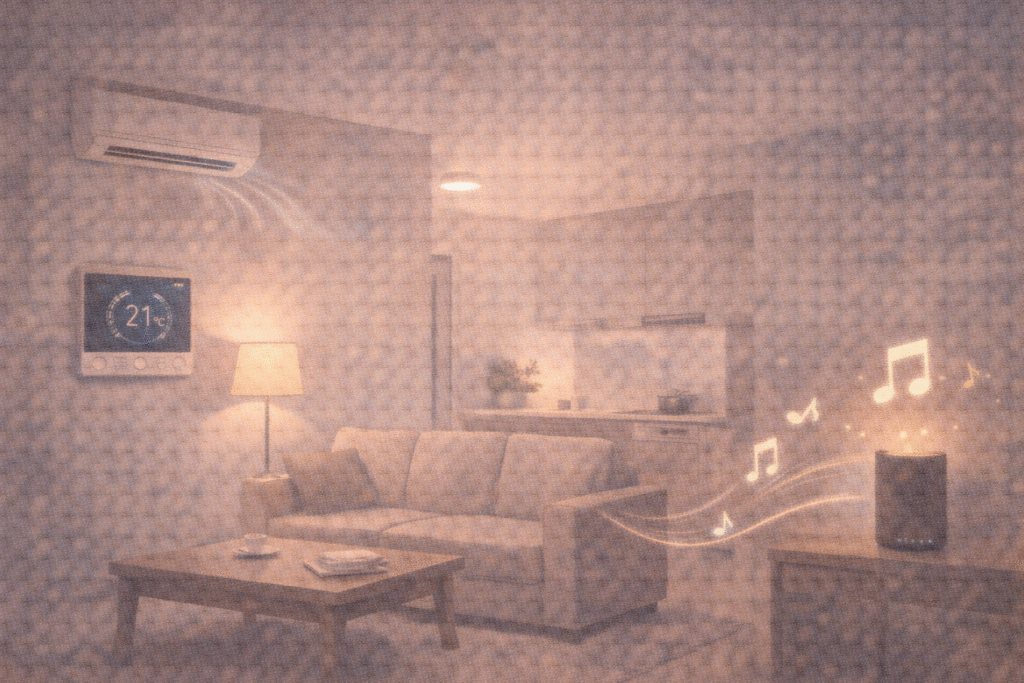
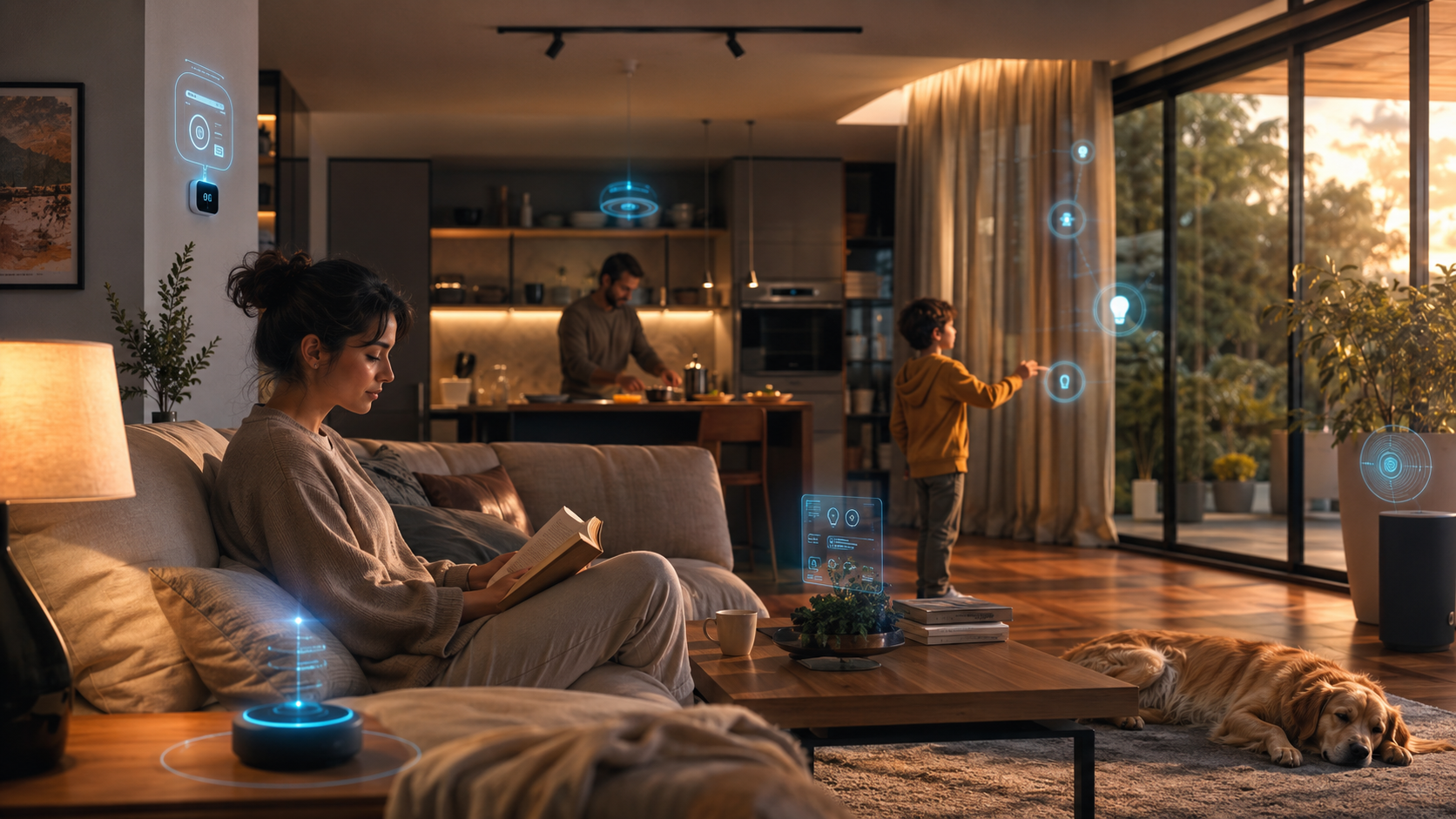
    Automated smart home adjusting daily life without human action

    Everyday life is shaped by countless small decisions.
    What to eat. When to turn off the lights. Whether to lock the door.

    Automation now handles many of these choices without requiring our attention.

    Smart thermostats adjust themselves.
    Lights turn on and off automatically.
    Payments are completed before we consciously register them.

    Nothing is forced.
    Yet something subtle changes.

    Decisions still happen — but we no longer experience ourselves as the ones deciding.
    Convenience replaces deliberation, and ease gradually weakens our sense of agency.

    Automation does not take control away.
    It simply makes control feel unnecessary.


    2. When Algorithms Choose With Us — and For Us
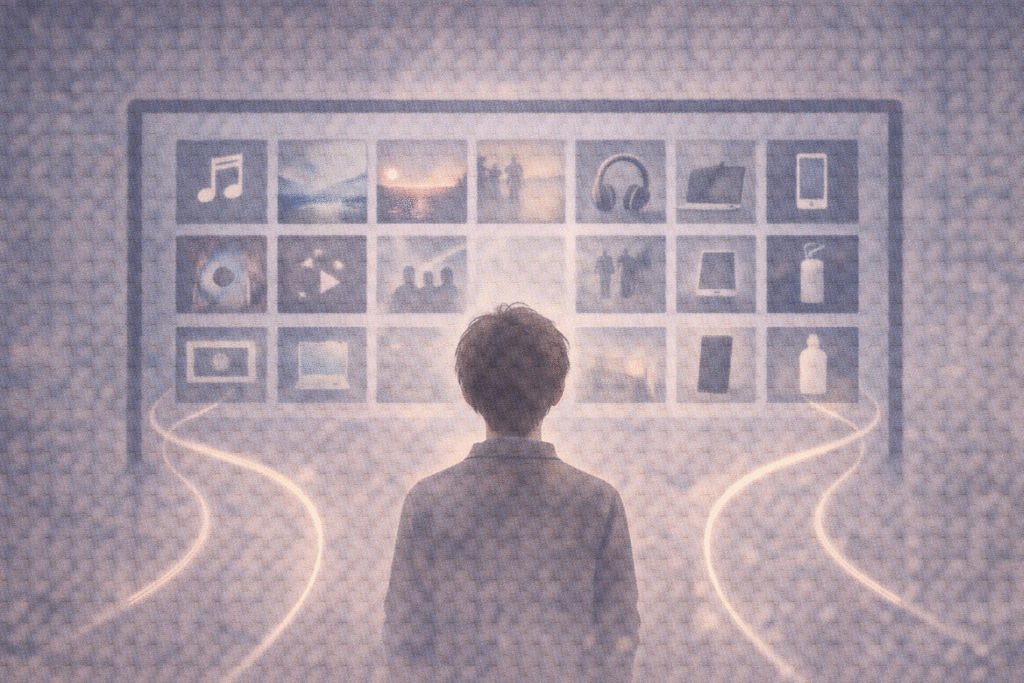
    Algorithmic recommendations shaping personal choices

    Recommendations now guide much of daily life.
    Music, movies, products, even news are selected before we actively search.

    This feels personal.
    But personalization also narrows experience.

    When choices are filtered through the same algorithms, novelty declines.
    We encounter what aligns with our past behavior — not what challenges or surprises it.

    Over time, preference becomes repetition.
    We grow comfortable inside systems that teach us what to want — and then confirm it.

    Convenience, here, quietly transforms freedom into predictability.


    3. Who Is the Automated Home Really For?

    Smart homes promise comfort, efficiency, and security.
    Yet automation does not serve everyone equally.

    Older adults may struggle with unfamiliar interfaces.
    Visually impaired users face touch-screen barriers.
    For some households, smart technology remains inaccessible.

    Automation expands possibility for some —
    while creating new forms of exclusion for others.


    4. Who Owns the Data Behind Convenience?

    Automation relies on constant data collection.

    Smart appliances track habits.
    Voice assistants store speech patterns.
    Location services monitor movement.

    Most of this information is stored beyond users’ direct control.
    We benefit from convenience without fully knowing how our data circulates.

    The hidden cost of automation may not be money —
    but intimacy without transparency.


    5. Familiarity Dulls Reflection

    What once felt innovative now feels normal.

    “It’s just easier.”
    “Everyone uses it.”
    “I couldn’t go back.”

    Familiarity discourages questioning.

    Automation is a tool — but tools shape those who rely on them.
    Without reflection, convenience quietly becomes governance.

    Human agency within an automated technological environment

    Conclusion: Convenience Should Not Replace Conscious Choice

    Smart homes, auto-payments, algorithmic recommendations —
    automation now frames everyday life.

    The question is not whether automation is useful.
    It is whether the things done for us still align with what we value.

    Technology should support human judgment, not quietly replace it.

    Convenience works best when paired with awareness.

    References

    Carr, N. (2014). The Glass Cage: How Our Computers Are Changing Us. W. W. Norton & Company.
    Carr critically examines how automation affects human judgment, attention, and agency. Through examples ranging from aviation to everyday technology, he shows how convenience can weaken our capacity for active decision-making.

    Zuboff, S. (2019). The Age of Surveillance Capitalism: The Fight for a Human Future at the New Frontier of Power. PublicAffairs.
    Zuboff exposes how automated services rely on large-scale data extraction and behavioral prediction. Her work reveals the hidden economic logic behind “smart” technologies and their implications for autonomy and democracy.

    Parisi, L. (Ed.). (2016). Automate This: How Algorithms Came to Rule Our World. Princeton Architectural Press.
    This collection explores how algorithms reshape decision-making, perception, and social life. It provides philosophical insight into how automated systems subtly transform freedom into designed choice.


  • Digital Aging: When Technology Moves Faster Than We Do

    Digital Aging: When Technology Moves Faster Than We Do

    “Where do I click?”
    “Can you show me again? Everything changed after the update.”
    “Is this a DM or a message?”

    Most of us have said—or heard—something like this at least once.

    Technology keeps accelerating, yet many of us experience a quiet, unsettling feeling:
    even without standing still, we somehow fall behind.

    That moment is often described as digital aging.

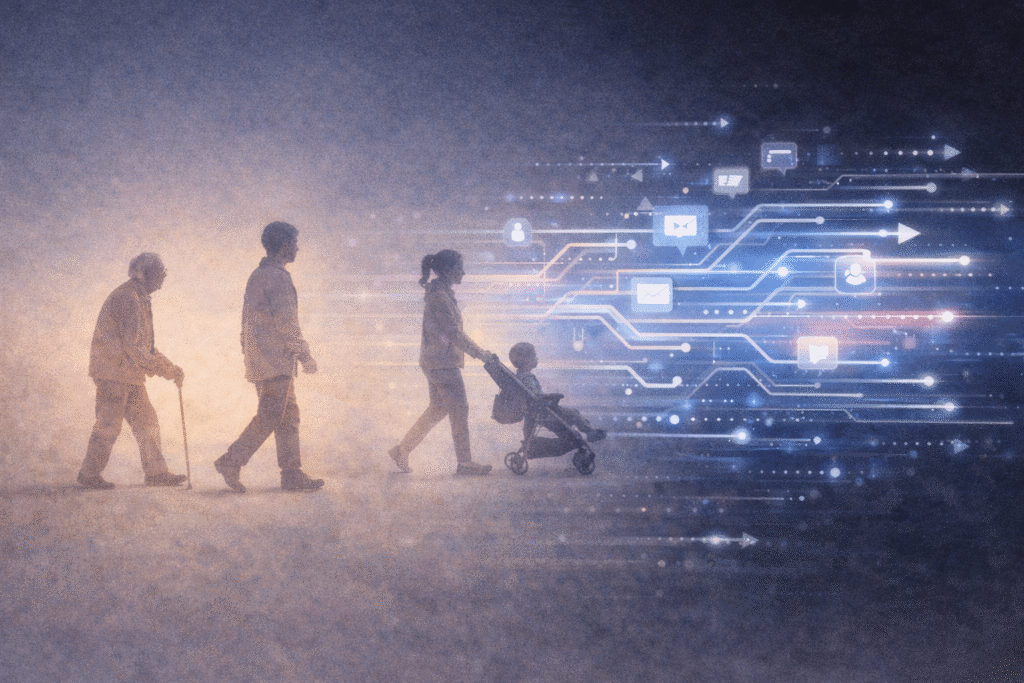
    A person hesitating in front of a complex digital interface, symbolizing digital aging

    1. What Is Digital Aging?

    Digital aging refers to the growing difficulty people experience as technology evolves faster than their ability—or willingness—to adapt.

    This is not simply about chronological age.
    It includes:

    • Feeling disoriented when interfaces change overnight
    • Knowing a feature exists but lacking the energy to relearn it
    • Feeling exhausted by constant updates rather than curious about them
    • Interpreting difficulty as personal failure instead of design overload

    Digital aging is less about incapacity and more about cognitive fatigue caused by relentless change.

    Importantly, this phenomenon affects all age groups.
    Many people in their twenties already describe themselves as “falling behind” certain platforms.


    2. Why Does Technology Evolve Without Waiting for Us?

    Technology claims to aim for convenience and efficiency.
    In practice, however, innovation often prioritizes novelty over familiarity.

    Common patterns include:

    • Menus relocating after updates
    • Essential settings buried deeper in interfaces
    • Gestures replacing buttons
    • Voice commands replacing visual cues

    Most digital systems are designed with speed-oriented, highly adaptable users in mind.
    As a result, those who value stability or need more time are unintentionally excluded.

    The message becomes subtle but clear:
    This system was not designed for you.

    Technology advancing faster than people, showing the growing digital gap

    3. How Technology Creates New Generational Divides

    Today, generational gaps are shaped less by age and more by technological fluency.

    • Some grew up before the internet
    • Some adapted during its expansion
    • Others have never known a world without smartphones

    Even within the same age group, digital confidence can vary dramatically depending on professional exposure, learning opportunities, and cultural context.

    Technology no longer just reflects generational difference—it produces it.


    4. From Discomfort to Digital Exclusion

    Digital aging becomes socially significant when it leads to exclusion.

    Examples include:

    • Older adults unable to use self-service kiosks
    • People missing invitations because communication moved to unfamiliar platforms
    • Students falling behind due to unfamiliar digital tools
    • Workers struggling with AI-driven systems introduced without support

    Over time, repeated difficulty can erode confidence and create avoidance.

    The psychological barrier often becomes stronger than the technical one.

    Inclusive digital design allowing people of all ages to use technology comfortably

    5. Can Technology Slow Down for Humans?

    There is growing recognition of the need for digital inclusion.

    Encouraging developments include:

    • Simplified device modes
    • Accessibility-focused design standards
    • Larger text and clearer interfaces
    • Digital literacy programs for all ages

    True inclusion, however, requires more than features.
    It requires design that respects human pacing, not just technological capability.

    Progress should not mean leaving people behind.


    Conclusion: Falling Behind Is a Shared Experience

    Digital aging is not a personal weakness.
    It is a structural consequence of rapid innovation without sufficient care.

    Everyone experiences moments of falling behind.

    The question is not whether technology advances—but whether it advances with people, not past them.

    You do not need to master every new tool.
    What matters is preserving curiosity without shame and designing systems that value humans as much as efficiency.

    Digital society becomes more humane when it moves at a pace people can actually live with.

    A Question for You

    Have you ever felt left behind by technology—
    even when you were trying your best to keep up?

    Related Reading

    The exhaustion that follows moral expectation connects to broader reflections on social pressure discussed in The Praise-Driven Society: Recognition and Self-Worth in the Digital Age.

    Similar emotional dynamics in daily life are also explored in How Social Media Amplifies Feelings of Lack and Comparison.

    The gap between technological progress and human adaptation is also evident in education, where AI reshapes how learning occurs (see The Paradox of AI Education).

    References

    1. Selwyn, N. (2004). Adult Learning in the Digital Age: Information Technology and the Learning Society. London: Routledge.
    This book examines how adults engage with rapidly evolving digital technologies and highlights structural inequalities in access, skills, and confidence. Selwyn emphasizes that difficulties with technology are not individual failures but socially produced gaps shaped by design, education, and policy. It provides a foundational framework for understanding digital aging beyond chronological age.

    2. Prensky, M. (2001). Digital Natives, Digital Immigrants. On the Horizon, 9(5).
    Prensky introduces the influential distinction between “digital natives” and “digital immigrants,” arguing that generational exposure to technology shapes thinking patterns and learning styles. While widely cited, this work is best read as a starting point for debates on digital generational gaps rather than a definitive explanation.

    3. Bennett, S., Maton, K., & Kervin, L. (2008). The ‘Digital Natives’ Debate: A Critical Review of the Evidence. British Journal of Educational Technology, 39(5), 775–786.
    This critical review challenges the oversimplified native–immigrant divide, showing that digital competence varies widely within age groups. The authors argue that social, educational, and cultural factors matter more than age alone, offering an important corrective perspective for discussions of digital aging and inclusion.

  • Algorithmic Bias: How Recommendation Systems Narrow Our Worldview

    Algorithmic Bias: How Recommendation Systems Narrow Our Worldview

    1. Do Algorithms Have “Preferences”?

    A person viewing a personalized digital feed shaped by recommendation algorithms

    Behind platforms we use every day—YouTube, Netflix, Instagram—are recommendation algorithms working silently.
    Their task seems simple: to show content we are likely to enjoy.

    The problem is that these recommendations are not neutral.

    Algorithms analyze what we click, what we watch longer, and what we like.
    Based on these patterns, they decide what to show next.
    It is as if a well-meaning but stubborn friend keeps saying,
    “You liked this, so you’ll like more of the same.”


    2. Filter Bubbles and Echo Chambers

    When recommendations repeat similar content, a phenomenon known as the filter bubble emerges.
    A filter bubble traps users inside a limited set of information, filtering out alternative views.

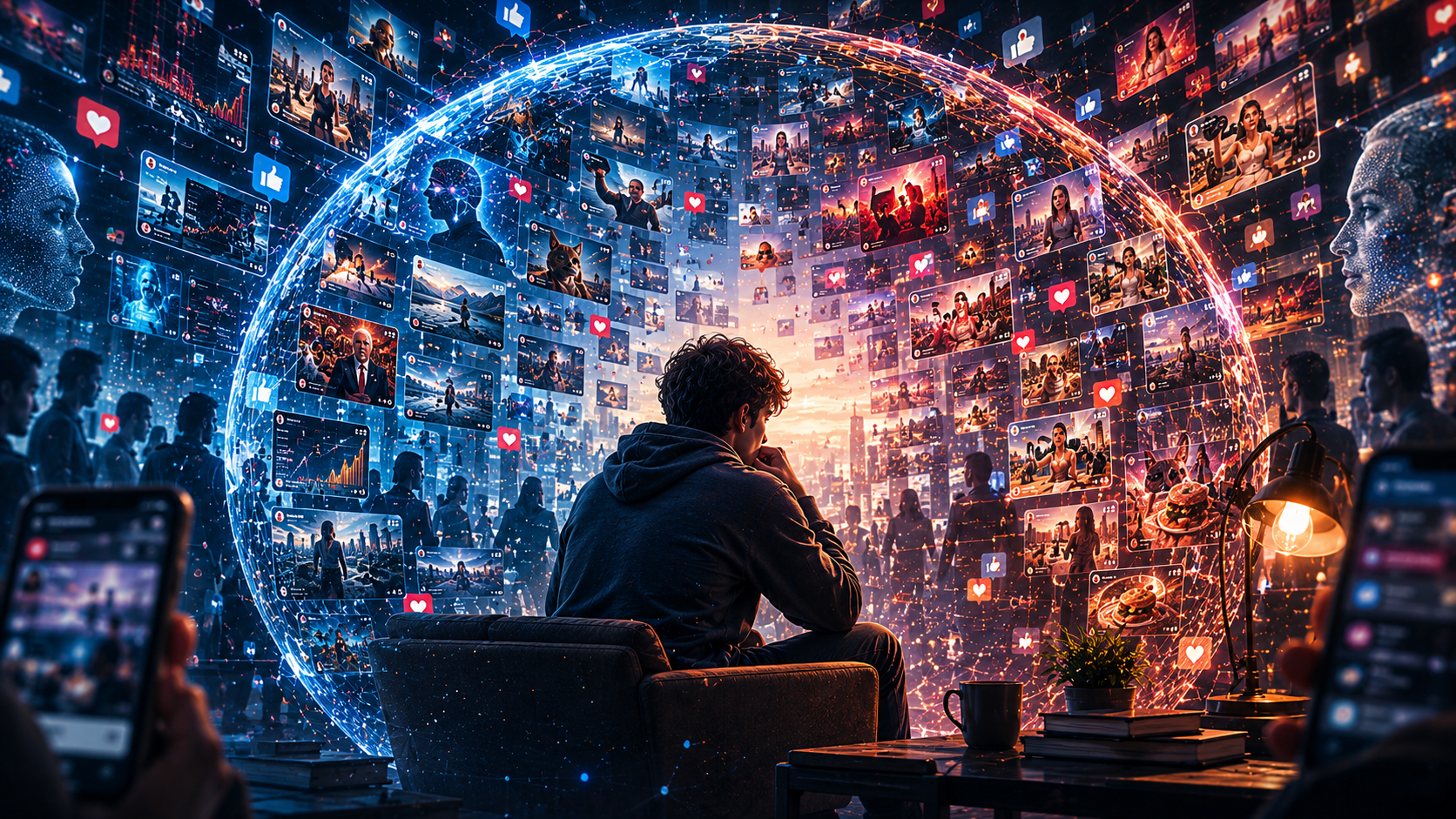
    A figure inside a transparent bubble surrounded by repeated information patterns

    For example, if someone repeatedly watches videos supporting a particular political candidate,
    the algorithm is likely to recommend more favorable content about that candidate—
    while opposing perspectives quietly disappear.

    This effect becomes stronger when combined with an echo chamber,
    where similar opinions are repeated and amplified.
    Like sound bouncing inside a hollow space, the same ideas echo back,
    gradually transforming opinions into unshakable beliefs.


    3. How Worldviews Become Narrower

    Algorithmic bias does more than simply provide skewed information.

    • Reinforced confirmation bias: People encounter only ideas that match what they already believe.
    • Loss of diversity: Opportunities to discover unfamiliar interests or viewpoints decrease.
    • Social fragmentation: People in different filter bubbles struggle to understand one another,
      fueling political polarization and cultural conflict.

    Consider someone who frequently watches videos about vegetarian cooking.
    Over time, the algorithm recommends only plant-based recipes and content emphasizing the harms of meat consumption.
    Eventually, this person may come to see meat-eating as entirely wrong,
    leading to friction when interacting with people who hold different dietary views.


    4. Why Does This Happen?

    The primary goal of recommendation algorithms is not user understanding, but engagement.
    The longer users stay on a platform, the more profitable it becomes.

    Content that triggers strong reactions—likes, comments, prolonged viewing—gets prioritized.
    Since people naturally spend more time on content that aligns with their beliefs,
    algorithms “learn” to reinforce those patterns.

    In this feedback loop, personalization slowly turns into polarization.


    5. How Can We Respond?

    Escaping algorithmic bias does not require abandoning technology, but using it more consciously.

    • Consume diverse content intentionally: Seek out unfamiliar topics or opposing viewpoints.
    • Reset or limit personalized recommendations when platforms allow it.
    • Practice critical thinking: Ask, “Why was this recommended to me?” and “What perspectives are missing?”
    • Use multiple sources: Check the same issue across different platforms and media outlets.
    A person standing before multiple paths representing diverse perspectives

    Conclusion

    Recommendation algorithms are powerful tools that efficiently connect us with information and entertainment.
    However, when their built-in biases go unnoticed, they can quietly narrow our understanding of the world.

    Technology itself is not the enemy.
    The real challenge lies in maintaining awareness and balance.

    Even in the age of algorithms,
    the responsibility to broaden our perspective—and the power to choose—still belongs to us.

    A Question for Readers

    If algorithms continuously show us only what we already prefer, are they helping us understand the world more clearly—

    or quietly limiting the range of perspectives we are able to see?


    Related Reading

    The cognitive framing power of digital interfaces is examined further in How Search Boxes Shape the Way We Think.

    These technical patterns also raise deeper philosophical questions addressed in If AI Can Predict Human Desire, Is Free Will an Illusion?

    References

    1. Pariser, E. (2011). The Filter Bubble: What the Internet Is Hiding from You.
      This book popularized the concept of the filter bubble, explaining how personalized algorithms limit exposure to diverse information and intensify social division.
    2. O’Neil, C. (2016). Weapons of Math Destruction: How Big Data Increases Inequality and Threatens Democracy.
      O’Neil analyzes how algorithmic systems reinforce bias, deepen inequality, and undermine democratic values through real-world examples.
    3. Noble, S. U. (2018). Algorithms of Oppression: How Search Engines Reinforce Racism.
      This work examines how search and recommendation algorithms can reproduce structural social biases, particularly related to race and gender.
  • Algorithmic Bias

    Algorithmic Bias

    How Recommendation Systems Narrow Our Worldview

    1. Do Algorithms Have “Preferences”?

    Personalized content feed shaped by recommendation algorithms

    We interact with recommendation algorithms every day—on platforms like YouTube, Netflix, and Instagram. These systems are designed to show us content we are likely to enjoy. At first glance, this seems helpful and efficient.

    However, the problem lies in the assumption that these recommendations are neutral. They are not.

    Algorithms analyze what we click on, how long we watch a video, which posts we like, and what we scroll past. Based on these patterns, they decide what to show us next. Over time, certain interests and viewpoints are repeatedly reinforced.

    In effect, the algorithm behaves like a well-meaning but stubborn friend who keeps saying, “You liked this before, so this is all you need to see.”


    2. Filter Bubbles and Echo Chambers

    As recommendations repeat, a phenomenon known as the filter bubble begins to form. A filter bubble refers to a situation in which we are exposed only to a narrow slice of available information.

    For example, if someone frequently watches videos supporting a particular political candidate, the algorithm will prioritize similar content. Gradually, opposing viewpoints disappear from that person’s feed.

    When this filter bubble combines with an echo chamber, the effect becomes stronger. An echo chamber is an environment where similar opinions circulate and reinforce one another. Hearing the same ideas repeatedly makes them feel more certain and unquestionable—even when alternative perspectives exist.

    Filter bubble created by algorithmic recommendation systems

    3. How Worldviews Become Narrower

    The bias built into recommendation systems affects more than just the content we consume.

    First, it strengthens confirmation bias. We are more likely to accept information that aligns with our existing beliefs and dismiss what challenges them.

    Second, it reduces diversity of exposure. Opportunities to encounter unfamiliar ideas, cultures, or values gradually diminish.

    Third, it can intensify social division. People living in different filter bubbles often struggle to understand why others think differently. This dynamic contributes to political polarization, cultural conflict, and generational misunderstandings.

    Consider a simple example. If someone frequently watches videos about vegetarian cooking, the algorithm will increasingly recommend content praising vegetarianism and criticizing meat consumption. Over time, the viewer may come to believe that eating meat is unquestionably wrong, making constructive dialogue with others more difficult.


    4. Why Does This Happen?

    The primary goal of most platforms is not user enlightenment, but engagement. The longer users stay on a platform, the more advertising revenue it generates.

    Content that provokes strong reactions—agreement, outrage, or emotional attachment—keeps users engaged for longer periods. Since people tend to engage more with content that confirms their beliefs, algorithms learn to prioritize such material.

    As a result, bias is not intentionally programmed in a moral sense, but it emerges structurally from the system’s incentives.


    5. How Can We Respond?

    Although we cannot fully escape algorithmic systems, we can respond more thoughtfully.

    • Consume diverse content intentionally: Seek out topics and perspectives you normally avoid.
    • Adjust or reset recommendations: Some platforms allow users to limit or reset personalized suggestions.
    • Practice critical reflection: Ask yourself, “Why was this recommended to me?” and “What viewpoints are missing?”
    • Use multiple sources: Compare information across different platforms and media outlets.

    These small habits can help restore balance to our information diets.


    Conclusion

    Critical awareness of algorithmic bias in digital media

    Recommendation algorithms are powerful tools that connect us efficiently to information and entertainment. Yet, if we remain unaware of their built-in biases, our view of the world can slowly shrink.

    Technology itself is not the enemy. The challenge lies in how consciously we engage with it. In the age of algorithms, maintaining curiosity, openness, and critical thinking is essential.

    Ultimately, even in a data-driven world, the responsibility for perspective and judgment still belongs to us.

    A Question for Readers

    If algorithms continuously reinforce what we already believe and prefer, are they helping us understand the world more efficiently—

    or gradually limiting our ability to encounter different perspectives and ideas?

    Related Reading

    Technologies originally designed to serve human convenience increasingly shape perception, attention, and behavior.
    Do Humans Control Technology explores how technological systems influence modern human life beyond conscious awareness.

    Algorithms not only filter information but also shape how reality is categorized and interpreted.
    The Power of Naming examines how language and classification influence social understanding and power structures.


    References

    1. Pariser, E. (2011). The Filter Bubble: What the Internet Is Hiding from You. New York: Penguin Press.
    → This book popularized the concept of the filter bubble, explaining how personalized algorithms can limit exposure to diverse information and deepen social divisions.

    2.O’Neil, C. (2016). Weapons of Math Destruction: How Big Data Increases Inequality and Threatens Democracy. New York: Crown.
    → O’Neil examines how large-scale algorithms, including recommendation systems, can reinforce bias and inequality under the appearance of objectivity.

    3.Noble, S. U. (2018). Algorithms of Oppression: How Search Engines Reinforce Racism. New York: NYU Press.
    → This work provides a critical analysis of how algorithmic systems can reproduce social prejudices, particularly regarding race and gender.

  • How Search Boxes Shape the Way We Think

    How Search Boxes Shape the Way We Think

    The Invisible Influence of Algorithms in the Digital Age

    Every day, billions of questions begin with a search box.

    We type a few words,
    receive suggestions,
    and follow links that appear almost instantly.

    But what if the search box is shaping our thoughts
    before we even finish the question?

    Search box autocomplete shaping user questions

    1. When Search Boxes Decide the Question

    Search boxes do more than provide answers.
    They subtly change the way we ask questions in the first place.

    Think about autocomplete features.
    You begin typing “today’s weather,” and before finishing, the search box suggests
    “today’s weather air pollution.”

    Without intending to, your attention shifts.
    You were looking for the weather, but now you are thinking about air quality.

    Autocomplete does not simply predict words.
    It redirects thought.
    Questions that once originated in your mind quietly become questions proposed by an algorithm.


    2. How Search Results Shape Our Thinking

    Algorithmic bias in ranked search results

    Search results are not neutral lists.
    They are ranked, ordered, and designed to capture attention.

    Most users focus on the first page—often only the top few results.
    Information placed at the top is easily perceived as more accurate, reliable, or “true.”

    For example, when searching for a diet method, if the top results emphasize dramatic success,
    we tend to accept that narrative, even when contradictory evidence exists elsewhere.

    In this way, search results do not merely reflect opinions.
    They actively guide the direction of our thinking.


    3. The Invisible Power Behind the Search Box

    At first glance, a search box appears to be a simple input field.
    Behind it, however, lie powerful algorithms shaped by commercial and institutional interests.

    Sponsored content often appears at the very top of search results.
    Even when labeled as advertisements, users unconsciously associate higher placement with credibility.

    As a result, companies invest heavily to secure top positions,
    knowing that visibility translates directly into trust and choice.

    Our decisions—what we buy, read, or believe—are often influenced
    long before we realize it.


    4. Search Boxes Across Cultures and Nations

    Search engines differ across countries and cultures.
    Google dominates in the United States, Naver in South Korea, Baidu in China.

    Searching the same topic on different platforms can yield strikingly different narratives,
    frames, and priorities.

    A historical event, for instance, may be presented through contrasting lenses depending on the search environment.

    We do not simply search the world as it is.
    We see the world through the window our search box provides—and each window has its own tint.


    5. Learning to Question the Search Box

    How can we avoid being confined by algorithmic guidance?

    The answer lies in cultivating critical habits:

    • Ask whether an autocomplete suggestion truly reflects your original question
    • Look beyond the top-ranked results
    • Compare information across platforms and languages

    These small practices widen the intellectual space in which we think.

    Critical awareness of algorithmic influence

    Conclusion

    Search boxes are not passive tools for finding answers.
    They shape questions, guide attention, and quietly train our ways of thinking.

    In the digital age, the challenge is not to reject these tools,
    but to use them without surrendering our autonomy.

    True digital literacy begins when we recognize
    that the most powerful influence of a search box
    lies not in the answers it gives,
    but in the questions it encourages us to ask.

    A Question for You

    Have you ever searched for something—and felt the results were guiding your thinking?

    If what you see is filtered,
    how much of your thinking is truly your own?


    Related Reading

    The invisible filtering mechanisms behind everyday searches are explored further in
    Algorithmic Bias: How Recommendation Systems Narrow Our Worldview, where digital systems subtly shape what we see and how we interpret information.

    The fragility of human perception goes even deeper in
    If Memory Can Be Manipulated, What Can We Really Trust?,
    which examines how memory itself can be altered, raising fundamental questions about truth, identity, and reality.

    Digital participation is not shaped by citizens alone; it is also shaped by the systems that guide attention.
    This issue is further explored in Clicktivism in Digital Democracy: Participation or Illusion?, where online political action is examined as both a new form of participation and a possible substitute for deeper engagement.

    References

    Pariser, E. (2011). The Filter Bubble: What the Internet Is Hiding from You. New York: Penguin Press.
    → Explores how personalized algorithms narrow users’ worldviews while shaping perception and judgment.

    Noble, S. U. (2018). Algorithms of Oppression: How Search Engines Reinforce Racism. New York: NYU Press.
    → Critically examines how search engines reflect and amplify social biases rather than remaining neutral tools.

    Beer, D. (2009). Power through the Algorithm? New Media & Society, 11(6), 985–1002.
    → Analyzes algorithms as invisible forms of power that structure everyday cultural practices.

  • Children Born in Laboratories?

    Children Born in Laboratories?

    The Ethics and Controversies of Artificial Wombs

    Artificial womb technology redefining human birth

    1. What Is an Artificial Womb?

    Technology Crossing the Boundary of Life

    An artificial womb (ectogenesis) is a system designed to sustain embryonic or fetal development outside the human body, reproducing essential physiological functions such as oxygen exchange and nutrient delivery.

    Once considered a miracle of nature, human birth is now approaching a technological threshold.
    Recent experiments in Japan and the United States have sustained animal fetuses in artificial wombs, raising the possibility that gestation may no longer be confined to the human body. While researchers emphasize medical benefits—especially for extremely premature infants—this shift introduces a deeper ethical question:

    If human life can begin in a laboratory, who—or what—decides that life should exist?

    This question signals a transformation of birth itself—from a biological event to a social, ethical, and political decision shaped by technology.

    2. Reproductive Rights Revisited

    Parental Choice or Social Authority?

    Reproductive rights have long been tied to bodily autonomy, especially that of women.
    Debates over abortion, IVF, and surrogacy have centered on one question:

    Who has the right to decide whether life begins?

    Artificial wombs radically alter this framework.
    Gestation no longer requires a pregnant body.
    As a result, reproduction may be separated from physical vulnerability altogether.

    This could expand reproductive possibilities—for infertile individuals, same-sex couples, or single parents.
    But it also raises a troubling possibility: does the right to have a child become a right to produce a child?

    When reproduction is technologically mediated, life risks becoming a project of desire, efficiency, or entitlement rather than responsibility.

    Ethical decision making in artificial gestation

    3. State and Corporate Power

    Is Life a Public Good or a Managed Resource?

    If artificial wombs become viable at scale, who controls them?

    Governments may intervene in the name of safety and regulation.
    Corporations may dominate through patents, infrastructure, and pricing.
    In either case, control over birth may concentrate in the hands of those who control the technology.

    Imagine a future in which:

    • Access to artificial wombs depends on cost or eligibility,
    • Certain embryos are prioritized over others,
    • Reproduction becomes subject to institutional approval.

    In such a world, birth risks shifting from a human right to a managed resource.

    When life becomes trackable, optimizable, and governable, it may lose its moral inviolability and become another system output.


    4. A New Ethical Question

    Is Life “Given,” or Is It “Made”?

    Artificial wombs force us to confront a fundamental moral dilemma:

    Is it ethically permissible for humans to manufacture the conditions of life?

    Natural birth involves contingency, vulnerability, and unpredictability.
    Ectogenesis replaces chance with planning, and emergence with design.

    Life becomes not something received, but something produced.

    This challenges traditional ethical concepts such as the sanctity of life.
    Some argue that technological power demands a new ethics of responsibility:
    If humans can create life, they must also bear full moral responsibility for its consequences.

    Technology expands possibility—but ethics must decide restraint.


    Conclusion

    Who Chooses That a Life Should Begin?

    Questioning who decides human life

    Artificial wombs represent humanity’s first attempt to fully externalize gestation.
    They promise reduced physical risk, expanded reproductive options, and medical progress.

    Yet they also carry the danger of turning life into an object of control, ownership, and optimization.

    Ultimately, the debate is not only about technology.
    It is about meaning.

    Is human life something we design, or something we are obligated to protect precisely because it is not designed?

    As technology accelerates, society must ensure that ethical reflection moves faster—not slower—than innovation.

    A Question for Readers

    If technology could completely replace pregnancy in the future, would human birth still carry the same meaning it does today?

    Or would life gradually become something designed, managed, and produced?

    Related Reading

    Artificial womb technology raises questions about whether human life itself may become technologically designed.
    AI Beauty Standards and Human Diversity explores how algorithms are already reshaping human identity, appearance, and social values through technological standards.

    As technology increasingly transforms human experiences into measurable and manageable systems, even birth itself risks becoming subject to optimization and social expectation.
    When Experience Becomes Competition explores how modern society turns deeply human experiences into objects of comparison, performance, and control.


    References

    1. Gelfand, S., & Shook, J. (2006). Ectogenesis: Artificial Womb Technology and the Future of Human Reproduction. Amsterdam: Rodopi.
      → A foundational philosophical analysis of artificial womb technology, examining how ectogenesis reshapes concepts of birth, agency, and responsibility.
    2. Scott, R. (2002). Rights, Duties and the Body: Law and Ethics of the Maternal-Fetal Conflict. Oxford: Hart Publishing.
      → Explores legal and ethical tensions between bodily autonomy and fetal interests, offering critical insights into reproductive technologies.
    3. Kendal, E. S. (2022). “Form, Function, Perception, and Reception: Visual Bioethics and the Artificial Womb.” Yale Journal of Biology and Medicine, 95(3), 371–377.
      → Analyzes how the visual representation of artificial wombs shapes public ethical perception of life and technology.
    4. De Bie, F., Kingma, E., et al. (2023). “Ethical Considerations Regarding Artificial Womb Technology for the Fetonate.” The American Journal of Bioethics, 23(5), 67–78.
      → A contemporary ethical assessment focusing on responsibility, care, and social implications of ectogenesis.
    5. Romanis, E. C. (2018). “Artificial Womb Technology and the Frontiers of Human Reproduction.” Medical Law Review, 26(4), 549–572.
      → Discusses legal and moral boundaries of artificial gestation, especially the shifting definition of pregnancy and parenthood.