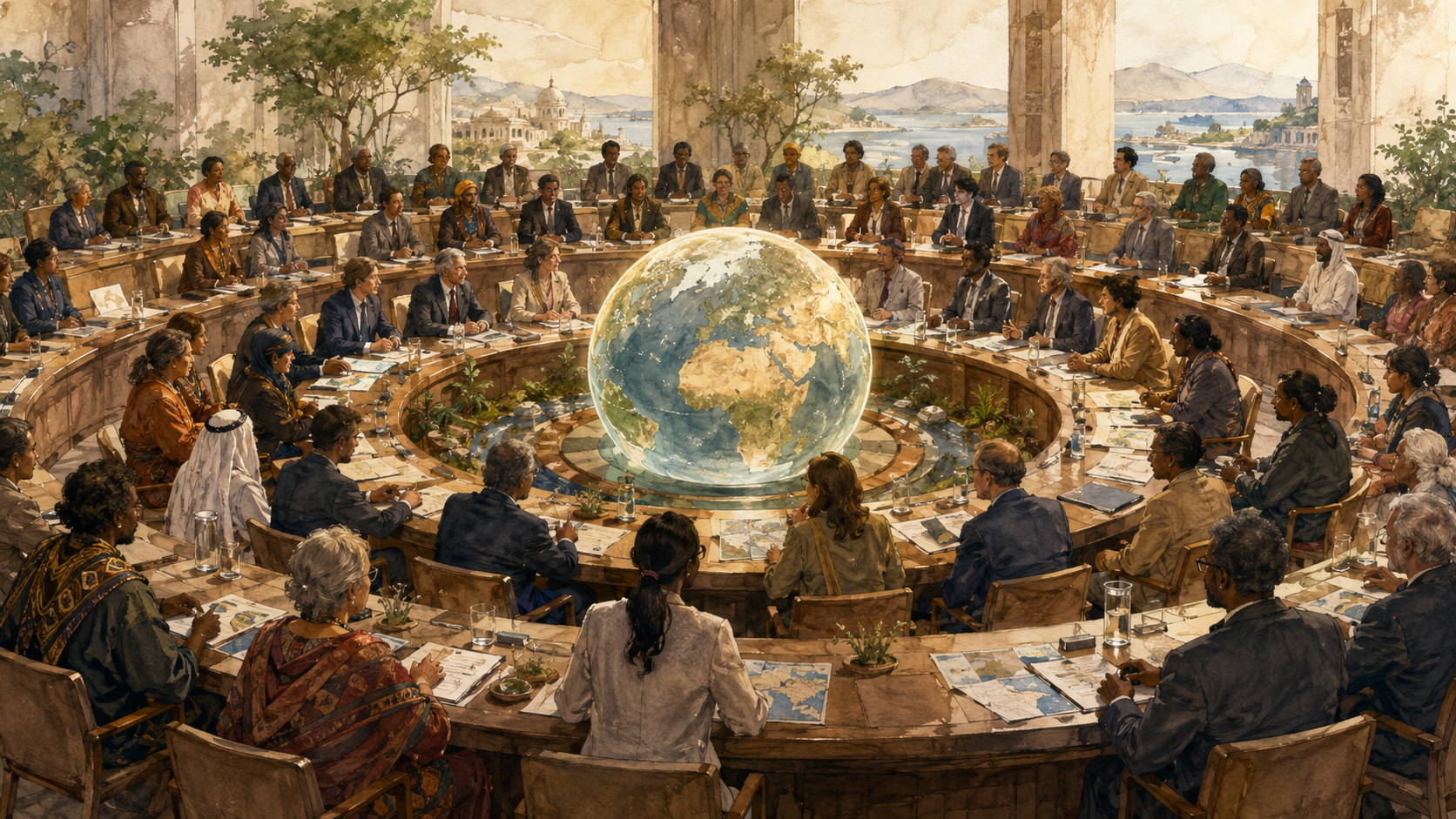
Global Problems Need Global Cooperation, but Should Humanity Ever Be Governed by a Single Political Authority?
Climate change does not stop at national borders.
Neither do pandemics, financial crises, cyberattacks, refugee movements, nuclear risks, or the consequences of rapidly developing artificial intelligence.
Many of humanity’s greatest problems are global.
Our political institutions, however, remain largely national.
Nearly 200 sovereign states maintain their own governments, laws, borders, militaries, economic interests, and political identities.
This creates an obvious question:
If our biggest problems are global, why don’t we have a global government capable of solving them?
At first glance, a world government might seem attractive. It could potentially coordinate climate policy, reduce international conflict, establish common standards, and respond more effectively to global crises.
But concentrating political authority at the planetary level would create another set of problems.
Who would govern?
Who would elect them?
Which laws and values would prevail?
And perhaps most importantly:
What would happen if a world government itself became oppressive?
The absence of world government may therefore reveal not simply humanity’s inability to cooperate, but a fundamental tension between global cooperation and political freedom.
1. What Would a World Government Actually Mean?
A world government would be fundamentally different from international cooperation.
Today, states sign treaties, participate in international organizations, and agree to common rules. But they generally retain sovereignty—the ultimate authority to govern their own territories and populations.
A genuine world government would go much further.
It would require some form of political authority capable of making and enforcing decisions across national borders.
That distinction matters when considering the United Nations.
The United Nations is sometimes imagined as an early version of a world government, but it is not one.
The UN depends fundamentally on its member states. It cannot normally tax individuals worldwide, enact ordinary domestic legislation, or independently command the governments of sovereign countries in the way a national government governs its citizens.
This limitation can be frustrating.
But it also reflects a deliberate principle of the existing international system:
states have not surrendered ultimate political authority to a global sovereign.
2. Why Would Nations Give Up Their Sovereignty?
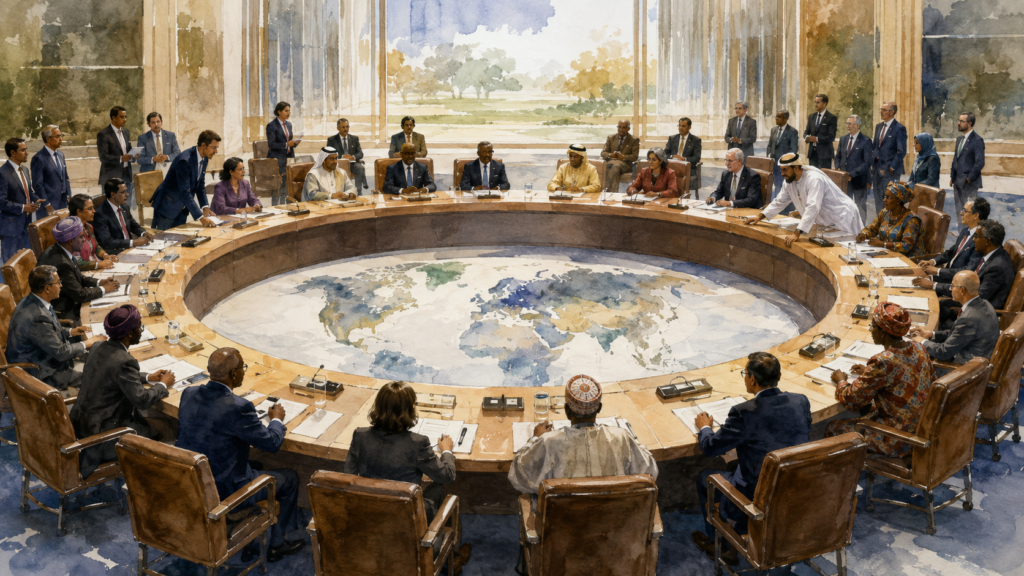
Sovereignty is one of the greatest obstacles to world government.
Governments make decisions about taxation, education, welfare, immigration, criminal law, defense, economic policy, and countless other issues.
Transferring substantial authority to a world government would mean surrendering some of that control.
Even countries that cooperate closely are reluctant to do this.
The European Union provides perhaps the most important contemporary example.
European integration has produced a single market, common institutions, extensive common rules, and—for many members—a shared currency.
Yet EU member states remain sovereign countries with their own governments, political cultures, welfare systems, foreign-policy interests, and national identities.
Disagreements over migration, budgets, regulation, defense, and the distribution of authority between national and European institutions demonstrate how difficult deep political integration can be even among geographically connected states with substantial institutional cooperation.
If political integration remains contested within Europe, integrating the entire planet would be vastly more difficult.
3. Can One Government Represent Humanity’s Cultural Diversity?
Humanity does not constitute a single cultural community.
Thousands of languages are spoken across the world. Religious traditions differ. Historical experiences differ. Ideas about family, education, individual rights, community, authority, and social responsibility can vary considerably.
Cultural diversity does not make global cooperation impossible.
But it makes legitimate global rule extraordinarily complicated.
Suppose a world parliament created common laws concerning education, religious expression, family policy, speech, or cultural practices.
Whose values should shape those laws?
A rule regarded as progressive in one society might be regarded as intrusive in another.
Conversely, defending cultural autonomy cannot justify every practice simply because it is traditional. Universal human rights themselves sometimes conflict with claims based on cultural or national sovereignty.
This creates one of the deepest problems facing any hypothetical world government:
How could humanity establish common political rules without turning cultural difference into political uniformity?
A functioning global political order would need not only institutions but also a way of protecting diversity within those institutions.
4. Who Would Pay—and Who Would Benefit?
Economic inequality creates another formidable obstacle.
Countries differ enormously in income, infrastructure, demographic conditions, natural resources, historical responsibility for environmental damage, and capacity to finance public services.
Climate change illustrates the difficulty.
Countries broadly agree that global warming requires collective action.
But agreement becomes harder when the discussion turns to responsibility.
How rapidly should different countries reduce emissions?
Should countries that industrialized earlier bear greater costs?
How much financial assistance should wealthier countries provide to developing economies?
How should the right to economic development be balanced against planetary environmental limits?
These disputes reveal a larger political reality.
Global problems may be shared, but their costs and benefits are rarely distributed equally.
A world government would therefore face questions familiar to every national welfare state—but on a dramatically larger scale.
Would there be global taxation?
Global redistribution?
Common social protections?
Transfers from wealthier regions to poorer ones?
The political conflicts surrounding redistribution within individual countries suggest how difficult such decisions would become at a planetary scale.
5. Would a World Government Prevent War—or Create a More Dangerous Concentration of Power?
One of the strongest arguments for world government is peace.
If sovereign states no longer possessed independent armies capable of fighting one another, interstate war might theoretically become far more difficult.
A single global authority could replace international military competition with a common security system.
But this solution creates a disturbing counter-question.
Who controls the global authority?
Political systems normally contain competing institutions, elections, courts, constitutions, local governments, civil society, and other mechanisms intended to limit power.
At the international level, sovereign states themselves also act as separate centers of power.
Under a world government, much of that ultimate authority could be concentrated in a single political structure.
If such a government became authoritarian, there might be no external sovereign power capable of resisting it.
This is the central paradox.
A world government might reduce the danger of wars between states while increasing the potential danger of global political domination.
The problem is therefore not merely whether humanity could create a world government.
It is whether humanity could create one powerful enough to govern the planet while remaining sufficiently limited to protect freedom.
6. Who Would Be a Citizen of the World?
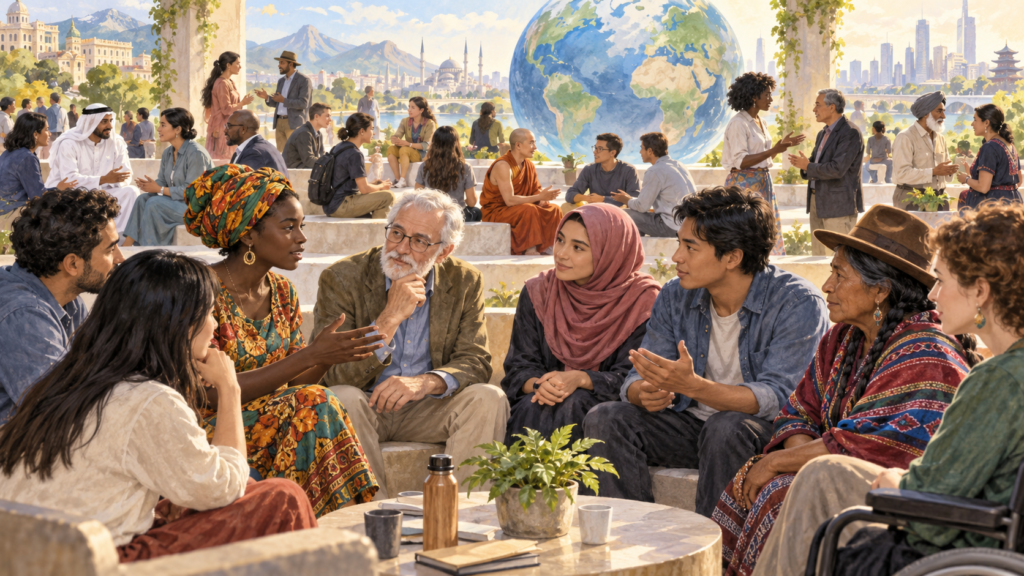
There is also a question that discussions of world government sometimes overlook:
What would citizenship mean?
Citizenship is not simply possession of a passport.
It involves rights, responsibilities, political participation, belonging, and some understanding of membership in a political community.
From the perspective of citizenship education, this creates a profound challenge.
In a world government, would people primarily understand themselves as citizens of humanity, or would national and local identities remain politically fundamental?
Could a farmer in Kenya, a teacher in Korea, a factory worker in Germany, and a software engineer in Brazil realistically feel represented by the same global political institutions?
Democracy requires more than elections.
Citizens need meaningful opportunities to understand public issues, debate competing interests, hold representatives accountable, and believe that political institutions are responsive to them.
At a planetary scale, the distance between citizen and government could become enormous.
The challenge would therefore be not simply to create global citizenship, but to ensure that global citizenship remained compatible with local participation, cultural pluralism, and democratic accountability.
A democratic world order would almost certainly need multiple layers of governance rather than one enormous centralized administration.
7. Do We Need World Government—or Better Global Governance?
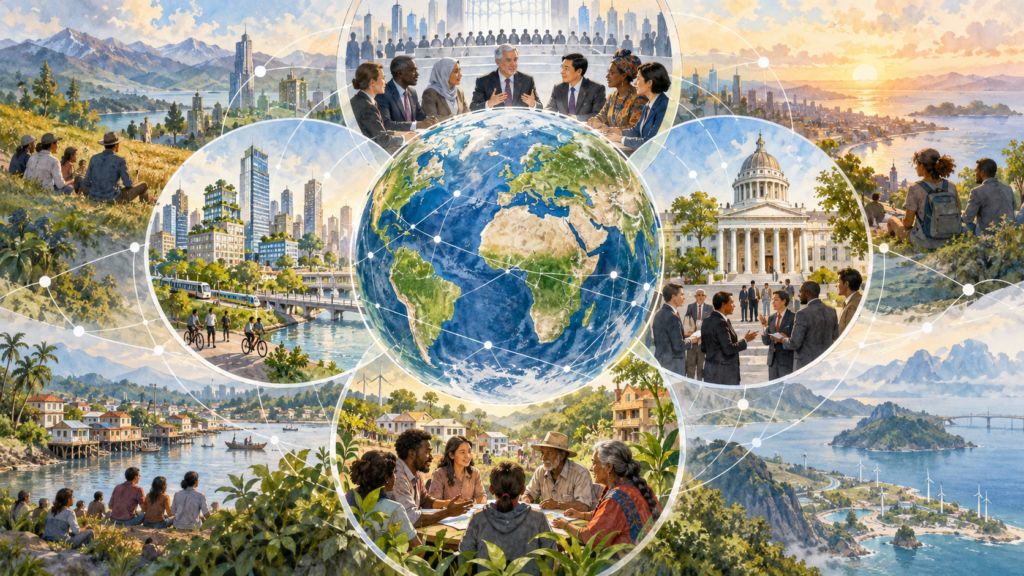
Perhaps the real choice is not between complete national sovereignty and a single world state.
There is a middle path:
global governance without global government.
We already see elements of this system.
States cooperate through international organizations, treaties, courts, scientific networks, economic institutions, regional organizations, and issue-specific agreements.
These arrangements are imperfect.
Countries can refuse cooperation. Powerful states often have greater influence. Enforcement can be weak. International institutions can become bureaucratic or politically divided.
Yet decentralized global governance has one important advantage.
It allows cooperation to deepen in areas where collective action is necessary without requiring humanity to transfer all political authority to a single institution.
Climate policy might require stronger international coordination.
Pandemic preparedness may require rapid global information sharing.
Artificial intelligence may eventually require international safety standards.
Nuclear weapons require arms-control mechanisms.
None of these necessarily requires one government ruling everything.
The challenge may therefore be to determine which problems genuinely require global authority and which decisions should remain national, regional, or local.
Conclusion: Humanity May Need More Cooperation Without One Global Ruler
The idea of world government begins with a powerful intuition.
Humanity shares one planet.
Many of our greatest risks are common risks.
Why, then, should political cooperation stop at borders created by history?
But the solution is not as simple as creating a larger government.
National sovereignty protects political independence.
Cultural diversity complicates universal rules.
Economic inequality creates conflicts over redistribution.
Different political systems disagree about fundamental values.
And concentrating global authority could create unprecedented risks if that authority became unaccountable.
The absence of world government is therefore not merely evidence that humanity has failed to unite.
It reflects a genuine political dilemma.
We need enough global cooperation to solve problems no nation can solve alone, but enough decentralization to preserve diversity, accountability, and freedom.
Perhaps the future will not require humanity to choose between nearly two hundred independent states and one enormous world state.
Instead, we may need stronger layers of cooperation in which local, national, regional, and global institutions each govern the problems they are best equipped to handle.
The hardest question is therefore not:
“Why don’t we have a world government?”
It is:
How much power should humanity place above the nation-state—and how can we ensure that global power remains accountable to the people it is meant to serve?
Reader Question
A world government might make it easier to address climate change, war, pandemics, and other problems that cross national borders—but it could also concentrate unprecedented political power in a single institution.
Would you trust a democratic world government with greater authority than your national government—or is some degree of national sovereignty necessary to protect freedom and diversity?
Related Reading
If creating stronger global institutions requires nations to surrender part of their political independence, how much sovereignty should states be willing to give up for the sake of global cooperation?
In Is National Sovereignty Absolute? The Biggest Barrier to a World Government, we examine why sovereignty remains one of the strongest obstacles to deeper global political integration—and whether national independence should remain absolute when humanity faces problems that no country can solve alone.
If global problems increasingly require international cooperation, what happens when powerful states view emerging technologies not as shared challenges but as instruments of geopolitical competition?
In Is the AI Arms Race the Beginning of a New Cold War?, we examine how competition for artificial intelligence could intensify rivalry among major powers and make international cooperation increasingly difficult.
References
1. Kant, I. (2006). Toward Perpetual Peace and Other Writings on Politics, Peace, and History. Yale University Press.
Kant’s political writings remain foundational to debates about international peace and relations among sovereign states. His work is especially relevant to the question of whether lasting peace requires centralized global authority or a federation of states that preserves political independence.
2. Held, D. (1995). Democracy and the Global Order: From the Modern State to Cosmopolitan Governance. Stanford University Press.
Held examines how globalization challenges political institutions built around sovereign nation-states. His concept of cosmopolitan democracy provides an important framework for considering whether democratic governance can extend beyond national borders without requiring a fully centralized world government.
3. Archibugi, D. (2008). The Global Commonwealth of Citizens: Toward Cosmopolitan Democracy. Princeton University Press.
Archibugi explores how democratic participation and accountability might be developed at the international level. The book is particularly useful for the article’s discussion of global citizenship and the possibility of creating stronger global institutions while preserving political pluralism.
4. United Nations. (1945). Charter of the United Nations.
The UN Charter establishes the institutional foundations of the contemporary international system while recognizing the sovereign equality of member states. It helps explain why the United Nations should be understood as an organization for cooperation among sovereign states rather than as a world government.
5. Ostrom, E. (2010). Polycentric systems for coping with collective action and global environmental change. Global Environmental Change, 20(4), 550–557.
Ostrom argues that complex global problems do not necessarily require a single centralized authority. Her polycentric approach supports the article’s concluding idea that local, national, regional, and global institutions can operate at different levels to address shared problems.