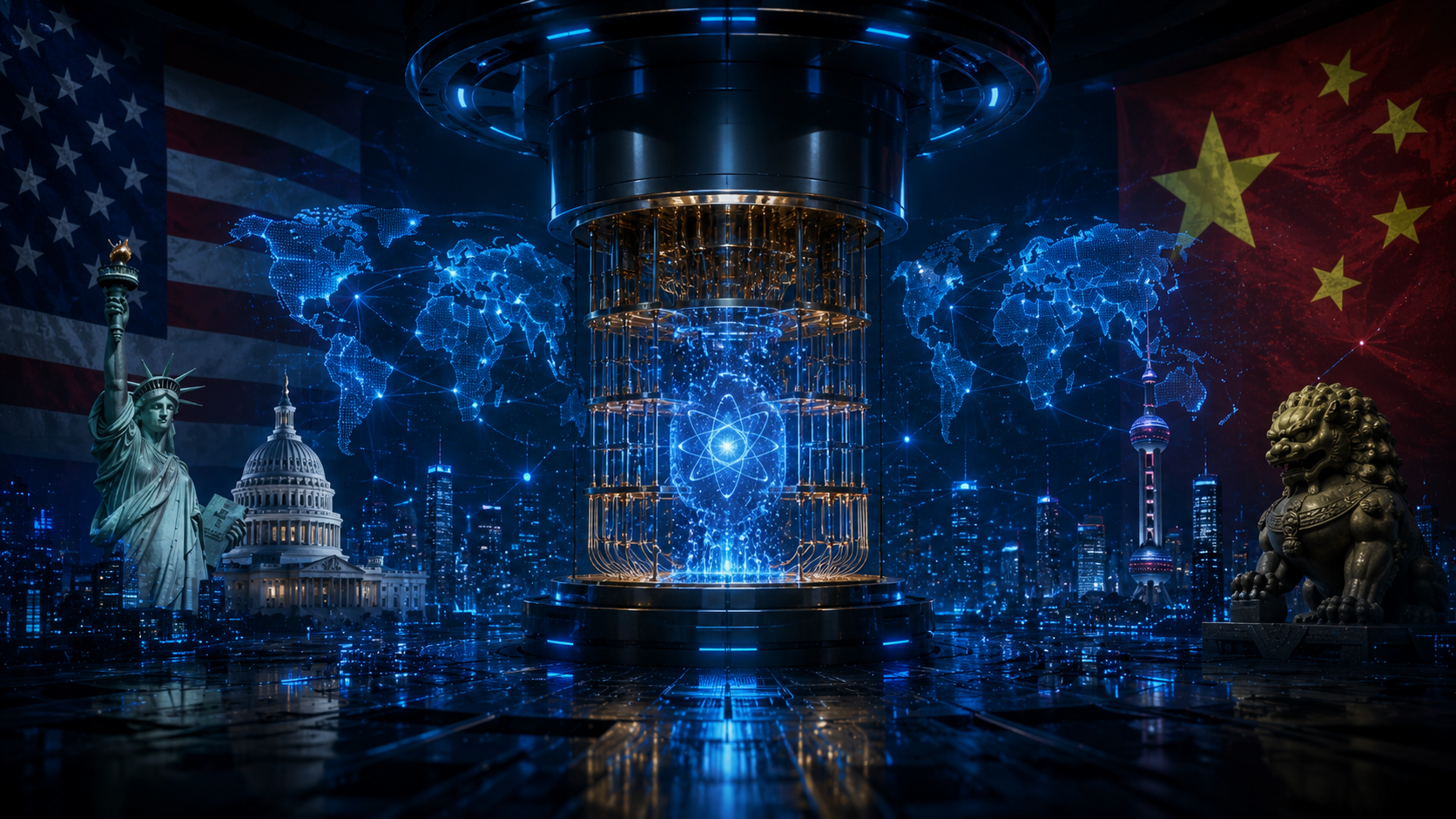
How Quantum Technology Could Reshape Geopolitics, Cybersecurity, and the Future Balance of Power
Throughout history, technological revolutions have repeatedly transformed global power.
The Industrial Revolution reshaped empires through manufacturing and energy.
The internet revolution redefined communication, finance, and information warfare.
Now, another technological race is rapidly emerging:
Quantum computing.
Unlike traditional computers, sufficiently advanced quantum computers could eventually solve certain specialized problems that are extraordinarily difficult for even the most powerful classical computers.
Because of this potential, quantum technology is no longer viewed as merely scientific research.
It is increasingly becoming:
- a geopolitical asset
- a potential challenge to existing cryptographic protection
- an economic advantage
- and potentially a source of strategic influence in the future
As the United States, China, and European Union intensify their quantum ambitions, a critical question emerges:
Could quantum computing become the defining technology of the next global power struggle?
1. The Global Quantum Race Has Already Begun
The United States and Corporate Quantum Leadership
The United States remains one of the global leaders in quantum computing research.
Major technology companies such as:
- IBM
- and Microsoft
are investing heavily in quantum technologies.
In 2019, Google announced what it called “quantum supremacy,” reporting that its quantum processor had completed a highly specialized computational task far faster than the classical systems used for comparison at the time.
IBM has developed increasingly advanced quantum processors and now offers cloud-based quantum computing access to researchers worldwide.
Microsoft continues exploring topological quantum computing, focusing on building more stable and scalable quantum systems.
In the United States, quantum development is deeply connected not only to scientific innovation—
but also to economic and strategic dominance.
Quantum development in the United States is also supported by a broader national strategy. Through the National Quantum Initiative, federal agencies coordinate research in quantum computing, networking, sensing, and workforce development, reflecting the growing view that quantum technology is important not only for scientific leadership but also for economic competitiveness and national security.
China’s State-Driven Quantum Expansion
China has rapidly emerged as a major quantum power through strong government-led investment.
Researchers at the University of Science and Technology of China developed the photonic quantum computer “Jiuzhang,” demonstrating extraordinary computational speed in specialized tasks.
China is also advancing quantum communication technologies.
Its Micius satellite has been used to demonstrate quantum communication technologies, including experiments involving quantum key distribution over long distances.
These examples show why a simple contrast between an American corporate model and a Chinese state model is incomplete. Quantum development involves relationships among governments, universities, and companies, and the balance differs across countries.
Europe’s Quantum Strategy
The European Union launched the Quantum Technologies Flagship in 2018. The European Commission describes it as a ten-year initiative with an expected EU budget of €1 billion, supporting research in quantum computing, communication, sensing, and simulation.
The Flagship brings together research institutions, industry, and public funders. It is one component of Europe’s wider quantum effort, rather than a measure of all European investment.
This distinction matters when comparing national strategies: funding for one research program should not be treated as directly comparable to another country’s total public and private investment.
2. Could Quantum Technology Create a New Cold War?
Cryptographic Risk Is Real—but It Has a Specific Scope
A sufficiently capable quantum computer could threaten widely used public-key cryptographic systems, including RSA and elliptic-curve cryptography. This does not mean that quantum computers would automatically defeat every form of encryption or gain access to every protected system.
In 2024, the U.S. National Institute of Standards and Technology finalized its first three post-quantum cryptography standards. These are designed for use on conventional computing systems; organizations do not need quantum computers to adopt them.
One reason to prepare early is the risk of “harvest now, decrypt later”: an attacker may collect encrypted information today in the hope of decrypting it with future capabilities. Information that must remain confidential for many years deserves particular attention.
Research Leadership Is Not Automatic Strategic Dominance
The geopolitical consequences would depend on more than which country announces a breakthrough first. They would also depend on the capability and reliability of the system, the value of the information exposed, and whether potential targets had already migrated to suitable protection.
Quantum communication and post-quantum cryptography should also be distinguished. The former uses quantum physical processes; the latter develops cryptographic methods intended to resist quantum attacks on conventional networks. Neither removes every security risk.
Calling this competition a “new Cold War” can highlight rivalry, but it can also obscure important differences. Quantum development involves commercial competition, scientific collaboration, standards, and several technological fields—not a single weapon or a single finish line.
My assessment is that preparedness matters alongside research leadership. A country that protects its infrastructure and develops the skills to use new technologies may strengthen its position without being the first to build the most powerful machine.
3. The Risk of Quantum Inequality
Technological Gaps Between Nations
Quantum computing could dramatically widen global inequality.
Countries with advanced quantum infrastructure may dominate:
- medicine
- climate modeling
- finance
- logistics
- artificial intelligence
- and military systems
Meanwhile, nations lacking access to quantum technologies could become increasingly dependent on technologically dominant powers.
This may create a new form of digital hierarchy in the global economy.
Corporate Monopoly and Technological Concentration
Another concern involves corporate concentration.
Today, a small number of large technology corporations already dominate much of the digital world.
If quantum computing becomes controlled by only a few companies, technological inequality may deepen further.
Smaller businesses and developing nations could struggle to compete in a quantum-driven economy.
This raises difficult questions about:
- technological fairness
- access to innovation
- and the concentration of computational power
The future quantum economy may therefore become not only a scientific issue—
But also a political and ethical one.
Conclusion: Quantum Leadership Is One Part of Power
Quantum computing could become an important source of scientific and strategic advantage. It does not follow that the country with the strongest quantum processor would automatically become the next global superpower.
The applications discussed above are possibilities to evaluate, not benefits that every quantum system can already deliver. Research achievements must become reliable and useful capabilities before they can produce substantial economic or strategic gains.
I would judge a country’s quantum position through three questions: can it turn research into useful applications, protect important systems during the cryptographic transition, and develop the people and institutions needed to sustain progress?
Fair access matters as well. If skills, infrastructure, and opportunities remain concentrated, the benefits may be distributed unevenly. But that outcome is not inevitable; it depends partly on choices about education, research access, competition, and cooperation.
Quantum computing may reshape the balance of power. It is unlikely to determine that balance on its own. The more useful question is how societies can prepare for its risks and share its benefits without treating technological leadership as an entitlement to dominate others.
Reader Question
If quantum computing gives a few nations or corporations overwhelming technological power—
Could the future of global politics become less about military strength,
and more about computational dominance?
Or should quantum technology be treated as a shared global resource rather than a strategic weapon?
Related Reading
If future technologies increasingly reshape global power structures, could national sovereignty itself become more flexible and unstable in the digital age?
In Is National Sovereignty Absolute?, we explore how technological competition and global cooperation continuously challenge traditional ideas of political power and international order.
References
1. National Academies of Sciences, Engineering, and Medicine. (2019). Quantum Computing: Progress and Prospects. Washington, DC: The National Academies Press.
This authoritative report examines the scientific foundations, technological challenges, and potential applications of quantum computing. It provides an important framework for understanding both the transformative possibilities of quantum technology and the substantial technical barriers that must still be overcome before large-scale quantum computers become practical.
National Academies — Quantum Computing: Progress and Prospects
2. National Quantum Initiative. (n.d.). The National Quantum Initiative. United States Government. Accessed October 9, 2026.
The National Quantum Initiative coordinates U.S. federal efforts in quantum information science and technology, including research, infrastructure, workforce development, and cooperation between government, universities, and industry. It demonstrates how quantum technology has become connected not only to scientific leadership but also to economic competitiveness and national security.
U.S. National Quantum Initiative
3. National Institute of Standards and Technology. (2024). Post-Quantum Cryptography Standards: FIPS 203, FIPS 204, and FIPS 205. U.S. Department of Commerce.
In 2024, NIST finalized its first three post-quantum cryptography standards to protect digital information against attacks from future quantum computers. These standards show that the cybersecurity implications of quantum computing are no longer merely theoretical: governments and organizations are already preparing existing digital infrastructure for a post-quantum security environment.
NIST — Post-Quantum Cryptography Standards
4. National Institute of Standards and Technology. (2024). Transition to Post-Quantum Cryptography Standards (NIST IR 8547 Initial Public Draft). U.S. Department of Commerce.
This draft report addresses the transition from quantum-vulnerable cryptographic systems to post-quantum standards. It is particularly relevant to the geopolitical dimension of quantum computing because the ability of governments, financial institutions, and critical infrastructure to protect information during this transition may become an important component of national security and technological resilience.
NIST — Transition to Post-Quantum Cryptography Standards
5. European Commission. (n.d.). Quantum Technologies Flagship. European Commission. Accessed October 9, 2026.
The European Quantum Technologies Flagship is a long-term research and innovation initiative designed to strengthen Europe’s capabilities in quantum computing, communication, simulation, and sensing. The program illustrates how quantum technology has become a strategic priority not only for individual companies but also for governments and regional institutions seeking technological sovereignty and competitiveness in the emerging quantum economy.
European Commission — Quantum Technologies Flagship