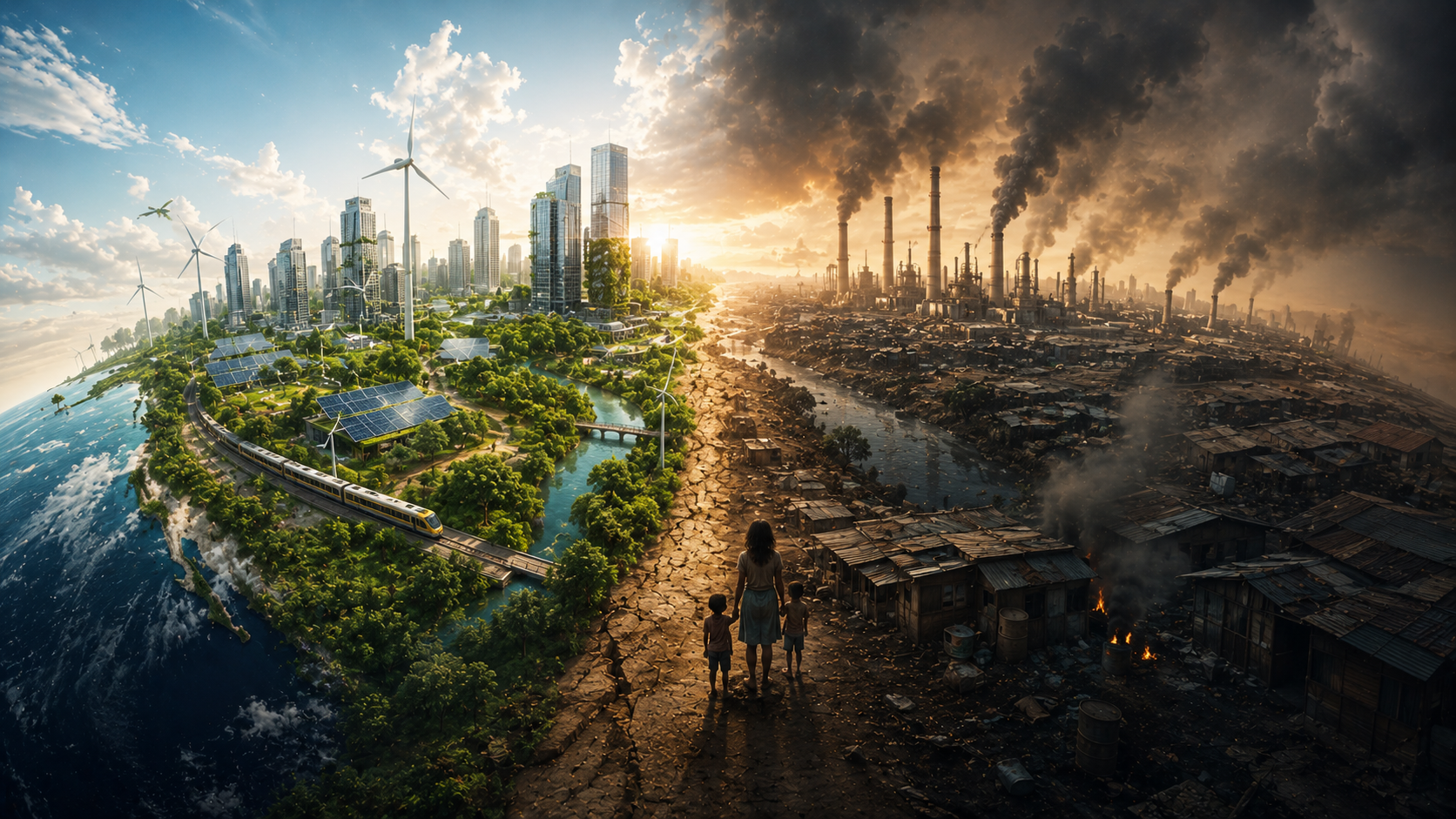
Climate Justice and the Economics of the Global Energy Transition
“Saving the planet” sounds like a universal moral goal.
Governments pledge to achieve carbon neutrality.
Companies advertise sustainability initiatives.
Consumers are encouraged to drive electric cars and reduce their carbon footprints.
The transition away from fossil fuels is now presented as both necessary and urgent.
But beneath this global consensus lies a difficult question:
Who is actually paying the price of decarbonization?
For many developing countries, the path toward a green economy does not feel equally fair.
Some nations became wealthy through two centuries of industrial pollution.
Others are now being told to limit emissions before they have fully industrialized at all.
This tension lies at the heart of what is now called climate justice.
1. The Past of Industrialization Still Shapes the Present
Countries have contributed very differently to climate change. Early-industrializing economies, especially the United States and European countries, account for a substantial share of cumulative carbon dioxide emissions from fossil fuels and industry.
However, historical responsibility is not measured by a single number. The picture changes depending on the period examined, whether land-use change is included, and whether emissions are compared in total or per person. Historical contributions also differ from today’s annual emissions.
A fair assessment therefore needs to consider several factors together: past contributions, present emissions, capacity to act, and development needs. Countries grouped as “developing” do not all have the same circumstances or responsibilities.
The geography of clean-energy production is more complex than a simple division between wealthy technology producers and poorer technology users. China plays a leading role in solar-panel and battery manufacturing, while countries occupy different positions in finance, technology development, mineral extraction, and equipment production.
The question is therefore not only who possesses green technology, but who can finance its deployment and capture the jobs, income, and industrial opportunities it creates.
Developing nations face a very different reality.
Many are still struggling to provide stable electricity, transportation infrastructure, and basic industrial growth.
In parts of Africa and South Asia, diesel generators remain essential sources of energy.
For these countries, rapid decarbonization can feel less like environmental responsibility
and more like a limitation placed upon development itself.
A difficult question emerges:
Is it fair to demand equal sacrifice from countries that did not contribute equally to the crisis?
2. Green Technology Is Not Equally Accessible
In wealthier nations, installing rooftop solar panels or purchasing electric vehicles is increasingly normalized.
Government subsidies, technological infrastructure, and financial systems support the transition.
For many lower-income countries, the obstacle is not simply the price of a solar panel or wind turbine. A project must also secure affordable finance, connect to a reliable grid, and operate within a workable regulatory system.
Renewable-energy projects often require substantial investment before they begin generating electricity. Higher borrowing costs can therefore make a project difficult to finance even when its expected operating costs are low. Currency risks, weak electricity networks, and uncertainty over payments can add further barriers.
Reducing these obstacles requires more than exporting equipment. Affordable financing, grid investment, technical capacity, and reliable institutions all influence whether clean energy becomes a realistic development option.
As a result, the global transition toward sustainability risks deepening economic inequality.
Some countries move quickly toward carbon neutrality.
Others remain trapped between climate pressure and economic survival.
This imbalance is one reason why climate policy is no longer viewed only as an environmental issue.
It has become an ethical and economic debate.
3. Climate Justice and “Common but Differentiated Responsibilities”
International climate agreements recognize the principle of common but differentiated responsibilities and respective capabilities, often abbreviated as CBDR-RC. The Paris Agreement states that this principle should be applied in light of different national circumstances.
The principle combines shared responsibility with differentiated effort. All countries have a role in addressing climate change, but that does not imply identical obligations or equal financial burdens. Historical contributions, economic capacity, and development needs are central to debates about fairness.
Climate finance is one way of putting differentiated responsibility into practice. Yet its quality matters as well as its headline value. A grant and a loan create different obligations for the recipient. Funding that is difficult to access may provide little immediate help to a community facing urgent needs.
It is also important to distinguish finance for reducing emissions from finance for adapting to climate impacts. Building clean electricity systems and protecting communities from flooding serve related but different purposes.
The practical question is therefore not only how much funding is promised, but who receives it, on what terms, and whether it reaches the people and projects that need it.
4. The Meaning of a “Just Transition”
The debate is no longer only about reducing carbon emissions.
It is about how the transition itself is managed.
A just transition means that environmental policies should not create new forms of inequality while solving ecological problems.
This includes questions such as:
- Who loses jobs during the energy transition?
- Which communities bear rising energy costs?
- Who controls green technologies and supply chains?
- Who profits from sustainability?
These questions also arise within countries. A national transition can bring overall benefits while concentrating losses in particular towns, industries, or households.
Consider a community dependent on a coal-fired power station. Closing the plant may reduce emissions, but workers, local businesses, and public services may lose income. A credible transition plan would consider income protection, realistic employment opportunities, regional investment, and participation by those affected. Training alone is insufficient if suitable jobs are unavailable.
Similarly, policies that raise household energy costs need to consider people who cannot easily replace their heating systems, improve rented housing, or switch to public transport. Fairness depends on the alternatives and support available, not simply on asking everyone to accept the same price increase.
Trade creates another question about responsibility. Territorial emissions accounting generally records emissions where they occur. Consumption-based accounting instead attributes emissions along supply chains to the final demand for goods and services.
For example, emissions from manufacturing an exported product appear in the producing country’s territorial account, while a consumption-based account links them to the country where the product is ultimately consumed.
These are different ways of examining the same emissions, not additional emissions to be added together. Territorial accounting helps identify where production must become cleaner; consumption-based accounting reveals how demand elsewhere contributes to that production.
Neither perspective alone settles how costs should be shared. Together, they show why climate responsibility cannot be understood only by looking at national borders.
A Citizenship Perspective: Who Has a Voice in the Transition?
From a citizenship education perspective, climate justice concerns both the distribution of costs and the process through which decisions are made. Workers, lower-income households, and communities affected by energy projects should have meaningful opportunities to shape plans before the main choices are settled.
A useful test is to ask three questions: Who bears the costs? Who receives the benefits? And who can influence the decision or challenge an unfair outcome?
Fairness also requires considering the costs of delay. Continued climate change can deepen existing inequalities, especially where people have fewer resources to protect themselves and recover from damage. An unjust transition and inadequate climate action can both harm vulnerable communities.
The aim should therefore be to make emissions reductions feasible and fair through support, participation, and accountability. Climate justice should help determine how the transition proceeds, rather than become a reason to postpone it indefinitely.
Conclusion: A Green Future Must Also Be a Fair One
Climate change is undeniably a global crisis.
But fairness matters.
A sustainable future cannot be built on unequal sacrifice.
If decarbonization becomes a system in which wealthy countries maintain prosperity while poorer nations absorb the economic burden,
then the transition itself risks becoming another form of global inequality.
The future requires more than technological innovation.
It also requires solidarity, ethical responsibility, and international cooperation.
The real challenge is not only:
How fast can humanity transition to a green economy?
But also:
How can that transition happen without leaving parts of the world behind?
A truly sustainable future must be environmentally sustainable—
and socially just at the same time.
Reader Question
When deciding who should pay for the energy transition, how should we weigh historical emissions, present emissions, and the ability to contribute?
Think of a community facing a power-station closure or higher energy costs. What support—and what voice in decision-making—would make the transition fair without delaying necessary climate action?
Related Reading
Climate justice depends on cooperation among countries with different interests, resources, and responsibilities. In Is National Sovereignty Absolute? The Biggest Barrier to a World Government, we examine how states can share authority without creating a single world government—and why international commitments require both credibility and accountability.
The distribution of transition costs also raises questions about fairness within countries. In Social Justice and the Welfare State: How Much Should Governments Reduce Economic Inequality?, we explore how public institutions can protect people against economic insecurity while respecting individual freedom. These questions become especially relevant when climate policies affect workers, households, and regions in different ways.
References
1. Intergovernmental Panel on Climate Change. (2022). Climate Change 2022: Mitigation of Climate Change. Contribution of Working Group III to the Sixth Assessment Report.
This assessment examines emissions trends, mitigation pathways, and the economic and social conditions affecting decarbonization. Chapter 2 distinguishes historical and current emissions, as well as territorial and consumption-based accounting. It provides a scientific foundation for discussing unequal contributions to climate change without reducing responsibility to a single measure.
IPCC — Chapter 2: Emissions Trends and Drivers
2. International Energy Agency. (2022). Solar PV Global Supply Chains.
This report traces solar-panel production across manufacturing stages and documents the concentration of production capacity in China. It helps explain why clean-energy technology cannot be understood through a simple division between wealthy producer countries and poorer importing countries.
IEA — Solar PV Global Supply Chains
3. International Energy Agency. (2024). Reducing the Cost of Capital.
This report examines how financing costs constrain clean-energy investment in emerging and developing economies. It explains why lower equipment costs alone cannot guarantee affordable deployment and considers how policy, financial institutions, and risk-reduction measures can help projects secure funding.
IEA — Reducing the Cost of Capital
4. United Nations Framework Convention on Climate Change. (2015). Paris Agreement. Articles 2 and 9.
Article 2 places equity and common but differentiated responsibilities and respective capabilities within the context of different national circumstances. Article 9 addresses financial support for developing countries, including mitigation and adaptation. Together, these provisions provide an institutional foundation for discussing differentiated effort and the distribution of climate-finance responsibilities.
5. International Labour Organization. (n.d.). “Just Transition towards Environmentally Sustainable Economies and Societies.”
The ILO explains a just transition through decent work, social protection, labour rights, and social dialogue. This framework supports the article’s discussion of workers and communities affected by energy-system changes and shows why employment opportunities and participation must accompany environmental policy.
ILO — Just Transition towards Environmentally Sustainable Economies and Societies
6. Intergovernmental Panel on Climate Change. (2023). Climate Change 2023: Synthesis Report.
This synthesis brings together evidence on climate impacts, vulnerability, adaptation, and mitigation. It supports the article’s emphasis on the unequal consequences of climate change and the importance of considering both transition costs and the risks of delayed action.