
The Relativity of Happiness in Psychology, Culture, and Modern Society
Almost everyone wants happiness.
Governments pursue it through economic growth. Individuals search for it through relationships, success, health, or personal meaning. Entire industries are built around helping people become happier.
But despite humanity’s obsession with happiness, one difficult question remains:
Can happiness actually be measured objectively?
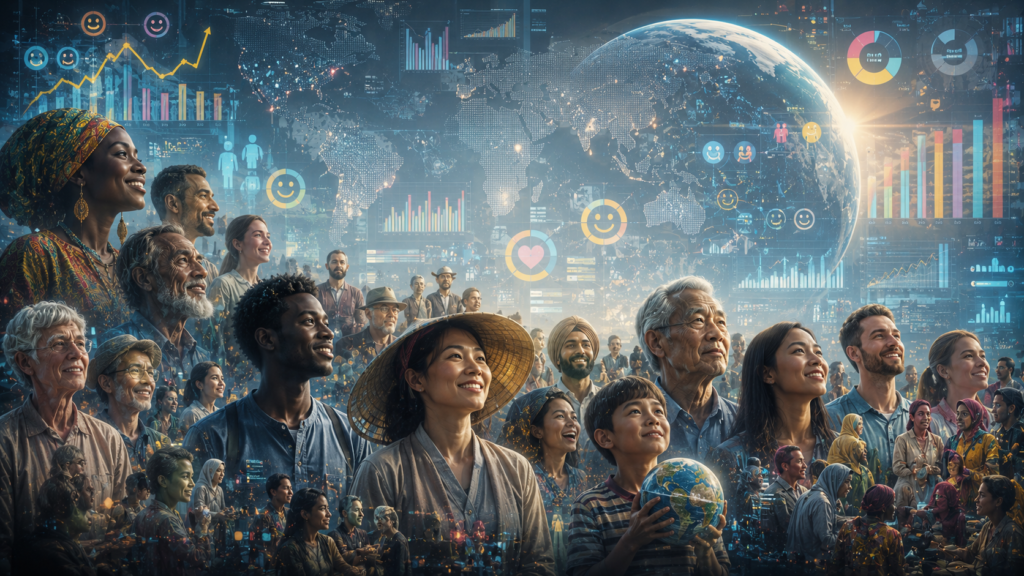
Today, international organizations publish happiness rankings comparing countries around the world. Psychologists analyze subjective well-being through surveys and behavioral studies. Economists attempt to connect happiness with income and social stability.
Yet happiness often resists measurement.
Some people living in wealthy societies feel emotionally exhausted and disconnected. Others living in difficult circumstances still report deep satisfaction and meaning in life.
This suggests that happiness may not simply be a measurable condition.
It may be something far more relative, cultural, emotional, and deeply human.
1. Can Happiness Be Objectively Measured?
The Rise of Happiness Indexes
One of the most widely known attempts to measure happiness is the United Nations World Happiness Report.
This report evaluates national well-being using factors such as:
- income levels
- social support
- life expectancy
- political freedom
- trust in institutions
- and perceptions of corruption
Countries such as Finland, Denmark, and Switzerland frequently rank near the top due to strong welfare systems and social stability.
These rankings suggest happiness can be analyzed scientifically.
But the reality may be more complicated.
The Gap Between Statistics and Experience
Economic stability certainly affects well-being.
However, happiness is not determined by material conditions alone.
Some people living in affluent societies experience:
- loneliness
- anxiety
- burnout
- and emotional emptiness
Meanwhile, others living in financially difficult environments may still find happiness through:
- family relationships
- spirituality
- community belonging
- or personal meaning
This reveals an important limitation of happiness indexes:
Objective conditions and subjective experience do not always match.
2. Culture Changes How Humans Understand Happiness
Individual Happiness vs Collective Harmony
Different cultures define happiness differently.
In many Western societies, happiness is often associated with:
- personal achievement
- freedom of choice
- self-expression
- and individual fulfillment
In many East Asian cultures, however, happiness may be more strongly connected to:
- social harmony
- family relationships
- emotional balance
- and collective stability
As a result, people from different cultures may answer happiness surveys very differently—even when living under similar conditions.
Cultural Bias in Measuring Well-Being
Researchers also note that cultural communication styles affect self-reporting.
For example, people in countries such as South Korea or Japan may understate their happiness due to cultural norms emphasizing modesty and emotional restraint.
In contrast, cultures encouraging emotional openness may produce higher self-reported happiness scores.
This means happiness measurement is never fully culturally neutral.
Even the language used to ask “Are you happy?” may carry different meanings across societies.
3. Happiness Changes Across Time

Why the Past Often Feels Happier
Humans frequently remember the past more positively than it actually was.
Psychologists call this tendency retrospective bias.
People often soften painful memories while preserving emotionally meaningful moments.
A difficult childhood may later feel nostalgic because memories of family warmth or emotional connection become more emotionally powerful over time.
This explains why happiness is not simply experienced—
It is also reconstructed through memory.
The Hedonic Treadmill
Humans also tend to sacrifice the present while pursuing future happiness.
Students may believe happiness will arrive after entering university. Workers may postpone rest while chasing financial success. Many people assume happiness exists somewhere ahead of them.
However, psychology suggests people rapidly adapt to improved circumstances.
This phenomenon is known as the hedonic treadmill.
After reaching one goal, humans often normalize it and begin pursuing another.
As a result, happiness can become an endless moving target.
4. Is Happiness a Number—or a Meaning?
Beyond Economic Measurement
Modern societies often attempt to quantify happiness through:
- productivity
- income
- health statistics
- and social indicators
These measurements are useful.
But they cannot fully capture:
- emotional meaning
- inner peace
- love
- purpose
- grief
- or spiritual fulfillment
Some of the most meaningful human experiences resist numerical evaluation entirely.
Happiness as a Human Relationship
Perhaps happiness is not something humans possess individually.
It may emerge through relationships:
- with other people
- with memory
- with meaning
- and with the present moment itself
In this sense, happiness may be less like a measurable object—
And more like an ongoing human process.
Conclusion: The Difficulty of Measuring Human Happiness

Happiness indexes and psychological studies can reveal important patterns about well-being.
However, no system can fully measure the complexity of human happiness.
People interpret happiness differently across:
- cultures
- generations
- emotional histories
- and personal values
Humans also distort happiness through memory, expectation, and comparison.
This means happiness may never become entirely objective.
And perhaps that is not a weakness.
Perhaps the impossibility of perfectly measuring happiness reflects something essential about being human.
Ultimately, the most important question may not be:
“How happy are we?”
But rather:
What kind of life feels meaningful enough
to be experienced as happiness at all?
The answer may differ for every individual—
And that diversity itself may be part of what makes human happiness meaningful.
Reader Question
If happiness can be measured through statistics, income, health, and social stability—
Why do some people still feel emotionally empty despite living in “successful” societies?
And perhaps more importantly:
Are we spending too much time trying to measure happiness,
instead of asking what kind of life truly feels meaningful to us?
Related Reading
If emotions are shaped not only by individuals but also by social expectations and digital environments, could happiness itself also be socially constructed rather than purely personal?
In Are Our Emotions Truly Ours—or Socially Constructed?, we examine how modern societies influence emotional behavior, emotional expression, and collective emotional norms.
If humans constantly sacrifice the present while chasing future success, are modern societies redefining happiness as endless achievement rather than meaningful existence?
In Will AI and Automation Trigger the Next Social Revolution?, we explore how productivity, work, technology, and economic systems increasingly shape human identity and life satisfaction.
References
- Ed Diener et al. (2018). Advances in Subjective Well-Being Research.
This work explores the concept of subjective well-being and analyzes the gap between objective indicators of happiness and personal emotional experience. - Daniel Kahneman & Alan B. Krueger (2006). Developments in the Measurement of Subjective Well-Being.
This study examines various methods of measuring happiness and explains why traditional economic indicators alone cannot fully capture human well-being. - John F. Helliwell et al. (2023). World Happiness Report 2023.
This global report analyzes how income, health, trust, freedom, and social relationships contribute to national happiness levels. - Daniel Gilbert (2006). Stumbling on Happiness.
Gilbert investigates how humans predict future happiness and why people often misjudge what will actually make them happy. - Richard Easterlin (1974). Does Economic Growth Improve the Human Lot?
This influential work introduced the “Easterlin Paradox,” arguing that increased income does not always produce proportional increases in happiness.