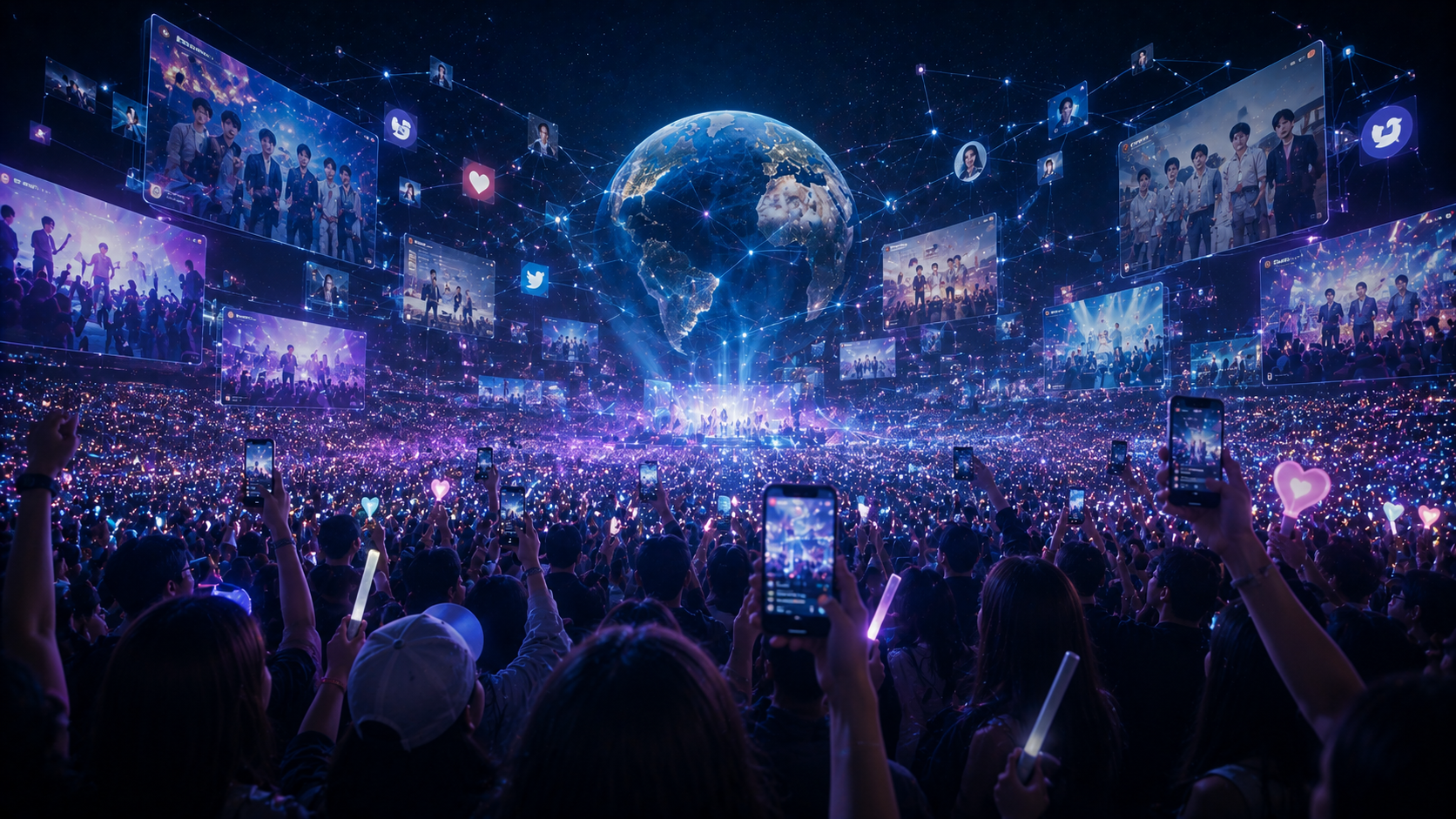
Digital Communities, Collective Identity, and the New Politics of Fan Culture
Fandom was once seen as simple entertainment.
Fans bought albums, attended concerts, collected merchandise, and passionately supported celebrities they admired.
But in the digital age, fandom has evolved into something much larger.
Today, online fan communities can:
- organize transnational campaigns
- raise substantial funds
- amplify issues across social media
- influence online public discussion
- and participate in social and political activism
Modern fandom is no longer only about consumption.
It is becoming a form of cultural power.
Global fan communities such as the fandom surrounding BTS have demonstrated how emotionally connected digital communities can transform into organized social forces.
This raises an important question:
Are fandoms still just groups of consumers—
or are they becoming a new form of collective political identity?
1. Fandom Is More Than Admiration
From Entertainment to Civic Participation
Modern fandoms increasingly operate beyond entertainment culture.
One of the most visible examples emerged in 2020, when BTS donated one million dollars to the Black Lives Matter movement.
Shortly afterward, BTS fans known as ARMY collectively matched the donation within twenty-four hours through online fundraising efforts.
This moment revealed something significant:
Fans were not simply supporting artists.
They were participating in coordinated social action.
Emotional Connection and Collective Action
Online fandoms frequently organize:
- charity campaigns
- hashtag movements
- fundraising projects
- social awareness campaigns
In some cases, digitally connected fan communities can mobilize rapidly across national and institutional boundaries.
Digital emotional connection becomes a source of collective power.
As a result, fandom can sometimes become a channel for civic participation rather than remaining solely a form of cultural consumption.
2. Fandom as a Digital Community
Identity in Online Spaces
Unlike traditional fan clubs centered on physical gatherings, modern fandoms exist primarily through digital platforms.
Fans communicate across:
- social media
- streaming platforms
- online forums
- group chats
- fan-created media spaces
Through these interactions, fandom becomes part of personal identity itself.
People do not simply follow artists.
They belong to communities.
Hierarchy and Internal Power
However, some digitally organized fandom communities have also engaged with issues such as:
Internal hierarchies often emerge.
Long-term fans, people who attend concerts frequently, collectors of rare merchandise, and influential fan creators may gain symbolic authority within the community.
At the same time, newer or more critical fans may become marginalized or attacked.
This reveals that fandoms can reproduce their own systems of:
- status
- inclusion
- exclusion
- and cultural power
Even communities built around emotional solidarity may contain hidden structures of authority.
3. Between Politics and Entertainment
“We Just Want to Enjoy Music”
Some fans resist political involvement entirely.
They argue that fandom should remain a space for enjoyment rather than ideological conflict.
For these individuals, music functions as emotional escape rather than political expression.
The Politicization of Fan Culture
However, many fandoms increasingly engage with issues such as:
- racial justice
- climate activism
- LGBTQ+ rights
- disability advocacy
- gender equality
For example, BTS fan communities have organized fundraising and awareness campaigns around a range of social causes, demonstrating how cultural affiliation can sometimes develop into collective civic action.
As a result, fandom occupies an unusual position.
It often claims to be apolitical while simultaneously engaging in highly political actions.
4. Are Fandoms Becoming New Social Movements?
Politics Through Emotion and Culture
Younger generations often participate in public life through forms that extend beyond conventional party politics, including digital campaigns, issue-based networks, and online communities.
Digital cultural communities can become another space through which younger people encounter social issues, express values, and participate in collective action.
For many younger people, fandom provides:
- emotional belonging
- political expression
- social connection
- and collective identity
This creates a new model of participation where culture and politics become deeply intertwined.
A New Form of Collective Identity
In this environment, some fandom networks may develop characteristics associated with transnational social movements.
Fans from different countries cooperate across borders through shared emotional investment rather than nationality, religion, or traditional political ideology.
The transnational spread of Korean popular culture across Southeast Asia illustrates this complexity particularly well. Fans do not simply receive cultural products from Korea as passive consumers. They translate content, create local fan communities, organize events, reinterpret cultural meanings, and sometimes connect shared fandom identities with local social concerns.
This suggests that global fandom is not simply the expansion of one national culture into another. It can also become a space where global cultural influences are actively reinterpreted through local identities and social experiences.
In other words, fandom transforms emotion into organized collective action.
This development illustrates how the boundaries between cultural participation, digital community, and civic action are becoming increasingly difficult to separate.
Conclusion: Fandom as Cultural Power
In the past, fans were often dismissed as emotional consumers.
Today, fandoms increasingly shape:
- online discourse
- political visibility
- social activism
- and cultural influence
The digital age has transformed fandom into something far more powerful than entertainment alone.
Modern fandoms connect emotion, identity, technology, and politics into massive global communities capable of real social impact.
Ultimately, fandom may no longer simply represent admiration for artists.
It may create new forms of civic participation built through emotional connection, cultural identity, and digital networks.
And perhaps the most important question is this:
When millions of emotionally connected people act together online,
where does fandom end—and where does political power begin?
Reader Question
Have online fan communities become more than spaces for entertainment and emotional support?
When millions of people organize, donate, campaign, and shape public opinion together through shared cultural passion—
Does fandom remain a form of consumption, or does it become a new kind of political power?
Related Reading
Fan communities can turn shared cultural interests into collective action, but they also depend on platforms that influence what becomes visible and whose voices reach wider audiences. In Who Will Control Culture in the Age of AI and the Metaverse?, we explore how digital technologies and platform power may shape cultural participation. Read together, these discussions invite us to consider how much influence communities can exercise within spaces governed by commercial platforms.
References
1. Andini, A. N., & Akhni, G. N. (2021). “Exploring Youth Political Participation: K-Pop Fan Activism in Indonesia and Thailand.” Global Focus, 1(1), 38–55.
This study examines K-pop fan activism in Indonesia and Thailand, focusing on the relationship between cultural participation and civic or political participation. It shows how shared fandom identities, digital skills, charitable activities, and political engagement can connect popular culture with broader forms of youth activism.
Exploring Youth Political Participation: K-Pop Fan Activism in Indonesia and Thailand
2. Kanozia, R., & Ganghariya, G. (2021). “More than K-pop Fans: BTS Fandom and Activism amid COVID-19 Outbreak.” Media Asia, 48(4), 338–345.
This article examines how BTS fandom moved beyond entertainment consumption to participate in social activism during the COVID-19 pandemic. It illustrates how digitally connected fan communities can use their organizational networks, collective identity, and online communication practices to support social causes.
More than K-pop Fans: BTS Fandom and Activism amid COVID-19 Outbreak
3. Sumardiono, N. (2022). “Aktivisme Digital dalam Konteks Penggalangan Donasi Fandom BTS (ARMY) Indonesia Melalui Twitter.” Jurnal Komunikasi, 16(2), 113–128.
Using BTS ARMY in Indonesia as a case study, this research examines digital activism through online fundraising and social-media mobilization. It highlights the importance of emotional persuasion, collective identity, transparency, and digital networks in enabling fandom communities to organize coordinated social action.
Digital Activism and BTS ARMY Indonesia
4. Phoborisut, P., & Park, J. (2024). “K-Pop Fandom and Political Activism in Thailand’s 2020 Student Uprising.” International Journal of Communication, 18.
This study examines the role of K-pop fandom in Thailand’s 2020 student-led political movement. It explores how digital skills, emotional bonds, and organizational practices developed within fandom were transferred into political engagement, demonstrating how cultural participation can intersect with civic activism and collective mobilization.
5. Kim, C. (2023). “Fandom as New Transnational Political Actor: Evidence from BTS ARMY Fandom.” Doğu Asya Araştırmaları Dergisi.
This article analyzes BTS ARMY activism surrounding the Black Lives Matter movement and the One In An ARMY charity network. It argues that social media, shared fandom identity, and transnational communication can enable fan communities to mobilize across national borders, blurring traditional boundaries between popular culture and political participation.
Fandom as New Transnational Political Actor: Evidence from BTS ARMY Fandom