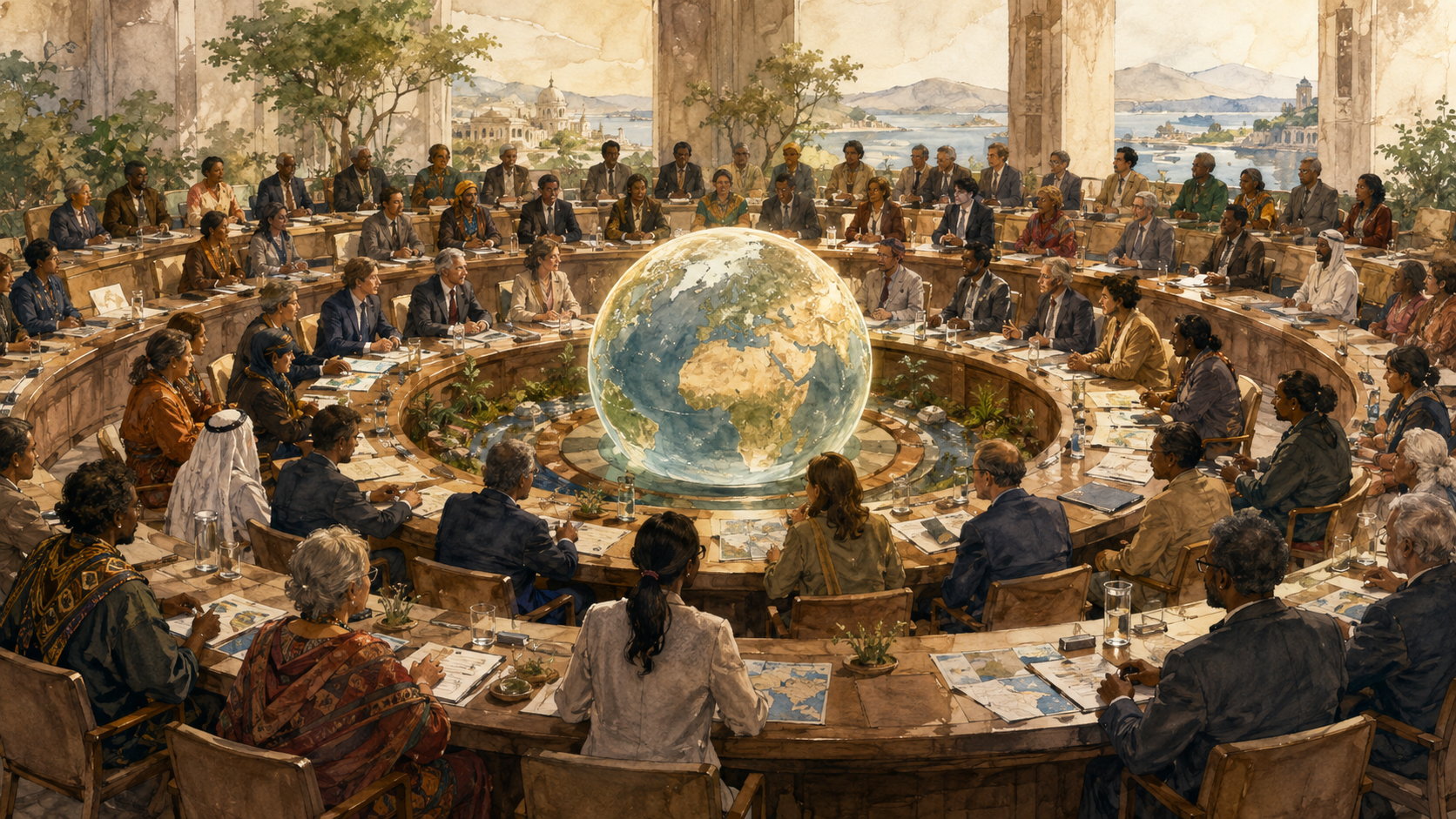
Shared problems create a case for global authority. Representation, enforcement, and accountability determine whether that authority deserves our trust.
A war crosses borders. Pollution travels beyond the country that produces it. A financial crisis disrupts livelihoods far from its point of origin.
In each case, a familiar question returns: why is there no government responsible for the world as a whole?
The appeal is understandable. If national governments create rules within countries, a world government might create and enforce rules for problems that countries cannot solve separately.
But enlarging the territory of government does not automatically make government legitimate.
Who would make the rules? How would people challenge them? Which powers would remain with national and local institutions?
There is no world government because states have not established a common sovereign authority above themselves. Whether they should do so depends on how that authority would be represented, limited, and held accountable.
This article approaches the question through three institutional problems: the limits of the United Nations, the representation of people and states, and the control of concentrated power.
1. The United Nations Is Not a World Government—but It Is More Than a Discussion Forum
International cooperation and world government are different arrangements.
Governments can agree to treaties and establish institutions without creating a single authority that governs the planet. A world government, as understood here, would possess final governing authority in specified areas across national borders. It need not administer every local matter, but it would have powers that national governments could not simply override.
The United Nations operates within a different framework.
Article 2 of the UN Charter establishes the sovereign equality of its members. It also protects matters essentially within domestic jurisdiction, while preserving the application of enforcement measures under Chapter VII.
That qualification matters. Describing the UN as entirely powerless would be inaccurate.
Under Chapter VII, the Security Council can determine threats to peace and decide measures to address them. Article 41 provides for measures without armed force; Article 42 provides for military action when the Council considers the measures under Article 41 inadequate.
These are significant powers. They do not give the UN the general authority of a national government over taxation, education, welfare, and ordinary domestic administration.
The distinction is therefore between an organization with specific international powers and a government with broader authority over a political community.
2. Why Can a Widely Supported Security Decision Still Fail?
Consider a hypothetical Security Council vote.
Fourteen members support a resolution on a non-procedural matter. One permanent member votes against it. The resolution fails because of the veto.
Now change the scenario: the permanent member abstains. If the resolution receives the required nine affirmative votes, it can be adopted.
The Council’s official explanation of its voting system distinguishes between procedural matters and other matters. Procedural decisions require nine affirmative votes. On non-procedural matters, a negative vote by a permanent member blocks adoption; abstention does not have the same effect.
This structure shows why the UN cannot be understood simply as a parliament in which the largest majority always wins.
It gives certain states a special position within collective security decisions. That arrangement can prevent action despite extensive support. It also reflects the institutional bargain on which the Council was established.
Changing the structure is difficult. Under Article 108, Charter amendments require adoption by two-thirds of General Assembly members and ratification by two-thirds of UN members, including all permanent Security Council members.
The implication is important: reforms affecting entrenched privileges depend on a process that requires the participation of the states holding those privileges.
The obstacle is not simply that countries have failed to recognize shared problems. They disagree about who should possess authority and under what conditions they will accept its use.
3. Would a World Parliament Represent People or Countries?
Suppose a democratic world parliament were created. How should its seats be distributed?
Giving every country the same number would protect equality among states. Yet citizens of a small country would have much greater representation per person than citizens of a large one.
Allocating seats entirely by population would move toward equality among individuals. But smaller countries might fear that a few populous states could dominate decisions affecting their communities.
Neither concern disappears by calling the institution global.
| Representation model | What it protects | What it risks |
|---|---|---|
| Equal representation for each state | Smaller states’ political voice | Unequal representation among individuals |
| Representation by population | Greater equality of individual voting weight | Dominance by large population blocs |
| A chamber for people and a chamber for states | A balance between both principles | More complex decisions and possible deadlock |
This comparison is an analytical framework, not a proposal that guarantees democratic legitimacy.
A two-chamber system might balance competing interests, but its rules would still need answers: which chamber approves taxation, who controls security powers, and how are disputes resolved?
There is a further difficulty. A vote cast by a government is not necessarily a freely expressed choice by that country’s citizens.
A world institution would need to consider the rights of people whose governments restrict political participation, as well as the interests of states represented in its chambers.
From a civic education perspective, this is a central distinction: representation of governments and representation of citizens are not interchangeable.
4. Common Rules Do Not Remove Disputes About Fairness
Imagine a proposed global levy to finance climate adaptation.
The purpose may command broad support. The allocation of costs may not.
Should contributions reflect population, current income, current emissions, or historical emissions? Should poorer countries receive exemptions? Who verifies that the money reaches the communities for which it was intended?
Each formula expresses a different understanding of fairness.
A rule based on current income emphasizes ability to pay. A rule based on emissions emphasizes responsibility for environmental damage. A rule based on population treats each person as an equal unit, but may overlook large differences in resources.
A world government would have to choose among these principles or combine them. Its existence would move the dispute into a common institution; it would not make the dispute disappear.
The same issue would arise in migration, public health, and the regulation of cross-border business.
For this reason, the claim that humanity shares one planet is a starting point for political cooperation. It is not a complete answer to who should pay, who should benefit, and who should decide.
5. Would World Government End War?
A common argument for world government is that independent national armies could be replaced by a shared security system.
In principle, this might reduce opportunities for war between sovereign states. But the outcome would depend on whether the system secured cooperation, controlled its forces, and maintained legitimacy.
A change in political structure would not automatically eliminate armed rebellion, civil conflict, or struggles over control of the central government.
Nor would it settle how force should be authorized.
Consider a global security institution accused of using excessive force. An accountable system would need independent investigation, judicial review, remedies for victims, and political consequences for those responsible.
These safeguards matter even when the institution claims to act for peace.
It would also be misleading to assume that sovereignty reliably protects freedom. National governments can oppress their own citizens, and state independence can obstruct outside assistance.
The comparison is therefore between imperfect arrangements.
My judgment is that any proposal for stronger global security authority must be assessed alongside its safeguards against abuse. The power to prevent violence and the power to commit it can exist within the same institution.
6. How Much Authority Should Be Global?
The choice need not be between isolated states and a government controlling everything.
Authority can be divided among local, national, regional, and global institutions. The difficult task is deciding where a particular responsibility belongs.
I would use four questions.
Does the problem produce serious effects across borders?
Cross-border harm strengthens the case for cooperation above the national level. It does not, by itself, establish the need for a comprehensive world government.
What is the least extensive authority capable of addressing it?
Information sharing, common reporting rules, coordinated funding, and enforcement powers are different tools. The appropriate arrangement depends on the problem and on why existing measures are inadequate.
Can affected people question the decision?
An institution should explain its reasoning and provide meaningful ways to challenge decisions. Consultation alone is insufficient if criticism cannot lead to review or correction.
What prevents the institution from expanding its own powers?
A defined mandate, independent scrutiny, budget controls, and review procedures can help constrain authority. Their effectiveness must be tested in practice.
Applied together, these questions provide a more useful standard than assuming that larger institutions are either inherently better or inherently more dangerous.
| Illustrative problem | Possible shared responsibility | Decisions that could remain closer to communities |
|---|---|---|
| Cross-border pollution | Agreeing on standards, monitoring, and remedies | Choosing locally appropriate implementation measures |
| International disease spread | Coordinating information and assistance | Organizing healthcare delivery for local conditions |
| Transnational financial misconduct | Sharing evidence and coordinating enforcement | Conducting proceedings within clearly defined legal jurisdictions |
These examples identify possible divisions of responsibility. They are not descriptions of a single existing global system.
7. Global Citizenship Must Include Participation
Global citizenship is often discussed as awareness of humanity’s shared interests. Awareness matters, but citizenship also raises questions about voice and accountability.
A person can care about a global problem while having little influence over the institutions addressing it.
If global authority grows, people will need accessible explanations of its decisions, opportunities to organize across borders, and ways to seek review. Language, cost, disability, and digital access will affect who can use those opportunities.
Local and national political participation should remain meaningful too.
A global institution that consults citizens while removing every consequential decision from their reach would offer a weak form of citizenship.
My position is that stronger international cooperation should expand people’s ability to influence shared decisions. Its legitimacy should be judged partly by that result, rather than only by the number of agreements it produces.
Conclusion: Shared Problems Require Shared Institutions—and Limits on Their Power
There is no world government because the international system remains organized around sovereign states. Those states have established institutions with important but limited powers, while retaining substantial control over their own affairs.
The UN demonstrates both the value and the difficulty of this arrangement. It provides a framework for cooperation and collective security, but its decision rules can block action.
Creating a world government would change those institutional boundaries. It would also create difficult choices about representation, redistribution, enforcement, and the protection of minorities.
The case for stronger cooperation is compelling where national decisions impose serious costs on others. The case for concentrating authority requires a further argument: why is that power necessary, and how will its use remain answerable to people?
I would therefore favor strengthening institutions for clearly defined shared problems, accompanied by enforceable limits and meaningful public scrutiny.
A world government should be evaluated by the same demanding questions we apply to national governments:
Whose interests does it serve, who can challenge it, and what happens when it is wrong?
Reader Question
Which problem would justify giving an international institution stronger authority over national governments? What safeguard would you require before accepting that authority?
Related Reading
Global cooperation raises a further question: when should national independence give way to responsibilities beyond borders?
In Is National Sovereignty Absolute? The Biggest Barrier to a World Government, we examine the tension between political independence and shared obligations.
Technological competition can also make cooperation more difficult. Is the AI Arms Race the Beginning of a New Cold War? considers how the pursuit of strategic advantage shapes international relations.
References
- United Nations. (1945). Charter of the United Nations, Chapter I: Purposes and Principles, Articles 1–2.
Read Chapter I. - United Nations. (1945). Charter of the United Nations, Chapter VII: Action with Respect to Threats to the Peace, Breaches of the Peace, and Acts of Aggression, Articles 39–51.
Read Chapter VII. - United Nations Security Council. (n.d.). Voting System. Accessed October 9, 2026.
Read the voting rules. - United Nations. (1945). Charter of the United Nations, Chapter XVIII: Amendments, Articles 108–109.
Read Chapter XVIII.