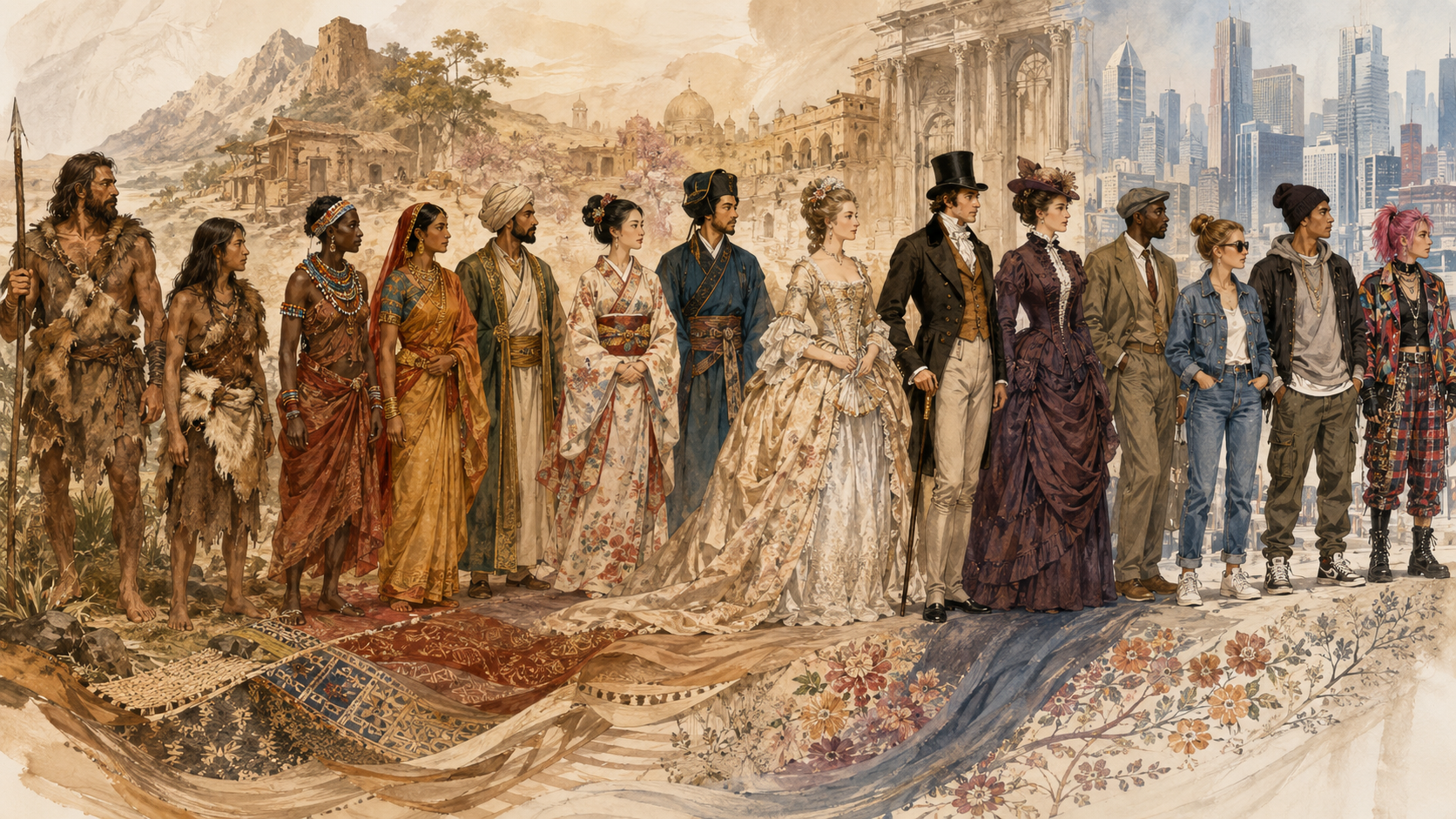
From Protection and Social Status to Beauty, Identity, and Self-Expression
We wear clothes every day, usually without thinking very much about why.
At the most basic level, clothing protects the human body. It helps us adapt to cold, heat, sunlight, wind, and other environmental conditions. Yet if protection were its only purpose, human clothing would probably be far simpler than it is.
Across history, people have decorated garments, chosen particular colors, valued rare materials, followed fashions, rejected fashions, and used clothing to distinguish themselves from others. A garment can tell us something about wealth, occupation, gender, religion, generation, cultural belonging, or personal taste.
Fashion therefore exists at an unusual intersection between function and aesthetics.
Clothes must interact with the body and the physical world, but they also interact with society and the imagination. What began partly as a practical response to human needs became one of the most visible ways in which people communicate who they are—and sometimes who they wish to become.
1. Why Did Humans Begin Wearing Clothes?
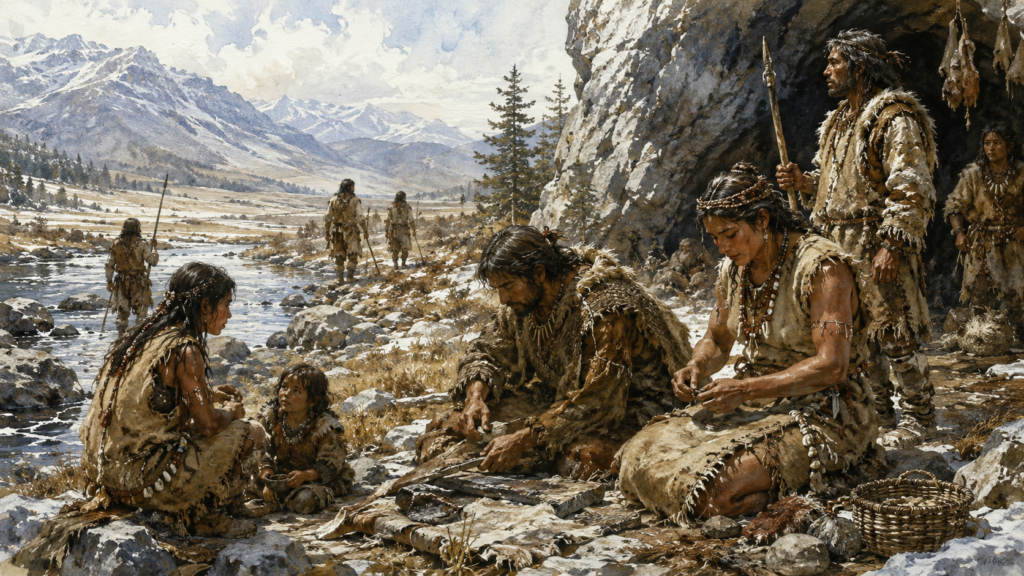
The earliest history of clothing is difficult to reconstruct because materials such as animal hides and plant fibers rarely survive for thousands of years.
What we can say is that clothing offered important practical advantages.
Early humans moving through different climates could use animal skins, fur, plant fibers, and eventually woven textiles to protect themselves from cold, wind, sunlight, and rough environments.
In this sense, clothing began with an obvious function: helping the human body survive conditions for which it was not naturally equipped.
But protection is unlikely to tell the whole story.
Humans decorate their bodies in almost every known culture. Pigments, beads, shells, jewelry, hairstyles, tattoos, and clothing have all been used to create social meaning.
Once clothing became visible to other people, it could communicate something.
A particular material might indicate membership in a group. An ornament might mark adulthood or achievement. A special garment might be worn only during rituals.
The history of clothing therefore cannot be reduced to a simple progression from “function” to “fashion.”
From an early stage, the practical and symbolic dimensions of dress probably developed together.
2. How Did Clothing Become a Symbol of Status and Power?
As societies became larger and more hierarchical, clothing became an increasingly powerful way of making social differences visible.
In ancient civilizations, rulers, priests, soldiers, officials, and ordinary people often wore different garments, materials, ornaments, or colors.
Ancient Egypt provides a useful example. Clothing and adornment could reflect rank and social position, while jewelry, headdresses, fine linen, and ceremonial objects helped communicate authority.
The same principle appeared in many other societies.
What someone was permitted—or able—to wear could reveal where that person stood within the social order.
Clothing as a Social Code
This became particularly visible in medieval and early modern Europe.
Silk, velvet, fine wool, embroidery, fur, and other expensive materials were difficult for ordinary people to obtain. Elaborate clothing therefore functioned partly as a display of wealth.
But economic inequality was not the only factor.
European societies also developed sumptuary laws, regulations intended to control who could wear certain fabrics, decorations, or styles. Clothing was considered socially important enough to regulate because appearance could blur distinctions between ranks.
Color could also communicate privilege.
Purple is one of history’s most famous examples. Certain purple dyes were extraordinarily expensive in the ancient Mediterranean world, and imperial purple became closely associated with political authority, especially in Roman and Byzantine contexts.
Fashion was therefore not merely about beauty.
It could make hierarchy visible.
A person could enter a room, and before speaking a word, clothing might already tell others something about rank, wealth, occupation, or power.
3. When Did Fashion Become an Aesthetic Language?
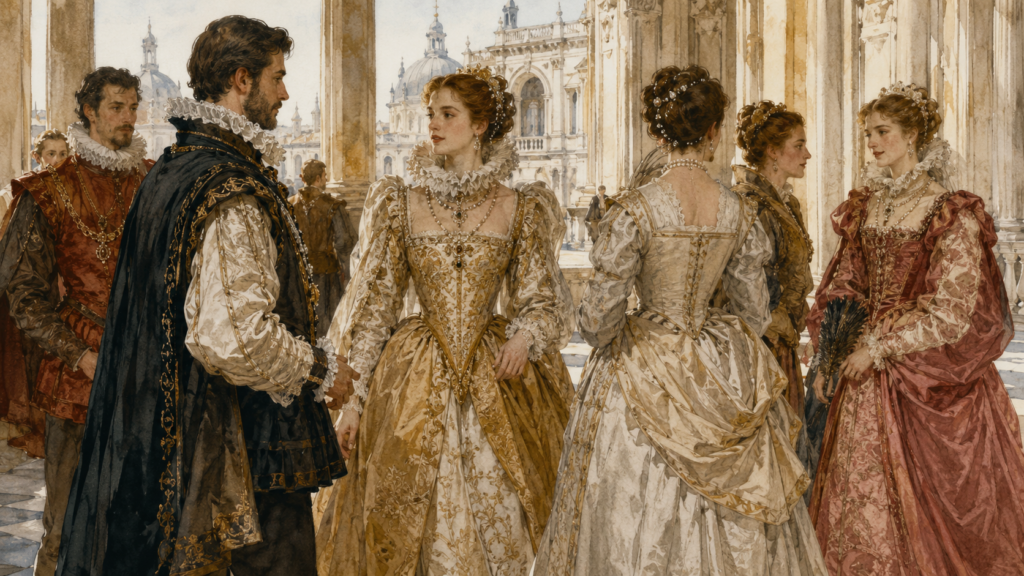
As textile production, trade, tailoring, and court culture developed, clothing became increasingly elaborate as a form of aesthetic expression.
During the Renaissance, particularly among European elites, dress became closely connected to changing ideals of beauty, proportion, refinement, and social presentation.
Fabrics, silhouettes, sleeves, embroidery, jewelry, and color combinations offered increasingly sophisticated ways of shaping the appearance of the body.
Portraits from the period reveal something important.
People were not simply depicted wearing clothes. Their clothes were part of the image they wished to present to the world.
A garment could communicate dignity, prosperity, education, masculinity, femininity, religious devotion, or political authority.
Fashion had become a visual language.
From Renaissance Courts to Louis XIV
This relationship between fashion and power became even more dramatic in the European court cultures of the seventeenth century.
Louis XIV of France is a particularly important example.
At Versailles, clothing, ceremony, etiquette, architecture, and spectacle worked together to reinforce royal authority. Court fashion was not merely decorative; participation in the elaborate culture surrounding the king helped organize aristocratic life around the monarchy.
France consequently became increasingly influential in European luxury and fashion culture.
This period illustrates an enduring feature of fashion:
beauty and power are often intertwined.
What a society considers elegant is not always independent of who possesses the authority to define elegance.
4. How Did Fashion Become a Form of Self-Expression?
The modern transformation of fashion accelerated with industrialization.
Mechanized textile production, sewing machines, department stores, mass manufacturing, photography, magazines, advertising, and eventually cinema and television made fashionable clothing accessible to much larger populations.
Fashion was no longer shaped only by aristocratic courts.
Urban consumers, designers, entertainers, workers, youth cultures, and eventually global media all became participants in the creation and circulation of style.
During the twentieth century, clothing also became closely connected with changing ideas about gender and everyday freedom.
Coco Chanel is one famous example. Her designs helped popularize a simpler and more practical vision of women’s fashion during a period when women’s social roles were changing significantly.
The little black dress, especially after its emergence in the 1920s, became an enduring example of how simplicity could itself become an aesthetic statement.
But modern fashion was shaped by far more than individual designers.
Changes in women’s employment, youth culture, leisure, popular music, mass consumption, and social movements all influenced what people wore.
Fashion increasingly became a way to answer a personal and social question:
Who am I?
5. Why Do Subcultures Use Fashion?
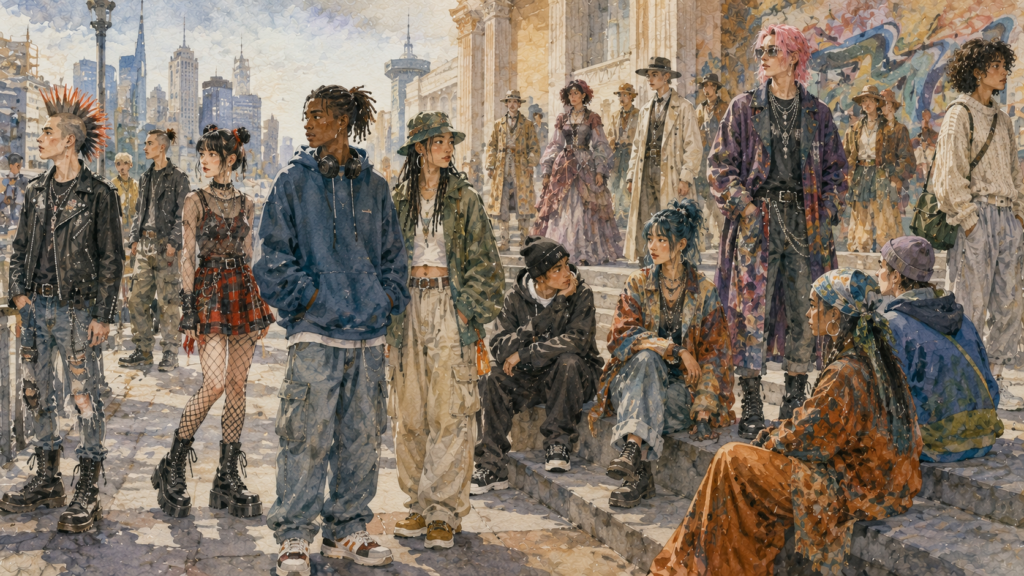
One of the most revealing developments in modern fashion is that influential styles do not always come from designers or luxury houses.
Sometimes they come from the street.
Punk culture in the 1970s transformed torn clothing, leather, safety pins, unconventional hairstyles, and deliberately provocative combinations into symbols of resistance against mainstream expectations.
Hip-hop developed another powerful visual language.
Emerging from Black and Latino communities in New York during the 1970s and expanding internationally in later decades, hip-hop fashion incorporated sneakers, sportswear, oversized silhouettes, jewelry, and other elements that became inseparable from music and cultural identity.
These examples demonstrate that fashion can function as collective self-expression.
Clothing can say:
We belong together.
It can also say:
We are different from you.
This is one reason fashion frequently becomes connected to generational conflict, political resistance, ethnicity, gender, class, and cultural identity.
Clothes do not merely cover individuals.
They can help create communities.
6. Is Fashion About Individuality—or Belonging?
Here we encounter one of fashion’s most interesting paradoxes.
People often say they use fashion to express their individuality.
Yet fashion also depends on imitation.
We choose clothes that make us feel distinctive, but we also learn what looks attractive by observing other people. We follow trends while trying not to look exactly like everyone else.
A teenager may dress differently from their parents while dressing similarly to friends.
A professional may choose clothing that expresses personality while remaining appropriate for the workplace.
Someone attending a wedding, funeral, religious ceremony, or festival may willingly follow a dress convention because belonging matters more than individuality in that particular moment.
Fashion therefore allows us to negotiate two human desires:
the desire to be different and the desire to belong.
This tension helps explain why fashion continually changes.
Once a distinctive style becomes widely adopted, people searching for distinction begin looking for something new.
7. What Is the Relationship Between Function and Beauty?
The distinction between practical clothing and beautiful clothing may seem obvious, but in reality the two often overlap.
A well-designed coat must protect the wearer from cold, but its shape, texture, color, and proportions can also create aesthetic pleasure.
Sportswear must allow movement, yet athletic shoes and clothing have become major fashion objects.
Uniforms serve practical and organizational functions, but their design also communicates authority, professionalism, or group identity.
This suggests that the aesthetics of fashion are not simply decorations added after practical needs have been satisfied.
Function itself can become beautiful.
Likewise, aesthetic choices can influence function.
The history of fashion is therefore partly a history of designers, craftspeople, and wearers repeatedly negotiating between the body and the imagination.
8. How Is Technology Changing Fashion?
Today, the relationship between function and aesthetics is entering another phase.
New materials and digital technologies are expanding what clothing can do.
Smart textiles and wearable devices can monitor aspects of physical activity or physiological conditions. Researchers and designers are experimenting with fabrics that respond to heat, moisture, movement, or environmental changes.
Three-dimensional printing and digital design also make it possible to create shapes and structures that would be difficult to produce through traditional methods.
Technology is changing the fashion industry in less visible ways as well.
Digital design tools, virtual fitting systems, online retail, social media, and artificial intelligence are influencing how clothes are designed, marketed, discovered, and consumed.
At the same time, these innovations raise new questions.
Will technology make clothing more personal and functional?
Will digital fashion reduce material consumption—or encourage even faster cycles of novelty?
And as algorithms increasingly influence what people see and buy, who will shape our sense of style: ourselves, designers, communities, or machines?
The ancient relationship between function and aesthetics has not disappeared.
It is simply entering a new technological environment.
Conclusion: Clothing as a Human Language
Fashion began partly with one of the most practical human needs: protecting the body.
Yet clothing became much more.
Across different societies and historical periods, people have used dress to express status, power, beauty, gender, belonging, resistance, creativity, and personal identity.
This is why fashion cannot be understood simply by asking whether a garment is useful or beautiful.
It can be both.
A coat protects us from cold. A uniform identifies a role. A ceremonial garment connects us to a community. A subcultural style challenges social expectations. An ordinary outfit can quietly express how we want others to see us.
Fashion changes because societies change—and because people continually reinterpret themselves.
Perhaps that is why clothing remains so fascinating.
We wear clothes to protect the body, but we create fashion to communicate something about the person inside.
A Question for Readers
Fashion allows us to express individuality, but it also reflects the expectations and values of the groups and societies to which we belong.
When you choose what to wear, how much of that choice expresses who you are—and how much is shaped by the culture around you?
Related Reading
Fashion becomes especially interesting when styles that begin outside the mainstream eventually reshape the wider culture of dress. This transformation is explored further in The Evolution of Streetwear: From Subculture to High Fashion, which examines how skateboarding, hip-hop, and other youth subcultures turned clothing into a powerful expression of identity before influencing the world of high fashion.
Clothing also communicates more than personal taste; it can reflect the social expectations surrounding identity and the roles people are expected to perform. This relationship is explored from a more critical perspective in Fashion and Gender: How Clothing Shapes Identity and Social Roles, which examines how fashion can both reinforce traditional gender norms and provide individuals with ways to challenge and redefine them.
References
1. Entwistle, Joanne. The Fashioned Body: Fashion, Dress and Modern Social Theory. Polity Press, 2015.
Entwistle examines clothing as something that exists at the intersection of the body, identity, and society. The book is especially useful for understanding why dress is more than physical protection and how clothing becomes part of the way individuals present themselves within social environments.
2. Crane, Diana. Fashion and Its Social Agendas: Class, Gender, and Identity in Clothing. University of Chicago Press, 2000.
Crane explores the relationship between fashion and major social categories such as class, gender, and identity. Her work helps explain the historical transition from clothing as a visible marker of social hierarchy to fashion as a more complex means of personal and collective expression.
3. Hollander, Anne. Seeing Through Clothes. University of California Press, 1993.
Hollander approaches clothing through the history of visual culture and art, showing how ideas about the dressed body are shaped by changing aesthetic conventions. The book is particularly relevant to the article’s discussion of fashion as a visual and aesthetic language rather than merely a practical necessity.
4. Steele, Valerie. Paris Fashion: A Cultural History. Bloomsbury Academic, 2017.
Steele traces the cultural development of Paris as a major center of fashion and examines the relationship among clothing, modernity, social change, and cultural influence. It provides useful historical context for understanding how European court culture and later modern fashion helped transform clothing into an influential cultural institution.
5. Wilson, Elizabeth. Adorned in Dreams: Fashion and Modernity. I.B. Tauris, 2003.
Wilson treats fashion as an important expression of modern culture rather than as something superficial or trivial. Her analysis connects clothing with identity, sexuality, social change, modernity, and imagination, making the book particularly valuable for understanding why fashion can function as a form of cultural communication.