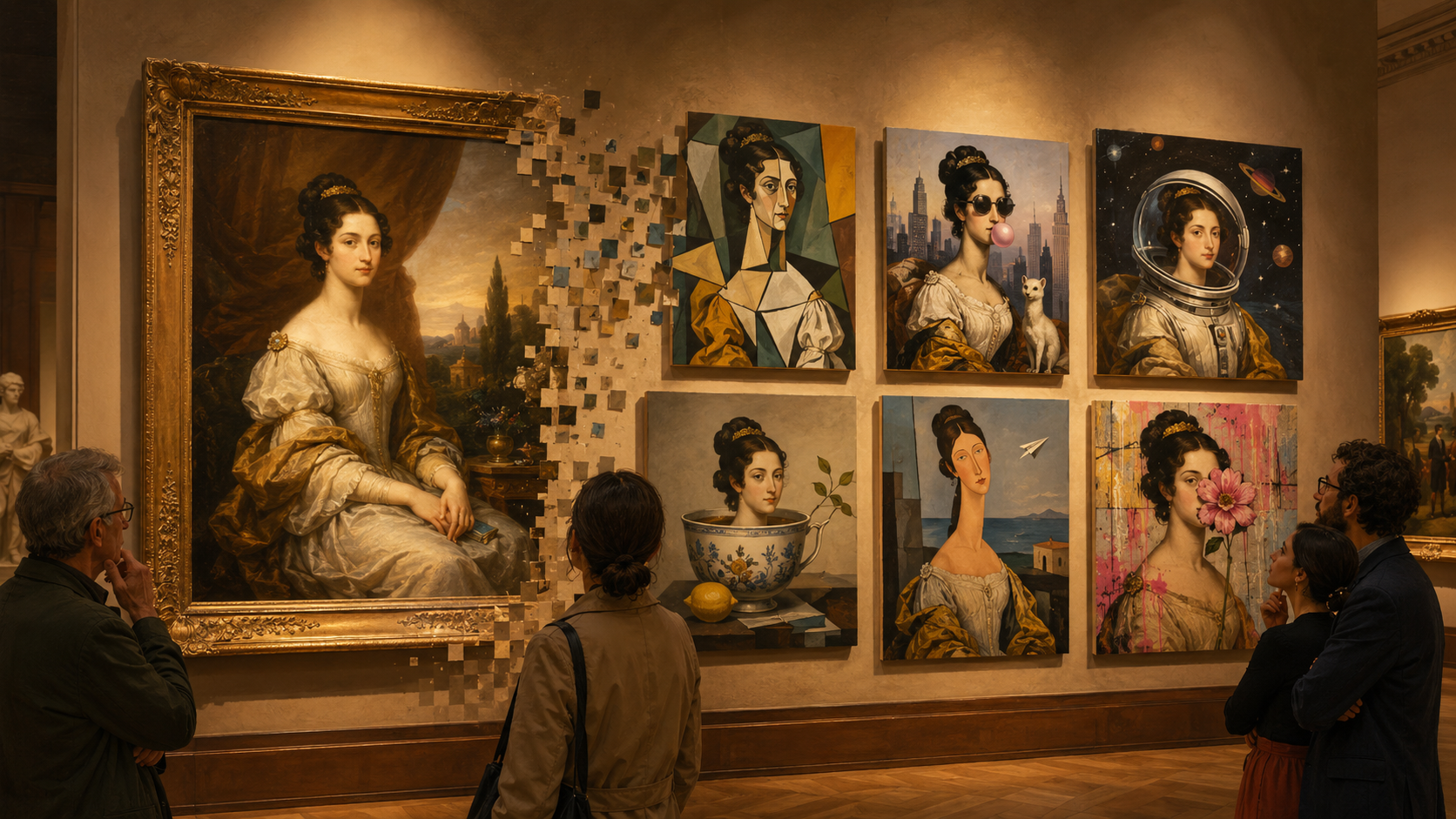
When Borrowing, Humor, and Criticism Create Something New
Parody has always occupied a curious place in art.
It borrows from what already exists, yet it often creates something audiences have never seen before. A familiar painting may be transformed into political criticism. A well-known image may be altered to question consumer culture. A recognizable scene may reappear as an internet meme about modern life.
This creates a fundamental artistic question:
Can a work that depends on another work still be considered original art?
The question has become even more relevant in the digital age. Images are copied, remixed, edited, and shared across borders within seconds. Parody now appears not only in galleries but also in films, advertising, street art, social media, and internet memes.
To understand whether parody can be original, however, we first need to distinguish copying from transformation.
1. What Is Parody in Art?
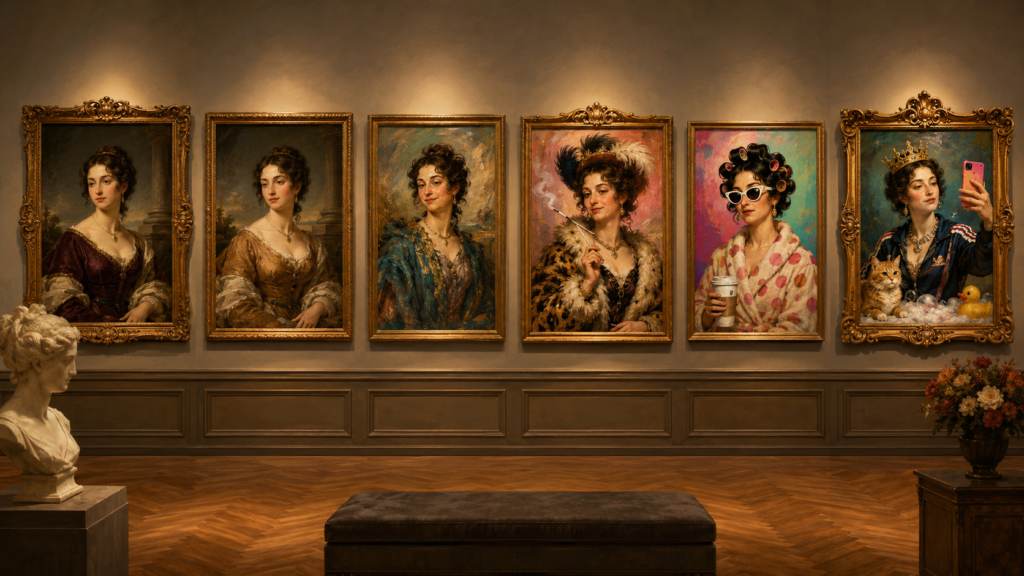
Recognition and Transformation
Parody begins with recognition.
It deliberately borrows a familiar artwork, style, character, or cultural symbol and changes it to create a new effect.
Sometimes the purpose is humor. Sometimes it is criticism. Sometimes parody expresses admiration while simultaneously questioning the original.
The important point is that parody does more than reproduce.
A simple copy attempts to preserve the original. A parody changes its context, tone, or meaning.
This is also why parody is not exactly the same as appropriation.
Appropriation broadly refers to using existing images, objects, or cultural material in a new work. Parody is more specific: it usually creates meaning through a recognizable relationship with the source, often using exaggeration, irony, humor, or criticism.
The audience therefore plays an important role.
If viewers recognize the original reference, they can understand the gap between what the image once meant and what it means now.
That gap is where parody begins to create something new.
2. When Does Imitation Become Original Art?
One of the strongest criticisms of parody is that it depends too heavily on someone else’s creativity.
If an artist simply reproduces a famous painting and adds a humorous detail, can that really be called original?
Sometimes the answer may be no.
Not every parody is creatively significant. A weak parody may do little more than exploit the familiarity of the original.
But originality in art has rarely meant creating something from absolutely nothing.
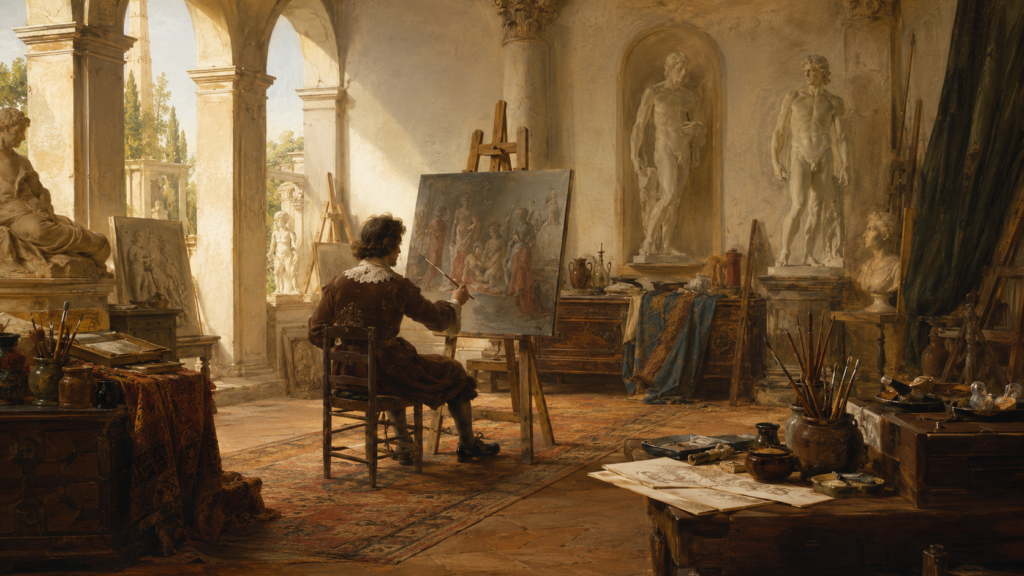
Writers borrow narrative structures. Musicians reinterpret older musical forms. Painters learn from previous painters. Filmmakers quote or recreate scenes from earlier films.
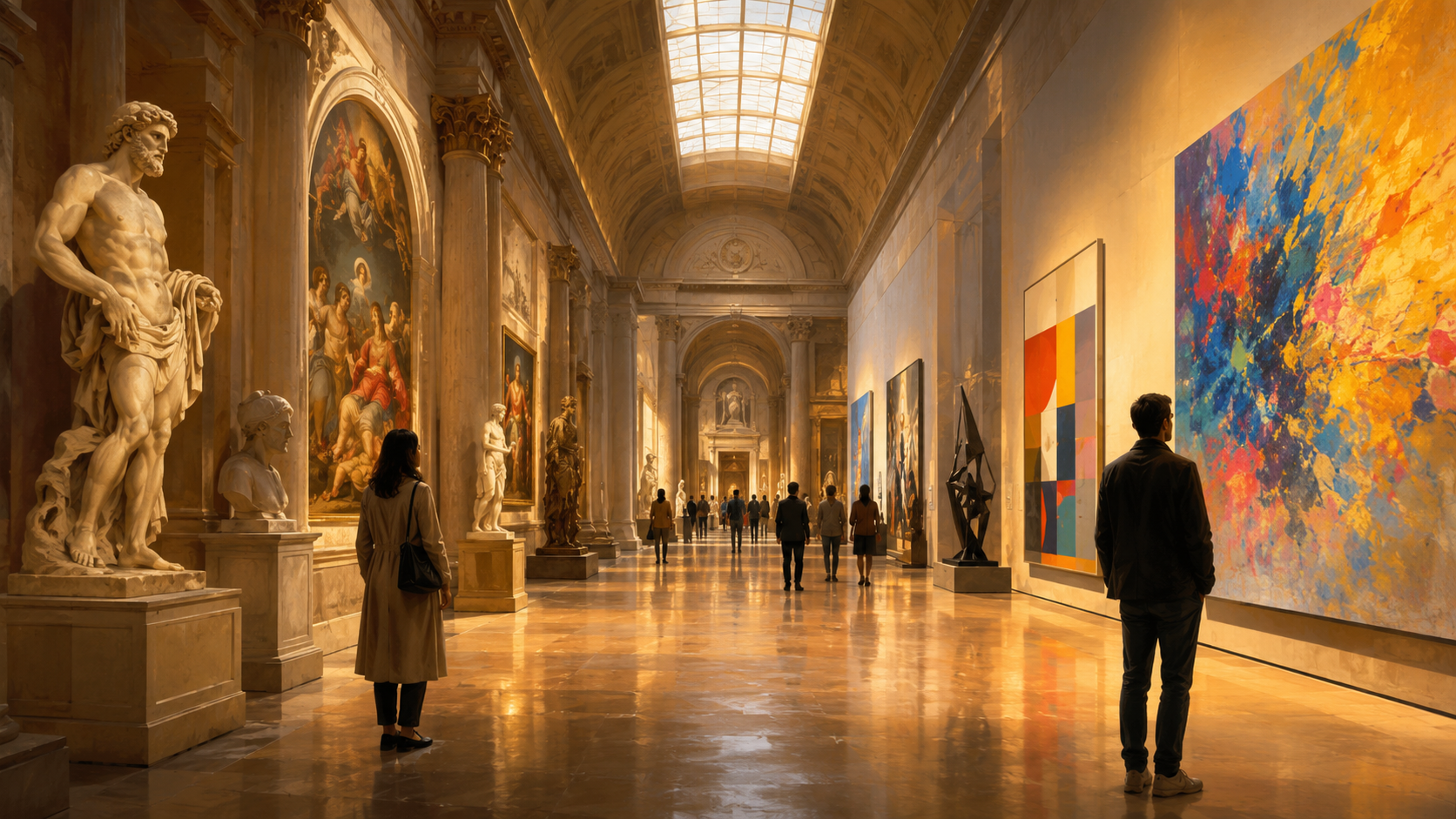
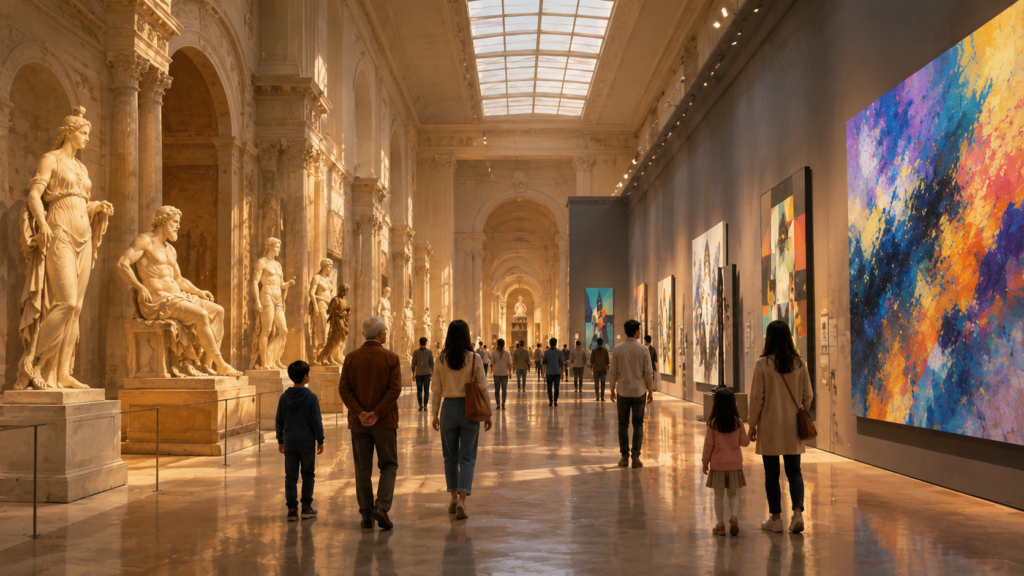
Art develops through an ongoing conversation with what came before.
The more useful question is therefore not:
“Did the artist borrow something?”
but:
“What did the artist create through that borrowing?”
If a parody merely repeats the original, it remains imitation.
If it changes our interpretation, reveals a contradiction, creates criticism, or places the familiar work in a radically different context, borrowing can become creative transformation.
The original provides the vocabulary, but the parody creates a new sentence.
3. How Have Artists Used Parody?
From the Mona Lisa to Contemporary Street Art
One of the most famous examples of artistic parody involves Leonardo da Vinci’s Mona Lisa.
Because the painting is so widely recognized, even a small alteration can immediately change the way viewers respond to it.
In 1919, Marcel Duchamp famously added a mustache and goatee to a reproduction of the Mona Lisa and titled the work L.H.O.O.Q.
The gesture was humorous, but it was also provocative.
Duchamp was challenging traditional assumptions about artistic authority, originality, and the almost sacred status given to famous masterpieces.
The work depended completely on the audience knowing Leonardo’s painting. Yet its meaning was very different from the original.
Contemporary street art often uses a similar strategy.
Banksy, for example, frequently works with familiar cultural symbols and visual conventions, placing them in unexpected contexts to comment on war, authority, inequality, consumer culture, or everyday social contradictions.
The viewer first recognizes something familiar.
Then the context changes.
That movement from recognition to disruption is one of parody’s most powerful artistic techniques.
4. Why Is Parody Such a Powerful Form of Social Criticism?
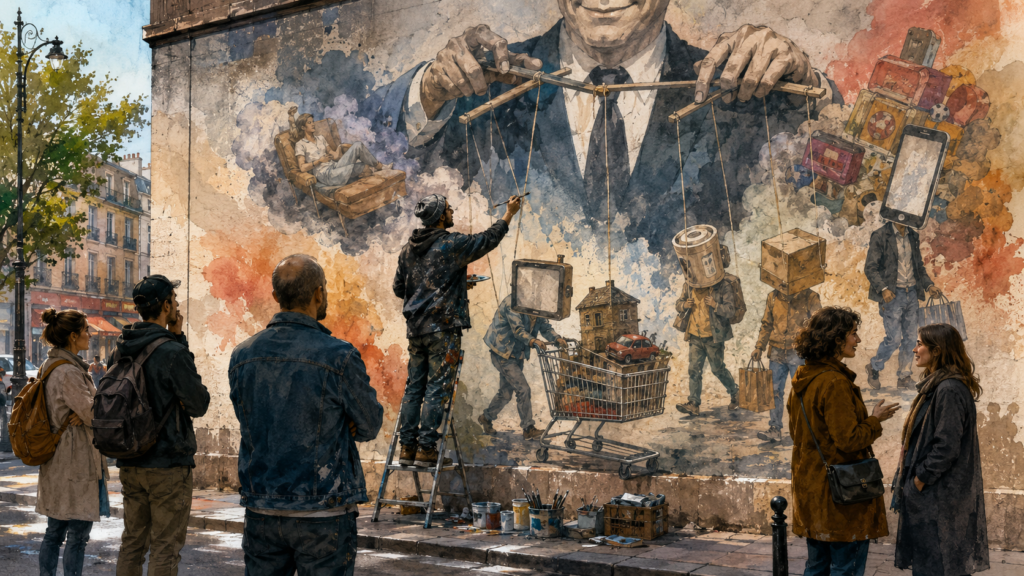
Parody is particularly effective when it turns humor into criticism.
A direct political argument can immediately divide an audience. Parody often approaches the same issue indirectly.
First we recognize the joke.
Then we recognize what the joke is saying.
This is why parody appears so frequently in political cartoons, literature, television, film, advertising, and visual art.
Programs such as The Simpsons and South Park, for example, have used parody and satire to comment on politics, celebrity culture, consumerism, media, and social behavior.
The humor can make criticism more accessible, but it can also make it more unsettling.
Parody asks audiences to reconsider things they normally accept without much thought.
This is particularly important in a world saturated with images.
Advertisements, political messages, brands, celebrities, entertainment, and social-media content compete constantly for our attention. Familiarity can eventually make these images almost invisible.
Parody interrupts that familiarity.
It takes something we think we already understand and forces us to look at it again.
In this sense, parody is not merely a way of making fun of culture.
It can also be a way of thinking critically about culture.
5. How Did Parody Evolve into Internet Meme Culture?
The internet has radically expanded who can create and distribute parody.
In earlier periods, artists often needed publishers, broadcasters, galleries, or other institutions to reach large audiences.
Today, almost anyone with a smartphone can modify an image and share it globally.
Internet memes are perhaps the clearest contemporary example.
A Renaissance painting can suddenly become a joke about office life. A historical portrait can express frustration with modern technology. A familiar movie scene can become commentary on education, economics, relationships, or politics.
Most memes are not created as museum art.
Yet their cultural mechanism resembles traditional parody.
They rely on recognition.
They change context.
They invite reinterpretation.
Digital culture has therefore blurred the boundary between audience and creator. People do not merely consume images anymore. They copy, modify, remix, caption, circulate, and reinterpret them.
But this new freedom creates another question:
When does creative transformation become unauthorized copying?
6. Parody, Copyright, and the Limits of Borrowing
The artistic value of parody does not automatically settle its legal or ethical status.
Copyright law varies between countries. In the United States, some parodies may qualify as fair use, while other legal systems apply different exceptions or concepts such as fair dealing.
Simply describing something as parody does not automatically make copying lawful.
Several questions can matter.
How much of the original work was used? How substantially was it transformed? Does the new work actually comment on the original, or does it simply use its popularity? Could the new work substitute for the original commercially?
These questions reveal a genuine tension.
Artists need enough freedom to criticize, reinterpret, and respond to existing culture.
At the same time, creators have legitimate interests in protecting their own work.
The challenge is therefore not to choose between unlimited artistic freedom and absolute copyright protection.
It is to determine when borrowing creates enough new meaning to justify being treated as transformation rather than reproduction.
Conclusion: Can Parody Be Original?
Parody occupies an unusual position in art.
It depends on something that already exists, yet its success depends on creating something the original did not say.
Not every parody achieves this.
Simply copying a famous work and adding a joke does not automatically produce meaningful art.
But when parody transforms context, questions assumptions, exposes contradictions, or allows audiences to see familiar images differently, imitation can become genuine creative expression.
Perhaps originality does not always mean beginning with nothing.
Art rarely develops that way.
Artists inherit techniques, stories, images, symbols, and ideas from those who came before them. Creativity often emerges through the ways those inherited materials are rearranged, questioned, challenged, and transformed.
Parody simply makes that process unusually visible.
It begins with something we already recognize—and asks whether we can see it differently.
A copy repeats an image. A successful parody changes the way we see it.
Reader Question
Parody often begins with something another artist has already created. Yet the strongest parodies can completely change how we understand the original.
At what point do you think imitation becomes a genuinely new work of art—and what should an artist add to make that transformation meaningful?
Related Reading
Questions about parody ultimately lead us to ask where originality ends and reinterpretation begins, and whether artistic value depends on creating something entirely new. A related debate about creativity, ideals, and human limitations appears in Why Do Humans Seek Perfection While Knowing They Are Incomplete?, which examines why we continue to pursue ideal forms even when perfection itself may be impossible.
Parody also becomes easier to understand when we see art as a continuing conversation between different periods rather than as a series of completely independent creations. This historical relationship between changing styles and human expression is explored further in Classical and Modern Art, which examines how artists across different eras have transformed the ways we represent emotions and inner experience.
References
1. Hutcheon, Linda. A Theory of Parody: The Teachings of Twentieth-Century Art Forms. University of Illinois Press, 2000.
Hutcheon examines parody as more than humorous imitation, describing it as a creative form of repetition that introduces critical distance and new meaning. The book is especially useful for understanding why parody can simultaneously depend on an earlier work and become an independent artistic expression.
2. Rose, Margaret A. Parody: Ancient, Modern, and Post-Modern. Cambridge University Press, 1993.
Rose traces parody across different historical periods and examines its relationship with imitation, humor, irony, and artistic transformation. It provides an important theoretical foundation for understanding how parody has changed along with literature, art, and popular culture.
3. Kuenzli, Rudolf E., ed. Dada and Surrealist Film. MIT Press, 1996.
This collection explores the experimental culture surrounding Dada and Surrealism, movements that challenged conventional ideas about artistic originality and authority. It provides useful historical context for understanding Marcel Duchamp and the radical artistic environment in which works such as L.H.O.O.Q. emerged.
4. Lewisohn, Cedar. Street Art: The Graffiti Revolution. Tate Publishing, 2008.
Lewisohn explores the development of graffiti and street art as important forms of contemporary visual culture. The book helps explain how street artists use familiar symbols, public spaces, humor, and visual disruption to communicate political and social criticism.
5. Shifman, Limor. Memes in Digital Culture. MIT Press, 2014.
Shifman examines internet memes as a major form of contemporary cultural communication. The book is particularly relevant to understanding how digital audiences continually copy, modify, reinterpret, and circulate familiar cultural images—extending many of the mechanisms traditionally associated with parody.