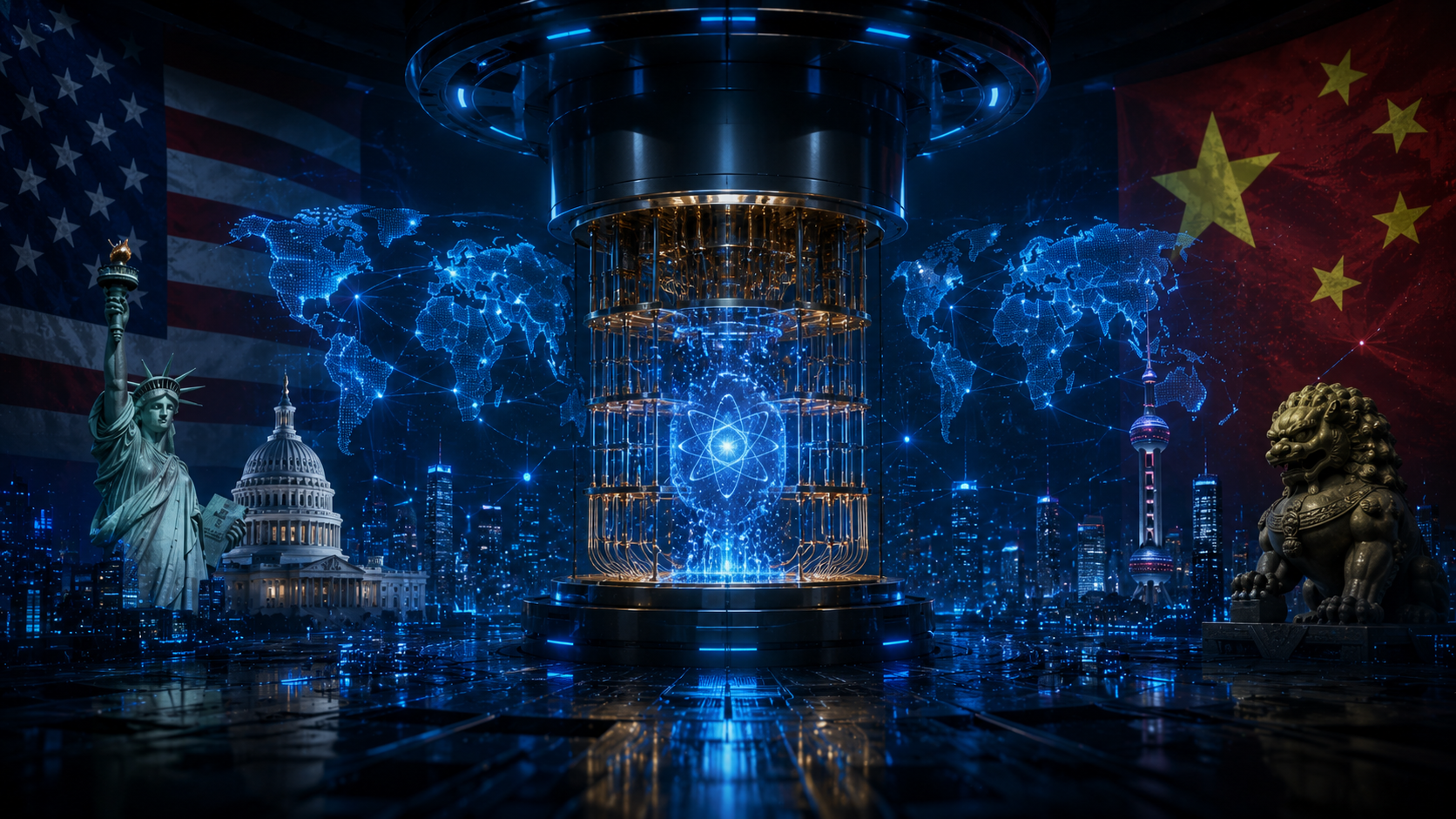
How Quantum Technology Could Reshape Geopolitics, Cybersecurity, and the Future Balance of Power
Throughout history, technological revolutions have repeatedly transformed global power.
The Industrial Revolution reshaped empires through manufacturing and energy.
The internet revolution redefined communication, finance, and information warfare.
Now, another technological race is rapidly emerging:
Quantum computing.
Unlike traditional computers, quantum computers may eventually solve problems so complex that today’s most powerful supercomputers would require thousands—or even millions—of years to complete them.
Because of this potential, quantum technology is no longer viewed as merely scientific research.
It is increasingly becoming:
- a geopolitical asset
- a cybersecurity weapon
- an economic advantage
- and possibly the foundation of future global dominance
As the United States, China, and European Union intensify their quantum ambitions, a critical question emerges:
Could quantum computing become the defining technology of the next global power struggle?
1. The Global Quantum Race Has Already Begun

The United States and Corporate Quantum Leadership
The United States remains one of the global leaders in quantum computing research.
Major technology companies such as:
- IBM
- and Microsoft
are investing heavily in quantum technologies.
In 2019, Google announced it had achieved “quantum supremacy,” claiming its quantum processor solved a problem in minutes that would take classical supercomputers thousands of years.
IBM has developed increasingly advanced quantum processors and now offers cloud-based quantum computing access to researchers worldwide.
Microsoft continues exploring topological quantum computing, focusing on building more stable and scalable quantum systems.
In the United States, quantum development is deeply connected not only to scientific innovation—
but also to economic and strategic dominance.
China’s State-Driven Quantum Expansion
China has rapidly emerged as a major quantum power through strong government-led investment.
Researchers at the University of Science and Technology of China developed the photonic quantum computer “Jiuzhang,” demonstrating extraordinary computational speed in specialized tasks.
China is also advancing quantum communication technologies.
Its quantum satellite, Micius, was designed to explore ultra-secure quantum encryption systems resistant to conventional hacking methods.
Unlike the largely corporate-driven American model, China’s quantum strategy is heavily integrated into national policy and long-term geopolitical planning.
Europe’s Quantum Strategy
The European Union launched the Quantum Flagship initiative to strengthen Europe’s position in the global quantum race.
This large-scale program aims to invest billions of euros into:
- quantum computing
- quantum communication
- quantum sensing
- and quantum simulation technologies
Countries such as Germany, France, and United Kingdom continue expanding collaborative research networks to avoid falling behind American and Chinese competitors.
2. Could Quantum Technology Create a New Cold War?
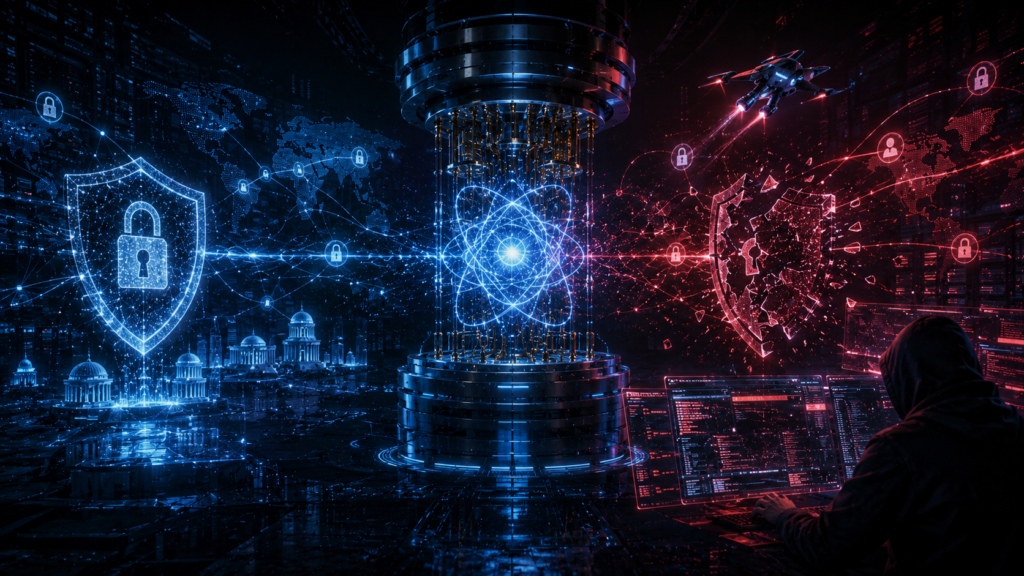
Quantum Computing and National Security
One of the greatest geopolitical concerns involves encryption.
Modern digital systems rely heavily on cryptographic protection.
Current encryption methods such as RSA are extremely difficult for classical computers to break.
However, sufficiently advanced quantum computers could potentially decrypt many existing security systems dramatically faster.
If a single nation achieved overwhelming quantum capability first, it might gain unprecedented access to:
- military communications
- financial systems
- intelligence databases
- and global digital infrastructure
This possibility has transformed quantum research into a national security priority.
As a result, quantum computing increasingly resembles a strategic arms race rather than purely scientific competition.
Cyber Warfare and Information Power
Future cyber conflict may depend heavily on quantum advantage.
Quantum-powered cybersecurity systems could create nearly unbreakable encryption.
At the same time, offensive quantum capabilities might undermine traditional digital security entirely.
This creates a dangerous paradox:
Quantum technology could simultaneously become:
- the ultimate defensive tool
and - the ultimate offensive weapon
Such dynamics may intensify geopolitical tensions between major powers, particularly between the United States and China.
Some analysts therefore describe the quantum race as the beginning of a new technological Cold War.
3. The Risk of Quantum Inequality
Technological Gaps Between Nations
Quantum computing could dramatically widen global inequality.
Countries with advanced quantum infrastructure may dominate:
- medicine
- climate modeling
- finance
- logistics
- artificial intelligence
- and military systems
Meanwhile, nations lacking access to quantum technologies could become increasingly dependent on technologically dominant powers.
This may create a new form of digital hierarchy in the global economy.
Corporate Monopoly and Technological Concentration
Another concern involves corporate concentration.
Today, a small number of large technology corporations already dominate much of the digital world.
If quantum computing becomes controlled by only a few companies, technological inequality may deepen further.
Smaller businesses and developing nations could struggle to compete in a quantum-driven economy.
This raises difficult questions about:
- technological fairness
- access to innovation
- and the concentration of computational power
The future quantum economy may therefore become not only a scientific issue—
But also a political and ethical one.
Conclusion: The Future Balance of Power

Quantum computing may become one of the most transformative technologies in human history.
Its potential benefits are enormous:
- faster medical discoveries
- advanced climate prediction
- revolutionary materials science
- and unprecedented computational capability
However, quantum technology also carries major geopolitical risks.
If monopolized by powerful nations or corporations, it could deepen:
- economic inequality
- cybersecurity instability
- and global political tension
The challenge of the quantum age may therefore extend beyond technological achievement itself.
Humanity must also decide:
- who controls these systems
- who benefits from them
- and how global cooperation can prevent technological domination from becoming a new form of digital imperial power
Perhaps the future question is no longer:
“Can humans build quantum computers?”
But rather:
What kind of global order will emerge once they succeed?
Reader Question
If quantum computing gives a few nations or corporations overwhelming technological power—
Could the future of global politics become less about military strength,
and more about computational dominance?
Or should quantum technology be treated as a shared global resource rather than a strategic weapon?
Related Reading
If future technologies increasingly reshape global power structures, could national sovereignty itself become more flexible and unstable in the digital age?
In Is National Sovereignty Absolute?, we explore how technological competition and global cooperation continuously challenge traditional ideas of political power and international order.
If scientific breakthroughs constantly redefine what humanity considers possible, should societies focus only on technological progress—or also on the ethical responsibility that comes with it?
In Is Scientific Truth Ever Absolute?, we examine how science evolves through uncertainty, paradigm shifts, and humanity’s changing understanding of reality.
References
- The Quantum Spy by David Ignatius
This geopolitical thriller explores espionage and technological rivalry surrounding quantum computing competition between major global powers. - National Academies of Sciences, Engineering, and Medicine (2019). Quantum Computing: Progress and Prospects.
This report analyzes the scientific progress of quantum computing and its implications for national security and global technological competition. - Elsa B. Kania & John Costello. The Geopolitics of Quantum Computing.
This study examines how quantum technologies may reshape international relations and strategic competition. - Chris Bernhardt. Quantum Computing and International Relations.
Bernhardt discusses how quantum technologies may influence geopolitical power structures and global inequality. - Andrew Futter. The Quantum Race: Securing the Future through Quantum Diplomacy.
This work explores how quantum competition could intensify geopolitical tensions while highlighting the need for international cooperation.