A Path to Redemption or a Descent into Nihilism?
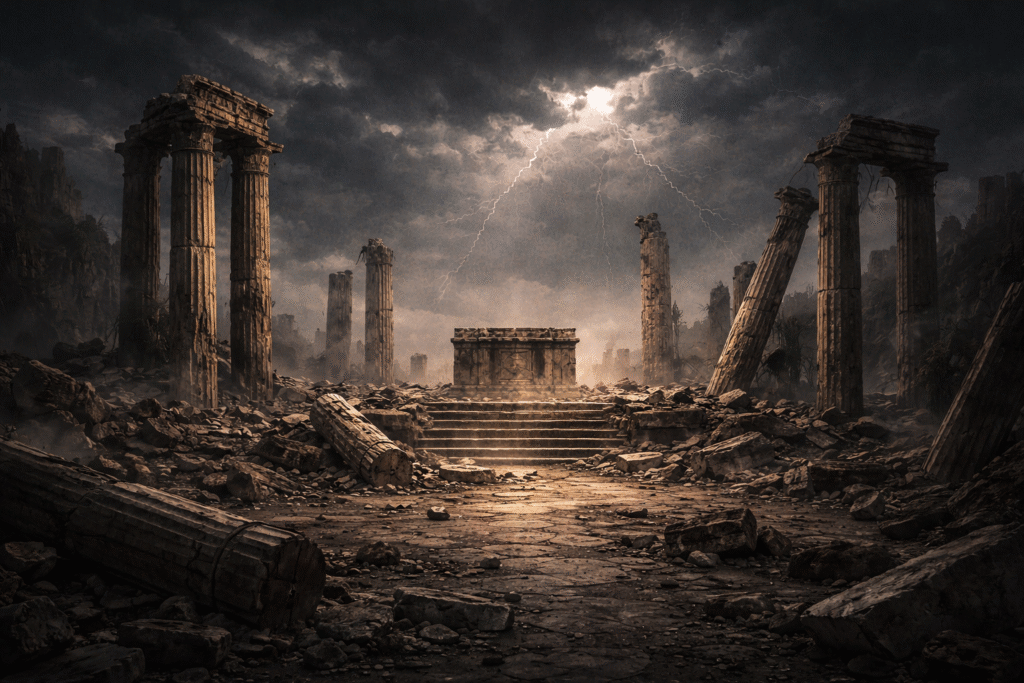
After the Death of God
In an age shaped by artificial intelligence, misinformation, and moral fragmentation, one unsettling question keeps resurfacing:
Are there still any absolute standards left in the world?
Friedrich Nietzsche confronted this question long before our digital age.
In the nineteenth century, he famously declared, “God is dead.”
With this statement, Nietzsche did not simply reject religion. He diagnosed a civilizational crisis: the collapse of the metaphysical, moral, and religious foundations that had long given meaning to human life.
If the traditional sources of value have vanished, what—or who—can take their place?
Nietzsche’s answer was radical and provocative: the Übermensch, often translated as the Overman or Superhuman.
But what does this figure truly represent today?
Is the Übermensch a path toward redemption in a godless world, or does it lead us deeper into the swamp of nihilism?
1. The Death of God and the Crisis of Meaning
1.1. What Does “God Is Dead” Really Mean?
Nietzsche’s declaration that “God is dead” is not a triumphalist slogan.
It is a diagnosis of loss. The shared moral horizon that once guided human judgment has dissolved.
At this moment of collapse, Nietzsche implicitly raises a question that still haunts us today:
If there is no longer an absolute authority, what grounds our values, our truths, and our responsibilities?
Without new foundations, humanity risks falling into nihilism—a condition in which life appears meaningless, directionless, and empty.
1.2. The Übermensch as a Response to Nihilism
The Übermensch is Nietzsche’s attempt to respond to this crisis.
This figure is not a muscular hero or a biological superior being. Rather, the Übermensch is a creator of values.
Where old moral systems collapse, the Übermensch does not despair.
Instead, this figure affirms life by generating new standards from within, refusing to rely on inherited authorities.
2. The Übermensch as a Creator of New Values

2.1. Active Nihilism and Self-Transcendence
Nietzsche distinguishes between passive nihilism, which merely negates old values, and active nihilism, which destroys in order to create.
The Übermensch embodies this active form. Three core traits define this ideal:
- Self-overcoming: The Übermensch transcends inherited norms and continually reshapes the self through reflection and struggle.
- Affirmation of life: Pain, uncertainty, and suffering are not rejected but embraced as essential to growth.
- Creative existence: Life itself becomes a work of art, shaped rather than obeyed.
2.2. Eternal Recurrence and Radical Affirmation
Nietzsche’s idea of eternal recurrence—the thought that one must will the repetition of one’s life endlessly—serves as a test of affirmation.
The Übermensch is the one who can say “yes” to life so completely that even infinite repetition becomes acceptable.
In this sense, the Übermensch represents Nietzsche’s most radical attempt to overcome nihilism.
3. The Shadow of Nihilism: Critical Perspectives
Despite its ambition, the concept of the Übermensch has drawn serious criticism.
3.1. The Risk of Deeper Relativism
If all values are self-created, can any value claim lasting legitimacy?
Critics argue that Nietzsche’s solution risks replacing one form of nihilism with another, where all meaning becomes arbitrary.
3.2. Elitism and the Problem of the “Herd”
Nietzsche often contrasts the Übermensch with the “herd.”
This has led to accusations of elitism, suggesting that only a select few are capable of value creation, while the majority are dismissed as passive followers.
Such implications raise concerns about social equality and solidarity.
3.3. The Problem of Practical Realization
The Übermensch may be philosophically compelling, but is it achievable?
Many argue that it remains an abstract ideal—seductive in theory, yet unreachable in lived reality.
From this perspective, the Übermensch risks becoming not a cure for nihilism, but merely its most refined expression.
4. The Übermensch in Contemporary Contexts
4.1. Self-Improvement and Performance Culture
Modern self-help and productivity discourses often reinterpret the Übermensch as relentless self-optimization.
Yet this translation can distort Nietzsche’s intent, turning creative self-overcoming into capitalist pressure and burnout.
4.2. Art, Innovation, and Creative Resistance
In contrast, artists, thinkers, and innovators continue to draw inspiration from Nietzsche’s vision.
Here, the Übermensch survives as a symbol of creative rebellion against conformity and stagnation.
4.3. Ethics and Community
The most difficult question remains unresolved:
How can radical individual creativity coexist with ethical responsibility and communal life?
The Übermensch stands at the center of this unresolved tension.

Conclusion: Between Redemption and Nihilism
Nietzsche’s Übermensch is one of the boldest figures in modern philosophy.
It represents both an attempt to overcome nihilism and a risky experiment that flirts with it.
Is the Übermensch a path to redemption or a descent into meaninglessness?
The answer depends not on Nietzsche alone, but on how we interpret and live his challenge.
If the Übermensch is reduced to a fantasy of superiority, it collapses into nihilistic parody.
But if it is understood as a call to responsibility, creativity, and self-overcoming, it may still illuminate a fragile path forward in a world without absolute guarantees.
References
Nietzsche, F. (1883–1885). Thus Spoke Zarathustra. Leipzig: Ernst Schmeitzner.
→ Nietzsche’s foundational work introducing the Übermensch, eternal recurrence, and the declaration of the death of God, presenting them as responses to nihilism.
Nietzsche, F. (1887). On the Genealogy of Morals. Leipzig: C. G. Naumann.
→ A critical examination of moral values that reveals why traditional ethical systems collapse and why new forms of valuation become necessary.
Kaufmann, W. (1974). Nietzsche: Philosopher, Psychologist, Antichrist. Princeton: Princeton University Press.
→ A classic interpretation emphasizing Nietzsche’s concern with creativity and self-overcoming rather than brute power.
Heidegger, M. (1961). Nietzsche (Vols. 1–2). Neske Verlag.
→ A profound analysis situating Nietzsche as the culmination of Western metaphysics, highlighting the unresolved tension between nihilism and transcendence.
Ansell-Pearson, K. (1994). An Introduction to Nietzsche as Political Thinker: The Perfect Nihilist. Cambridge: Cambridge University Press.
→ A political and critical reading that questions whether the Übermensch truly overcomes nihilism or merely transforms it.
Leave a Reply