Blog

  • Why Hypocrisy Persists in Modern Society

    Why Hypocrisy Persists in Modern Society

    — Social Masks in the Age of Social Media

    Hypocrisy is something most people dislike.

    We criticize politicians whose promises differ from their actions.
    We question celebrities whose charity work turns out to be a marketing strategy.
    And we feel uncomfortable when acquaintances show sympathy in public but criticize behind someone’s back.

    Yet hypocrisy is not simply someone else’s problem.

    In modern society, it may be more accurate to say that everyone lives under the shadow of hypocrisy in one way or another. Interestingly, hypocrisy is not always a simple moral failure—it can also function as a complex social survival strategy.


    1. Hypocrisy Is Not a New Problem

    1.1 The Discomfort We Feel

    When we hear the word “hypocrisy,” our instinctive reaction is often negative.

    We tend to associate it with dishonesty, manipulation, or moral weakness. But hypocrisy has existed throughout human history. Social norms, expectations, and reputations have always shaped how people present themselves to others.


    1.2 More Than a Moral Flaw

    What makes hypocrisy complicated is that it often emerges from the tension between who we are and who we believe we should be.

    Modern life constantly places individuals in situations where ideals and reality do not perfectly match. In this gap between the ideal self and the real self, hypocrisy often appears.


    2. Everyday Hypocrisy: How Honest Can We Really Be?

    contrast between reusable tumbler and disposable cups

    Hypocrisy often appears in very ordinary situations.

    Someone carries a reusable tumbler to show concern for the environment but uses disposable cups during a busy company dinner.

    Someone advises a colleague that “health is the most important thing,” yet continues to work excessive overtime while coping with stress through unhealthy habits.

    On social media, people promote the idea of “being authentic,” while carefully selecting filters, editing captions, and crafting the most appealing version of themselves.

    These examples may feel familiar.

    Most people constantly balance between who they want to be and who they actually are. Hypocrisy often emerges in that balancing act.

    Importantly, this does not always mean malicious intent.


    3. Social Media: A Mirror That Produces Hypocrisy

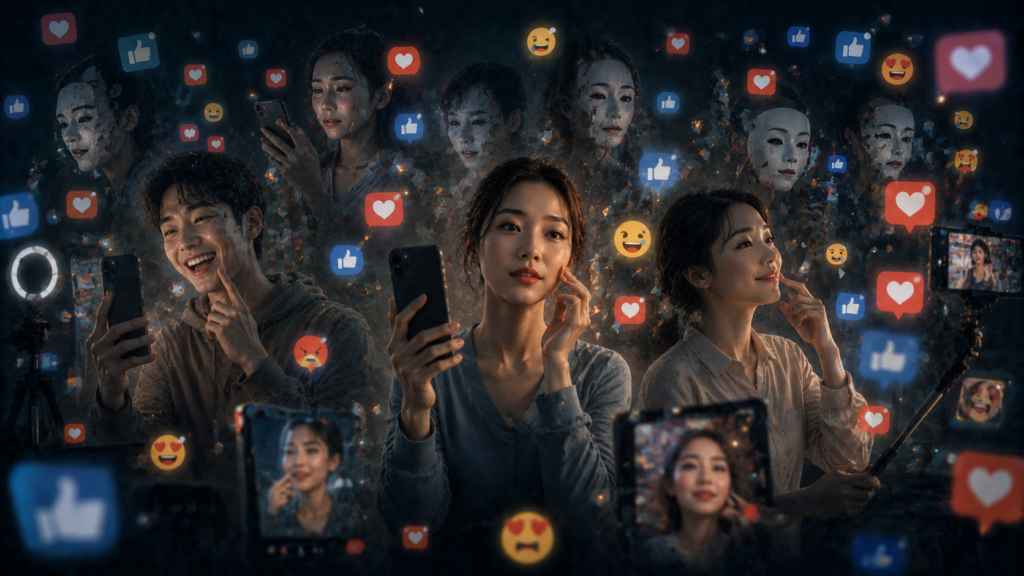
    contrast between real self and social media selfie

    In modern society, one of the places where hypocrisy appears most frequently is social media.

    Platforms that promise freedom of self-expression also create an environment of constant comparison and performance.

    For example:

    • A post saying “I’m happy with my life as it is” may appear alongside dozens of carefully edited travel photos.
    • Messages encouraging people to “love their true selves” often coexist with metrics such as follower counts and “likes.”

    These structures encourage people to live for the audience, not just for themselves.

    Psychologists sometimes describe this phenomenon as mask culture—a social environment in which individuals construct an idealized version of themselves online while feeling a growing distance from their real identities.


    4. The Social Consequences of Hypocrisy

    The real problem emerges when hypocrisy becomes widespread.

    Repeated exposure to inconsistency between words and actions can gradually erode social trust.

    People may begin to distrust political promises.
    Corporate social responsibility initiatives may be dismissed as public relations strategies.
    Even genuine kindness from acquaintances may be interpreted as calculated behavior.

    This dynamic creates what some scholars call moral fatigue—a growing sense of exhaustion and cynicism toward ethical claims.

    If hypocrisy becomes normalized, sincerity itself may be treated with suspicion. In such a society, truly honest people may appear naïve or unrealistic.


    5. What Can We Do About It?

    person reflecting quietly after putting phone aside

    Completely eliminating hypocrisy is probably impossible.

    Human beings are emotional, contextual, and imperfect. No one can remain perfectly consistent at all times.

    However, it is possible to reduce the influence of hypocrisy in everyday life through small practices:

    • asking ourselves whether we can truly live up to what we say
    • avoiding the need to appear perfect
    • reflecting on our own contradictions before criticizing others
    • recognizing that apparent hypocrisy may sometimes reflect a person’s attempt to grow or change

    Understanding hypocrisy as part of the complexity of human life allows us to approach it with self-awareness rather than denial.


    Conclusion

    Hypocrisy is a shadow that quietly follows modern life.

    Social media often intensifies it, encouraging people to present carefully constructed versions of themselves. Yet the presence of hypocrisy does not necessarily mean that sincerity has disappeared.

    Reducing hypocrisy does not require perfection.

    It begins with reflection—recognizing the contradictions within ourselves and choosing honesty whenever possible.

    Perhaps the simple effort to be a little more sincere today than yesterday is where genuine authenticity begins.

    Related Reading

    The psychological mechanisms behind how people judge themselves and others are explored further in Why We Excuse Ourselves but Blame Others: Understanding the Actor–Observer Bias, where differences in perspective reveal why individuals often justify their own behavior while criticizing the actions of others. These cognitive patterns help explain why social hypocrisy can persist even when people believe they are acting consistently with their values.

    At a broader societal level, similar questions about public behavior and digital identity appear in Clicktivism in Digital Democracy: Participation or Illusion?, where debates about online activism examine whether digital participation reflects genuine civic engagement or merely symbolic expression. In an era of social media visibility, the boundaries between authentic action and performative behavior become increasingly blurred.

    Question for Readers

    Do you think hypocrisy is an unavoidable part of modern life?

    Or do you believe people can live authentically even within social expectations?

    Share your thoughts in the comments.


    References

    Goffman, E. (1959). The Presentation of Self in Everyday Life. New York: Anchor Books.
    → This classic sociological work analyzes how individuals present themselves in everyday interactions. Goffman compares social life to theatrical performance, suggesting that people adopt different roles depending on the expectations of their audience. The concept helps explain why individuals often wear “social masks” and why hypocrisy can emerge as part of impression management.

    Turkle, S. (2011). Alone Together: Why We Expect More from Technology and Less from Each Other. New York: Basic Books.
    → Turkle explores how digital technologies and social media reshape human relationships. She argues that online platforms encourage individuals to construct curated identities while simultaneously increasing feelings of loneliness and social distance. Her analysis helps explain why modern communication environments can intensify performative behavior and perceived hypocrisy.

    Baumeister, R. F. (1984). Choking Under Pressure: Self-consciousness and Paradoxical Effects of Incentives on Skillful Performance. Journal of Personality and Social Psychology, 46(3), 610–620.
    → Baumeister’s research examines how heightened self-consciousness and external expectations can undermine natural behavior and performance. The study highlights how social evaluation pressures influence human actions, offering insight into why individuals sometimes engage in impression management or contradictory behavior in public settings.

  • Why Lighting a Candle Feels Like a Ritual

    — The Cultural Meaning of Candlelight

    Physically speaking, a candle is simple.

    It is only wax, a wick, and a small flame.

    Yet when someone lights a candle in a quiet space,
    the moment rarely feels ordinary.

    A birthday candle before making a wish,
    a candle in prayer,
    or a candle held during a public vigil.

    Across cultures, candlelight often signals the beginning of something meaningful.

    Why does such a small flame carry such emotional weight?


    Person lighting a candle in a quiet room

    1. Everyday Candlelight and the Feeling of Transition

    Have you ever noticed how a room changes when a candle is lit?

    The light is softer than electric lamps.
    The flame moves gently.
    The atmosphere becomes calmer.

    In moments like birthday celebrations,
    people often grow quiet as the candles are lit.

    Even before the wish is made,
    everyone senses that the moment matters.

    Lighting a candle subtly tells our minds:

    something meaningful is about to happen.


    2. The Psychology of Moving Light

    Candlelight creating calm reflective atmosphere

    From a scientific perspective, candlelight affects perception.

    Studies on environmental psychology suggest that warm and flickering light can influence mood, attention, and relaxation.

    Unlike static electric light, a candle flame moves.

    This movement captures our visual attention and encourages slower, more reflective states of mind.

    Lower lighting levels also stimulate relaxation responses in the body.

    As a result, candlelight often encourages introspection, memory recall, and emotional awareness.


    3. Candles as Symbols of the Sacred

    Historically, candles have been deeply connected to religious and spiritual rituals.

    In ancient cultures, fire was associated with divine presence.

    In Judaism, the Hanukkah candles symbolize miracle and memory.
    In Christianity, candles mark sacred time during Advent and prayer.
    In Buddhism, lanterns and candles symbolize enlightenment.

    Across traditions, lighting a flame represents a bridge between the ordinary and the sacred.


    4. Candlelight and Collective Expression

    People holding candles during a candlelight vigil

    In modern societies, candles also appear in civic rituals.

    Candlelight vigils and public gatherings often use candles as symbols of solidarity, remembrance, or peaceful protest.

    A single flame becomes a quiet statement:

    “We are present.”
    “We remember.”
    “We stand together.”

    In this way, candlelight transforms from personal symbolism into collective meaning.


    Conclusion: What Candlelight Reveals About Human Ritual

    Candles are more than sources of light.

    They are tools that reshape how we experience time and space.

    A candle marks a boundary between the ordinary and the meaningful.

    It invites pause, reflection, and shared attention.

    Perhaps this is why people continue lighting candles even in an age of electricity.

    Not because we need more light,
    but because we need moments that feel significant.

    Sometimes, the smallest flame
    creates the deepest sense of ritual.


    Related Reading

    The cultural power of symbols and the meanings societies attach to everyday acts are further explored in The Power of Naming: Is Naming an Act of Control?, where the relationship between language, symbols, and social meaning reveals how seemingly simple practices can shape collective perception and cultural identity.

    At a broader societal level, the role of symbolic gestures in public life is examined in Clicktivism in Digital Democracy: Participation or Illusion?, where debates about symbolic participation raise deeper questions about whether collective expressions—both online and offline—create real change or primarily function as shared social rituals.

    References

    1. Bille, M., Hastrup, F., & Sørensen, T. F. (2010). An Anthropology of Luminosity: Light, Vision and the Experience of the Everyday. Routledge.
    → This work examines how humans experience light culturally and sensorially, showing how illumination shapes emotion, perception, and everyday spatial meaning.

    2. Eliade, M. (1959). The Sacred and the Profane: The Nature of Religion. Harcourt.
    → Eliade explores how symbolic acts, including fire and light, separate sacred time from ordinary life, explaining why ritual gestures feel meaningful.

    3. Taylor, C. (2007). A Secular Age. Belknap Press of Harvard University Press.
    → Taylor discusses how modern societies continue to create meaning through symbolic practices even in secular contexts, highlighting the persistence of ritual-like behaviors.

  • Fusion Culture: Creative Exchange or Cultural Imperialism?

    Fusion Culture: Creative Exchange or Cultural Imperialism?

    Cultural fusion is everywhere today.

    From food and music to fashion and architecture, cultures mix and blend in ways that would have been unimaginable just decades ago.

    But when cultures merge, are they truly meeting as equals?

    In the twenty-first century, cultural boundaries appear more fluid than ever before. Foods travel across continents, music circulates instantly through digital platforms, and fashion trends move from one culture to another at unprecedented speed.

    This environment has produced what is often called fusion culture. Different cultural elements—culinary traditions, musical styles, aesthetic forms—combine to create something new. Korean bulgogi appears in tacos, traditional instruments blend with electronic beats, and historical clothing styles are reimagined in contemporary design.

    To many observers, fusion represents creativity and cultural dialogue. It demonstrates how cultures learn from one another and generate new artistic possibilities.

    Yet not everyone celebrates this phenomenon.

    Critics argue that fusion often emerges within unequal power relations shaped by globalization. When dominant cultures absorb elements from weaker ones, the result may not be genuine exchange but a form of cultural imperialism, in which local traditions are simplified, commodified, or erased.

    This raises a central question for the global age:

    Is cultural fusion a creative form of exchange, or is it a new expression of cultural domination?


    1. Fusion as Creative Cultural Exchange

    bulgogi taco representing Korean Mexican cultural fusion

    Supporters of cultural fusion emphasize its potential to generate creativity and expand cultural understanding.

    Cultural traditions have never been completely isolated. Throughout history, societies have exchanged ideas, technologies, and artistic forms through migration, trade, and communication.

    Fusion culture can therefore be understood as a continuation of this long historical process.

    One important benefit of fusion is creative innovation. When different traditions interact, they often produce new artistic forms that would not have existed otherwise. For example, musicians who combine traditional instruments with contemporary electronic sounds create new aesthetic experiences that attract global audiences.

    Fusion can also contribute to expanding cultural identities. In an increasingly interconnected world, individuals often belong to multiple cultural contexts simultaneously. Fusion culture reflects this reality by allowing people to express hybrid identities rather than rigid cultural boundaries.

    Finally, fusion may function as a medium of global communication. Food, music, and fashion often serve as accessible entry points through which people encounter unfamiliar cultures. Fusion forms can therefore act as bridges between societies, encouraging curiosity and dialogue.

    From this perspective, fusion is not simply a mixture of elements but a creative space where cultures interact and evolve.


    2. The Shadow of Cultural Imperialism

    symbolic illustration representing cultural imperialism and cultural dominance

    Despite these positive interpretations, critics argue that fusion culture cannot be separated from the power dynamics of globalization.

    Global cultural exchange rarely occurs on equal terms. Economic power, media influence, and global markets often favor certain cultures over others.

    In such contexts, fusion may become a process in which dominant cultures selectively appropriate elements from marginalized traditions.

    This phenomenon can take several forms.

    First, cultural appropriation may occur when elements of a minority culture are adopted without understanding their historical or symbolic meanings. Cultural symbols may be transformed into aesthetic objects detached from their original context.

    Second, fusion often involves commercialization. Cultural elements become products designed for global markets. Traditional cuisines, for instance, may be modified to suit international tastes, sometimes losing their historical significance in the process.

    Third, there is the risk of cultural homogenization. When global markets favor certain cultural styles, local traditions may gradually adapt to dominant global aesthetics in order to remain commercially viable.

    In these cases, fusion does not necessarily represent equal cultural dialogue. Instead, it may reflect deeper inequalities within global cultural systems.


    3. Real-World Examples of Cultural Fusion

    The debate surrounding fusion culture becomes clearer when examining concrete examples.

    In cuisine, the globalization of food has produced numerous fusion dishes. Korean-Mexican tacos, sushi burritos, and bulgogi pizza illustrate how culinary traditions can blend across cultures. These creations often introduce new audiences to unfamiliar ingredients and cooking techniques.

    However, critics note that such dishes sometimes simplify complex culinary traditions into easily marketable forms.

    Music provides another example. Contemporary popular music frequently combines elements from multiple traditions. The global success of genres such as K-pop reflects a mixture of Western pop structures with Korean language and cultural aesthetics.

    Supporters see this as evidence of cultural innovation and global creativity. Critics argue that global music markets often privilege Western production styles, influencing how local musical traditions evolve.

    Fashion offers similar examples. Traditional garments are frequently redesigned in modern styles and marketed internationally. While these reinterpretations can renew interest in historical clothing, they may also transform cultural symbols into commercial commodities.

    These cases illustrate that fusion culture is neither purely creative nor purely exploitative. Instead, it often contains both possibilities simultaneously.


    4. Theoretical Perspectives: Hybridity and Cultural Power

    Cultural theorists have proposed different frameworks for understanding these dynamics.

    Homi K. Bhabha introduced the concept of cultural hybridity, emphasizing how interactions between cultures create a “third space” where new identities and meanings emerge. In this perspective, cultural fusion is not simply imitation or domination but a productive site of negotiation and creativity.

    Hybridity challenges the idea that cultures are fixed or pure. Instead, it highlights how cultural identities are continuously reshaped through interaction.

    In contrast, the theory of cultural imperialism, developed by scholars such as Herbert Schiller, emphasizes the role of global power structures in shaping cultural exchange. According to this view, media systems and global markets often spread dominant cultural forms across the world, influencing local traditions and creating patterns of cultural dependency.

    These two theoretical perspectives offer contrasting interpretations of fusion culture.

    One emphasizes creativity and hybridity.
    The other highlights power, inequality, and domination.

    Understanding fusion culture requires acknowledging both dimensions.


    5. Toward a More Balanced Cultural Exchange

    Recognizing the dual nature of fusion culture invites a more nuanced approach.

    Fusion does not automatically lead to either cultural enrichment or cultural domination. Its outcomes depend largely on how cultural interactions are structured.

    Several principles may help encourage more balanced forms of cultural exchange.

    First, cultural interaction should involve mutual participation rather than one-sided appropriation. Genuine dialogue requires that multiple cultural voices contribute to the process.

    Second, it is important to respect cultural context. Cultural elements should not be treated merely as aesthetic resources but as expressions of historical traditions and social meanings.

    Third, fusion should emphasize creative authenticity rather than purely commercial motives. When cultural exchange is driven solely by market logic, the risk of cultural simplification increases.

    By recognizing these principles, societies may foster fusion practices that encourage creativity while respecting cultural diversity.


    Conclusion

    people from different cultures sharing food representing cultural dialogue

    Fusion culture is one of the defining cultural phenomena of globalization.

    It reflects the increasing interconnectedness of societies and the creative possibilities that emerge when traditions meet and interact.

    At the same time, fusion culture cannot be separated from the economic and political structures that shape global cultural exchange.

    Whether fusion becomes a space of genuine dialogue or a vehicle for cultural domination depends largely on how cultural interactions are organized and interpreted.

    Ultimately, the question is not simply whether fusion is good or bad.

    The more important question is this:

    Does fusion represent a conversation between cultures, or does it conceal unequal power behind the language of creativity?

    The answer may determine whether fusion becomes a force for cultural diversity or a pathway toward cultural uniformity.

    A Question for Readers

    When you encounter a fusion culture — in food, music, or fashion — do you see it as creative dialogue or cultural domination?

    Can fusion ever be completely equal, or will power differences always shape it?

    Related Reading

    The psychological foundations of how people interpret others and their actions are explored further in Why We Excuse Ourselves but Blame Others: Understanding the Actor–Observer Bias, where differences in perspective shape how individuals assign responsibility, judge intentions, and interpret behavior across social contexts.

    At a broader political and ethical level, similar questions about power, influence, and participation in global systems appear in Clicktivism in Digital Democracy: Participation or Illusion?, where debates about digital activism raise deeper concerns about whether global cultural and technological exchanges create genuine participation—or reproduce new forms of dominance and influence.

    What appears as cultural exchange may sometimes reflect deeper structures of influence and dependency (see Buena Vista Social Club: Cultural Diversity or a New Form of Dependency?).


    References

    1. Bhabha, H. K. (1994). The Location of Culture. London: Routledge.
    This influential work introduces the concept of cultural hybridity and the “third space,” emphasizing how interactions between cultures produce new meanings and identities. Bhabha’s theory provides a foundation for interpreting fusion culture as a creative process of negotiation rather than simple cultural imitation.

    2. Schiller, H. I. (1976). Communication and Cultural Domination. New York: International Arts and Sciences Press.
    Schiller’s classic study develops the theory of cultural imperialism, arguing that powerful nations spread their cultural products globally through media and economic systems. His analysis highlights how cultural exchange can reproduce global inequalities and influence local traditions.

    3. Tomlinson, J. (1999). Globalization and Culture. Chicago: University of Chicago Press.
    Tomlinson examines the complex relationship between globalization and cultural identity. The book explores how global cultural flows produce both hybrid cultural forms and new forms of cultural dependency.

    4. Iwabuchi, K. (2002). Recentering Globalization: Popular Culture and Japanese Transnationalism. Durham: Duke University Press.
    Iwabuchi analyzes how Japanese popular culture circulates globally, illustrating the interplay between cultural exchange, national identity, and global cultural markets.

    5. Marcus, G. E., & Myers, F. R. (1995). The Traffic in Culture: Refiguring Art and Anthropology. Berkeley: University of California Press.
    This edited volume explores how cultural artifacts move through global markets and institutions. The essays examine how traditions are reinterpreted, commodified, and transformed in transnational cultural exchanges.

  • Mixed Martial Arts: Sport or Institutionalized Violence?

    MMA fighters facing off in cage

    Mixed Martial Arts (MMA) has become one of the most visible forms of combat sport in contemporary popular culture.

    Inside the cage, fighters clash using punches, kicks, elbows, knees, and grappling techniques drawn from multiple martial arts traditions.

    Although MMA is governed by strict rules and safety regulations, the spectacle often evokes a deeper question:

    Is mixed martial arts a legitimate sport—or the institutionalization of violence?

    This debate lies at the intersection of sport, entertainment, ethics, and human psychology.


    1. Mixed Martial Arts as Sport

    Supporters of MMA argue that it should be understood primarily as a modern combat sport.

    1.1 Institutional Rules and Safety Measures

    Professional MMA competitions are governed by detailed rules.

    Weight classes, referees, medical supervision, and mandatory protective equipment—such as gloves and mouthguards—are designed to protect fighters and reduce risk.

    These regulations distinguish MMA from uncontrolled street violence.


    1.2 Technical Complexity

    MMA integrates techniques from a wide range of martial arts traditions:

    • Wrestling
    • Judo
    • Boxing
    • Brazilian Jiu-Jitsu
    • Muay Thai

    Fighters must combine strength, endurance, tactical thinking, and technical mastery.

    For supporters, this complexity demonstrates that MMA is far more than raw violence—it is a highly sophisticated athletic discipline.


    1.3 Discipline and Self-Mastery

    Professional fighters undergo years of disciplined training.

    Success requires not only physical strength but also psychological control, strategic intelligence, and resilience.

    In this sense, MMA continues a long historical lineage of combat sports—from ancient pankration in the Greek Olympics to modern martial arts competitions.

    MMA fighters grappling during match

    2. The Critique: Institutionalized Violence

    Critics, however, argue that MMA represents a troubling normalization of violence.


    2.1 The Spectator’s Pleasure

    Spectators often react most intensely when fighters are knocked out or visibly injured.

    From this perspective, MMA satisfies a deep human fascination with violence.

    The sport may therefore function as a socially acceptable channel for primitive aggressive impulses.


    2.2 Commercial Exploitation

    Major promotions such as the Ultimate Fighting Championship (UFC) generate enormous revenue through broadcasting rights, sponsorships, and pay-per-view events.

    Critics argue that the physical risks faced by fighters are transformed into commercial spectacle.

    In this view, MMA becomes less a sport and more a commodified form of violence.


    2.3 Ethical Concerns

    Repeated head trauma and long-term neurological damage—such as chronic traumatic encephalopathy (CTE)—raise serious ethical questions.

    Even when fighters voluntarily participate, society must still ask whether encouraging such risks is morally defensible.


    3. Cultural Context: Civilization and Controlled Violence

    The sociologist Norbert Elias provides a useful framework for understanding this phenomenon.


    3.1 The Civilizing Process

    According to Elias, modern societies gradually regulate and restrain violence.

    Instead of eliminating violent impulses entirely, societies often institutionalize and control them through rules and social norms.

    MMA can be interpreted as an example of this process:

    • Violence becomes regulated rather than chaotic
    • Spectators experience aggression indirectly
    • Primitive impulses coexist with modern social order

    3.2 Legalized Primitivism

    In this sense, MMA may represent what could be called legalized primitivism.

    The sport is highly structured and regulated, yet it still evokes humanity’s ancient fascination with physical confrontation.

    Civilization and primal instinct coexist within the same spectacle.


    4. Media, Commercialization, and Spectacle

    The rise of MMA cannot be separated from the role of global media.


    4.1 Media Amplification

    Television broadcasting and digital platforms amplify the emotional intensity of fights.

    Slow-motion replays, dramatic commentary, and carefully edited highlights transform the competition into a powerful spectacle.

    Fighters are often portrayed as modern gladiators.


    4.2 The Modern Coliseum

    This dynamic has historical echoes.

    Ancient Roman gladiatorial games also combined athletic skill, spectacle, and political entertainment.

    In many ways, MMA can be understood as a globalized, media-driven version of the modern coliseum.


    5. Searching for a Balance

    Reducing MMA to either “sport” or “violence” oversimplifies a complex cultural phenomenon.

    The real challenge lies in how societies manage the tension between entertainment, athletic competition, and ethical responsibility.

    Several key issues remain crucial:

    • strengthening medical protection for fighters
    • reducing sensationalized portrayals of violence
    • emphasizing technique, discipline, and strategy over brutality
    MMA fighters showing respect after fight

    Conclusion: Between Civilization and Primal Instinct

    Mixed martial arts reflects a deep paradox within modern society.

    We live in highly regulated and civilized environments, yet we remain fascinated by displays of raw physical confrontation.

    MMA exists precisely at this intersection.

    Whether it is interpreted as a sophisticated sport or a form of institutionalized violence ultimately depends on how societies choose to regulate, represent, and understand it.

    The debate surrounding MMA therefore reveals something fundamental about humanity itself:

    our enduring tension between civilization and primal instinct.

    Related Reading

    The ethical tension surrounding violence within socially accepted systems is further explored in The Lottery: Equal Opportunity or Unequal Probability?, where debates about fairness, risk, and institutional legitimacy raise deeper questions about how societies justify systems that can produce both winners and harm.

    At a psychological level, the complex dynamics of human judgment and moral perception are reflected in Why We Excuse Ourselves but Blame Others, where the tendency to interpret actions differently depending on perspective reveals how easily humans rationalize behavior within competitive or conflict-driven environments.


    References

    1. Spencer, D. C. (2009). Habit(us), Body Techniques and Body Callusing: An Ethnography of Mixed Martial Arts. Body & Society, 15(4), 119–143.
      → This ethnographic study explores how MMA fighters develop bodily discipline through repeated training and physical conditioning, offering sociological insight into the boundary between sport and violence.
    2. Downey, G. (2007). Producing Pain: Techniques and Technologies in No-Holds-Barred Fighting. Social Studies of Science, 37(2), 201–226.
      → Downey analyzes how pain is strategically produced, managed, and interpreted in MMA competitions, highlighting how violence becomes structured within technological and social systems.
    3. Green, K. (2011). It Hurts So It Is Real: Sensing the Seduction of Mixed Martial Arts. Social & Cultural Geography, 12(4), 377–396.
      → This research examines the sensory and cultural appeal of MMA, explaining why audiences perceive the sport not simply as violence but as a powerful embodied experience.
    4. Maguire, J., & Matthews, J. (2014). Are We All Fighters Now? Modern Sport, Media and the Martial Arts. Sport in Society, 17(9), 1233–1247.
      → The authors explore how modern media systems transform martial arts into global entertainment, contributing to the commercialization and popularization of MMA.
    5. Kim, S. H., & Kim, M. S. (2017). Mixed Martial Arts in Korea: Between Sportization and Commercialization. International Journal of the History of Sport, 34(10), 945–962.
      → This study investigates the development of MMA in South Korea, analyzing the tension between institutional sport regulation and commercial entertainment structures.
  • The Transparent Umbrella – Sheltered, Yet Still Connected to the World

    Finding the delicate balance between protection and connection.

    Person holding a transparent umbrella on a rainy street

    Beneath a transparent umbrella, someone learns how to stay protected without turning away from the world.

    Between shelter and connection, the heart slowly becomes stronger.


    Rain fell softly along the morning street.

    Someone walked through the drizzle holding a transparent umbrella.
    Raindrops tapped gently on its surface.

    The umbrella shielded the rain, yet the colors of the city were still visible through it.

    The passing cars.
    The glow of streetlights on wet pavement.
    The quiet rhythm of people moving through the day.

    And a thought appeared:

    “I want protection…
    but I don’t want to be completely separated from the world.”


    1. The Small Comfort of Shelter

    An umbrella is meant to protect.

    It keeps the rain away,
    gives us a small space of dryness in the middle of a storm.

    But sometimes protection becomes distance.

    When we guard ourselves too carefully,
    we may also block the warmth of connection.

    The transparent umbrella feels different.

    It protects,
    yet it allows the world to remain visible.

    Perhaps the human heart longs for the same thing.


    2. The Quiet Fear of Connection

    City seen through a transparent umbrella in the rain

    Many people want closeness with others.

    Yet the fear of being hurt
    often leads us to build invisible barriers.

    We protect our feelings.
    We hide what we truly think.

    And little by little,
    those protective layers become walls.

    But connection does not require perfect safety.

    It requires the courage
    to remain open while still caring for ourselves.


    3. Learning to Tilt the Umbrella

    Walking through the rain,
    the umbrella was tilted slightly.

    A few drops landed softly on a shoulder.

    Surprisingly, the feeling was comforting.

    Perfect protection is not always necessary.

    Sometimes, a gentle touch of the world—
    even a little rain—
    reminds us that we are still alive within it.

    In that moment, the city no longer felt distant.

    It felt shared.


    Conclusion: Staying Open Beneath the Rain

    Person walking in a rainy city holding a transparent umbrella

    Like the transparent umbrella,
    we cannot block every storm in life.

    But we can choose how we face it.

    We can protect ourselves
    while still allowing the world to reach us.

    True maturity may not lie in building stronger walls.

    Instead, it may lie in learning how to remain open—
    even when the rain is falling.


    A Small Note on Psychology

    In psychology, this balance is often described as emotional openness.

    It refers to the ability to express feelings honestly
    while still maintaining emotional stability.

    Being open does not mean being fragile.

    It means allowing the world to be seen clearly—
    while still standing firmly beneath our own shelter.


    Quote

    “Rain is grace; rain is the sky descending to the earth; without rain, there would be no life.”
    — John Updike


    Final Reflection

    Under a transparent umbrella,
    we learn something important:

    Protection does not have to mean isolation.

    Sometimes the strongest heart
    is the one that stays open to the world—
    even in the rain.


    One-line reflection

    Beneath a transparent umbrella, I learned how to face the world without hiding from it.

    Related Reading

    The subtle tension between personal space and social connection is further explored in The Wall of Earphones – Why Do We Choose to Isolate Ourselves?, where everyday technologies designed for comfort and privacy quietly reshape the boundaries between individuals and the surrounding world.

    At a broader societal level, the question of visibility and openness in modern life appears in The Transparency Society: Foundation of Trust or Culture of Surveillance?, where the growing demand for transparency raises deeper debates about whether openness strengthens trust—or gradually erodes personal freedom.

  • Why Do Taboo Words Exist?

    — Language, Power, and Social Control

    We often choose our words carefully.

    Some words feel uncomfortable to say out loud,
    even when they describe reality accurately.

    Profanity, sexual expressions, references to death, illness, religion, or politics —
    many societies treat certain expressions as taboo words.

    But why do these words become forbidden?

    Is it simply because they are offensive?

    In reality, taboo language reveals something deeper:
    how societies regulate emotion, maintain order, and exercise power.


    1. Language Is a Form of Power

    People speaking with blurred taboo words

    Language is not merely a tool for communication.

    It also reflects the structure of social authority.

    Who is allowed to speak certain words —
    and who is discouraged or forbidden from using them —
    often reveals underlying power relations.

    For example, insulting terms targeting social groups
    can damage dignity and reinforce hierarchy.

    By restricting such words, societies attempt to maintain stability and reduce conflict.

    In this sense, taboo words function as informal systems of social regulation.


    2. Euphemisms: Saying Without Saying

    People using euphemisms to soften difficult words

    When people avoid taboo words,
    they often replace them with euphemisms.

    Instead of saying someone “died,”
    we say they “passed away.”

    Instead of describing harsh realities directly,
    language softens them.

    Linguists sometimes call this process linguistic sanitization.

    The purpose is not merely politeness.

    It is a cultural strategy to reduce emotional shock
    and maintain social harmony.


    3. Taboo Words Change Over Time

    Changing boundaries of taboo language over time

    One fascinating aspect of taboo language
    is that it is never permanent.

    Words once considered unspeakable
    can later become normal.

    For example, topics related to mental health, sexuality, or reproductive health
    were often avoided in public discourse in earlier decades.

    Today, many of these topics are discussed openly.

    Taboo words therefore act as indicators of social boundaries —
    showing what a culture is ready to confront and what it still prefers to avoid.


    4. When Language Becomes Harmful

    Some taboo words are not merely uncomfortable.

    They can reinforce discrimination and social exclusion.

    Terms targeting race, gender, disability, or sexual orientation
    can perpetuate harmful stereotypes.

    Avoiding such language is not simply about censorship.

    It reflects a collective effort
    to protect dignity and foster respect within communities.

    Language always carries responsibility.


    Conclusion: What Taboo Words Reveal About Society

    Taboo words are more than simply forbidden expressions.
    They reflect the values, fears, and power structures that shape a society.

    Taboo words are more than forbidden expressions.

    They act as mirrors of cultural values.

    The words a society restricts reveal
    what it fears,
    what it respects,
    and what it is still struggling to confront.

    Choosing our words carefully is not weakness.

    It is a form of awareness —
    an acknowledgment that language shapes how we see one another.

    Related Reading

    The relationship between language and symbolic meaning is further reflected in The Power of Naming: Is Naming an Act of Control?, where the act of naming itself is explored as a subtle form of authority—shaping perception, identity, and the boundaries of what society recognizes as acceptable or unacceptable.

    At a broader societal level, the power of words and symbols within collective discourse appears in Clicktivism in Digital Democracy: Participation or Illusion?, where digital expressions and simplified forms of political language raise deeper questions about whether communication empowers genuine participation or merely creates the appearance of engagement.


    References

    1. Allan, K., & Burridge, K. (2006). Forbidden Words: Taboo and the Censoring of Language. Cambridge University Press.
    → Allan and Burridge provide one of the most comprehensive studies of taboo language, examining how societies regulate profanity, sexual language, and insults through censorship and euphemism.

    2. Foucault, M. (1978). The History of Sexuality, Volume 1: An Introduction. Pantheon Books.
    → Foucault analyzes how power structures shape what can and cannot be spoken about, showing how silence and taboo are often produced through systems of knowledge and authority.

    3. Pinker, S. (2007). The Stuff of Thought: Language as a Window into Human Nature. Viking.
    → Pinker explains how taboo words trigger strong emotional responses and explores the cognitive and social mechanisms that give language its psychological force.

  • Do We Fear Freedom or Desire It?

    The Paradox of Human Liberty

    The Double Face of Freedom

    Person standing in an open landscape symbolizing human freedom

    Freedom has long been one of humanity’s most celebrated ideals.

    Revolutions have been fought in its name.
    Movements for civil rights, democracy, and independence have all been driven by the promise of freedom.

    Yet freedom has always carried a hidden tension.

    For some, it represents possibility, self-determination, and the chance to shape one’s own life.
    For others, freedom brings anxiety, responsibility, and the burden of choosing.

    This raises a difficult question:

    Do human beings truly desire freedom, or do we secretly fear it?


    1. The Philosophical Paradox: Freedom and Anxiety

    1.1 Sartre and the Burden of Freedom

    The existentialist philosopher Jean-Paul Sartre famously claimed that human beings are “condemned to be free.”

    For Sartre, freedom is unavoidable.
    We cannot escape the responsibility of choosing, and every decision becomes an act through which we define ourselves.

    But this freedom is not always liberating.
    Because if we are truly free, we must also accept full responsibility for the consequences of our actions.

    In this sense, freedom is both possibility and burden.


    1.2 The Fear of Unrestricted Freedom

    Other philosophers approached freedom with caution.

    Plato worried that unrestrained freedom could lead to chaos within a political community.
    Thomas Hobbes warned that without strong authority, society would collapse into a “war of all against all.”

    From this perspective, freedom requires limits in order to preserve social order.

    Thus, the philosophical tradition reveals a recurring tension:
    freedom is both a cherished value and a potential danger.


    2. The Social Dimension: Freedom and Order

    2.1 Freedom within Rules

    Freedom rarely exists in isolation.

    Democratic societies aim to protect individual liberty, yet they also establish laws and institutions that restrict certain actions.

    Freedom of expression, for example, cannot justify harming others through defamation or incitement.
    Similarly, personal freedom must coexist with collective security.

    Freedom therefore exists not as absolute independence, but as a negotiated balance between liberty and order.


    2.2 Unequal Access to Freedom

    Another complication is that freedom is rarely distributed equally.

    Social class, gender, race, and nationality all influence how much freedom individuals actually experience.

    In one society, expressing political opinions may be protected speech.
    In another, the same act could result in punishment.

    Thus, while freedom is often described as a universal value, its reality is deeply shaped by social and political conditions.


    3. The Psychological Dimension: The Burden of Choice

    Person standing at multiple crossroads representing the burden of freedom

    3.1 The Paradox of Choice

    Psychological research suggests that freedom can sometimes undermine happiness.

    When individuals are confronted with too many options, they may feel overwhelmed by the pressure to make the “right” choice.
    This phenomenon has been described as the paradox of choice.

    More freedom can mean more responsibility — and more potential regret.


    3.2 The Comfort of Authority

    Because of this burden, many people willingly accept systems of authority and structure.

    Rules in schools and workplaces provide stability.
    Traditions and religious practices offer guidance and certainty.

    In some cases, these frameworks may function as psychological shelters from the anxiety of unlimited freedom.


    4. Freedom in the Digital Age

    Digital algorithms influencing human decisions on a smartphone

    4.1 The Expansion of Expression

    In the digital age, the question of freedom has become even more complex.

    The internet has dramatically expanded freedom of expression, allowing individuals across the world to share ideas instantly.

    Yet the same digital platforms have also produced misinformation, online harassment, and new forms of manipulation.

    Governments and societies increasingly debate how much regulation is necessary — and how much freedom should remain unrestricted.


    4.2 Algorithmic Influence

    Another challenge comes from the growing influence of algorithms.

    Artificial intelligence and data-driven platforms shape what we see, read, and purchase.
    In many cases, they subtly guide our decisions.

    This raises an unsettling possibility:

    Are we still exercising genuine freedom, or are our choices quietly being steered by invisible systems?


    Conclusion: Between Desire and Fear

    Freedom is never a simple gift.

    It is inseparable from responsibility, uncertainty, and the weight of decision.

    Some people embrace that burden.
    Others seek the safety of rules, traditions, or authority.

    Perhaps the truth is that human beings both desire freedom and fear it at the same time.

    The real question, then, is not simply whether we possess freedom.

    It is whether we are prepared to live with everything that freedom demands.

    Related Reading

    The subtle psychological tension between autonomy and social perception is further explored in Why It Feels Like Everyone Is Watching You: The Spotlight Effect, where the human tendency to overestimate how closely others observe us reveals how internal pressure can quietly shape our sense of freedom.

    At a broader technological and political level, the invisible constraints shaping modern choice are examined in Algorithmic Bias: How Recommendation Systems Narrow Our Worldview, where digital systems increasingly guide what we see, think, and ultimately decide.

    References

    1. Fromm, Erich. (1941). Escape from Freedom. New York: Farrar & Rinehart.
    In this influential work, Fromm argues that modern individuals often experience freedom as a source of anxiety rather than liberation. Faced with the burden of responsibility, many people seek psychological refuge in authority, conformity, or submission. His analysis reveals the paradox that humans may escape from the very freedom they claim to desire.

    2. Berlin, Isaiah. (1969). Two Concepts of Liberty. Oxford: Oxford University Press.
    Berlin distinguishes between “negative liberty,” the absence of external constraints, and “positive liberty,” the capacity to be one’s own master. This distinction has become central to modern political philosophy, highlighting how freedom can be understood both as protection from interference and as the realization of self-governance.

    3. Mill, John Stuart. (1859). On Liberty. London: John W. Parker & Son.
    Mill defends individual liberty as a fundamental condition for human progress and social development. At the same time, he introduces the “harm principle,” arguing that freedom should only be limited to prevent harm to others. His work remains one of the most influential philosophical defenses of liberal freedom.

    4. Arendt, Hannah. (1958). The Human Condition. Chicago: University of Chicago Press.
    Arendt interprets freedom not simply as independence from constraint but as the capacity for action within a shared public world. For her, genuine freedom emerges when individuals participate in collective life and take responsibility for their actions within the political sphere.

    5. Taylor, Charles. (1991). The Ethics of Authenticity. Cambridge, MA: Harvard University Press.
    Taylor examines the modern pursuit of authenticity and personal freedom, arguing that contemporary individualism often produces both empowerment and alienation. His work explores how the modern ideal of self-expression can deepen personal meaning while also creating new forms of social and psychological tension.

  • When Being Good Becomes Exhausting

    — Understanding Moral Fatigue

    “I stayed patient again.”
    “I gave in again.”
    “So why do I feel more tired?”

    Have you ever felt drained not because you did something wrong,
    but because you tried to do the right thing?

    In a culture that constantly praises kindness, empathy, and self-restraint,
    we often forget that goodness also requires energy.

    Psychologists refer to this state as moral fatigue
    a psychological exhaustion caused by sustained moral self-regulation.


    Person suppressing emotion in social situation

    1. The Cost of Staying Good

    Most people want to see themselves as morally decent.

    We hold doors open.
    We forgive.
    We stay silent to avoid conflict.
    We help even when inconvenient.

    But each act of self-control consumes mental energy.

    Over time, repeated self-restraint can lead to emotional depletion.

    Imagine someone who always volunteers for extra work.
    At first, they feel proud.
    Later, they begin to feel resentful.

    That quiet resentment is often moral fatigue.


    2. Self-Control Has Limits

    Emotional exhaustion from constant self-restraint

    Research on willpower suggests that self-regulation draws from finite cognitive resources.

    Repeatedly suppressing anger, prioritizing others, or making “ethical” choices
    requires ongoing internal effort.

    When that effort accumulates,
    small requests begin to feel overwhelming.

    This does not mean the person has become selfish.

    It means the emotional system is asking for rest.


    3. The Link to Compassion Fatigue

    Moral fatigue is closely related to compassion fatigue —
    a state often experienced by caregivers, teachers, medical workers, and helpers.

    When one is constantly responsible for being patient, understanding, and supportive,
    empathy itself becomes tiring.

    Ironically, the more responsible and caring a person is,
    the more vulnerable they may be to moral exhaustion.


    4. The Trap of the “Good Person” Identity

    Sometimes the fatigue does not come from action,
    but from identity.

    If someone feels they must always be the understanding one,
    the forgiving one,
    the mature one,

    they may begin to suppress their own needs.

    At that point, morality shifts from choice to obligation.

    And obligation drains faster than choice.


    5. Balancing Goodness and Well-Being

    How can we respond to moral fatigue?

    • Choose sustainable kindness over constant sacrifice.
    • Practice saying “no” without guilt.
    • Extend compassion inward, not only outward.

    Being good does not require self-erasure.

    Sometimes the most ethical act
    is protecting your own emotional boundaries.


    Conclusion: A Gentle Recalibration

    Setting healthy boundaries to prevent moral fatigue

    Moral fatigue is not proof of failure.

    It is proof that you have been trying.

    Perhaps the goal is not to stop being kind,
    but to redefine kindness
    so that it includes yourself.

    Goodness without rest becomes pressure.
    Goodness with boundaries becomes strength.

    Related Reading

    The emotional cost of constant kindness and blurred boundaries is further explored in The Many Faces of Self-Love: Where Healthy Self-Esteem Ends and Toxic Narcissism Begins, where the tension between self-respect and self-sacrifice is examined in depth.

    At a broader social level, the question of how environments silently shape behavior and inclusion is examined in Uncomfortable by Design: How Spaces Are Built to Exclude, where structural expectations and hidden norms reveal how pressure is embedded into everyday life.


    References

    1. Baumeister, R. F., & Tierney, J. (2011). Willpower: Rediscovering the Greatest Human Strength. Penguin Press.
    → This work explores self-control and ego depletion, explaining how repeated acts of regulation can drain psychological resources and lead to fatigue.

    2. Bloom, P. (2016). Against Empathy: The Case for Rational Compassion. HarperCollins.
    → Bloom argues that emotional empathy, when unchecked, can produce burnout and distorted moral decisions, advocating for balanced and sustainable compassion.

    3. Figley, C. R. (1995). Compassion Fatigue. Brunner/Mazel.
    → Figley analyzes how sustained caregiving and emotional labor lead to compassion fatigue, expanding understanding of moral exhaustion in professional and personal contexts.

  • When Experience Becomes Competition

    When Experience Becomes Competition

    From Personal Moments to Social Currency in the Experience Economy

    We used to ask, “Did you enjoy your trip?”

    Now we ask, “Where have you been?”

    We used to ask, “Do you like your hobby?”

    Now we ask, “How good are you at it?”

    Somewhere along the way, experience stopped being something we felt
    and became something we displayed.

    What once lived in memory now lives in visibility.

    People photographing a scenic landmark for social media

    1. From Cultural Capital to Experiential Capital

    French sociologist Pierre Bourdieu argued that society is shaped not only by money, but by cultural capital—taste, education, and lifestyle.

    Today, we can extend his idea:

    Experience itself has become capital.

    • The countries you have visited
    • The exhibitions you have attended
    • The hobbies you pursue
    • The stories you can tell

    These are no longer just personal memories.
    They function as social signals.

    They communicate:

    • mobility
    • refinement
    • exposure
    • even privilege

    What appears as personal choice is often structured by
    time, resources, and access.

    Experience becomes symbolic currency.


    2. The Experience Society

    German sociologist Gerhard Schulze described modern society as an “experience society” (Erlebnisgesellschaft).

    In the past:

    • A good life meant stability

    Today:

    • A good life means intensity and uniqueness

    But this shift has consequences.

    • Ordinary moments are rarely shared
    • Moderate experiences rarely trend
    • Quiet satisfaction rarely goes viral

    Digital platforms amplify the spectacular.

    Over time, we internalize this logic.

    We no longer simply live experiences.
    We curate them.


    3. The Platform Effect: Visibility and Comparison

    Contrasting private hobby and public performance culture

    Social media did not invent comparison.

    But it industrialized it.

    Experiences are now measurable:

    • followers
    • likes
    • views
    • places visited
    • achievements earned

    Numbers appear neutral.

    But they quietly create hierarchy.

    This aligns with Leon Festinger’s idea of social comparison:

    We evaluate ourselves by comparing with others.


    The problem today?

    We compare:

    our everyday life
    with someone else’s highlight reel


    The result:

    The more visible experiences become,
    the harder satisfaction becomes.


    4. The Marketization of Feeling

    In today’s economy, we don’t just buy products.

    We buy feelings.

    • “Authentic travel”
    • “Transformative retreat”
    • “Premium lifestyle experiences”

    According to B. Joseph Pine II and James H. Gilmore:

    Modern economies stage experiences as products.


    This creates a powerful shift:

    • Emotions are designed
    • Experiences are packaged
    • Identity becomes consumable

    We are no longer just consumers of goods.

    We are consumers of selves.


    5. What Are We Losing?

    When experience becomes capital, something subtle changes.

    • We visit more places → but feel less depth
    • We try more hobbies → but gain less mastery
    • We share more → but live less

    This creates a quiet anxiety:

    “Am I living fully enough?”


    But this anxiety may not be personal failure.

    It may be structural pressure.

    Person resting quietly without using smartphone at sunset

    Conclusion: Reclaiming Experience

    Once we understand the structure, the question changes.

    Instead of asking:

    “Is my life impressive enough?”

    We begin to ask:

    • Is this meaningful to me?
    • Would it matter if no one saw it?
    • Does it deepen me—or display me?

    Experience does not have to be capital.

    It can return to what it once was:

    a lived moment, not a performed asset


    Perhaps the rarest luxury today is not travel, achievement, or visibility—

    but an experience that is not shared at all.


    When comparison pauses, experience becomes personal.

    And when experience becomes personal,

    it stops being competition.

    A Question for You

    Have you ever felt your experiences being quietly compared?

    If no one could see your life—

    Would you still choose the same experiences?

    Related Reading

    The transformation of everyday life into structured performance is further explored in The Standardization of Experience — How Modern Systems Shape Everyday Life,where personal moments are gradually shaped by invisible social frameworks.

    A deeper reflection on identity in the age of algorithms can be found in AI Beauty Standards and Human Diversity — Does Algorithmic Beauty Threaten Us?, which examines how digital systems redefine human value and perception.

    The pressure to curate meaningful experiences is closely tied to a deeper paradox of modern life—where more freedom can actually produce more anxiety (see Is Freedom an Expansion of Choice — or an Expansion of Anxiety?).

    References

    1. Bourdieu, P. (1984). Distinction: A social critique of the judgement of taste. Harvard University Press.
      → Bourdieu demonstrates that taste and lifestyle choices are socially structured rather than purely individual. His concept of cultural capital explains how travel, hobbies, and aesthetic experiences function as markers of social distinction, making “experience” a form of symbolic capital in modern societies.
    2. Pine, B. J., & Gilmore, J. H. (1999). The experience economy: Work is theatre & every business a stage. Harvard Business School Press.
      → Pine and Gilmore argue that advanced economies increasingly sell memorable experiences rather than goods or services. Their framework clarifies how emotions and staged experiences become economic commodities within contemporary consumer culture.
    3. Schulze, G. (1992). Die Erlebnisgesellschaft: Kultursoziologie der Gegenwart. Campus Verlag.
      → Schulze introduces the idea of the “experience society,” in which individuals pursue intensity, uniqueness, and emotional stimulation as central life goals. His analysis helps explain the cultural shift from stability-oriented values to experience-driven identity formation.
    4. Festinger, L. (1954). A theory of social comparison processes. Human Relations, 7(2), 117–140.
      → Festinger’s foundational theory explains how individuals evaluate themselves through comparison with others. In digital environments, this mechanism becomes amplified as experiences are constantly visible and quantifiable.
    5. Goffman, E. (1959). The presentation of self in everyday life. Doubleday.
      → Goffman conceptualizes everyday interaction as a form of performance. His dramaturgical framework offers a powerful lens for interpreting social media culture, where experiences are curated and identities are staged before an imagined audience.
  • Why Is Candy a Symbol of Reward for Children?

    — The Psychology of Sweetness and Behavioral Conditioning

    “Be brave and you’ll get candy.”
    “Finish your homework and here’s a treat.”
    “Don’t cry at the doctor, and you can have one.”

    Across many cultures, candy has become the universal symbol of reward for children.

    But why candy?
    Why not toys, books, or something else?

    Why has a small, sweet object become the emotional shorthand for praise?


    1. Sweetness Is Biologically Rewarding

    Child enjoying sweetness as instant reward

    Humans are wired to prefer sweetness from birth.

    Breast milk itself is sweet, and infants quickly show a strong positive reaction to sugary tastes.

    From an evolutionary perspective, sweetness signals energy-rich carbohydrates — a valuable resource in harsh environments.

    In other words, sweetness equals survival.

    Candy, therefore, triggers immediate pleasure responses in the brain’s reward system.

    For children, whose emotional regulation is still developing, such immediate reinforcement is especially powerful.


    2. From Luxury to Behavioral Tool

    Sugar was once rare and expensive.

    But after industrialization made sugar widely available in the 19th century, candy transformed from a luxury item into a mass-produced consumer good.

    At the same time, modern childhood emerged as a protected and emotionally significant stage of life.

    Candy began to function not merely as food, but as a behavioral incentive.

    “Good behavior = sweet reward.”

    This simple formula reinforced compliance, courage, and discipline.

    Over time, candy became embedded in parenting, schooling, and even medical routines.


    3. Candy as Emotional Recognition

    When adults give candy, they are not only giving sugar.

    They are giving acknowledgment.

    “You did well.”
    “I see your effort.”
    “You were brave.”

    Candy becomes a tangible symbol of recognition.

    For a child, this small object carries emotional meaning far beyond its size.

    It marks a moment of approval and belonging.


    4. Cultural Ritual and Symbolic Memory

    Today, candy is deeply woven into childhood rituals:

    Halloween trick-or-treating
    Birthday parties
    Doctor’s office reward baskets
    Holiday celebrations

    Through repetition, candy has become ritualized.

    It is no longer simply sweet.
    It is symbolic.

    It represents courage, obedience, growth, and celebration.

    These associations become part of early emotional memory.


    Conclusion: A Small Object, A Big Meaning

    Candy is not merely sugar.

    It is a compact emotional language.

    It links biology (reward circuits),
    economics (mass production of sugar),
    and culture (ritualized childhood practices).

    For children, candy often means:

    “You did well.”
    “You are loved.”
    “You belong.”

    Perhaps that is why its sweetness lingers far beyond taste.


    Related Reading

    The subtle emotional layering behind childhood memories and symbolic objects is further explored in The Texture of Time — How the Mind Shapes the Weight of Our Moments, where lived experience gradually transforms simple sensations into lasting meaning.

    In the digital age, the way small pleasures evolve into social comparison is examined in How Social Media Amplifies Feelings of Lack and Comparison, where personal satisfaction can quietly shift into a metric of visibility and validation.

    References

    1. Mintz, S. W. (1985). Sweetness and Power: The Place of Sugar in Modern History. Viking Penguin.
    → Mintz explores how sugar became embedded in systems of power, consumption, and social meaning, showing how sweetness evolved from luxury to everyday reward.

    2. Allison, A. (2006). Millennial Monsters: Japanese Toys and the Global Imagination. University of California Press.
    → Allison examines how children’s consumer culture connects toys, treats, and reward structures, highlighting how material goods mediate emotion and identity.

    3. Zelizer, V. A. (1994). Pricing the Priceless Child. Princeton University Press.
    → Zelizer analyzes the changing cultural value of children in modern society, explaining how material tokens such as gifts and treats became expressions of emotional recognition.