Late at night, the lights are turned off and a pause is taken by the window. The city remains awake below, but the sky above quietly gathers the dark.
Between drifting clouds, starlight appears in scattered fragments. It is neither bright nor dramatic, yet it is strangely difficult to look away.
“The stars have always been there… why do they feel as if they’re speaking tonight?”
Breathing slows. Words fall away. For a while, the night sky is simply watched in silence.
2. A Light Thought for Today
Counting stars seems like a good idea— until it quickly isn’t.
“One, two, three… wait, is that a star or an airplane?”
A small laugh follows. “Right. Tonight, what matters more than the number of stars is the state of my own heart.”
3. Reflection – What This Moment Revealed
Stars do not speak. Yet when people look at them, their own stories begin to surface.
Waiting. Farewell. Hope. Regret.
Starlight refuses none of these emotions. It does not correct, interrupt, or judge. It simply remains.
And that is when a realization arrives: the night sky comforts not because it offers answers, but because it allows space for one’s own story to emerge.
Stars never rush. They wait patiently—even for feelings not yet ready to be named.
4. A Gentle Practice
Speaking to the Stars
Tonight, look up at the sky and bring to mind one sentence you have been carrying.
It may be something you never said to another, or a question you left unanswered within yourself.
Then say it quietly, inwardly if you wish: “This is the story I am holding right now.”
The stars will not respond— yet in their silence, the heart often feels lighter.
5. A Small Action for the Day
Set the phone aside. Breathe in the night air slowly.
And say, without urgency: “Today, I carried this much—and I made it here.”
That acknowledgement alone is enough to soften the night.
The starlight remains unchanged, but the darkness no longer feels empty.
6. Quote of the Day
“We are all in the gutter, but some of us are looking at the stars.” — Oscar Wilde
7. Closing – Returning Gently to Ourselves
The night sky does not tell grand stories. Instead, it quietly makes room for the stories already within you.
Under the stars, you are allowed to lay your narrative down for a moment.
Starlight does not judge. It does not hurry you forward. It simply stays.
And sometimes, that is all the comfort we need.
8. A Thought to Remember
Psychology describes a cosmic perspective effect— the tendency to perceive personal concerns as smaller when gazing at the night sky or the vastness of space.
This shift in perspective can ease anxiety and restore emotional balance.
Looking at the stars, then, is not merely an aesthetic act— it is a quiet way of tuning the heart.
9. Today’s One-Line Insight
“Starlight says nothing, yet it listens to our stories until the end.”
AI Avatars, Virtual Friends, and the Rise of Digital Companions
1. Is a Virtual Friend a Real Friend?
“Hi. How was your day?” A small character smiles from the screen and speaks with gentle familiarity. It sounds caring. It feels present. Yet it is not human.
Behind the expressive gestures lies artificial intelligence—code rather than consciousness. And still, many people no longer feel alone when such a presence speaks to them. Perhaps we are learning a new way of being alone—without feeling lonely.
1.1 From Tool to Emotional Partner
“Talking to AI? Isn’t that just talking to yourself?”
Until recently, conversations with AI assistants were often treated as novelty or amusement. Today, however, emotional AI avatars and conversational agents have moved beyond mere tools. They have become objects of attachment.
One notable example is Gatebox, a Japanese device featuring a holographic character named Azuma Hikari. She turns on the lights when her user comes home, comments on the weather, and engages in daily conversation. Many users describe her not as a gadget, but as a partner—or even family.
1.2 Redefining Presence
These beings have no physical body, yet they often feel emotionally closer than real people. They are always available, always attentive, and never impatient.
In such relationships, we may be forced to rethink what presence and existence truly mean in human life.
2. The Loneliness Industry and Digital Companions
2.1 Loneliness as a Market
Sociologist Sherry Turkle famously asked in Alone Together: “When machines can simulate companionship, what do we gain—and what do we lose?”
Digital companions did not emerge in a vacuum. They are responses to structural loneliness: rising single-person households, aging populations, weakened local communities, and the emotional aftershocks of the COVID-19 pandemic.
2.2 Care without Consciousness
Robotic companions such as PARO, a therapeutic seal robot used for dementia patients, provide comfort and emotional stability. Children form bonds with virtual game characters. Adults share daily routines with chatbots.
Virtual beings are quietly entering the domain of care—without ever truly caring.
3. Between the Real and the Artificial: Ethical Questions
3.1 Can Simulation Replace Understanding?
These new relationships raise unsettling questions:
Can an AI truly understand me, or only mimic understanding?
If my emotions are real but the other’s are not, is the relationship meaningful?
Who bears responsibility in emotionally asymmetric relationships?
3.2 The Philosophical Dilemma
Virtual beings can simulate empathy, affection, and concern—but they do not feel. Yet humans feel toward them.
This imbalance forces us to confront a new ethical and philosophical tension: relationships built on emotional authenticity from only one side.
4. Expansion of Humanity—or Its Substitution?
4.1 A Long History of Imagined Companions
Human beings have always lived alongside imaginary entities—gods, myths, literary characters, animated figures. Emotional engagement with the unreal is not new.
From this perspective, AI avatars may represent an extension of human imagination and relational capacity.
4.2 The Risk of Convenient Relationships
At the same time, something troubling emerges. Human relationships demand patience, misunderstanding, and vulnerability. Virtual companions do not.
They never argue. They never withdraw. They never demand reciprocity.
Are we becoming accustomed to relationships without friction—and losing the skills required for human connection?
Conclusion: Who Is Living Beside You?
Living with virtual beings is no longer speculative fiction. It is a present reality.
People confide in AI avatars, find comfort in digital pets, and share meals with virtual characters. The critical question is no longer whether these beings are “real” or “fake.”
What matters is the space they occupy in our emotional lives.
So we must ask ourselves:
Who are we living with? And what does that choice reveal about our loneliness, our imagination, and our future as human beings?
The answer may begin wherever your sense of connection quietly resides.
Turkle, S. (2011). Alone Together: Why We Expect More from Technology and Less from Each Other. New York: Basic Books. → A foundational work analyzing how emotional relationships with digital entities reshape human intimacy and social expectations.
Darling, K. (2021). The New Breed: What Our History with Animals Reveals about Our Future with Robots. New York: Henry Holt and Co. → Explores emotional bonds between humans and robots through ethical and historical perspectives on companionship.
Reeves, B., & Nass, C. (1996). The Media Equation. Cambridge: Cambridge University Press. → Demonstrates how humans instinctively treat media and machines as social actors, offering insight into AI avatar interactions.
Few political ideas provoke as much controversy as the notion of the minimal state. Should the state exist only to protect individual liberty, or does it bear responsibility for promoting social justice and the common good?
In modern political philosophy, this question is most famously associated with Robert Nozick, a leading libertarian thinker. His defense of the minimal state continues to shape debates about freedom, inequality, welfare, and the moral limits of government power.
1. The Idea of the Minimal State
1.1 Nozick’s libertarian foundation
In Anarchy, State, and Utopia (1974), Robert Nozick confronts the question of state legitimacy head-on. According to Nozick, the only morally justified state is a minimal one—limited to protecting individuals against force, theft, fraud, and breach of contract.
Any state that goes beyond these functions—by redistributing wealth, providing welfare, or promoting collective goals—violates individual rights. For Nozick, such interventions amount to unjust coercion.
1.2 The “night-watchman state”
Nozick famously likens the legitimate state to a night-watchman: its role is narrow but essential—police, courts, and national defense. Education, healthcare, and economic redistribution, by contrast, should remain matters of voluntary choice and private association.
This raises a fundamental question: Is the protection of liberty enough to justify the state’s existence?
2. The Minimal State as an Ideal of Liberty
2.1 Absolute respect for property rights
At the core of Nozick’s argument lies a strong conception of property rights. Justice, he argues, is procedural rather than distributive. If holdings are acquired justly and transferred voluntarily, the resulting distribution—however unequal—is morally legitimate.
From this perspective, taxation for redistributive purposes resembles forced labor, as it compels individuals to surrender the fruits of their labor for others.
2.2 Freedom without coercion
For libertarians, freedom is defined by the absence of coercion. Markets, when left alone, reflect voluntary exchanges among individuals pursuing their own ends.
The state’s role, therefore, is not to engineer outcomes but to ensure that exchanges remain free from violence and fraud.
2.3 Limiting state power
Because the state monopolizes legitimate force, libertarians argue that its power must be minimized. The less authority the state holds, the more space individuals have to live according to their own values.
From this viewpoint, the minimal state represents the purest institutional expression of liberty.
3. Critiques: The Neglect of the Common Good
Despite its appeal, the minimal state faces powerful objections.
3.1 Deepening social inequality
Critics argue that voluntary exchange does not occur on a level playing field. Economic inequality shapes bargaining power, meaning that “free” transactions often reproduce structural injustice.
Without redistributive mechanisms, the most vulnerable members of society may lack access to basic necessities—education, healthcare, or even physical security.
3.2 The problem of public goods
Markets struggle to provide public goods such as national defense, environmental protection, and public health. These goods are vulnerable to free-rider problems, making collective action unavoidable.
In such cases, state intervention appears not as a threat to liberty but as a condition for social stability.
3.3 Erosion of social solidarity
A state that recognizes only individual rights risks undermining social cohesion. Communities depend on shared responsibilities, not merely contractual relations.
Paradoxically, neglecting the common good may ultimately weaken the very freedoms libertarians seek to protect.
4. Nozick and Rawls: A Philosophical Tension
4.1 Justice as procedure vs. justice as fairness
Nozick’s theory stands in sharp contrast to John Rawls’sA Theory of Justice. Rawls argues that inequalities are acceptable only if they benefit the least advantaged members of society.
While Nozick prioritizes the fairness of procedures, Rawls emphasizes the moral significance of outcomes.
4.2 Two visions of the state
Nozick: The state should never violate individual rights, regardless of social consequences.
Rawls: The state has a duty to secure fair opportunities and protect the vulnerable.
This tension captures a central dilemma of modern political philosophy.
5. Is the Minimal State Viable Today?
5.1 Contemporary relevance
The minimal state remains attractive as a critique of bureaucratic excess and paternalism. It reminds us that unchecked state power can threaten autonomy and creativity.
5.2 Structural limitations
Yet modern challenges—climate change, global pandemics, digital monopolies—cannot be addressed through individual action alone. Powerful corporations and transnational forces often exceed the regulatory capacity of a minimal state.
In such contexts, non-intervention may amount to tacit injustice.
Conclusion: Between Ideal and Reality
The minimal state offers a compelling vision of liberty grounded in respect for individual rights. At the same time, it risks overlooking the social conditions that make freedom meaningful in practice.
The enduring question remains:
Should the state be merely a guardian of liberty, or an active agent of the common good?
In confronting this question, Nozick’s philosophy continues to serve not as a final answer, but as a powerful lens through which to examine freedom, justice, and responsibility in modern society.
Nozick, R. (1974). Anarchy, State, and Utopia. New York: Basic Books. → The foundational text of libertarian political philosophy, offering the most systematic defense of the minimal state and absolute property rights.
Rawls, J. (1971). A Theory of Justice. Cambridge, MA: Harvard University Press. → A landmark work proposing justice as fairness and providing the most influential critique of libertarian minimalism.
Sandel, M. J. (1982). Liberalism and the Limits of Justice. Cambridge University Press. → Explores the moral and communal limits of liberal theories that prioritize individual rights over shared values.
Cohen, G. A. (1995). Self-Ownership, Freedom, and Equality. Cambridge University Press. → A rigorous philosophical challenge to Nozick’s conception of self-ownership and libertarian justice.
Sen, A. (1999). Development as Freedom. Oxford University Press. → Expands the notion of freedom beyond non-interference, emphasizing capabilities, social conditions, and public responsibility.
Behind platforms we use every day—YouTube, Netflix, Instagram—are recommendation algorithms working silently. Their task seems simple: to show content we are likely to enjoy.
The problem is that these recommendations are not neutral.
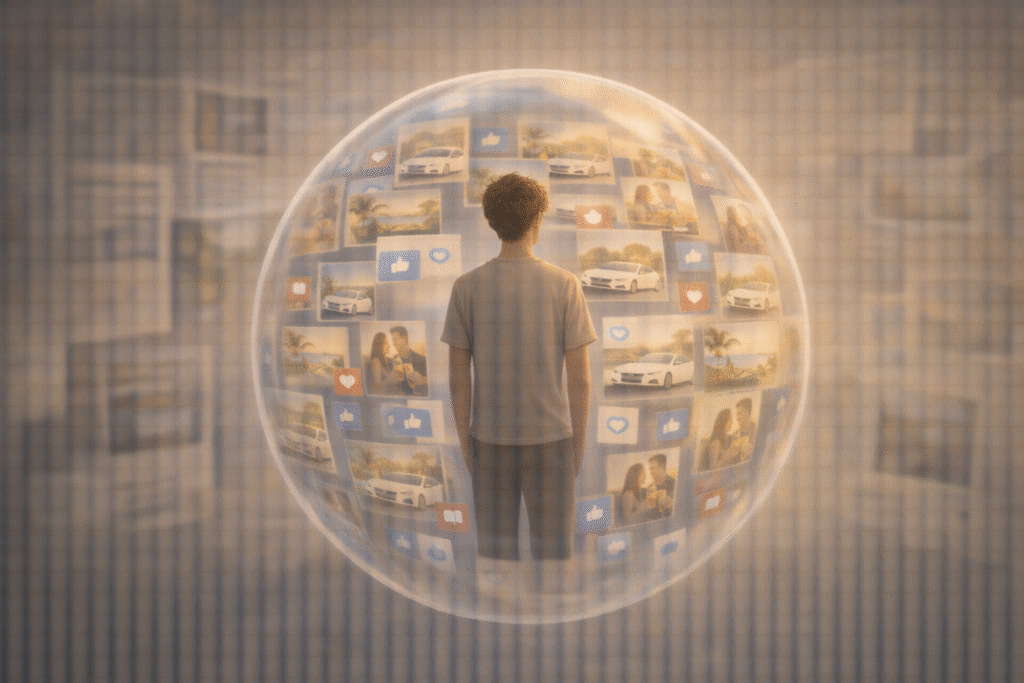
Algorithms analyze what we click, what we watch longer, and what we like. Based on these patterns, they decide what to show next. It is as if a well-meaning but stubborn friend keeps saying, “You liked this, so you’ll like more of the same.”
2. Filter Bubbles and Echo Chambers
When recommendations repeat similar content, a phenomenon known as the filter bubble emerges. A filter bubble traps users inside a limited set of information, filtering out alternative views.
For example, if someone repeatedly watches videos supporting a particular political candidate, the algorithm is likely to recommend more favorable content about that candidate— while opposing perspectives quietly disappear.
This effect becomes stronger when combined with an echo chamber, where similar opinions are repeated and amplified. Like sound bouncing inside a hollow space, the same ideas echo back, gradually transforming opinions into unshakable beliefs.
3. How Worldviews Become Narrower
Algorithmic bias does more than simply provide skewed information.
Reinforced confirmation bias: People encounter only ideas that match what they already believe.
Loss of diversity: Opportunities to discover unfamiliar interests or viewpoints decrease.
Social fragmentation: People in different filter bubbles struggle to understand one another, fueling political polarization and cultural conflict.
Consider someone who frequently watches videos about vegetarian cooking. Over time, the algorithm recommends only plant-based recipes and content emphasizing the harms of meat consumption. Eventually, this person may come to see meat-eating as entirely wrong, leading to friction when interacting with people who hold different dietary views.
4. Why Does This Happen?
The primary goal of recommendation algorithms is not user understanding, but engagement. The longer users stay on a platform, the more profitable it becomes.
Content that triggers strong reactions—likes, comments, prolonged viewing—gets prioritized. Since people naturally spend more time on content that aligns with their beliefs, algorithms “learn” to reinforce those patterns.
In this feedback loop, personalization slowly turns into polarization.
5. How Can We Respond?
Escaping algorithmic bias does not require abandoning technology, but using it more consciously.
Consume diverse content intentionally: Seek out unfamiliar topics or opposing viewpoints.
Reset or limit personalized recommendations when platforms allow it.
Practice critical thinking: Ask, “Why was this recommended to me?” and “What perspectives are missing?”
Use multiple sources: Check the same issue across different platforms and media outlets.
Conclusion
Recommendation algorithms are powerful tools that efficiently connect us with information and entertainment. However, when their built-in biases go unnoticed, they can quietly narrow our understanding of the world.
Technology itself is not the enemy. The real challenge lies in maintaining awareness and balance.
Even in the age of algorithms, the responsibility to broaden our perspective—and the power to choose—still belongs to us.
Pariser, E. (2011). The Filter Bubble: What the Internet Is Hiding from You. This book popularized the concept of the filter bubble, explaining how personalized algorithms limit exposure to diverse information and intensify social division.
O’Neil, C. (2016). Weapons of Math Destruction: How Big Data Increases Inequality and Threatens Democracy. O’Neil analyzes how algorithmic systems reinforce bias, deepen inequality, and undermine democratic values through real-world examples.
Noble, S. U. (2018). Algorithms of Oppression: How Search Engines Reinforce Racism. This work examines how search and recommendation algorithms can reproduce structural social biases, particularly related to race and gender.
Global temperatures are not the only thing rising in modern society—so are working hours, performance pressure, and expectations of constant availability. In this context, sleep is no longer taken for granted. It is measured, optimized, shortened, and often sacrificed.
This raises a fundamental question: Is sleep a natural human right, or merely a tool for maximizing productivity?
This tension is not new. More than a century ago, the Swiss philosopher and legal scholar Karl Hilty (1833–1909) warned against a life dominated by relentless activity and efficiency. His reflections on sleep offer a powerful lens through which to examine our present condition.
1. Karl Hilty and the philosophical meaning of sleep
1.1 Sleep as a foundation of moral life
Karl Hilty, best known for his writings on happiness and practical wisdom, believed that a meaningful life begins with respecting fundamental human needs. For him, sleep was not a mere biological function. It was a moral and spiritual necessity.
Hilty argued that without sufficient rest, human beings lose emotional balance, ethical clarity, and inner freedom. Fatigue, in his view, dulls moral judgment and erodes character.
1.2 A growing tension in modern society
In contrast, contemporary society treats sleep as something to be managed rather than respected. Smartwatches track sleep cycles, apps quantify sleep quality, and individuals are encouraged to function on minimal rest while maintaining peak performance.
In this shift, sleep becomes caught between two competing interpretations:
a natural human right, or
a resource to be optimized for productivity.
2. Hilty’s position: Sleep as a natural right
Hilty famously described sleep as “one of God’s greatest gifts to humanity.” This perspective frames sleep not as indulgence, but as an essential condition for a dignified human life.
2.1 Physical and psychological restoration
Adequate sleep restores both body and mind. Hilty warned that chronic sleep deprivation leads not only to physical illness but also to irritability, poor judgment, and ethical decline.
2.2 Inner peace and spiritual balance
For Hilty, nighttime rest allowed the human soul to regain equilibrium. Sleep prepared individuals for reflection, self-control, and moral responsibility.
2.3 An inalienable human right
From this standpoint, sleep cannot be subordinated to economic or social demands. It is a natural right, inseparable from human dignity and therefore not subject to negotiation.
3. The modern view: Sleep as a tool of productivity
In contemporary capitalist societies, however, sleep is increasingly framed as a variable to be controlled.
3.1 The ideology of performance
Popular narratives suggest that “successful people sleep less.” Wakefulness is celebrated as discipline, while sleep is portrayed as inefficiency.
This logic transforms sleep into a sacrifice rather than a right.
3.2 The rise of the sleep industry
Ironically, as sleep is shortened, it has also become commodified. Sleep medications, tracking devices, and optimization programs turn rest into a marketable product—one that must be purchased back.
3.3 Self-optimization culture
Morning routines, productivity hacks, and biohacking trends reinforce the idea that sleep exists primarily to fuel work. Rest becomes valuable only insofar as it enhances output.
4. The core conflict: Right versus instrument
At the heart of this debate lies a philosophical clash:
Rights-based view: Sleep is essential to moral agency, mental health, and human dignity.
Instrumental view: Sleep is a means to economic efficiency and personal achievement.
The question is unavoidable: Do we respect sleep as part of what it means to be human, or do we treat it as a tool to be engineered?
5. Contemporary implications
5.1 Sleep as a social responsibility
Organizations such as the International Labour Organization (ILO) and the World Health Organization (WHO) warn that chronic sleep deprivation violates basic human rights. Long working hours and insufficient rest are increasingly recognized as structural, not individual, problems.
5.2 The need for balance
Productivity cannot be ignored. Yet reducing human beings to machines optimized for output risks erasing what makes life meaningful.
5.3 Hilty’s enduring question
Hilty’s philosophy leaves us with a profound inquiry: Do we sleep merely to work better tomorrow, or to live more deeply today?
Conclusion: Sleep at the crossroads of humanity
Karl Hilty’s reflections remind us that sleep is not a luxury, nor a weakness. It is a cornerstone of ethical life and inner freedom.
Modern society, however, increasingly treats sleep as a tool to be managed in service of productivity.
The question therefore remains open—and urgent:
Is sleep a fundamental human right, or a resource to be optimized?
How we answer this question will shape not only our sleeping habits, but our understanding of what it means to be human.
Hilty, K. (1901/2002). Happiness: Essays on the Meaning of Life. Kessinger Publishing. → A foundational text outlining Hilty’s philosophy of simplicity, rest, and moral life, offering deep insight into his view of sleep as a human necessity.
Williams, S. J. (2011). Sleep and Society: Sociological Ventures into the (Un)known. Routledge. → Examines sleep as a social and cultural phenomenon, exploring its transformation from a private need into a managed social practice.
Wolf-Meyer, M. J. (2012). The Slumbering Masses: Sleep, Medicine, and Modern American Life. University of Minnesota Press. → Analyzes how sleep has become medicalized and regulated in modern society, contrasting sharply with humanistic perspectives like Hilty’s.
Kushida, C. A. (Ed.). (2007). Sleep Deprivation: Clinical Issues, Pharmacology, and Sleep Loss Effects. CRC Press. → Provides scientific evidence on the physical and psychological consequences of sleep deprivation, supporting arguments for sleep as a fundamental right.
Crary, J. (2013). 24/7: Late Capitalism and the Ends of Sleep. Verso Books. → A critical examination of how late capitalism erodes sleep, framing rest as one of the last frontiers of resistance against total productivity.
Scrolling through social media has become a daily ritual for many people. We wake up, reach for our phones, and are immediately greeted by images of vacations, promotions, fitness routines, and seemingly perfect lives.
Yet instead of feeling inspired, many of us experience an unexpected emotional dip. The reason is simple: social media largely presents highlights, not everyday reality. As a result, we begin to compare our ordinary lives with carefully curated moments—and a subtle sense of lack begins to grow.
1. The Psychology of Comparison: “Am I Falling Behind?”
People tend to share their happiest and most successful moments online—weddings, travels, career milestones, or idealized lifestyles. These posts create the illusion that others are constantly thriving.
Psychologists describe this tendency as social comparison theory. We unconsciously evaluate our own worth by measuring ourselves against others. On social media, however, this comparison becomes distorted.
A single vacation photo, taken once a year, may appear repeatedly on our feed. Over time, it can feel as though others are always living better lives, reinforcing the belief that we are somehow falling behind.
2. The Highlight Effect and Selective Exposure
Social media content is not neutral—it is selected, edited, and optimized for attention. A quiet morning coffee rarely competes with a sunset photo taken on a tropical beach.
Platforms dominated by visual content, such as Instagram or TikTok, intensify this effect. Users become increasingly aware of aesthetics, filters, and perfection. In comparison, our own daily routines may start to feel dull or insufficient, deepening psychological dissatisfaction.
3. Algorithms as Emotional Amplifiers
Social media platforms are designed to keep users engaged. Algorithms learn what captures our attention and deliver more of it.
If you interact with luxury travel, fitness influencers, or high-end dining content, similar posts will appear more frequently. Gradually, your feed becomes filled with images of “better” lives—carefully selected to provoke interest, admiration, and often envy.
In this way, social media does not merely reflect reality; it magnifies what we are most likely to compare ourselves against.
4. FOMO and Emotional Fatigue
This persistent comparison often leads to FOMO (Fear of Missing Out)—the anxiety that others are experiencing meaningful moments without us.
A peaceful weekend at home can suddenly feel empty when confronted with group photos from a trip or event. When such experiences accumulate, they can result in emotional exhaustion, reduced self-esteem, and even depressive feelings.
Research suggests that adolescents and young adults are particularly vulnerable, as repeated exposure can foster the belief that their lives are less exciting or less valuable.
5. Using Social Media Without the Sense of Lack
Social media itself is not inherently harmful. The key lies in how we use and interpret it.
Intentional use: Log in with a purpose—learning, inspiration, or connection—rather than endless scrolling.
Reality awareness: Remember that posts represent fragments, not complete lives.
Time boundaries: Setting daily limits can significantly reduce emotional fatigue.
When approached mindfully, social media can shift from a source of deficiency to a tool for motivation and insight.
Conclusion
Social media functions like a distorted mirror—one that reflects only the brightest moments of others while obscuring the full picture. When we mistake highlights for reality, we risk undervaluing our own lives.
The challenge is not to reject social media entirely, but to reclaim perspective. By recognizing the difference between curated images and lived experience, we can transform social media from a space of comparison into one of connection and self-awareness.
Vogel, E. A., Rose, J. P., Roberts, L. R., & Eckles, K. (2014). Social comparison, social media, and self-esteem. Psychology of Popular Media Culture, 3(4), 206–222. → This study empirically examines how social comparison on social media affects self-esteem, highlighting the role of upward comparison in feelings of inadequacy.
Chou, H. T. G., & Edge, N. (2012). “They are happier and having better lives than I am”: The impact of using Facebook on perceptions of others’ lives. Cyberpsychology, Behavior, and Social Networking, 15(2), 117–121. → Demonstrates how social media users systematically overestimate others’ happiness, reinforcing perceived personal deficiency.
Tandoc Jr., E. C., Ferrucci, P., & Duffy, M. (2015). Facebook use, envy, and depression among college students. Computers in Human Behavior, 43, 139–146. → Explores the link between social media use, envy, and depressive symptoms, offering insight into long-term emotional consequences.
Global temperatures have already risen close to 1.5°C above pre-industrial levels. Heatwaves, floods, wildfires, and droughts are no longer rare disasters but recurring realities. Climate change is no longer a future threat—it directly affects human survival today.
This reality forces a fundamental ethical question: Should human rights and interests always come first, or does nature itself deserve moral and legal priority?
1. Anthropocentrism: Humans as the Sole Bearers of Rights
1.1 Philosophical Foundations of Human-Centered Thinking
Modern Western thought has long placed humans at the center of moral consideration. Since Descartes’ declaration “I think, therefore I am,” nature has largely been treated as a resource to be controlled and utilized. Legal and political systems evolved primarily to protect human rights, often excluding non-human entities from moral concern.
1.2 Development Justified in the Name of Human Benefit
Large-scale development projects—such as dams, highways, or industrial complexes—have historically been justified by promises of economic growth and employment, even when they destroyed ecosystems or displaced communities. These decisions reflect anthropocentrism, the belief that human interests inherently outweigh those of the natural world.
2. The Challenge of Ecological Ethics: Nature as a Moral Subject
2.1 Aldo Leopold and the Land Ethic
In the mid-20th century, this worldview began to be challenged. Aldo Leopold’s concept of the Land Ethic argued that humans are not conquerors of nature but members of a broader ecological community. Soil, water, plants, and animals should be included within the sphere of moral responsibility.
2.2 Legal Recognition of Nature’s Rights
This ethical shift has increasingly entered legal frameworks. Ecuador’s constitution recognizes the rights of nature, and New Zealand granted legal personhood to the Whanganui River, reflecting Indigenous perspectives that view humans and nature as inseparable.
These cases represent a radical departure from seeing nature as property, redefining it instead as a rights-bearing entity.
3. Conflicting Values in the Climate Crisis
3.1 Rights Versus Rights
Climate conflicts often involve competing claims. A forest may serve as a vital carbon sink and habitat, yet local communities may depend on land development for housing and employment. Prioritizing nature may restrict economic rights, while prioritizing development may accelerate ecological collapse.
3.2 Climate Change as a Political and Ethical Crisis
This tension reveals that climate change is not merely an environmental issue but a conflict between rights—human rights versus ecological integrity. The challenge lies in resolving this conflict without sacrificing long-term survival for short-term gain.
4. Bridging Human and Natural Rights
Several approaches seek to move beyond simple opposition:
Interdependent Rights: Human rights depend on healthy ecosystems—clean air and water are prerequisites for life.
Intergenerational Justice: Future generations’ rights demand limits on present exploitation.
Community-Based Perspectives: Indigenous worldviews often treat humans and nature as members of a single moral community.
5. Ecological Ethics as a New Social Contract
5.1 Beyond Environmental Protection
Ecological ethics calls for more than conservation policies. It challenges political, legal, and economic systems to redefine responsibility in an age of planetary limits.
5.2 Legal and Moral Innovation
Recent climate lawsuits argue that government inaction violates citizens’ fundamental rights. At the same time, recognizing nature as a rights-holder suggests a future where humans and ecosystems share legal standing.
Conclusion: From Hierarchy to Coexistence
Can nature have rights above humans? Framed as a simple hierarchy, the question leads to endless conflict. Yet the climate crisis reveals a deeper truth: when nature’s rights are violated, human rights ultimately collapse as well.
True solutions lie not in choosing between humans and nature, but in recognizing their interdependence. In an age of ecological limits, justice may no longer belong to humans alone.
References
Stone, C. D. (1972).Should Trees Have Standing? Toward Legal Rights for Natural Objects. Southern California Law Review, 45(2), 450–501. → A foundational legal argument proposing that natural entities should be recognized as legal subjects rather than mere property.
Naess, A. (1989).Ecology, Community and Lifestyle: Outline of an Ecosophy. Cambridge University Press. → Establishes the philosophical foundations of deep ecology, rejecting anthropocentrism in favor of intrinsic ecological value.
Leopold, A. (1949).A Sand County Almanac. Oxford University Press. → A classic text in environmental ethics introducing the Land Ethic and redefining humans as members of a biotic community.
Singer, P. (1993).Practical Ethics. Cambridge University Press. → Expands ethical consideration beyond humans, including animals and environmental concerns.
Jonas, H. (1984).The Imperative of Responsibility: In Search of an Ethics for the Technological Age. University of Chicago Press. → Argues for ethical responsibility toward future generations and the natural world in an era of technological power.
On the way home after work, an old record shop in a narrow alley brings footsteps to a pause. From the slightly open door comes the faint crackle of a needle touching vinyl— a sound that feels strangely familiar.
“This sound… it’s been a while.”
Music on a phone is always clean. No noise, perfect quality, endlessly selectable. And yet, something imperfect and warm feels deeply missed.
After a moment, a quiet realization surfaces: “Perhaps I’ve grown too used to a world that is only smooth.”
2. A Light Thought for Today
“Why do people like analog things?” “Thinking back… changing batteries used to be exciting.” “Why?” “Because when the batteries wore out, it felt like proof that time—and even my feelings—were being used.”
A soft laugh follows.
3. Reflection – Why the Analog Heart Longs
Life in the digital age is fast and convenient. But convenience often smooths away the texture of emotion.
We take hundreds of photos that never stay with us. Messages leave only a “read” mark behind. Music flows in algorithmic order. Even meeting people is managed by scheduling apps.
Everything is precise and efficient— yet we continue living inside unorganized feelings.
This is why analog sensibility lingers.
Because it is imperfect. Because it is inconvenient. Because it is slow and slightly unsteady.
Within that unpolished space, we feel the true temperature of the heart.
Memories surface of a film camera once held in childhood. Photos couldn’t be checked immediately. Waiting was required. The shutter sounded different every time.
Yet the excitement of receiving developed photos is something thousands of digital images can never replace.
And then it becomes clear: “It’s not analog objects I miss— it’s the version of myself that lived through them.”
4. A Gentle Practice
Creating One Analog Moment Today
Try one small analog act today:
Write a single sentence by hand
Open an old book at random
Take one unfiltered photo
Listen to the radio instead of streaming
Send a voice message instead of text
These moments are imperfect— and that imperfection becomes a record of feeling.
5. A Small Action for the Day
At home, a small notebook opens. One simple sentence is written:
“Today, I breathed in something analog.”
The handwriting is uneven. Ink blurs slightly.
Yet in those imperfect lines, the heart quietly settles back into its own place.
6. Quote of the Day
“The more digital we become, the more analog our hearts remain.”
7. Closing – Returning Gently to Ourselves
A perfectly edited world can sometimes erase us. Analog feeling, however, allows us to exist as we are— unsteady, incomplete, real.
When perfection steps aside, emotion returns to its natural shape.
May one small analog moment today become a warm breath for your heart.
8. A Thought to Remember
The word “analog” comes from the Greek analogos, meaning “proportional” or “corresponding.”
Analog warmth is not mere nostalgia— it reflects a way of experiencing the world by resemblance, rhythm, and shared feeling.
9. Today’s One-Line Insight
“Convenience cannot replace emotion; at heart, we remain slow, warm beings.”
The classroom is more than a place for academic learning. It is a small society where students with different backgrounds, personalities, and experiences spend much of their daily lives together.
Some students are outgoing and expressive, while others are quiet and reflective. Differences appear in family backgrounds, regions, languages, cultures, religions, physical conditions, gender identities, and personal interests. In this sense, the classroom is one of the most visible spaces where diversity is lived, not just discussed.
1. What Does Diversity Mean?
1.1 Beyond Difference: Diversity as Value
Diversity is not simply about acknowledging differences. It is about recognizing those differences as meaningful and valuable.
UNESCO defines diversity across multiple dimensions—culture, language, religion, ethnicity, gender, physical ability, and socioeconomic background—and emphasizes it as a core principle of human rights.
1.2 Equality vs. Equity
Respecting diversity does not mean treating everyone exactly the same. It means understanding different needs and circumstances and responding with fairness and care.
2. Forms of Diversity in the Classroom
2.1 Cultural and Linguistic Differences
Students from multicultural families or those who have transferred from other countries may experience language barriers and cultural isolation.
2.2 Learning Styles and Pace
Some students learn best through visuals, others through discussion or hands-on activities. A slower pace does not indicate lower ability.
2.3 Physical and Psychological Differences
Students may have disabilities or experience emotional instability, requiring thoughtful support and accommodation.
2.4 Differences in Interests and Values
Music preferences, fashion, career goals, and social or political views can vary widely within the same classroom.
3. Practicing Respect in Everyday School Life
3.1 Language Matters
Derogatory or mocking language—even as a joke—can cause harm. Correctly pronouncing names and using preferred forms of address are small but powerful acts of respect.
3.2 Listening as Respect
Listening without interruption and acknowledging different perspectives builds trust. Saying “I see why you think that” can be meaningful even without agreement.
3.3 Learning About Differences
Curiosity leads to understanding. For example, learning why a classmate observes fasting can encourage natural and respectful consideration during lunchtime.
3.4 Designing Inclusive Activities
Group work should allow students with different strengths to participate meaningfully. Rotating roles—such as leader, presenter, or recorder—helps ensure inclusion.
4. Roles of Teachers and Students
4.1 The Role of Teachers
Teachers can:
Integrate diverse perspectives into learning materials
Monitor exclusion and intervene early
Guide conflicts toward educational dialogue rather than punishment
4.2 The Role of Students
Students can:
View differences as opportunities to learn
Speak out against bullying or hate speech
Remain open to perspectives different from their own
5. Why Respecting Diversity Benefits Everyone
Social skills improve through exposure to multiple viewpoints
Creativity increases as diverse experiences generate new ideas
Communities grow stronger through trust, cooperation, and mutual respect
Conclusion
Respecting diversity does not begin with grand policies or large-scale programs. It begins with small, everyday actions—listening carefully, using names correctly, and showing genuine curiosity about others.
When these actions become habits, habits form culture. And when respect becomes part of classroom culture, it shapes the society students will one day help lead.
📅 A 7-Day Diversity Respect Challenge (Optional Classroom Activity)
Day
Action
Description
Day 1
Use names correctly
Address classmates using their preferred names
Day 2
Five-minute listening
Listen without interrupting for five minutes
Day 3
Ask respectfully
Ask about a different culture or interest
Day 4
Change seats
Sit with someone you rarely talk to
Day 5
Give a sincere compliment
Acknowledge effort or kindness
Day 6
Encourage inclusion
Suggest balanced role distribution in group work
Day 7
Reflect on bias
Write down and reflect on personal assumptions
References
Banks, J. A., & Banks, C. A. M. (2019). Multicultural Education: Issues and Perspectives (10th ed.). Wiley. → A foundational work offering theoretical frameworks and practical strategies for multicultural education.
Gay, G. (2018). Culturally Responsive Teaching: Theory, Research, and Practice (3rd ed.). Teachers College Press. → Explains how teaching practices can respect and reflect students’ cultural backgrounds.
Nieto, S., & Bode, P. (2018). Affirming Diversity: The Sociopolitical Context of Multicultural Education (7th ed.). Pearson. → Connects diversity education with broader social and political contexts.
In the history of Western modernity, “civilization” and “the savage” have often been treated as two clearly separated worlds. One represents urban life, science, rationality, and industrial progress; the other is associated with nature, tradition, and so-called “primitive” communities. This distinction was not merely descriptive. During the age of imperialism, it functioned as a powerful ideological tool, legitimizing colonial domination under the assumption that “we are civilized, and they are not.”
However, this binary was fundamentally challenged by the French anthropologist Claude Lévi-Strauss. In The Savage Mind (1962), he argued that so-called “primitive” modes of thought are neither irrational nor inferior. Instead, they constitute a coherent and systematic form of reasoning—one that stands alongside scientific thinking rather than beneath it. From this perspective, the distinction between civilization and savagery no longer implies hierarchy, but rather reflects different ways of organizing meaning in the world.
1. The Traditional Divide Between Civilization and Savagery
1.1 Evolutionary Hierarchies and Early Anthropology
The hierarchical distinction between civilization and savagery originates largely from nineteenth-century social evolutionism. Early anthropologists such as Edward B. Tylor and Lewis Henry Morgan conceptualized human history as a linear progression from “savagery” to “barbarism” and finally to “civilization.” Within this framework, myths, rituals, and totemic systems of Indigenous societies were often dismissed as irrational remnants of an earlier stage of human development.
1.2 Knowledge as Power
These academic models did not remain confined to scholarly debates. They were actively mobilized to justify imperial expansion and colonial governance. By defining Western societies as inherently superior, the civilization–savagery binary reinforced political domination and cultural assimilation. Thus, the distinction functioned less as an objective description of human diversity and more as a discourse of power.
2. Lévi-Strauss and The Savage Mind
2.1 A Structural Reversal
Lévi-Strauss overturned this hierarchy by demonstrating that so-called “savage thought” operates according to rigorous principles of classification and logical consistency. Based on extensive ethnographic research in Amazonian and African societies, he showed that mythological systems are not chaotic or emotional improvisations, but structured modes of understanding relationships between nature, society, and meaning.
2.2 Myth and Science as Parallel Systems
In totemic systems, animals, plants, and natural phenomena are not arbitrarily linked to social groups. Rather, they function as symbolic tools for organizing social relations and collective identities. For Lévi-Strauss, this symbolic logic is structurally comparable to scientific classification. The difference lies not in rationality itself, but in the materials and methods through which rationality is expressed.
3. The Meaning of Relativity
3.1 Difference Without Hierarchy
Lévi-Strauss’s central claim is that the distinction between civilization and savagery should be understood as contextual rather than hierarchical. Scientific thinking relies on abstraction and mathematical modeling, while mythological thinking integrates nature and society through symbolic narratives. Both seek to impose order on the world.
3.2 Contemporary Implications
This insight remains highly relevant today. In the context of ecological crises, for example, Indigenous knowledge systems often offer holistic perspectives that complement scientific expertise. What was once dismissed as “traditional” or “primitive” may, in fact, provide essential insights for contemporary problem-solving.
4. The Persistence of Hierarchy
4.1 Cultural Consumption and Global Inequality
Despite the rise of cultural relativism, hierarchical distinctions persist. Indigenous knowledge is frequently commodified as cultural heritage or tourism content, stripped of its original social and ecological context.
4.2 Modern Echoes of an Old Binary
Similarly, global political discourse continues to reproduce civilizational hierarchies through terms such as “developed” and “developing” nations. These categories echo the older civilization–savagery divide in a modernized form.
5. Toward Coexistence Rather Than Opposition
5.1 Beyond Simple Relativism
Recognizing cultural difference as relative is necessary but insufficient. The real challenge lies in dismantling the unequal power relations that shape how different forms of knowledge are valued and utilized.
5.2 Complementary Ways of Knowing
When scientific rationality and symbolic thinking are understood as complementary rather than opposed, humanity gains a richer repertoire of intellectual tools. Civilization and the “savage mind” need not exclude one another; together, they can foster more inclusive and resilient ways of understanding the world.
Related Reading
The ethical complexity of diversity within modern institutions is further examined in Respecting Diversity: Why the Classroom Matters, where cultural difference becomes a pedagogical and moral question.
Lévi-Strauss’s concept of the “savage mind” fundamentally reshapes how we understand civilization and its supposed opposite. Civilization can no longer be positioned as a superior stage of human development, nor can “savagery” be dismissed as irrational. Instead, both represent distinct yet equally meaningful ways of organizing experience. The task before us is not to rank these systems, but to recognize their coexistence and mutual relevance in an increasingly complex global society.
Tylor, E. B. (1871). Primitive Culture. London: John Murray. → A foundational text of early anthropology that framed cultural difference within an evolutionary hierarchy, later critiqued by structuralist approaches.
Lévi-Strauss, C. (1962). La Pensée Sauvage. Paris: Plon. → The original work in which Lévi-Strauss challenges the civilization–savagery hierarchy and argues for the structural rationality of mythological thought.
Lévi-Strauss, C. (1978). Myth and Meaning. Routledge. → A more accessible exploration of mythological thinking and its relationship to modern rationality.
Geertz, C. (1973). The Interpretation of Cultures. Basic Books. → Introduces symbolic anthropology and expands the discussion of cultural meaning beyond evolutionary hierarchies.
Kuper, A. (1999). Culture: The Anthropologists’ Account. Harvard University Press. → Critically examines how the concept of culture has shaped anthropological debates, including the civilization–savagery divide.