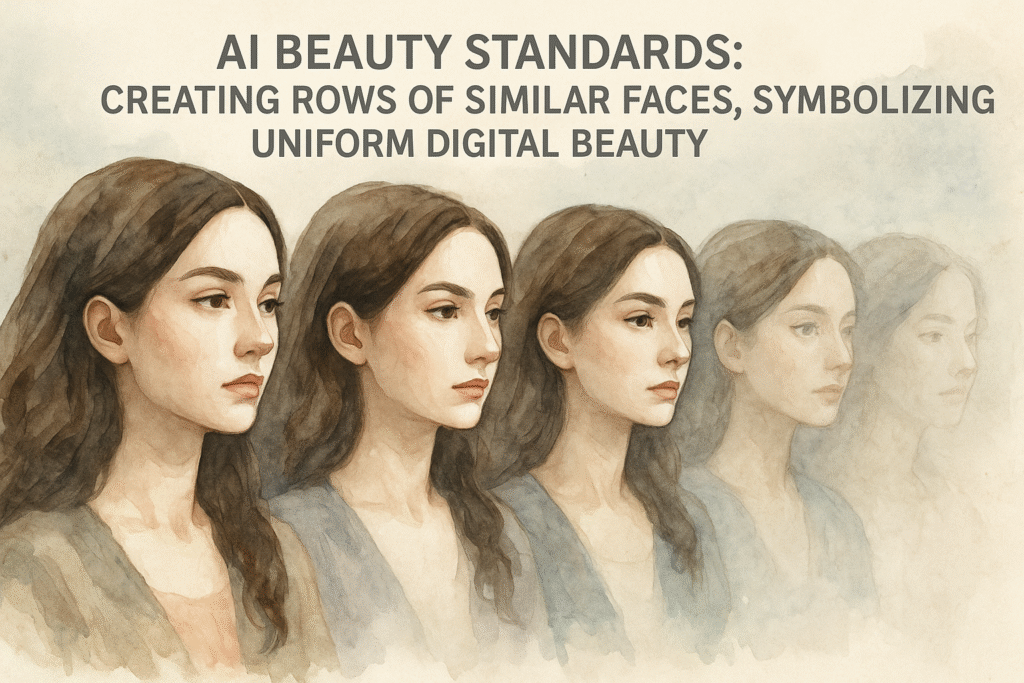
AI now creates a “perfect face” that circulates endlessly on social networks.
Smooth skin, flawless symmetry, and ideal proportions — these images increasingly shape how society defines beauty.
But as these faces grow more similar, a question emerges:
Where does human uniqueness go in a world where technology determines the rules of beauty?
1. Introduction — The Perfect Face, Yet Strangely Unfamiliar
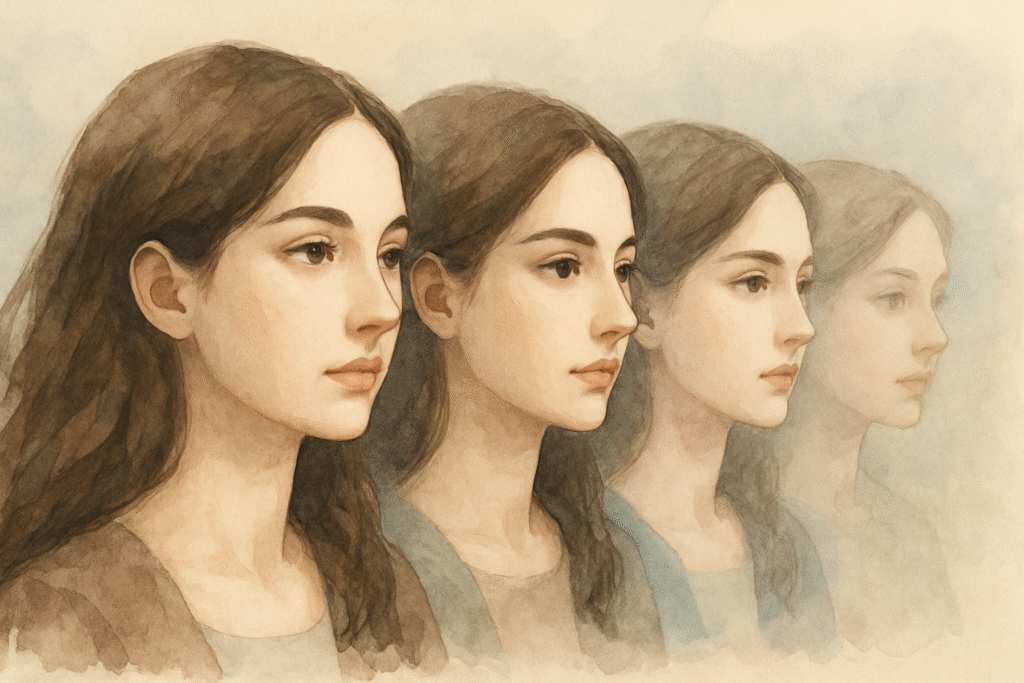
AI beauty standards are rapidly influencing how we perceive human faces. AI-generated portraits often line up like cloned models:
identical smiles, balanced features, and overly harmonious proportions.
Scrolling through today’s social media, we encounter a striking pattern:
faces that look eerily alike — not entirely human, yet strangely familiar.
Many of these aren’t real people at all, but AI-generated ideals produced through massive datasets and aesthetic algorithms.
AI has moved beyond reproducing beauty to producing the template of an “ideal human face.”
This template increasingly influences advertising, avatar design, entertainment, and even professional profile photos.
Beauty, once shaped by culture, individuality, and personal preference, is slowly being replaced by an algorithmic answer key.
2. Development — In the Age of AI Beauty, Where Did Diversity Go?
AI systems learn from vast datasets that reflect dominant cultural and demographic patterns.
In practice, these datasets often reinforce narrow standards:
- Westernized facial proportions
- Youthful, symmetrical features
- Slim or angular facial outlines
- Large eyes and sharp jawlines for women
- Broad jawlines and balanced musculature for men
These patterns then recirculate as “universal beauty,” despite being neither universal nor culturally neutral.
As a result, AI helps accelerate:
• The homogenization of beauty
Different faces collapse into a single optimized “average.”
• The digital reinforcement of bias
AI does not intend to discriminate — but the bias within its training data becomes amplified in its outputs.
• The evolution of lookism
Instead of challenging social prejudices, AI updates and upgrades them into a more persuasive, polished form.
Human uniqueness gets flattened into what the algorithm considers “efficient beauty.”
In this sense, AI preserves bias more effectively than any institution ever could.
3. Philosophical Reflection — Who Gets to Define Beauty?
Plato once believed beauty reflected ideal forms.
Modern philosophy, however, understands beauty as a cultural construction shaped by social, historical, and individual contexts.
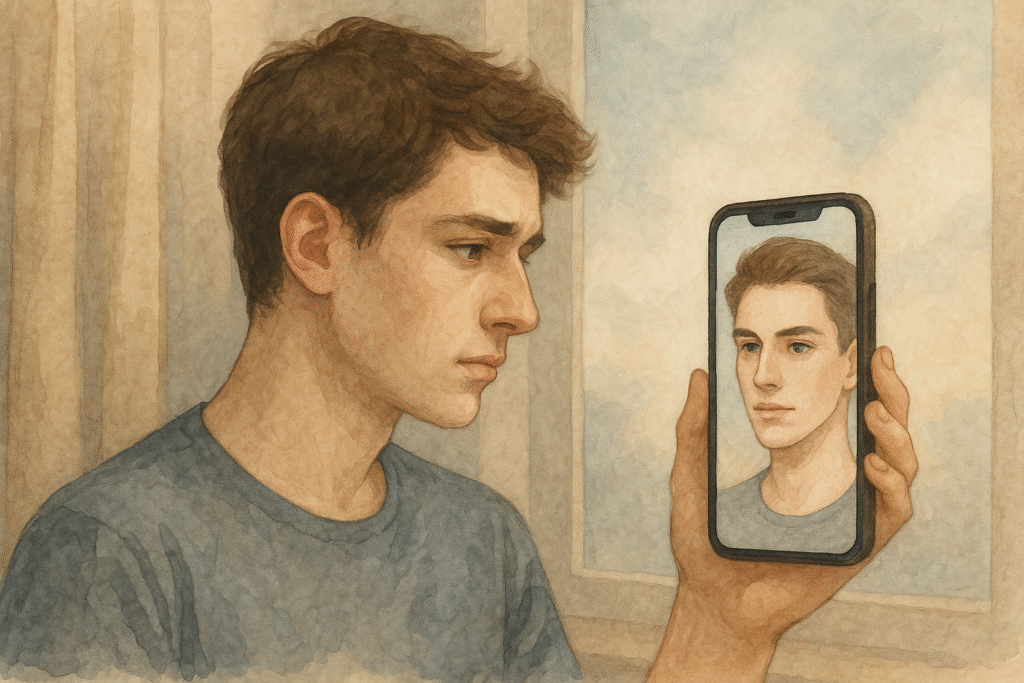
AI disrupts this paradigm by simplifying beauty into a pattern-recognition problem — something calculable, predictable, and reproducible.
This leads us to a core question:
Does AI liberate human perception, or does it imprison it within a single standardized template?
Human creativity has always flourished in imperfection and difference.
But as AI-driven standards push all faces toward a harmonious average, society risks losing the richness that diversity brings to our encounters with others.
If AI removes difference as a “visual inefficiency,”
then we face not only an aesthetic crisis but an ontological one:
The erosion of the conditions that allow individuality, identity, and social coexistence to flourish.
Beauty becomes not a celebration of human variation but an algorithmic filter that defines who fits and who falls outside the frame.
4. Conclusion — Choosing Imperfect Humanity Over Perfect Algorithms
The “perfect face” generated by AI may look impressive,
but it lacks the trembling of expression, the unpredictability of emotion,
and the subtle imperfections that make a face truly human.
To live meaningfully in the age of AI,
we must learn not merely to consume algorithmic beauty
but to interpret it, question it, and resist its sameness.
Human beauty lies in difference — in asymmetry, age, texture, and lived experience.
Ethics in the AI era begins not with perfection,
but with the courage to recognize and respect faces that do not follow the algorithm.
📚 References
1. Wolf, N. (1991). The Beauty Myth. New York: HarperCollins.
→ This book critiques how beauty standards operate as a form of social control, arguing that modern societies weaponize appearance norms to reinforce structural power. It remains foundational for discussing lookism in relation to gender politics and cultural systems.
2. Davis, K. (2017). The Making of Our Bodies, Ourselves. London: Routledge.
→ Davis examines how cultural norms around the body are constructed and reproduced, showing the deep connection between identity, embodiment, and technological mediation. This framework helps contextualize AI’s growing influence on self-image.
3. Benjamin, R. (2019). Race After Technology. Cambridge: Polity Press.
→ Benjamin analyzes how algorithmic systems encode racial bias. Her insights illuminate why AI-generated beauty standards often reflect and amplify existing inequalities, rather than neutralizing them.
4. Bourdieu, P. (1984). Distinction: A Social Critique of the Judgement of Taste. Cambridge: Harvard University Press.
→ Bourdieu demonstrates that taste is not neutral but shaped by social class structures. Applying his theory reveals how AI beauty standards reinforce — rather than transcend — cultural hierarchies.
5. Rini, R. (2020). Deepfakes and the Infocalypse. Cambridge, MA: MIT Press.
→ Rini explores the destabilization of visual truth in the digital era. Her analysis helps explain how AI-generated faces complicate authenticity, trust, and identity in contemporary media environments.
Leave a Reply