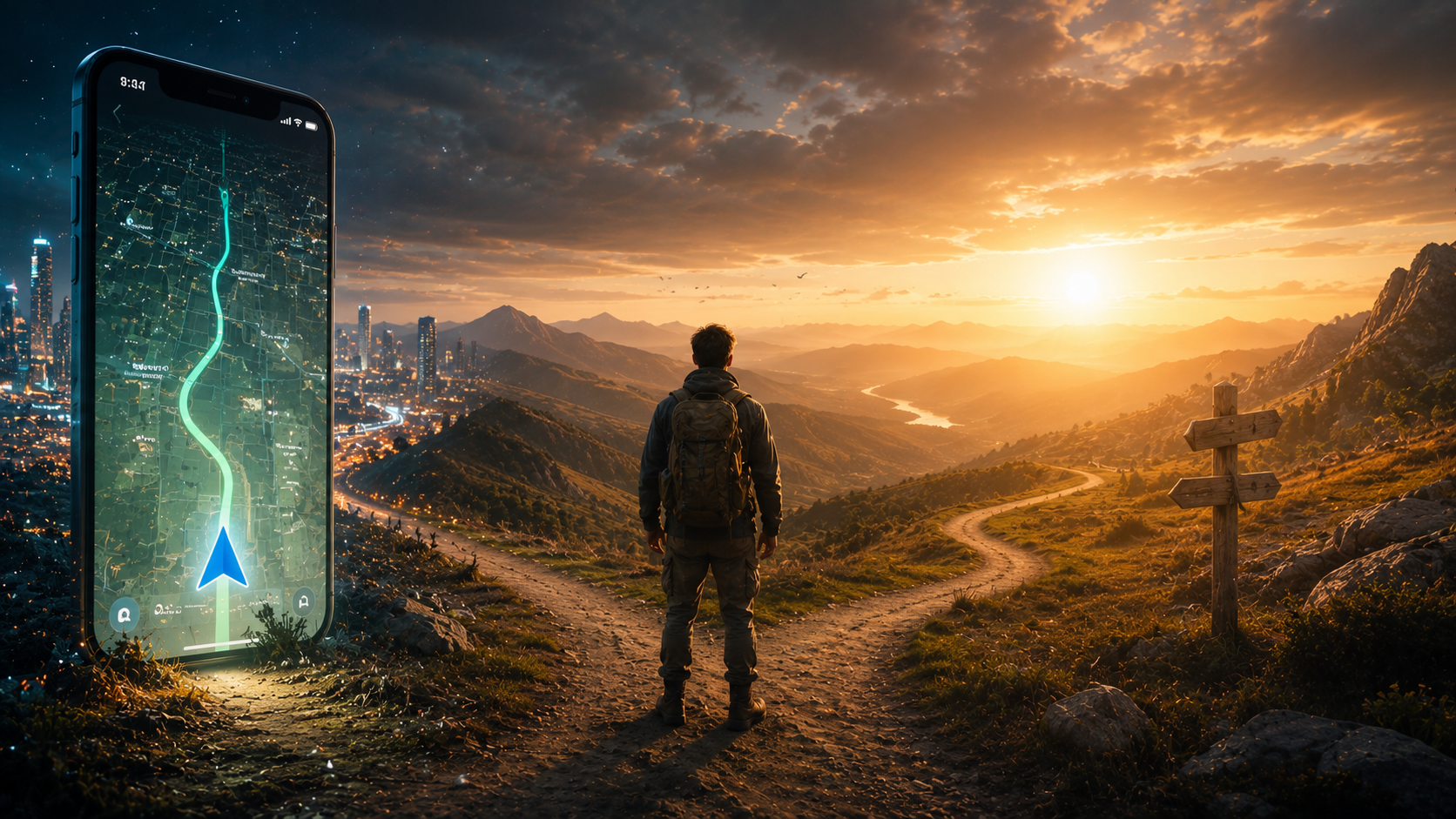
When Technology Guides Every Step, What Happens to the Joy of Discovery?
A few decades ago, traveling often meant unfolding paper maps, asking strangers for directions, and occasionally getting lost.
Today, travel looks very different.
A smartphone can guide us through unfamiliar cities, recommend restaurants within seconds, translate foreign languages instantly, and help us book accommodation with a few taps. Digital technology has made travel safer, faster, and more efficient than ever before.
Yet many travelers have begun asking an unexpected question:
Has technology made travel better, or has it quietly changed what travel means?
As navigation apps, review platforms, and social media become central to modern tourism, a growing debate has emerged about whether convenience is coming at the cost of autonomy, spontaneity, and genuine discovery.
1. How Digital Technology Has Transformed Travel
A More Efficient Way to Explore
Digital tools have dramatically reduced uncertainty in travel.
Applications such as Google Maps, Apple Maps, and local navigation services allow travelers to move through unfamiliar environments with confidence. Review platforms help visitors compare hotels, restaurants, and attractions before making decisions.
Imagine a traveler visiting Paris for the first time.
With a smartphone, it is possible to plan the most efficient route between the Louvre Museum, the Eiffel Tower, and Montmartre. Restaurant reviews can identify highly rated cafés, while translation apps remove many communication barriers.
As a result, travelers save time, avoid common mistakes, and gain access to information that previous generations could only obtain through guidebooks or local advice.
Safety and Accessibility
Digital technology also improves safety.
Travelers can:
- share real-time locations with family
- access emergency information
- receive weather alerts
- translate important instructions
- navigate unfamiliar transportation systems
For solo travelers, older adults, or people visiting countries with unfamiliar languages, these tools can significantly increase confidence and independence.
From this perspective, digital technology appears to make travel more accessible than ever before.
2. What Is Lost When We Depend Too Much on Technology?
The Disappearance of Serendipity
Critics argue that excessive digital dependence changes the nature of travel itself.
Traditionally, travel involved uncertainty. Travelers often discovered hidden cafés, unexpected streets, and memorable encounters simply because they wandered without a detailed plan.
Today, many people follow routes suggested by algorithms.
Instead of exploring, they move from one highly rated location to another.
The result is a paradox:
the more information travelers possess, the less likely they may be to encounter genuine surprises.
A small family restaurant discovered by accident may leave a stronger memory than the highest-rated establishment recommended by thousands of online reviews.
Yet digital optimization often reduces the likelihood of such unexpected experiences.
The Illusion of Control
Digital tools create the impression that every aspect of a journey can be predicted and managed.
However, some travel scholars argue that uncertainty is not a flaw in travel—it is part of its value.
Travel often teaches adaptability, curiosity, patience, and openness precisely because unexpected situations occur.
When technology removes all uncertainty, it may also reduce opportunities for personal growth.
The traveler becomes a consumer of carefully curated experiences rather than an explorer engaging with the unknown.
3. Social Media and the Performance of Travel
Experiencing Places or Performing Experiences?
Perhaps the most significant transformation involves social media.
Many travelers now document experiences almost continuously.
Photographs are uploaded instantly. Restaurants are reviewed in real time. Scenic viewpoints become opportunities for content creation.
This raises an important question:
Are people traveling to experience places, or to display experiences?
Researchers increasingly discuss the phenomenon of “performative tourism,” in which travel becomes closely connected to online identity construction.
Rather than asking:
“What do I want to experience?”
Travelers may unconsciously ask:
“What will look impressive online?”
The Influence of Algorithms
Social media platforms often amplify this tendency.
Algorithms promote visually attractive destinations, creating global trends that attract large numbers of visitors to the same locations.
As a result, unique local experiences may become standardized.
Millions of travelers take nearly identical photographs at the same landmarks because algorithms continually reinforce similar preferences.
The irony is striking:
Technology designed to personalize experiences may sometimes produce greater uniformity.
4. Can Digital and Human Travel Coexist?
Using Technology Without Surrendering Agency
The solution is not necessarily rejecting technology.
Few travelers would willingly abandon navigation apps, digital tickets, or emergency communication tools.
Instead, the challenge may be learning how to use technology without allowing it to dominate the travel experience.
Some travelers intentionally create “offline moments” during their journeys.
They may:
- avoid navigation for a few hours
- ask locals for recommendations
- explore neighborhoods without a specific destination
- postpone social media posting until after the trip
These practices reintroduce uncertainty and personal discovery while retaining the benefits of modern technology.
Rediscovering Human Connection
Technology can provide information, but it cannot fully replace human interaction.
Many of the most memorable travel experiences emerge through conversations with residents, unexpected encounters, and cultural exchanges.
A local recommendation often reveals aspects of a destination that algorithms cannot easily identify.
In this sense, the future of meaningful travel may depend on balancing digital efficiency with human connection.
5. The Future of Travel in an AI World
From Smart Tourism to AI Tourism
Artificial intelligence is already transforming tourism.
AI systems can:
- generate personalized itineraries
- predict traveler preferences
- recommend attractions
- translate conversations instantly
- automate travel planning
These developments promise even greater convenience.
However, they also raise an important philosophical question:
If AI plans every destination, recommends every meal, and optimizes every route, will travelers still feel that they are discovering the world for themselves?
Convenience Versus Autonomy
The debate surrounding travel and technology ultimately reflects a larger societal challenge.
Across many aspects of life, humans increasingly exchange autonomy for convenience.
Travel simply makes this trade-off more visible.
The question is not whether technology is beneficial—it clearly is.
The question is how much control people are willing to surrender in exchange for efficiency.
Conclusion
Digital technology has unquestionably transformed travel for the better in many ways.
It improves safety, increases accessibility, reduces uncertainty, and allows travelers to navigate unfamiliar environments with unprecedented confidence.
Yet convenience comes with trade-offs.
Excessive dependence on digital tools may reduce spontaneity, weaken personal exploration, and encourage travelers to experience destinations through screens rather than direct engagement.
The future of travel may therefore depend not on rejecting technology, but on using it wisely.
Technology should remain a tool, not the traveler.
When people continue to leave room for curiosity, uncertainty, and human connection, travel retains its ability to surprise, challenge, and transform us.
And perhaps that is what meaningful travel has always been about.
Reader Question
Would you rather travel efficiently with complete digital guidance, or risk getting lost in exchange for unexpected discoveries and authentic experiences?
Related Reading
As artificial intelligence becomes increasingly capable of making decisions for us, how much personal autonomy are we willing to exchange for convenience and efficiency?
In Will Hyper-Personalization Reshape the Future of Work?, we explore how algorithms increasingly shape human choices, behavior, and daily life.
References
1. Carr, N. (2011). The Shallows: What the Internet Is Doing to Our Brains.
Nicholas Carr examines how digital technologies influence attention, memory, and human experience. His work provides valuable insight into how constant connectivity may shape travel behavior and perception.
2. Urry, J., & Larsen, J. (2011). The Tourist Gaze 3.0.
This influential work explores how tourism experiences are socially constructed and increasingly influenced by media and digital technologies.
3. Gretzel, U., Sigala, M., Xiang, Z., & Koo, C. (2015). “Smart Tourism: Foundations and Developments.” Electronic Markets, 25(3), 179–188.
This study analyzes how digital technologies are transforming tourism and examines both the opportunities and limitations of smart travel systems.
4. Munar, A. M., & Jacobsen, J. K. S. (2014). “Motivations for Sharing Tourism Experiences Through Social Media.” Tourism Management, 43, 46–54.
This study examines why travelers share tourism experiences through social media and how digital platforms have become integrated into the experience of travel itself. It provides useful context for understanding how travel increasingly involves not only experiencing destinations but also presenting and sharing those experiences with online audiences.
5. Borràs, J., Moreno, A., & Valls, A. (2014). “Intelligent Tourism Recommender Systems: A Survey.” Expert Systems with Applications, 41(16), 7370–7389.
This study reviews the development of intelligent tourism recommender systems and the artificial-intelligence techniques used to personalize travel information and recommendations. It provides an important foundation for the article’s discussion of how algorithmic systems can increasingly guide destinations, activities, and travel decisions—and why greater convenience may also raise questions about traveler autonomy and independent choice.
Leave a Reply