Tag: world history

  • Food and the Course of History

    Food and the Course of History

    Has Food Been the Hidden Force Behind Civilization?

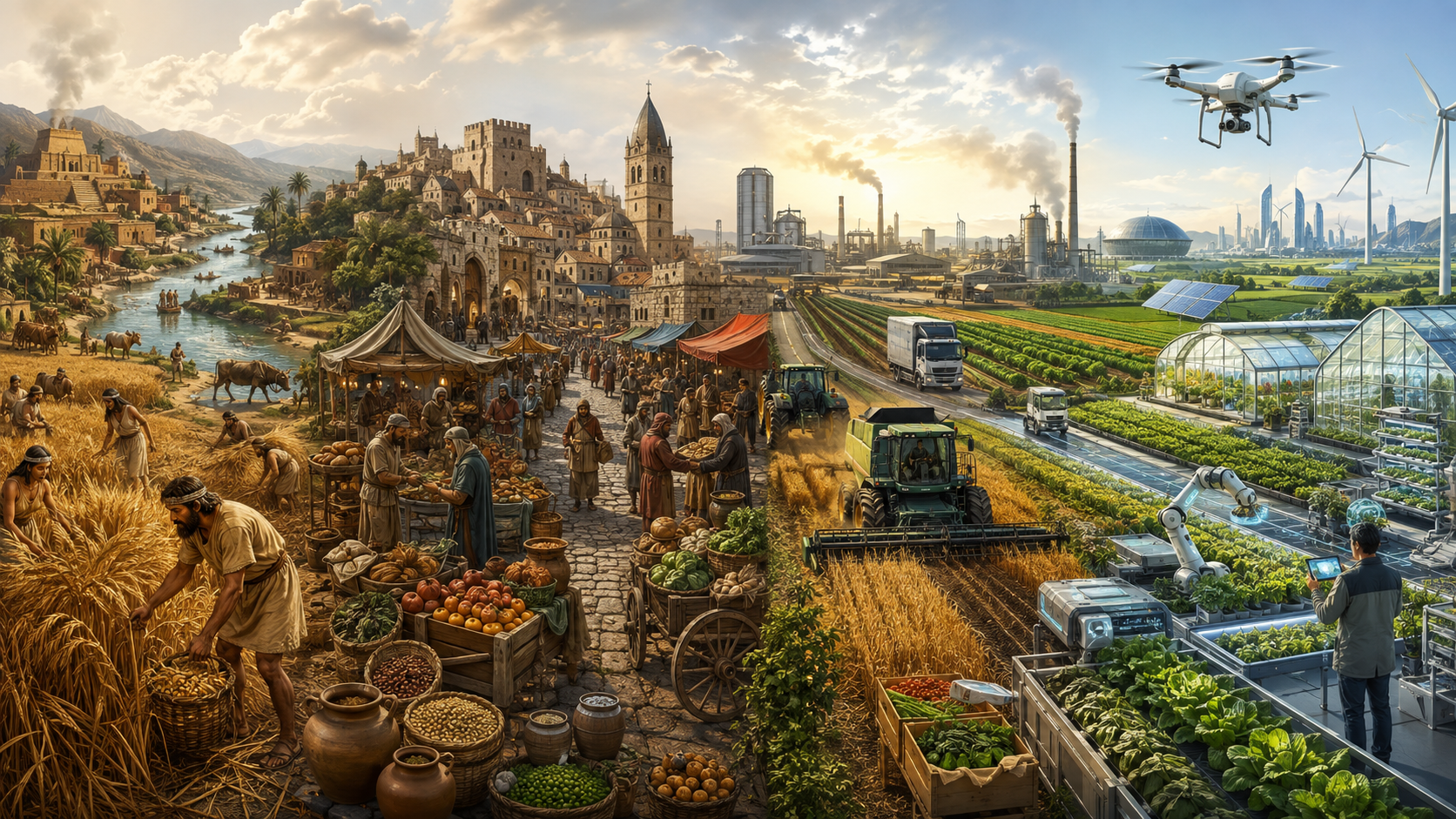
    Food is one of humanity’s most basic necessities. Yet throughout history, it has been far more than a means of survival. The ability to produce, store, distribute, and control food has shaped civilizations, determined the outcomes of wars, influenced political revolutions, and transformed economic systems. Entire empires have risen because they secured reliable food supplies, while others have collapsed after prolonged famine or agricultural failure.

    Even in the twenty-first century, food remains a strategic resource. Climate change, population growth, armed conflicts, and global supply chains have made food security one of the world’s most urgent concerns. The war in Ukraine disrupted grain exports, extreme weather threatens harvests across multiple continents, and millions still suffer from hunger despite unprecedented agricultural productivity.

    These realities raise an important historical question: Has food been the hidden force behind civilization, or has it simply reflected deeper political, technological, and social changes?

    The answer lies somewhere between these two perspectives. Food has rarely acted alone, but history repeatedly demonstrates that no civilization can thrive for long without a stable food system.


    1. Food Built Civilization

    The Agricultural Revolution: Humanity’s First Great Transformation

    Around 10,000 years ago, the Agricultural Revolution fundamentally changed the course of human history.

    Before agriculture, most people lived as hunter-gatherers whose survival depended on seasonal resources. Population growth remained limited because food supplies were unpredictable. Once humans learned to cultivate crops and domesticate animals, however, food production became more reliable, allowing permanent settlements to emerge.

    This transformation produced food surpluses that changed society in profound ways.

    Instead of spending every day searching for food, people could specialize in new occupations such as pottery, metalworking, administration, trade, religion, and military service. Villages expanded into cities, governments developed, and organized civilizations appeared for the first time.

    In many ways, civilization began when food became more predictable.

    Surplus Food Created Complex Societies

    Agricultural surplus did far more than feed growing populations.

    It supported taxation, financed armies, enabled long-distance trade, and encouraged technological innovation. Governments could collect grain, redistribute resources during difficult years, and maintain political authority.

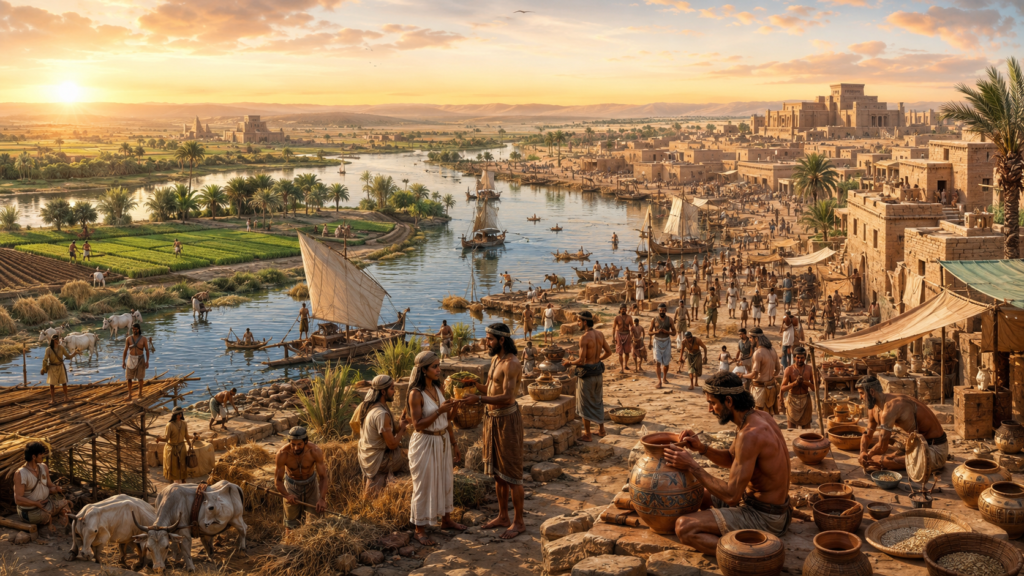
    Ancient Egypt offers one of history’s clearest examples. The annual flooding of the Nile River created fertile farmland capable of producing abundant grain harvests. These reliable food supplies allowed Egypt to sustain large populations, construct monumental architecture, and maintain centralized political power for centuries.

    Similarly, Mesopotamia, the Indus Valley, and early Chinese civilizations all depended on successful agricultural systems.

    Food was not merely an economic resource—it became the foundation upon which civilizations were built.
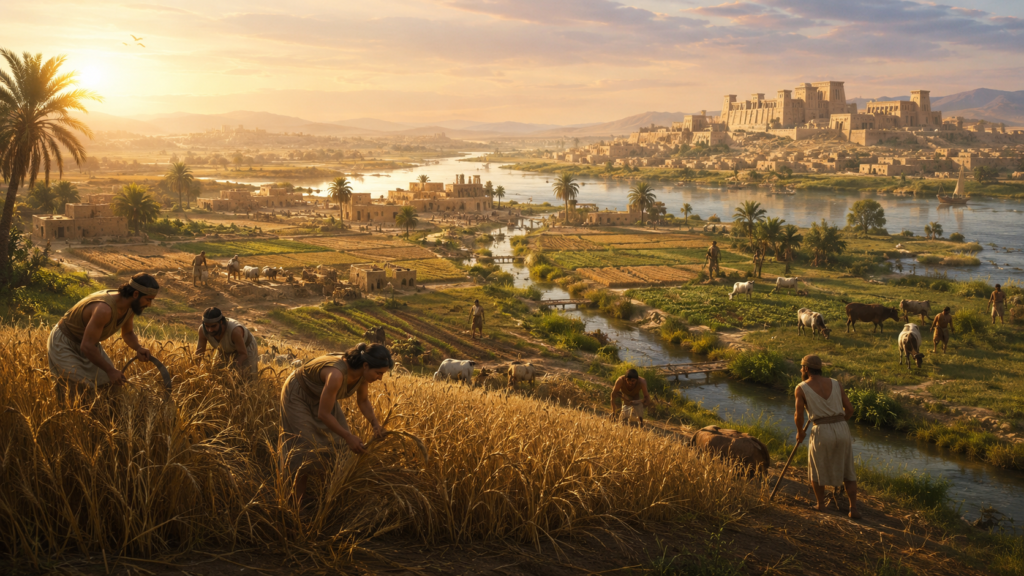
    the Agricultural Revolution laying the foundation of civilization

    2. When Food Becomes Scarce

    The Collapse of Civilizations

    History also reveals the devastating consequences of food shortages.

    Agricultural failure caused by drought, environmental degradation, war, or poor governance has repeatedly destabilized societies.

    The Classic Maya civilization illustrates this relationship. Although the Maya developed advanced mathematics, astronomy, and architecture, prolonged droughts combined with environmental overuse weakened agricultural production. As food supplies declined, political authority weakened, cities were abandoned, and much of the civilization eventually collapsed.

    Food shortages alone did not destroy the Maya, but they intensified existing social and political problems until the system could no longer survive.

    The Great Famine in Medieval Europe

    Food insecurity transformed medieval Europe as well.

    During the Great Famine of 1315–1317, unusually cold and wet weather devastated harvests across much of Northern Europe. Crop failures led to widespread hunger, rising food prices, disease, and social unrest.

    Only a few decades later, the Black Death struck an already weakened population, dramatically reshaping European society.

    These crises exposed the vulnerability of agricultural economies that depended almost entirely on favorable weather and local food production.

    History repeatedly demonstrates that food shortages rarely remain agricultural problems alone—they quickly become political, economic, and humanitarian crises.


    3. Food as a Weapon of War

    Victory Depends on Supply

    Military history is filled with examples showing that armies march not only on courage but also on food.

    Successful military campaigns require reliable supply lines capable of feeding soldiers over long periods. Without food, even the strongest armies eventually lose their effectiveness.

    Napoleon’s invasion of Russia in 1812 remains one of the best-known examples.

    Rather than confronting Napoleon’s army directly, Russian forces adopted a scorched-earth strategy, destroying crops, villages, and food supplies during their retreat. As winter approached, French soldiers suffered starvation, disease, and exhaustion.

    The campaign ended in disaster, illustrating how food logistics can determine military outcomes as much as battlefield tactics.

    Food and Modern Conflict

    Food continues to influence geopolitical conflicts today.

    During World War II, securing agricultural resources and transportation networks became strategic priorities for many nations.

    More recently, the war between Russia and Ukraine demonstrated how modern conflicts affect global food systems.

    Ukraine is one of the world’s largest exporters of wheat, corn, and sunflower oil. Disruptions to grain exports caused sharp increases in global food prices, particularly affecting countries in Africa and the Middle East that rely heavily on imported grain.

    In today’s interconnected world, a regional conflict can rapidly become a global food crisis.

    food shortages influencing the outcome of military campaigns

    4. Food, Politics, and Global Stability

    Food Prices and Political Change

    Food has often influenced political stability.

    When basic necessities become unaffordable, public frustration frequently turns into political protest.

    During the Arab Spring, rising food prices contributed to growing dissatisfaction in several countries. Although political repression, unemployment, and corruption were major causes, rapidly increasing bread prices intensified economic hardship and helped fuel widespread demonstrations.

    Food insecurity often exposes deeper structural problems within society.

    Food Security in a Changing Climate

    Today, climate change represents one of the greatest long-term challenges to global food production.

    More frequent droughts, floods, heatwaves, and unpredictable weather reduce crop yields and threaten agricultural livelihoods.

    Regions such as the Sahel in Africa have already experienced declining agricultural productivity due to desertification and prolonged drought.

    Meanwhile, rising sea levels threaten fertile coastal farmland in many parts of Asia.

    Food security has therefore become closely connected to environmental sustainability.

    The challenge is no longer producing enough food globally but ensuring that food remains available, affordable, and accessible under changing environmental conditions.

    The Paradox of Hunger and Waste

    One of the greatest contradictions of modern society is that hunger and food waste exist simultaneously.

    Each year, enormous quantities of edible food are discarded while hundreds of millions of people remain undernourished.

    This imbalance demonstrates that food scarcity is often not simply a production problem but also a problem of distribution, infrastructure, poverty, and political priorities.

    Improving global food systems therefore requires addressing inequality as much as increasing agricultural output.


    5. Is Food the Driving Force Behind History?

    The Case in Favor

    Many historians argue that food has been one of history’s most influential forces.

    Without stable food production, populations cannot grow, cities cannot expand, governments cannot collect taxes, and armies cannot remain effective.

    Agricultural productivity has repeatedly determined economic prosperity, political stability, and national power.

    From this perspective, food is the invisible foundation supporting nearly every major civilization.

    The Counterargument

    Others argue that food alone cannot explain historical change.

    Political leadership, technological innovation, religion, trade, education, and cultural values also shape civilizations.

    Countries with similar agricultural conditions have often experienced very different historical outcomes because of differences in institutions and governance.

    Likewise, technological advances—including irrigation systems, fertilizers, mechanized farming, and biotechnology—have repeatedly transformed humanity’s relationship with food.

    History is therefore shaped by multiple interacting forces rather than a single determining factor.


    6. The Future of Food

    Technology and Sustainable Agriculture

    Agriculture is entering another period of profound transformation.

    Artificial intelligence, satellite monitoring, precision farming, autonomous machinery, and gene-editing technologies are helping farmers increase productivity while reducing environmental impact.

    These innovations may allow humanity to produce more food using fewer natural resources.

    However, technological progress also raises ethical questions regarding access, affordability, biodiversity, and environmental sustainability.

    The challenge is ensuring that innovation benefits both wealthy and developing nations.

    Food Security as a Global Responsibility

    Food security can no longer be viewed solely as a national issue.

    Global trade, climate change, migration, pandemics, and armed conflicts connect food systems across continents.

    Governments, international organizations, scientists, farmers, and consumers all share responsibility for building resilient food systems capable of feeding future generations.

    Achieving this goal will require sustainable agriculture, reduced food waste, international cooperation, and policies that promote both productivity and fairness.


    Conclusion
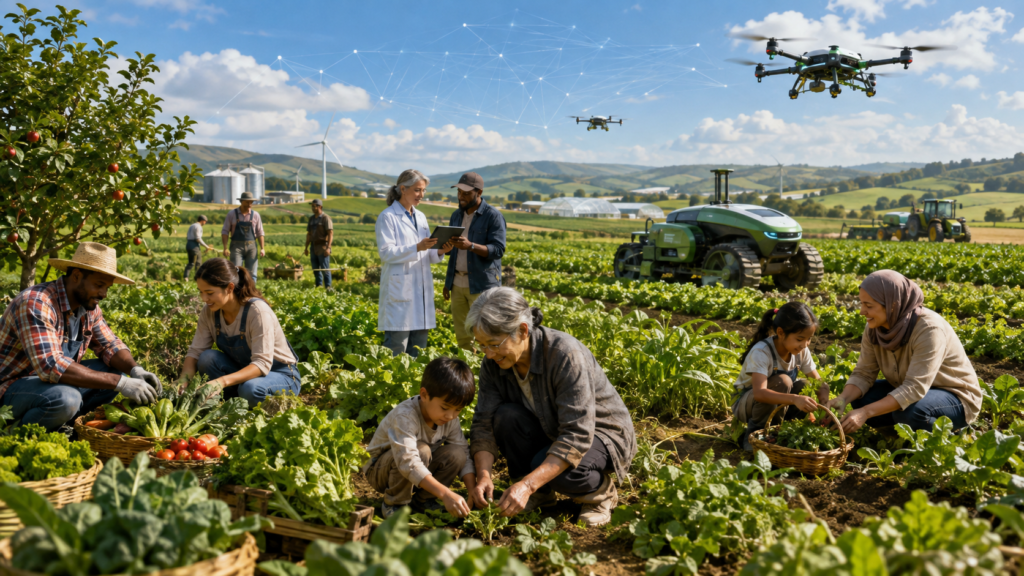
    sustainable agriculture and global food security in the future

    Food has never been merely a biological necessity. Throughout history, it has shaped civilizations, influenced political systems, determined military success, and transformed economic development.

    The Agricultural Revolution laid the foundation for organized societies. Famines contributed to the collapse of civilizations. Wars have often been won or lost because of supply lines rather than battlefield strength alone. Even today, climate change, global conflicts, and economic inequality continue to demonstrate that food remains one of humanity’s most strategic resources.

    Yet food does not act independently.

    Its historical influence is inseparable from politics, technology, geography, economics, and culture. Civilizations succeed not simply because they produce enough food, but because they manage food systems wisely, distribute resources fairly, and adapt to changing conditions.

    As humanity confronts climate change, population growth, and technological transformation, the debate over food’s role in history becomes increasingly relevant.

    Perhaps the most important lesson history offers is this: the future of civilization will depend not only on producing more food, but on creating food systems that are sustainable, resilient, and equitable for everyone.

    Reader Question

    If food shortages have repeatedly transformed civilizations throughout history, do you believe future conflicts will be driven more by food security than by traditional political rivalries?

    As climate change and population growth place increasing pressure on global agriculture, what responsibilities should governments, businesses, and individuals share in building a more sustainable food system?


    Related Reading

    If population growth has historically depended on stable food production, how closely are demographic change and food security connected in shaping civilizations?

    In Population and the Course of History: Is Demographic Change the Driving Force Behind Civilizations? we explore how population growth, aging societies, migration, and technological innovation have influenced the rise and transformation of human civilizations.


    If climate change increasingly threatens global agriculture, can technological innovation secure humanity’s future without compromising environmental sustainability?

    In The Future of Happiness: How Will We Define Happiness in the Age of AI and Climate Change? we examine how technology, sustainability, and changing human values may redefine prosperity and well-being in the decades ahead.

    References

    1. Diamond, J. (1997). Guns, Germs, and Steel: The Fates of Human Societies. W. W. Norton & Company.

    Jared Diamond argues that geography, agriculture, and food production played decisive roles in shaping civilizations. The book explains how access to domesticable plants and animals influenced the development of societies, political institutions, and global power.


    2. Standage, T. (2009). An Edible History of Humanity. Walker & Company.

    Standage traces world history through the lens of food, showing how agriculture, trade, exploration, war, and industrialization were all profoundly influenced by the production and distribution of food. It provides a highly accessible historical perspective on civilization.


    3. Food and Agriculture Organization of the United Nations (FAO). (2024). The State of Food Security and Nutrition in the World 2024. FAO.

    This annual FAO report examines global hunger, malnutrition, food insecurity, and sustainable agriculture. It highlights how climate change, conflict, and economic inequality continue to threaten global food systems despite advances in agricultural productivity.


    4. Sen, A. (1981). Poverty and Famines: An Essay on Entitlement and Deprivation. Oxford University Press.

    Amartya Sen challenges the idea that famines are caused only by food shortages. He argues that political institutions, economic inequality, and failures in food distribution often play a greater role than agricultural production itself.


    5. United Nations. (2015). Transforming Our World: The 2030 Agenda for Sustainable Development. United Nations.

    The United Nations emphasizes that ending hunger is central to achieving sustainable development. Sustainable agriculture, resilient food systems, and equitable food distribution are presented as essential foundations for global peace, prosperity, and environmental sustainability.
  • Population and the Course of History

    Population and the Course of History

    Is Demographic Change the Driving Force Behind Civilizations?

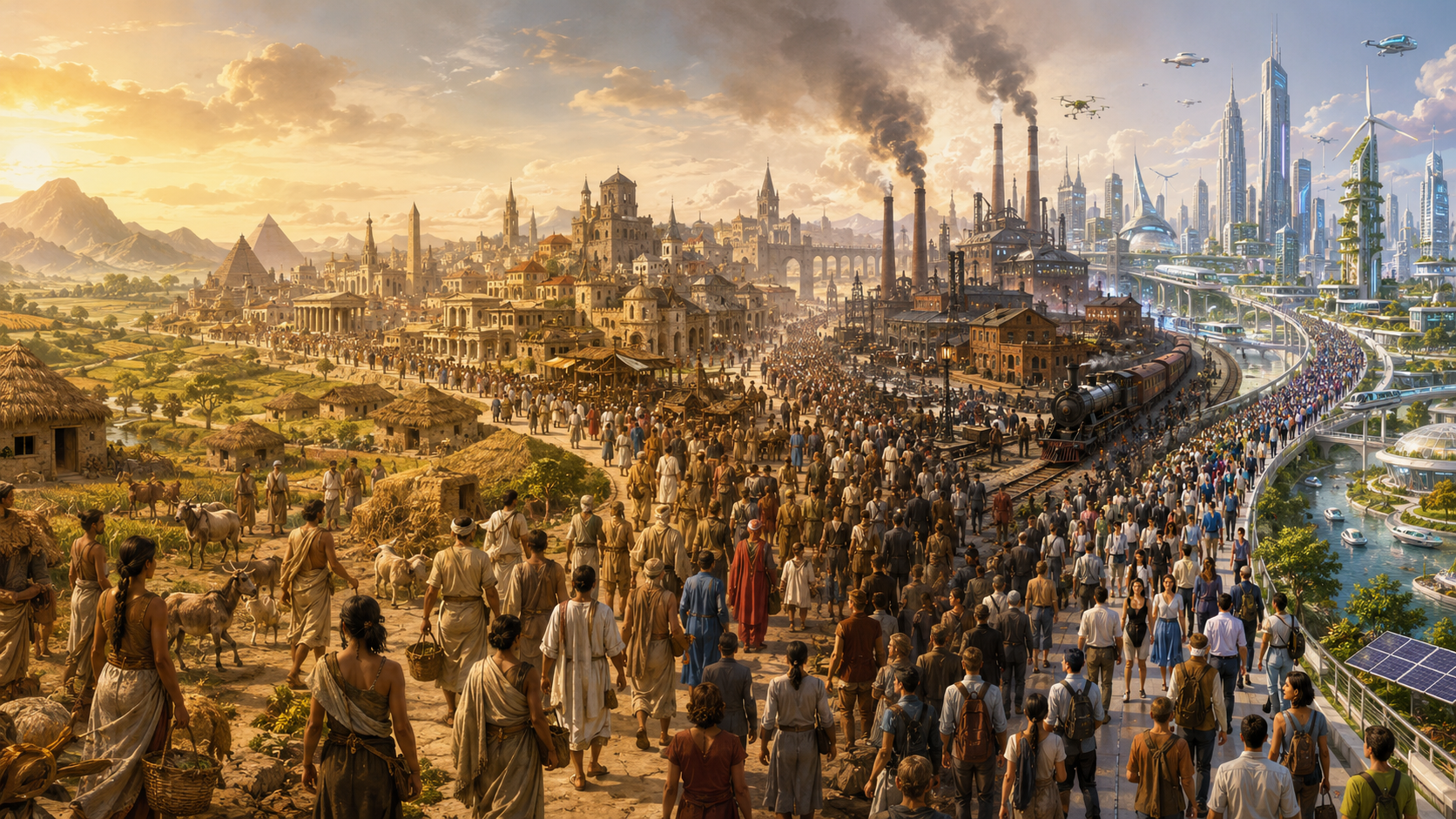
    Throughout history, the rise and fall of civilizations have often been explained through wars, political leaders, technological breakthroughs, or economic systems. Yet beneath these visible events lies a quieter but equally powerful force: population change.

    Population influences nearly every aspect of society. It determines the size of the workforce, the demand for food and housing, the strength of armies, the growth of cities, and the sustainability of welfare systems. A rapidly growing population can stimulate innovation and economic expansion, while a declining population may reshape labor markets, social structures, and national priorities.

    Today, demographic change has once again become a global concern. Aging societies, declining birth rates, migration, urbanization, and climate-driven displacement are transforming countries in very different ways. At the same time, advances in artificial intelligence and automation are raising a new question: Will population remain the primary engine of history, or will technology gradually replace its historical role?

    The debate is no longer simply about how many people live in a country. It is about how demographic trends interact with technology, politics, economics, and culture to shape the future of civilization.


    1. Population Has Always Shaped Human Civilization

    The Agricultural Revolution: The First Population Boom

    Roughly 10,000 years ago, the Agricultural Revolution fundamentally changed human history.

    Before agriculture, most people lived as hunter-gatherers, and population growth remained limited by the availability of food. Once farming allowed communities to produce stable food supplies, permanent settlements emerged, infant survival improved, and populations expanded rapidly.

    Larger populations created opportunities for specialization. Instead of producing food alone, people could become craftsmen, merchants, priests, soldiers, or administrators. Cities developed, governments became more organized, and some of the world’s earliest civilizations—including Mesopotamia and Ancient Egypt—flourished along fertile river valleys.

    In this sense, population growth did not simply accompany civilization; it helped make civilization possible.

    The Industrial Revolution: Population Meets Productivity

    The Industrial Revolution created another dramatic demographic transformation.

    Improvements in sanitation, medicine, and public health reduced mortality rates, while advances in agriculture produced more reliable food supplies. At the same time, factories generated new employment opportunities, encouraging rapid urbanization.

    Growing populations provided expanding labor forces and larger consumer markets, allowing industrial economies to scale production at unprecedented levels.

    Britain’s rise during the Industrial Revolution illustrates how demographic expansion, technological innovation, and economic development reinforced one another to transform global history.

    population growth supporting the rise of early civilizations

    2. When Population Declines

    The Black Death: Crisis That Changed Europe

    Population growth has often stimulated development, but demographic collapse has also transformed history.

    During the fourteenth century, the Black Death killed an estimated one-third to one-half of Europe’s population. Entire communities disappeared, agricultural production declined, and severe labor shortages disrupted economic life.

    Yet the consequences were not entirely negative.

    With fewer workers available, surviving laborers gained greater bargaining power. Wages increased, feudal obligations weakened, and social mobility gradually improved. Many historians argue that these demographic changes contributed to the decline of feudalism and helped create conditions that later supported the Renaissance.

    The plague demonstrates that population decline can destroy existing systems while simultaneously creating opportunities for profound social transformation.

    Wars and Demographic Recovery

    The two World Wars also reshaped global demographics.

    Millions of deaths reduced labor forces and disrupted national economies. However, reconstruction efforts accelerated industrial modernization, expanded educational opportunities, and significantly increased women’s participation in the workforce.

    History repeatedly shows that demographic shocks often trigger unexpected political and economic reforms rather than producing only long-term decline.


    3. Today’s Demographic Challenges

    Aging Societies and Declining Birth Rates

    Many developed countries are now experiencing historically low fertility rates.

    Japan, South Korea, Italy, Germany, and several other nations face shrinking working-age populations alongside rapidly growing elderly populations.

    This demographic shift creates numerous challenges:

    • Labor shortages
    • Slower economic growth
    • Greater pension costs
    • Rising healthcare expenditures
    • Pressure on younger generations to support aging societies

    For many governments, maintaining economic vitality while supporting older citizens has become one of the defining policy challenges of the twenty-first century.

    Population Growth in Developing Countries

    While many wealthy nations struggle with population decline, parts of Africa and South Asia continue to experience rapid population growth.

    Countries such as Nigeria are expected to see significant increases in population over the coming decades.

    A youthful population can become a powerful economic advantage if accompanied by education, healthcare, infrastructure, and employment opportunities. Economists often describe this opportunity as the demographic dividend—a period during which a large working-age population can accelerate economic development.

    However, without sufficient investment, rapid population growth may also increase unemployment, inequality, housing shortages, and pressure on public services.

    Population itself is neither a guarantee of prosperity nor a cause of poverty. The outcome depends largely on how societies manage demographic change.

    Migration as a Historical Force

    Population change today is driven not only by birth and death but also by migration.

    International migration reshapes labor markets, cities, and cultural identities. Many aging countries increasingly depend on immigrants to fill labor shortages, while millions of people migrate in search of economic opportunities, education, or safety.

    Climate change is expected to intensify migration further through rising sea levels, droughts, and extreme weather events.

    Migration has therefore become one of the most significant demographic forces shaping the modern world.

    aging population and automation transforming modern society

    4. Is Population the Engine of History?

    The Argument in Favor

    Many historians and economists argue that demographic change lies beneath most major historical transformations.

    Larger populations generally create:

    • Greater economic productivity
    • Larger domestic markets
    • Stronger military capacity
    • Faster technological diffusion
    • More opportunities for innovation

    From this perspective, population serves as the foundation upon which political, economic, and cultural developments occur.

    Without sufficient people, even the most advanced technologies or institutions may struggle to generate sustained growth.

    The Counterargument

    Others argue that population alone explains very little.

    History contains numerous examples of relatively small societies exerting extraordinary global influence through technological leadership, political institutions, education, or cultural innovation.

    Ancient Athens, Renaissance Florence, Singapore, and modern Israel demonstrate that human capital, governance, and innovation can sometimes matter more than population size itself.

    In addition, technological revolutions have repeatedly altered the relationship between population and productivity.

    The quality of institutions and knowledge may ultimately outweigh the quantity of people.


    5. Artificial Intelligence and the Future of Population

    Can Technology Replace Human Labor?

    Artificial intelligence and robotics are beginning to transform the relationship between demographics and economic growth.

    For decades, economists assumed that declining populations would inevitably reduce productivity because fewer workers meant lower economic output.

    Automation challenges that assumption.

    Factories increasingly rely on intelligent machines. AI assists doctors, lawyers, engineers, translators, researchers, and educators. Agricultural robots and autonomous logistics systems continue reducing dependence on manual labor.

    If productivity continues rising despite smaller populations, countries may discover new ways to sustain economic growth without demographic expansion.

    A New Demographic Debate

    However, technology cannot replace every human contribution.

    Innovation, creativity, caregiving, leadership, entrepreneurship, and democratic participation all depend heavily on people rather than machines.

    Moreover, societies consist not only of economies but also of families, communities, and cultures.

    A nation with fewer children may successfully automate production while still struggling to preserve schools, local communities, cultural traditions, and intergenerational connections.

    The future question therefore becomes increasingly complex.

    Perhaps the issue is no longer whether population matters, but how population and technology will work together to shape human societies.


    Conclusion

    people and AI working together in the future despite demographic change

    Population has never been the only force shaping history, but it has consistently influenced the rise, transformation, and decline of civilizations.

    From the Agricultural Revolution and the Industrial Revolution to the Black Death, world wars, urbanization, migration, and today’s aging societies, demographic change has repeatedly altered economies, political institutions, and social structures.

    Yet history also teaches that population does not determine destiny on its own.

    Technology, education, governance, cultural values, and innovation continually reshape how societies respond to demographic challenges.

    In the twenty-first century, artificial intelligence, automation, and global migration are redefining the historical relationship between population and progress. Countries with declining populations may remain prosperous through innovation, while rapidly growing societies may flourish only if they invest in education, opportunity, and effective institutions.

    Ultimately, the most important question is not whether population drives history, but how humanity chooses to respond to demographic change.

    The future will belong not simply to the countries with the largest populations, but to those that can successfully balance demographic realities with technological progress, social resilience, and long-term human development.

    Reader Question

    As artificial intelligence and automation continue to transform economies, do you think population size will remain the most important driver of national prosperity, or will innovation become even more influential?

    If your country faces either rapid population growth or population decline, what policies do you believe should be the highest priority to build a sustainable future?


    Related Reading

    If technological innovation increasingly changes how societies produce goods, create wealth, and solve labor shortages, how might it reshape the historical relationship between population and economic development?

    In The Future of Happiness: How Will We Define Happiness in the Age of AI and Climate Change?, we explore how artificial intelligence, technological progress, and changing social values may redefine not only individual well-being but also the future of human societies.


    If historical change is driven by many interconnected forces rather than a single factor, how should we understand the relationship between population, technology, politics, and cultural development?

    In Is There a Single Historical Truth, or Many Narratives?, we examine how historical events can be interpreted through multiple perspectives and why understanding history often requires looking beyond a single explanation.

    References

    1. McNeill, W. H. (1976). Plagues and Peoples. Anchor Books.

    William H. McNeill examines how epidemics have repeatedly reshaped civilizations by altering population size, labor availability, political stability, and economic systems. The book remains one of the foundational works connecting demographic change with world history.


    2. Livi-Bacci, M. (2017). A Concise History of World Population (7th ed.). Wiley-Blackwell.

    Livi-Bacci traces global population trends from prehistoric societies to the modern era, explaining how fertility, mortality, migration, and technological advances have influenced the development of civilizations. It is widely regarded as a classic introduction to historical demography.


    3. Rosling, H., Rosling, O., & Rönnlund, A. R. (2018). Factfulness: Ten Reasons We’re Wrong About the World—and Why Things Are Better Than You Think. Flatiron Books.

    Using global demographic data, Hans Rosling challenges common misconceptions about population growth, poverty, health, and development. The book encourages readers to understand demographic change through evidence rather than assumptions.


    4. Lee, R., & Mason, A. (2011). Population Aging and the Generational Economy: A Global Perspective. Edward Elgar Publishing.

    This book explores the economic consequences of aging populations, declining fertility, and changing age structures. It discusses how societies can adapt through policy reforms, productivity improvements, and intergenerational cooperation.


    5. United Nations. (2024). World Population Prospects 2024. United Nations Department of Economic and Social Affairs (UN DESA).

    The UN’s flagship demographic report provides the latest projections on population growth, aging, fertility, migration, and life expectancy across the world. It is one of the most authoritative sources for understanding future demographic trends and their global implications.