
Why WHO Supports Front-of-Pack Nutrition Labelling—and Why the Debate Is About More Than What We Eat
Imagine standing in a supermarket with two breakfast cereals in your hands.
Both packages promise something positive.
One says “high in fiber.” Another emphasizes vitamins and natural ingredients.
You turn the packages around and find detailed nutrition tables filled with numbers, percentages, serving sizes, sugars, sodium, fats, and calories.
You have information.
But do you really have understanding?
This distinction lies at the heart of the global debate over nutrition labelling.
The World Health Organization (WHO) has long supported stronger nutrition labelling policies, including front-of-pack nutrition labelling (FOPL), as part of broader efforts to create healthier food environments. Rather than requiring consumers to interpret complicated nutrition tables while shopping, front-of-pack systems aim to provide information that can be understood more quickly.
The issue has become increasingly important as obesity and diet-related noncommunicable diseases have grown worldwide. According to WHO data, 2.5 billion adults were overweight in 2022, including more than 890 million living with obesity. Adult obesity worldwide has more than doubled since 1990.
Clearer labels therefore sound like an obvious solution.
But the issue becomes more complicated when we ask what a food label is supposed to do.
Should it simply provide information?
Should it warn us?
Should it actively influence what we buy?
And how much responsibility for healthy eating should belong to individuals, governments, and food companies?
1. What Is Front-of-Pack Nutrition Labelling?
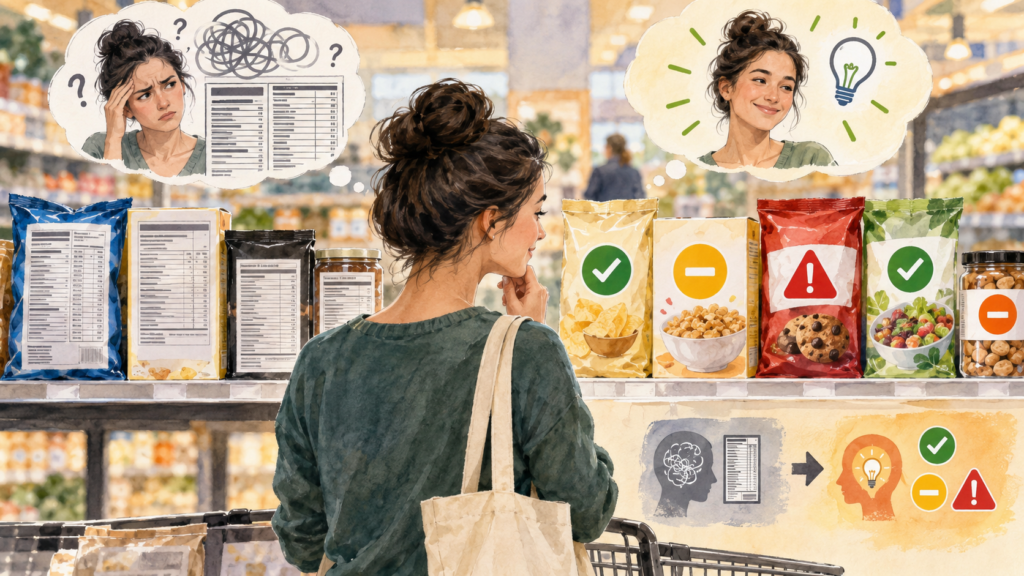
Most packaged foods already provide some nutritional information.
The problem is that conventional nutrition panels often require consumers to interpret numbers while making quick purchasing decisions.
Front-of-pack nutrition labelling tries to simplify this process.
WHO describes FOPL as supplementary nutrition information displayed prominently on food packages to help consumers understand nutritional characteristics and make more informed purchasing decisions. WHO has also emphasized that nutrition labelling policies should be government-led, evidence-based, and adapted to national circumstances.
There is no single universal design.
Different systems may use:
- warning symbols,
- traffic-light colors,
- letter or numerical scores,
- nutrient-specific information,
- or other simplified visual indicators.
Some systems emphasize products that contain high levels of nutrients of concern. Others provide an overall assessment intended to help consumers compare products.
This distinction matters.
A label saying “high in sodium” communicates something different from a label assigning an overall nutritional score.
So the debate is not merely whether foods should carry labels.
It is also about what information the label should communicate and how strongly it should influence consumer judgment.
2. Why Does WHO Consider Better Nutrition Labelling Important?
Poor diets are a major public-health problem.
WHO describes unhealthy diets and poor nutrition as important risk factors for diet-related noncommunicable diseases, while overweight and obesity have become global problems affecting countries across income levels.
This creates a problem for traditional approaches based mainly on personal responsibility.
Telling people to “eat healthier” assumes that healthy choices are easily identifiable.
But modern food environments are complicated.
Consumers encounter nutritional claims, attractive packaging, portion sizes, advertising, promotions, and long ingredient lists—all while making purchasing decisions quickly.
Nutrition labelling attempts to change the choice environment.
Instead of expecting every shopper to become an expert in nutritional science, a well-designed front-of-pack label can make important information easier to recognize.
WHO therefore treats effective nutrition labelling, including FOPL, as one strategy governments can use to address unhealthy diets.
The underlying principle is simple:
information is useful only when people can understand and use it.
3. Do Warning Labels Actually Change What People Buy?
This is the crucial question.
A label can be clear without changing behavior.
Food decisions are influenced by price, taste, habit, convenience, culture, income, advertising, and availability. A person may understand perfectly well that a product contains large amounts of sugar and still buy it.
Nutrition labels should therefore not be treated as a magic solution.
Nevertheless, front-of-pack labelling has an additional potential effect that is sometimes overlooked.
It can influence companies, not just consumers.
WHO notes that effective nutrition labelling may encourage favorable changes in the composition of food products. If prominent labels make products high in certain nutrients less attractive to consumers, manufacturers gain an incentive to reformulate them.
This changes the policy question.
A food label is no longer simply a small educational message printed on a package.
It can become part of the relationship between public health policy, consumer behavior, and the food market.
That is one reason the design of labels becomes politically controversial.
4. What Are the Problems With Food Label Reform?
Simplifying Nutrition Can Also Oversimplify Food
The strongest argument for front-of-pack labels is simplicity.
Ironically, simplicity is also one of their potential weaknesses.
Nutrition is complicated.
Reducing a product to a color, symbol, score, or warning may help consumers make rapid comparisons, but it can also create the impression that foods can always be divided neatly into “good” and “bad.”
Portion size matters.
Overall dietary patterns matter.
Frequency of consumption matters.
National dietary traditions differ.
And different labelling systems use different criteria for evaluating products.
WHO itself recognizes that front-of-pack systems should take account of local nutritional conditions, dietary customs, food availability, and national health priorities.
There is another risk.
Labels themselves can confuse or even mislead consumers if poorly designed. WHO’s review of nutrition-labelling implementation notes that some labelling approaches can create false perceptions about the healthfulness of products.
The challenge is therefore to make information simple enough to use without making it so simple that it becomes misleading.
5. Why Do Food Companies Sometimes Oppose Stronger Labels?

Food labelling is not only a scientific issue.
It is also an economic and political one.
A prominent warning on the front of a package can affect how consumers perceive a product.
Companies may therefore raise concerns about implementation costs, inconsistent national standards, trade implications, the criteria used to classify products, or the possibility that simplified labels unfairly stigmatize particular foods.
Public-health advocates, however, may argue that consumers have a right to easily understandable information—especially when products contain high levels of nutrients associated with health risks.
This tension has not disappeared.
WHO’s 2026 technical work on population diet policies explicitly recognizes that governments can face significant opposition from industry stakeholders when implementing measures including front-of-pack labelling.
This leads to a broader question:
Who should have greater influence over the information presented on food packages—the companies selling the food or public institutions responsible for protecting health?
A credible system requires transparency.
If consumers suspect that labels are shaped primarily by commercial interests, trust declines.
But if governments create classifications that appear arbitrary or scientifically unclear, trust can decline as well.
Good labelling policy therefore requires not merely regulation, but credible and transparent regulation.
6. Is Food Choice Really Just an Individual Responsibility?

This may be the most important debate behind food labels.
One position emphasizes individual freedom.
Governments should provide accurate information, but adults should ultimately decide what to eat. A chocolate bar does not become unacceptable simply because it contains sugar, and public-health policy should not turn every personal dietary decision into a government concern.
Another perspective asks whether consumer choice is genuinely free when the information environment is unequal.
Food companies possess considerable expertise in marketing, package design, consumer psychology, and product promotion.
An individual shopper may spend only a few seconds making a decision.
From a citizenship perspective, this raises an important distinction between freedom of choice and the conditions necessary for informed choice.
Providing clearer information does not necessarily remove freedom.
It may strengthen it.
But there is still a line to consider.
A label that provides understandable information helps people decide.
A label deliberately designed to change behavior moves closer to a public-health intervention.
Neither is automatically wrong.
But societies should be transparent about which goal they are pursuing.
7. Can Better Labels Solve the Obesity Problem?
No.
And they should not be expected to.
Obesity is far more complex than an inability to read food labels. WHO describes it as a chronic, relapsing disease arising from interactions among biological factors, eating behavior, access to healthy diets, market forces, and broader environments.
Food prices matter.
Income matters.
Education matters.
Marketing matters.
The availability of healthy foods matters.
School food environments matter.
Urban environments and opportunities for physical activity matter.
This is why nutrition labelling works best as one element of a broader food policy rather than as a substitute for it.
Recent WHO policy development reflects this broader approach. For example, WHO has also issued guidance on healthier school food environments and lower-sodium salt substitutes as part of wider efforts to improve diets and reduce diet-related disease.
A clearer label may help someone choose between two products.
It cannot ensure that affordable, nutritious food is available in the first place.
Conclusion: A Small Label Raises a Much Bigger Question
Food labels occupy only a few centimeters of a package.
But the debate surrounding them touches on some much larger questions.
What information do consumers have a right to receive?
How much responsibility should individuals carry for healthy choices?
When should governments redesign the environment in which those choices are made?
And how much influence should food companies have over the way their products are presented?
WHO’s continuing emphasis on nutrition labelling reflects an important principle: consumers should be able to understand the nutritional information relevant to their decisions, not merely be given technically accurate numbers that are difficult to interpret.
But better labels alone cannot create healthier societies.
They cannot eliminate economic inequality, change food availability, remove aggressive marketing, or transform deeply established dietary habits.
Their value may be more modest—and still important.
A good food label can make an invisible nutritional characteristic visible at the moment a decision is made.
That does not tell us what we must eat.
It gives us a better opportunity to know what we are choosing.
And perhaps that is the most useful way to frame the debate:
Should food labels simply tell us what is inside a product—or should they also help us decide whether we should eat it?
Reader Question
Clearer nutrition labels can help consumers understand what they are buying, but warning symbols and simplified scores are also designed to influence purchasing decisions.
Should food labels simply provide understandable information—or should governments use them actively to encourage healthier choices?
Related Reading
If food choices are increasingly shaped by health concerns, medical needs, ethical considerations, and changing social norms, is choosing what to eat still simply a matter of personal preference?
In The Rise of Dietary Restrictions, we explore why dietary restrictions are becoming more visible and how changing ideas about health, identity, ethics, and personal choice are reshaping the way people think about food.
But even when nutrition labels clearly tell us which choices may be healthier, why is it still so difficult to change what we actually eat?
In Self-Control and Habit Formation: How to Build Better Habits, we examine how habits and self-control shape everyday behavior—and why having better information does not automatically lead to better choices.
References
1. World Health Organization. (2024). Online Public Consultation: Draft Guideline on Nutrition Labelling Policies.
WHO developed the draft guideline to help countries introduce or strengthen evidence-based nutrition labelling policies, including nutrient declarations, front-of-pack labelling, and nutrition and health claims. The document is particularly important because it frames nutrition labelling as a government-led and transparent public-health policy rather than simply a matter of voluntary food-industry communication.
2. World Health Organization. (2022). Nutrition Labelling: Policy Brief.
This policy brief explains the major forms of nutrition labelling, including ingredient lists, nutrient declarations, front-of-pack labelling, and nutrition and health claims. It supports the article’s argument that nutrition information should not merely exist on packages but should help consumers understand the nutritional characteristics of foods when making purchasing decisions.
3. World Health Organization. (2025). Obesity and Overweight.
WHO reports that 2.5 billion adults were overweight in 2022, including more than 890 million living with obesity, while worldwide adult obesity prevalence has more than doubled since 1990. These updated figures replace the older statistics used in the original 2024 draft and demonstrate why improving food environments remains a major global public-health concern.
4. World Health Organization. (2019). Guiding Principles and Framework Manual for Front-of-Pack Labelling for Promoting Healthy Diets.
This framework explains how countries can design, implement, monitor, and evaluate front-of-pack labelling systems. Importantly, WHO emphasizes government leadership while recognizing that systems need to reflect national circumstances and learn from international experience.
5. Taillie, L. S., Reyes, M., Colchero, M. A., Popkin, B., & Corvalán, C. (2020). An evaluation of Chile’s Law of Food Labeling and Advertising on sugar-sweetened beverage purchases from 2015 to 2017: A before-and-after study. PLOS Medicine, 17(2), e1003015.
This study examined Chile’s policy package combining front-of-package warning labels with restrictions on child-directed marketing and school sales. Purchases of beverages classified as high in regulated nutrients declined substantially relative to the estimated counterfactual, although the study cannot isolate the effect of warning labels from the other measures implemented simultaneously.