“I have no time.”
“Today flew by.”
“I didn’t even get a moment to rest this weekend.”
Most of us say these things almost automatically.
Yet, when we look closely, our schedules are not always as full as our exhaustion suggests.
So a question arises:
Why do we feel busy even when we are not doing that much?
1. Time Is a Feeling: Psychological Time vs. Clock Time
1.1 The Difference Between Measured and Lived Time
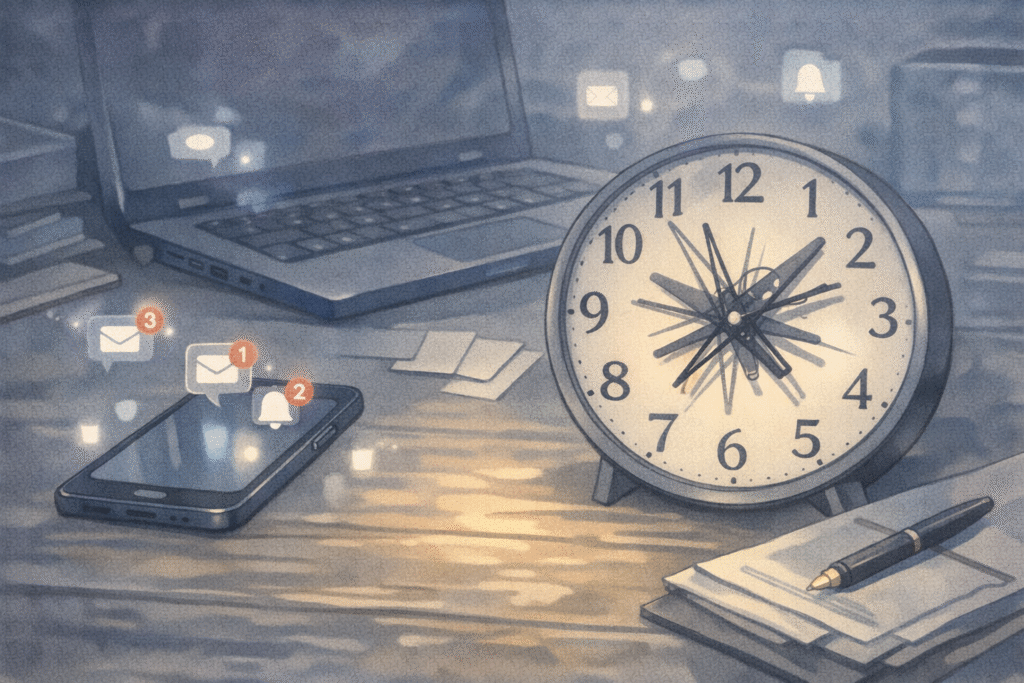
The time we experience is not the same as the time measured by clocks.
Psychologists distinguish between physical time and perceived time.
An hour spent watching a favorite movie can pass in an instant, while ten minutes of worrying about unfinished tasks can feel unbearably long.
1.2 Why Modern Time Feels Fragmented
Our sense of time is shaped by emotion, attention, and environment.
Constant notifications, emails, messages, and social media alerts repeatedly interrupt our focus.
Even without completing many tasks, our attention becomes fragmented.
As a result, the day feels scattered, unproductive, and exhausting — leaving us with the impression that we were “busy” all along.
2. Saying “I’m Busy” as Social Self-Defense
2.1 Busyness as a Social Signal
When asked, “How are you doing?”, many people instinctively answer, “I’m busy.”
This response is not just a factual update.
Psychologists describe it as a form of social self-presentation.

2.2 When Busyness Equals Competence
In competitive societies, busyness is often equated with usefulness and capability.
To appear busy is to appear productive, valuable, and responsible.
Conversely, appearing relaxed or unoccupied can feel risky — as if it signals laziness or irrelevance. Over time, we internalize this script and begin to believe we are busy even when we are not.
3. More “Shoulds” Than Actual Tasks
3.1 The Pressure to Always Be Doing Something
We may not have many urgent tasks, but our minds are filled with things we feel we should be doing.
Scrolling through social media can trigger thoughts like:
“Everyone else is exercising.”
“Everyone else is improving themselves.”
“I should be doing more.”
3.2 FOMO and Constant Mental Tension
This pressure is closely linked to FOMO (Fear of Missing Out).
Even without taking action, we remain mentally alert, comparing ourselves and anticipating future demands.
The result is a constant state of tension — a feeling of being chased by time without actually moving.
4. “Time Is Money”: Addiction to Efficiency
4.1 When Every Moment Must Be Useful
From an early age, many of us learn that time should never be wasted.
This belief, rooted in industrial and capitalist values, turns time into a resource that must always generate value.
Even rest is evaluated:
“Is this productive rest?”
“Is this helping me improve?”
4.2 When Efficiency Becomes Exhausting
An efficiency-centered view of time makes stillness uncomfortable.
It keeps us asking, “Am I doing enough?” — a question that never truly ends.
In this way, busyness becomes less about tasks and more about identity.
Conclusion: Recovering Slowness

Feeling busy is not simply a scheduling problem.
It is a psychological state shaped by social expectations, time culture, and self-worth.
The solution, therefore, is not only to reduce tasks, but to rethink how we relate to time.
Allowing moments where nothing needs to be done.
Accepting rest as a meaningful outcome.
Remembering that moving slowly does not mean falling behind.
These small shifts can loosen the grip of constant busyness.
If you feel busy all the time, today, being slow is allowed.
Related Reading
The social construction of productivity is analyzed in Sleep: A Fundamental Human Right or a Tool for Productivity?Sleep: A Fundamental Human Right or a Tool for Productivity?, which challenges the moralization of efficiency.
A structural perspective on modern comparison culture appears in How Social Media Amplifies Feelings of Lack and ComparisonHow Social Media Amplifies Feelings of Lack and Comparison, highlighting how digital environments intensify temporal anxiety.
References
1.Rosa, H. (2013). Social Acceleration: A New Theory of Modernity. New York: Columbia University Press.
Rosa analyzes how modern societies experience constant acceleration, showing that feelings of time pressure are rooted in structural and cultural change rather than individual failure.
2.Southerton, D. (2009). “Re-ordering Temporal Rhythms: Coordinating Daily Practices in the UK.” Time & Society, 18(1), 91–113.
This study examines how social scheduling and fragmented daily rhythms contribute to chronic feelings of busyness and time scarcity.
3.Wajcman, J. (2015). Pressed for Time: The Acceleration of Life in Digital Capitalism. Chicago: University of Chicago Press.
Wajcman explores how digital technologies reshape attention and time perception, explaining why modern individuals feel increasingly busy despite technological convenience.