
Equality, Freedom, and the Hidden Paradox of Ideal Worlds
Imagine a society where no one owns property,
everyone works,
and no one goes hungry.
There is no extreme wealth—
but also no poverty.
It sounds like a dream.
But what if such equality comes at a cost?
In Utopia (1516), Thomas More presents a world that appears perfectly ordered—
yet quietly raises a troubling question:
Can a society be truly ideal if freedom is limited?
1. A Serious Proposal—or a Subtle Satire?
Thomas More’s Utopia was written in a time of deep social inequality,
political corruption, and widespread poverty.
Rather than directly criticizing his society,
More imagined an alternative world—
not as it was, but as it could be.
In this sense, Utopia is both a serious proposal
and a subtle satire.
It invites us to reflect on reality
by presenting something that seems better—
but may not be entirely desirable.
2. Equality as Order—and as Control

In Utopia, private property does not exist.
Citizens work fixed hours,
wear similar clothing,
and share resources equally.
At first glance, this appears to eliminate inequality.
Yet the same system imposes strict regulation:
Travel requires permission.
Daily life follows uniform routines.
Privacy is nearly nonexistent.
This raises a difficult question:
Is equality being achieved—
or is individuality being erased?
3. The Legacy of Utopian Thinking
More’s vision did not remain in the 16th century.
Modern societies continue to pursue forms of “utopian” design:
- Welfare states aiming at social equality
- Smart cities optimizing efficiency and order
- Planned communities seeking harmony
Each reflects a desire to create a better world.
But they also reveal the same tension:
How much control is acceptable
in the pursuit of collective well-being?
4. When Ideal Becomes Oppressive
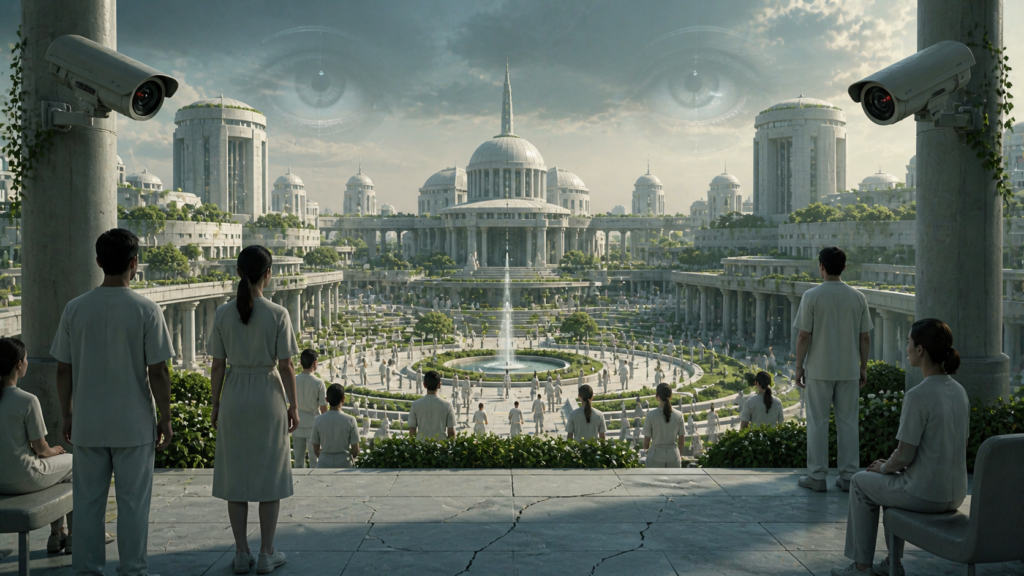
History has shown that ideal visions
can sometimes lead to unintended consequences.
Systems designed to create equality
may evolve into rigid structures of control.
When uniformity replaces diversity,
and stability overrides freedom,
an ideal society can begin to resemble its opposite.
In this sense, Utopia may not only describe a dream—
but also warn against it.
Conclusion: A Question, Not an Answer

Thomas More’s Utopia offers no final answer.
Instead, it presents a paradox:
A world that appears just—
yet feels constrained.
Perhaps its true purpose is not to define perfection,
but to provoke reflection.
What do we value more—
equality or freedom?
And can we ever have both without compromise?
Utopia remains powerful
not because it solves the problem of society—
but because it forces us to keep questioning it.
A Question for Readers
If a society could guarantee equality, stability, and security for everyone—
but required you to give up some personal freedom—
would you accept it?
Or is freedom something that cannot be traded,
no matter how perfect the system appears?
Related Reading
The dream of a perfectly ordered society often hides deeper questions about power and control.
In Are Cities Symbols of Progress—or Spaces of Inequality?, the structure of modern urban life reveals how systems designed for efficiency can also reinforce hidden hierarchies.
At the same time, the expansion of technological governance raises new concerns about freedom.
In How Much Surveillance Is Too Much?, the rise of data-driven monitoring shows how control can emerge not through force—but through systems we willingly accept.
The vision of a perfect society is closely tied to humanity’s enduring fascination with the impossible,
as explored in Dreams, Utopia, and the Impossible,
which examines why humans continue to pursue ideals they know cannot be fully realized.
References
More, T. (1516/2009). *Utopia.* Cambridge: Cambridge University Press.
→ This authoritative edition presents More’s original text with modern annotations, helping readers understand both the ideal vision and its underlying ambiguities.
Skinner, Q. (2000). *Thomas More: A Very Short Introduction.* Oxford: Oxford University Press.
→ Skinner situates *Utopia* within its historical and political context, showing how it functions as both a critique of power and a humanist reflection on society.
Surtz, E. L. (1957). *The Praise of Wisdom: A Commentary on Thomas More’s Utopia.* Chicago: Loyola University Press.
→ This classic commentary interprets *Utopia* through philosophical and theological traditions, highlighting tensions between idealism and moral constraint.
Claeys, G. (2011). *Searching for Utopia: The History of an Idea.* London: Thames & Hudson.
→ Claeys traces the evolution of utopian thought from More to modern political systems, revealing how ideal societies can inspire both reform and control.
Turner, C. (2010). Thomas More’s Utopia and the Legacy of Dystopia. *Renaissance and Reformation, 33*(3).
→ This study examines how *Utopia* influenced later dystopian works, suggesting that ideal societies often contain the seeds of their own critique.