Tag: Urban Sociology

  • Cities of Memory—or Cities of Forgetting?

    Cities of Memory—or Cities of Forgetting?

    How Can We Balance Development and Preservation?

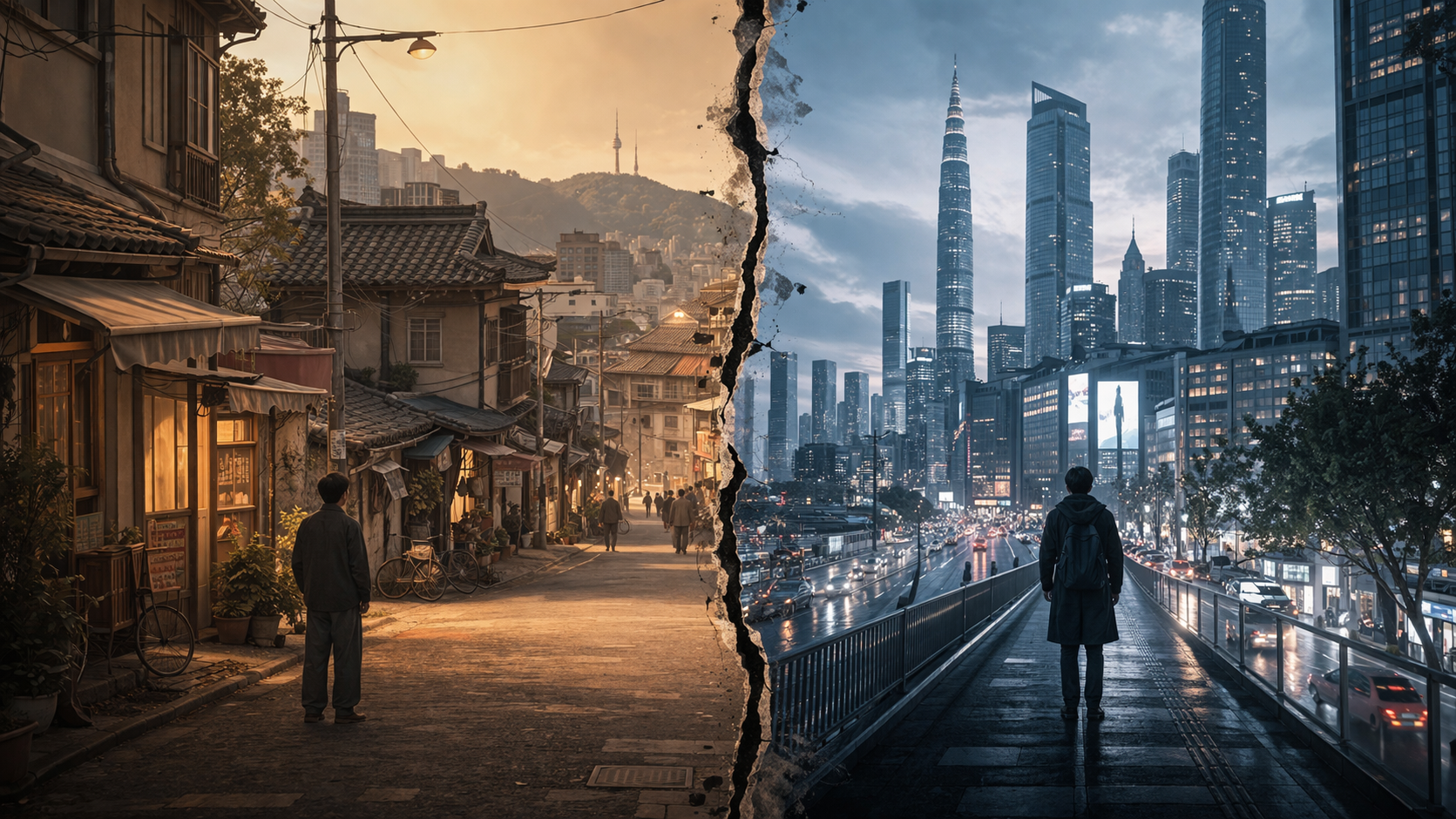
    Have you ever returned to a place you once knew—
    only to find it completely changed?

    A familiar street replaced by glass towers.
    A small shop gone without a trace.

    In moments like these, we are not just losing buildings.
    We are losing pieces of memory.

    This raises a deeper question:

    Are cities meant to preserve our past—
    or to constantly erase and rebuild it?


    1. Cities as Spaces of Memory
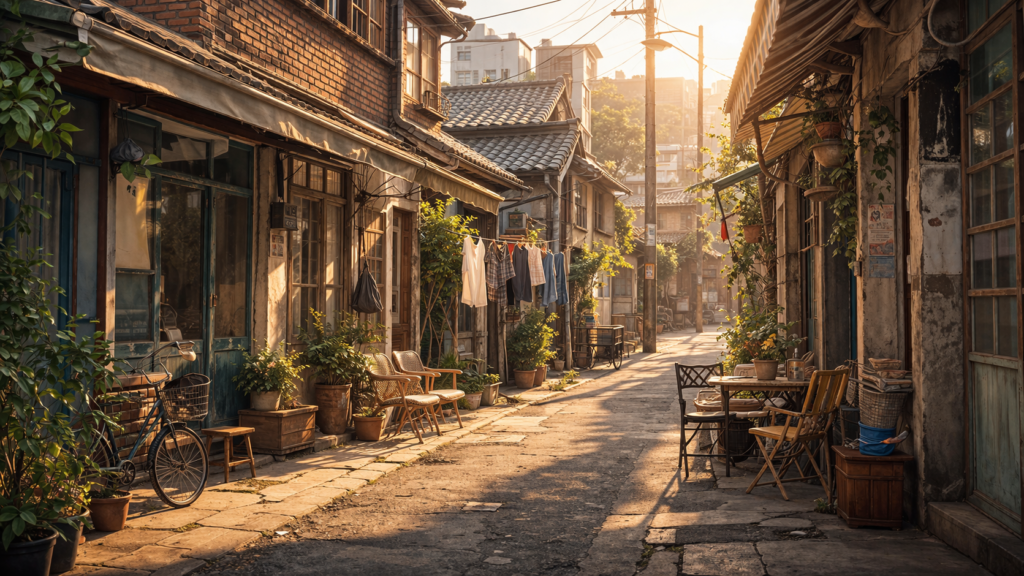
    old alley with traces of daily life

    Cities are not just collections of buildings and infrastructure.
    They are living archives of human experience.

    Old alleys, schools, cinemas, factories, and even faded signs—
    these are not simply outdated structures.

    They are carriers of collective memory.

    Yet, across the world, such places are disappearing rapidly.
    Urban redevelopment often replaces them with standardized spaces—
    efficient, modern, but emotionally detached.


    2. Why Memory and Development Collide

    The disappearance of historical spaces is not due to neglect alone.
    It is the result of a deeper conflict between two values.

    2.1. Development Logic

    Cities must grow—accommodating population, economy, and infrastructure.
    Old structures are often seen as inefficient or unprofitable.

    2.2. Preservation Logic

    At the same time, these spaces hold identity, history, and emotional meaning.
    They are not just physical assets—but cultural ones.

    This conflict reflects a fundamental question:
    What role should the past play in the future of cities?
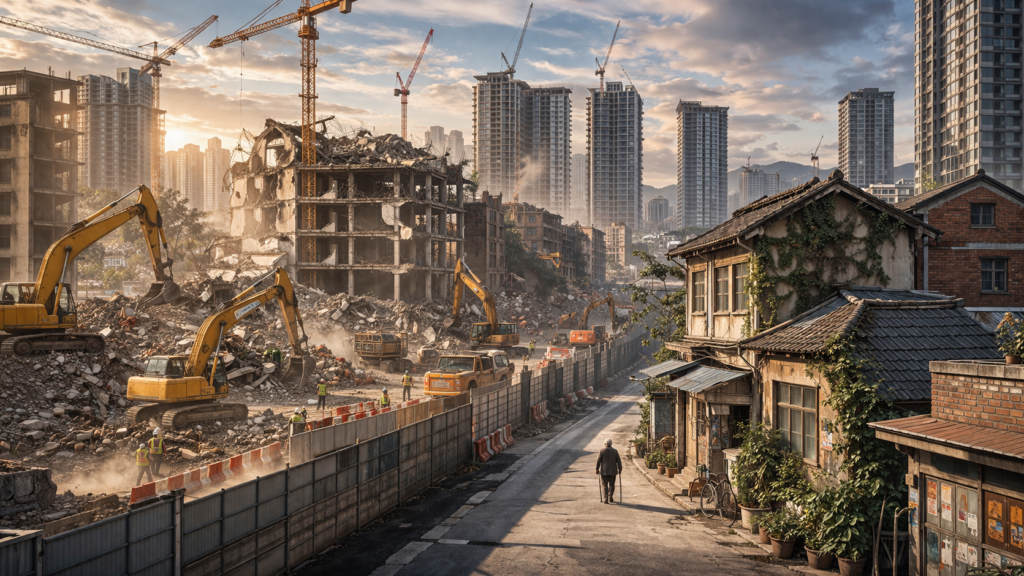
    city redevelopment conflict scene

    3. Case Studies: Conflict in Practice

    3.1. Seoul: Cheonggyecheon & Sewoon Arcade

    The restoration of Cheonggyecheon transformed the city into a greener, pedestrian-friendly space.
    Yet it also displaced long-standing communities and local economies.

    Sewoon Arcade, once a symbol of industrial modernization,
    faced repeated threats of demolition before partial preservation efforts emerged.

    3.2. Kyoto: Preservation Through Consensus

    Kyoto represents a different approach.
    Strict building regulations, height limits, and cultural protections
    have allowed the city to maintain its historical identity.

    This reflects a strong social agreement:
    the past must coexist with the future.


    4. Can Development and Preservation Coexist?

    Development and preservation are not necessarily opposites.

    Cities can evolve without erasing their past.

    The concept of “places of memory”, introduced by Pierre Nora,
    suggests that physical spaces hold emotional and cultural significance.

    Development, therefore, should not eliminate memory—
    but reinterpret and integrate it.


    5. Toward a Balanced Future

    Preserving urban memory requires more than nostalgia.

    It requires:

    • Institutional systems to evaluate historical value
    • Citizen participation in planning
    • Cultural reinterpretation through art and storytelling
    • Hybrid models combining preservation and development

    Cities must be designed not only for efficiency—
    but for meaning.


    Conclusion
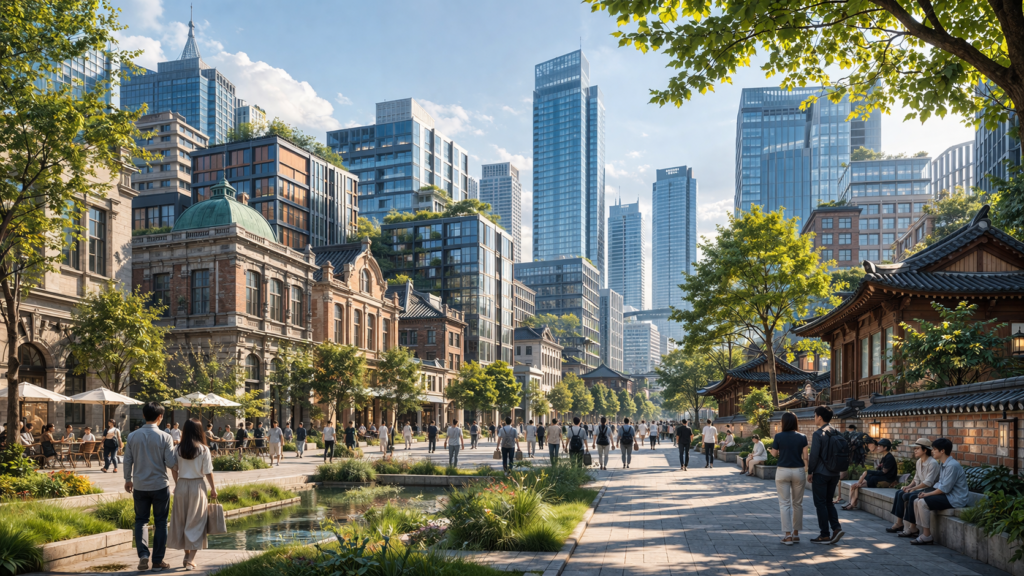
    modern and historic buildings coexist

    Cities are always changing.
    But how they change matters.

    When a place disappears, we do not just lose space—
    we lose memory, relationships, and identity.

    A city that preserves memory becomes more than livable—
    it becomes meaningful.

    So we are left with a choice:

    Will our cities remember—
    or will they forget?

    A Question for Readers

    Have you ever lost a place that mattered to you—
    and felt like a part of your memory disappeared with it?


    Related Reading

    The tension between preservation and change becomes even more complex when we consider how societies interpret the past.
    In Is There a Single Historical Truth—or Many Narratives?, the idea of collective memory reveals how different groups construct and contest the meaning of history.

    At the same time, the fragility of memory itself is further explored in If Memory Can Be Manipulated, What Can We Really Trust?, where the instability of personal and collective memory raises deeper questions about what should be preserved—and why.

    References

    1. Nora, P. (1996). Realms of Memory: Rethinking the French Past. New York: Columbia University Press.
      → This work introduces the concept of “sites of memory,” explaining how physical places carry collective emotional and historical meaning. It provides a foundational framework for understanding cities as spaces where memory is preserved and constructed.
    2. Hayden, D. (1997). The Power of Place: Urban Landscapes as Public History. Cambridge, MA: MIT Press.
      → This book explores how urban spaces function as living histories, especially for marginalized communities. It highlights the importance of incorporating diverse social memories into city planning and development.
    3. Zukin, S. (1982). Loft Living: Culture and Capital in Urban Change. Baltimore: Johns Hopkins University Press.
      → Zukin analyzes how urban redevelopment and gentrification transform cultural spaces into economic assets. It critically examines how such processes often erase historical traces while creating new forms of consumption.
    4. Huyssen, A. (2003). Present Pasts: Urban Palimpsests and the Politics of Memory. Stanford: Stanford University Press.
      → This work conceptualizes cities as layered spaces where past and present coexist and interact. It emphasizes how memory is not static but constantly reshaped through political and cultural forces.
    5. Lynch, K. (1960). The Image of the City. Cambridge, MA: MIT Press.
      → Lynch introduces the idea of the “mental image” of the city, showing how individuals perceive and remember urban environments. His framework connects spatial structure with human experience and urban identity.
  • Are Cities Symbols of Progress—or Spaces of Inequality?

    Are Cities Symbols of Progress—or Spaces of Inequality?

    Urban Growth, Power, and the Hidden Divides of Modern Life

    Cities have long been celebrated as the pinnacle of human civilization.

    From the Industrial Revolution to today’s smart cities, urbanization has brought economic growth, cultural diversity, technological innovation, and expanded opportunities.

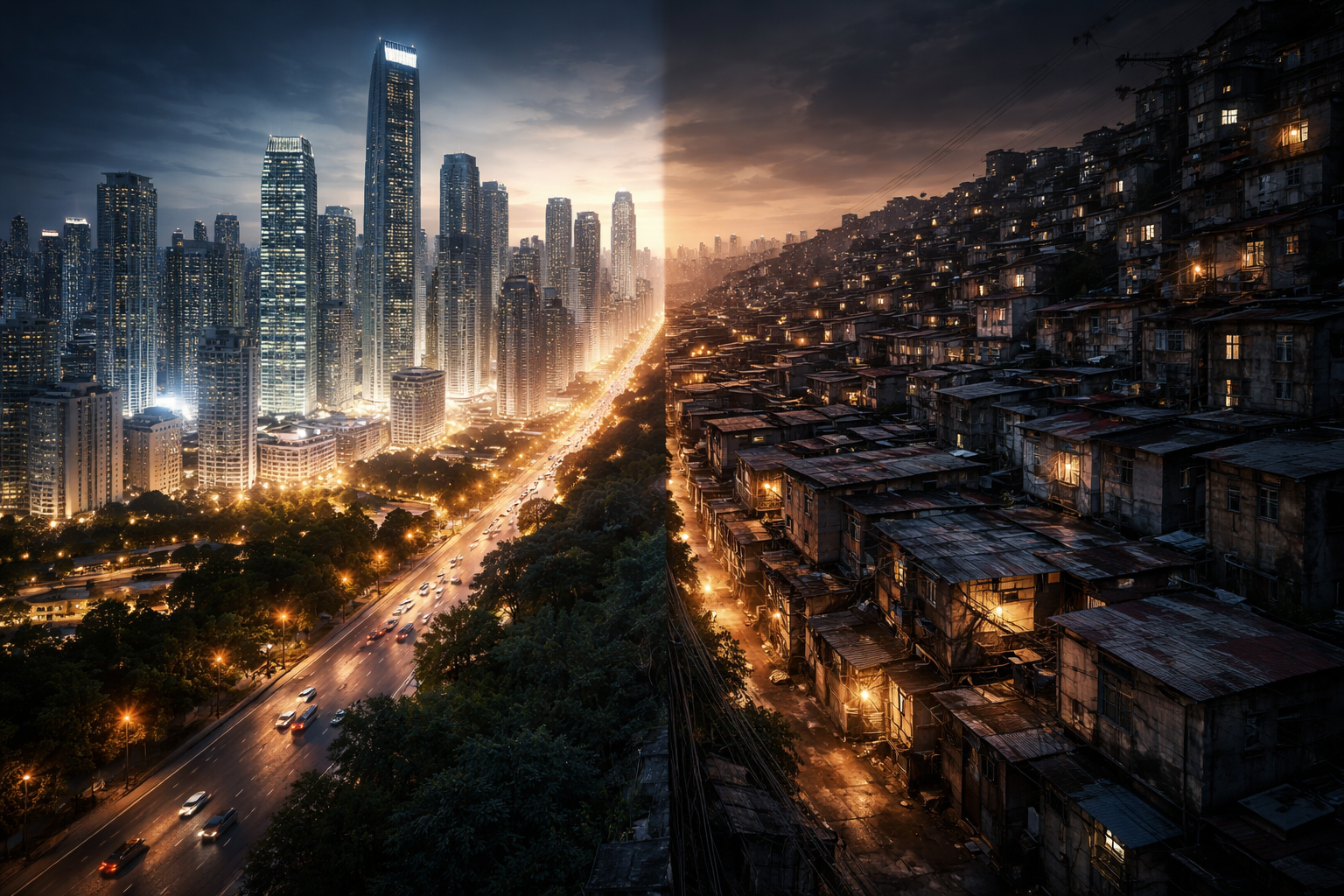
    Skylines filled with glass towers and networks of digital infrastructure present cities as symbols of progress and the future.

    But beneath this image lies a more complex reality.

    Do cities truly benefit everyone equally—
    or do they also produce new forms of inequality and exclusion?


    1. Cities as Engines of Progress

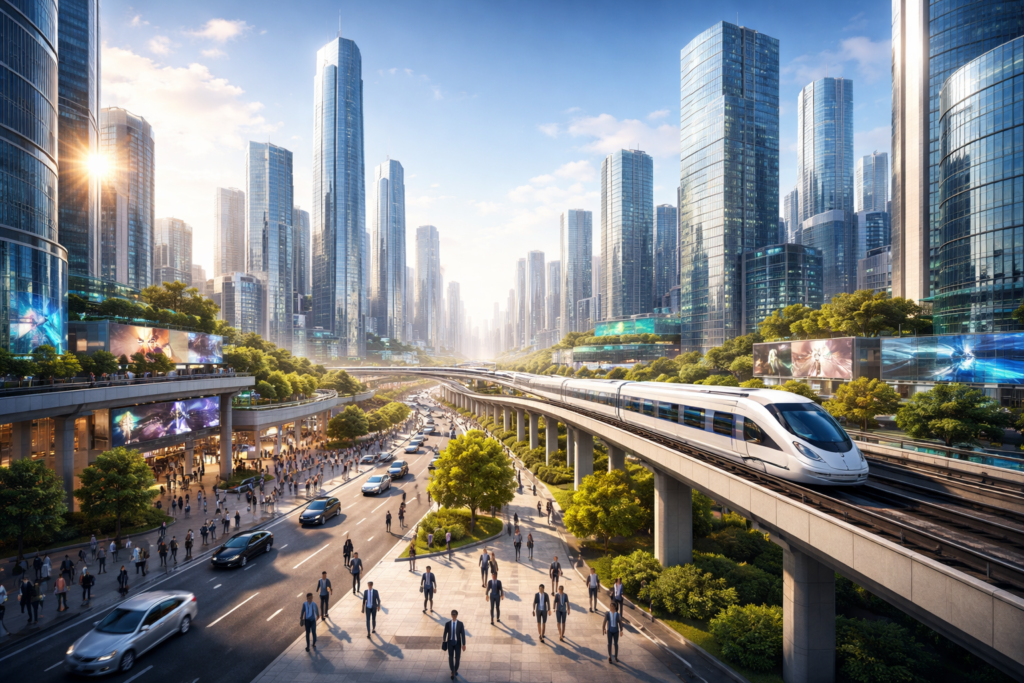
    modern city representing progress and growth

    Urbanization has historically been associated with advancement.

    Cities concentrate knowledge, talent, and capital, enabling innovation and economic growth. As urban economist Edward Glaeser argues, cities are places where ideas collide, interact, and evolve, making them powerful drivers of human development.

    Urban environments also create opportunities:

    • Job creation and economic mobility
    • Access to education and healthcare
    • Cultural exchange and diversity
    • Infrastructure for transportation and communication

    From this perspective, cities are not just places to live—they are platforms for progress.


    2. The Other Face of Urbanization: Inequality and Exclusion

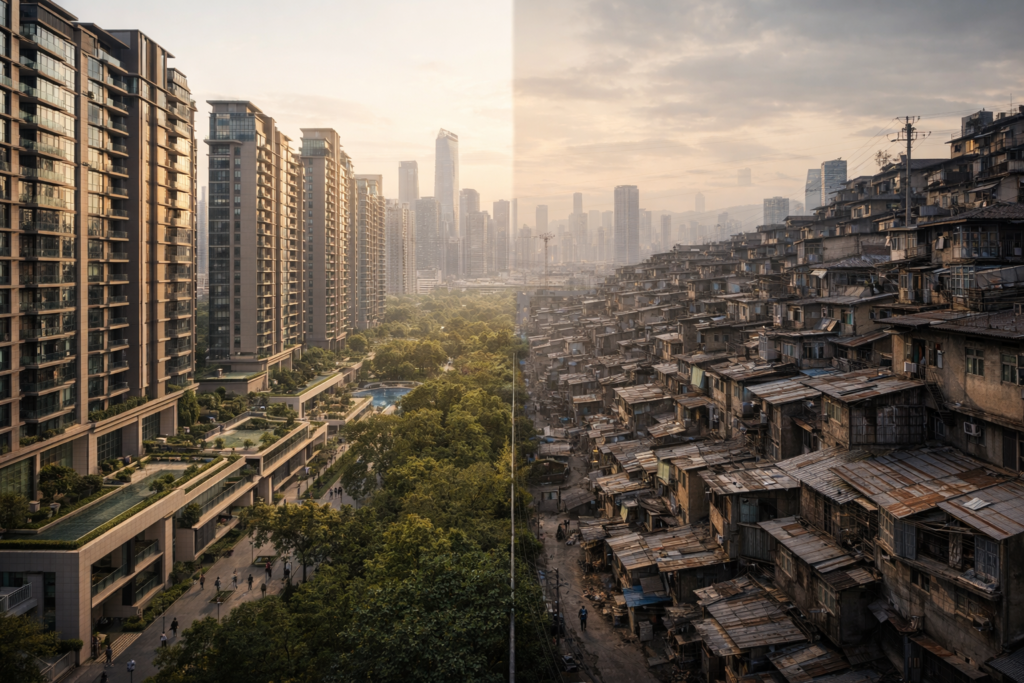
    urban inequality between rich and poor areas

    Yet urbanization also produces spatial inequality.

    As cities expand, wealth and resources tend to concentrate in certain areas, while marginalized populations are pushed to the periphery. This process, often described as the spatialization of inequality, creates invisible boundaries within cities.

    Historically, cities such as London, Paris, and New York have shown patterns of spatial segregation, where socioeconomic status is closely tied to geography.

    The sociologist Henri Lefebvre argued that urban space is not neutral—it is shaped by power, capital, and social relations.

    In this sense, cities are not only physical spaces but also political and economic structures that determine who belongs—and who does not.


    3. A Global Pattern: Uneven Cities Everywhere

    This phenomenon is not limited to one country.

    Across the world, cities reveal stark contrasts:

    • In Rio de Janeiro, luxury high-rises stand next to sprawling favelas
    • In Mumbai, financial districts coexist with some of the largest slums in the world
    • In Johannesburg, economic inequality is deeply embedded in urban geography

    According to UN-Habitat, over one billion people worldwide live in informal settlements, and this number continues to rise.

    Cities, therefore, are not only engines of growth—they are also sites where inequality becomes visible and intensified.


    4. A Case Study: Seoul as a Divided City

    The dynamics of urban inequality can also be seen in Seoul, a global megacity often associated with rapid modernization and technological advancement.

    Since the 1960s, Seoul has transformed into a highly developed urban center. However, this growth has also produced internal divides.

    The contrast between Gangnam and other districts reflects how urban space can embody social hierarchy:

    • Concentration of wealth, education, and infrastructure in certain areas
    • Disparities in housing, public services, and opportunities
    • The emergence of “address-based inequality,” where location shapes life chances

    This pattern is not unique to Seoul—it mirrors similar dynamics in cities around the world.


    5. Rethinking the City: Toward Inclusive Urban Futures

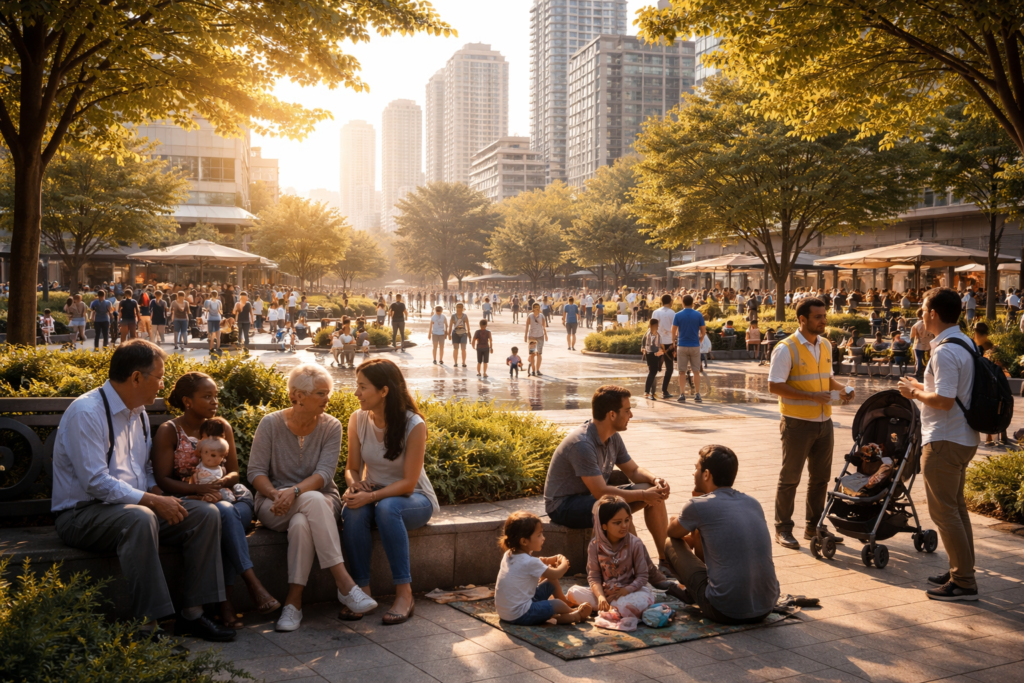
    In response to these challenges, scholars and policymakers are increasingly advocating for the concept of the inclusive city.

    An inclusive city is not defined solely by infrastructure or economic output, but by how well it supports the lives of all its residents.

    Key approaches include:

    • Expanding affordable housing and reducing spatial inequality
    • Ensuring equitable access to education, healthcare, and public services
    • Promoting participatory urban governance
    • Preserving cultural diversity and community identity

    These efforts aim to transform cities from spaces of division into spaces of shared belonging.

    inclusive city with diverse community

    Conclusion: Who Is the City For?

    Cities can indeed be symbols of progress.

    But progress only matters when it is shared.

    When cities become spaces of exclusion, they risk turning into showcases of wealth rather than environments for human life.

    The essential question remains:

    Who is the city built for?

    Urban development must go beyond growth—it must embrace justice, equity, and inclusion.

    Only then can cities fulfill their promise—not just as centers of progress, but as spaces where diverse human lives can truly coexist.


    💬 A Question for Readers

    Do you see your city as a place of opportunity—
    or as a space where inequality is quietly built into everyday life?

    Related Reading

    The structural foundations of inequality in modern societies are further explored in Is There a Single Historical Truth, or Many Narratives?, where the role of power, perspective, and interpretation reveals how dominant narratives can shape not only our understanding of the past, but also the inequalities embedded in present social structures.

    At a more individual and psychological level, the lived experience of inequality is reflected in Am I Falling Behind? — How Comparison Distorts Our Sense of Time, where everyday perceptions of success and failure demonstrate how invisible hierarchies influence human emotion, motivation, and self-understanding.


    References

    1. Harvey, D. (2012). Rebel Cities: From the Right to the City to the Urban Revolution. London: Verso.
      Harvey analyzes how capitalist urban development shapes inequality and social division, introducing the concept of the “right to the city” as a form of resistance and democratic claim over urban space.

    1. Glaeser, E. (2011). Triumph of the City. New York: Penguin Press.
      Glaeser presents cities as engines of innovation and economic growth, while also addressing the challenges of inequality and the need for effective urban policy.

    1. Florida, R. (2017). The New Urban Crisis. New York: Basic Books.
      Florida examines how the concentration of the creative class has intensified inequality within cities, revealing the paradox of urban success and social fragmentation.

    1. Jacobs, J. (1961). The Death and Life of Great American Cities. New York: Random House.
      Jacobs critiques top-down urban planning and emphasizes the importance of community, diversity, and human-scale urban environments.

    1. Davis, M. (2006). Planet of Slums. London: Verso.
      Davis exposes the global expansion of slums and the structural inequalities embedded in rapid urbanization, particularly in developing regions.

  • Why Elevator Silence Feels So Uncomfortable: Unspoken Social Rules

    Morning rush hour.
    An elevator packed with strangers.

    No one speaks, yet the space feels strangely tense.
    A sigh, a cough, or the sound of a phone screen lighting up subtly shifts the atmosphere. Someone checks their phone, and others instinctively glance away — or glance too much.

    The elevator is small and quiet, but rarely comfortable.

    Why does such a brief, silent moment feel so awkward?


    Awkward silence among strangers in an elevator

    1. Physical Closeness and Psychological Distance

    1.1 When Personal Space Disappears

    Elevators force strangers into close physical proximity within a confined space. According to psychological research on personal space, people feel most comfortable when a certain distance from others is maintained.

    In elevators, this distance collapses.

    When physical closeness is not accompanied by social interaction, the brain registers tension. We are close to others, yet socially disconnected — a combination that easily produces discomfort.

    1.2 The Brain Never Stops Noticing Others

    Even in silence, our minds continuously monitor those around us. When someone stands too close, we may feel irritation or defensiveness without knowing why.

    Elevators create a paradox: physical intimacy without emotional familiarity. This imbalance places quiet strain on both body and mind.

    Lack of personal space in a crowded elevator

    2. When Silence Becomes a Rule

    2.1 Silence as an Unspoken Norm

    Most people do not speak in elevators.
    Over time, this absence of speech becomes an implicit rule.

    Sociologist Erving Goffman described such patterns as “interaction frames” — shared expectations that guide behavior in specific situations.

    2.2 Breaking the Frame

    In elevators, silence is treated as politeness.
    Someone who speaks loudly on the phone or initiates casual conversation is often perceived as violating the situation’s frame.

    The silence, then, is not neutral.
    It is a collectively maintained form of self-regulation and mutual monitoring.


    3. A Space of Nonverbal Communication

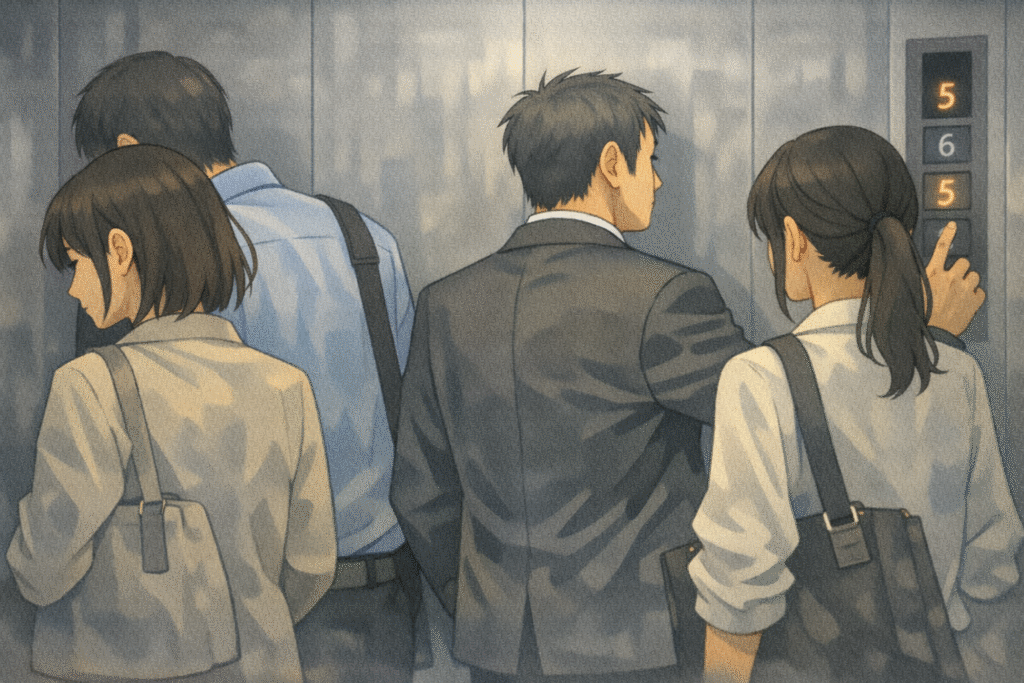
    Nonverbal social rules inside an elevator

    3.1 Communication Without Words

    Interestingly, elevators are full of communication — just not verbal.

    A brief glance
    A slight turn of the body toward the wall
    The careful extension of a hand to press a button
    A small nod to someone holding the door

    3.2 Cooperation Through Gesture

    These gestures help reduce tension and signal cooperation.
    Because words are absent, nonverbal actions become more visible — and more meaningful.

    At the same time, this heightened sensitivity makes the space vulnerable to awkwardness. Small missteps feel amplified.


    4. Why Elevators Feel Especially Intense

    4.1 The Pressure of No Escape

    In cafés or parks, we can leave whenever we want.
    Elevators offer no such freedom.

    Once inside, we must wait until the doors open again.

    4.2 Silence Under Confinement

    This temporary lack of exit heightens awareness.
    Sounds feel louder. Movements feel heavier. Silence feels thicker.

    The discomfort of elevator silence is not just about quiet — it is about being enclosed in a shared social situation with no way out.


    Related Reading

    The psychological mechanisms behind self-perception and social visibility are further explored in TThe Sociology of Selfieshe Sociology of Selfies, where digital identity and performative presence are analyzed.
    From a structural and philosophical perspective, TThe Age of Overexposure: Why Do We Turn Ourselves into Products?he Age of Overexposure: Why Do We Turn Ourselves into Products? expands this discussion by examining how social systems amplify the feeling of constant exposure.

    Conclusion

    The silence in elevators feels uncomfortable because it is not empty.
    It is filled with social rules, psychological tension, and silent coordination.

    Within that small space, we constantly adjust ourselves — our gaze, posture, and presence — in response to others, even without speaking.

    If you feel awkward in an elevator, it is not a personal flaw.
    It is a shared response to a space governed by unspoken norms.

    The discomfort is not yours alone.
    It belongs to all of us, quietly standing together in silence.


    References

    1.Goffman, E. (1959). The Presentation of Self in Everyday Life. New York: Anchor Books.
    Goffman analyzes how individuals manage impressions in social settings. Elevator silence can be understood as a form of “front-stage” behavior, where individuals carefully regulate their actions under the gaze of others.

    2.Hall, E. T. (1966). The Hidden Dimension. New York: Doubleday.
    This classic work introduces the concept of proxemics, explaining how physical distance influences psychological comfort. It is essential for understanding discomfort in confined spaces like elevators.

    3.Argyle, M. (1988). Bodily Communication (2nd ed.). London: Methuen.
    Argyle explores nonverbal communication, offering insight into how gestures, posture, and eye contact function as silent social signals in situations where speech is absent.