Language as the Boundary of the Human World

Language has long been considered one of the defining features of humanity.
Through language, we articulate thoughts, interpret reality, and connect with others.
Yet language is never complete. Subtle emotions, unconscious impulses, and ineffable inner experiences often remain beyond words.
Today’s artificial intelligence systems process and generate human language with astonishing fluency.
They answer questions, compose essays, and simulate dialogue in ways that appear remarkably human.
This raises a profound question:
If AI were to perfectly understand human language, could it also share our thoughts?
Or does something beyond language remain uniquely human?
1. Language and Thought: Are They the Same?
1.1 Wittgenstein and the Limits of Expression
The philosopher Ludwig Wittgenstein famously wrote,
“The limits of my language mean the limits of my world.”
This statement suggests that language shapes the boundaries of thought.
If this is true, then a system that fully understands language might also grasp the structure of thought itself.
1.2 Thought Beyond Words
However, not all thinking is propositional or linguistic.
Intuition, sensory awareness, artistic inspiration, and emotional experience often arise before or beyond verbal formulation.
Thought may use language—but it is not exhausted by it.
2. Meaning, Context, and the Depth of Understanding
2.1 Statistical Language vs. Lived Meaning
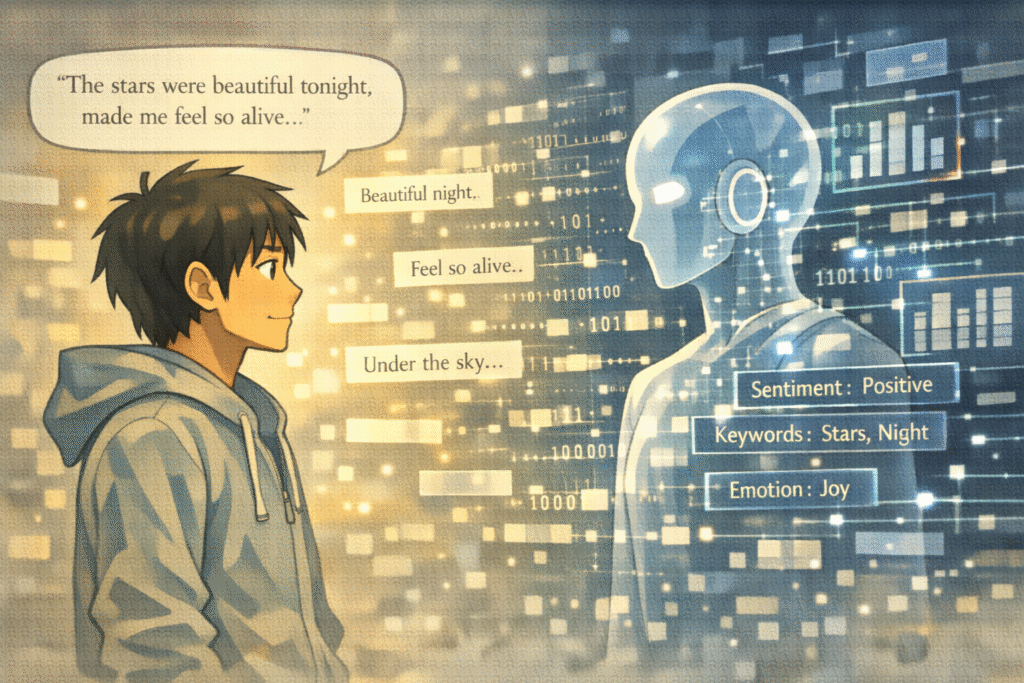
AI models interpret language through statistical and probabilistic patterns.
They analyze correlations, predict likely continuations, and simulate coherence.
Yet human meaning is shaped by context, culture, memory, and embodied experience.
Consider the phrase “I’m fine.”
Depending on tone, situation, and relationship, it may express reassurance, anger, exhaustion, or resignation.
True understanding requires more than syntactic accuracy—it demands lived context.
2.2 The Symbol Grounding Problem
Philosopher Stevan Harnad described the symbol grounding problem:
Can a system manipulate symbols without ever grounding them in real-world experience?
An AI system may process the word “pain,” but does it experience pain?
If understanding is detached from embodiment, can it be called understanding at all?
3. The Possibility of Shared Thought
3.1 Language as Translation
Language functions as a translation tool for thought.
If AI were to perfectly interpret linguistic structures, humans might gain new ways of expressing inner states with greater precision.
Combined with technologies such as brain-computer interfaces, even pre-verbal cognitive patterns might someday be decoded.
This suggests the theoretical possibility of more direct cognitive exchange.
3.2 The Risk to Subjectivity
Yet the idea of shared thought carries ethical risks.
If our most private mental states become interpretable by machines, what happens to autonomy and privacy?
Does shared cognition enhance freedom—or erode individuality?
The dream of perfect understanding may also become a tool of surveillance.
4. Consciousness and the Hard Problem
Philosopher David Chalmers distinguishes between explaining cognitive functions and explaining conscious experience.
AI may replicate functional language use.
But does it possess subjective experience—what philosophers call qualia?
Understanding language structurally does not necessarily mean sharing inner awareness.
A system may simulate thought without having a first-person perspective.
Conclusion: Beyond Language

Even if AI someday achieves flawless linguistic comprehension, that alone does not guarantee shared consciousness.
Language is a window into thought—but not the entirety of it.
As AI deepens its linguistic capabilities, we may be forced to confront a deeper question:
Perhaps the real issue is not whether AI can understand us.
Rather, it is whether we are prepared to fully express ourselves through language.
The more clearly AI mirrors our words, the more urgently we must ask what remains unspoken.
Related Reading
The philosophical tension between human agency and algorithmic systems is further examined in Automation of Politics: Can Democracy Survive AI Governance?, where AI’s role in collective decision-making is debated.
For a more personal and experiential dimension, The Standardization of Experience reflects on how digital mediation reshapes individual autonomy.
References
- Philosophical Investigations
Wittgenstein, L. (1953/2009). Philosophical Investigations. Wiley-Blackwell.
→ Explores how language shapes meaning and thought, forming the foundation for debates about linguistic limits and cognition. - The Conscious Mind
Chalmers, D. (1996). The Conscious Mind. Oxford University Press.
→ Introduces the “hard problem” of consciousness, distinguishing between functional explanation and subjective experience. - The Language Instinct
Pinker, S. (1994). The Language Instinct. HarperCollins.
→ Examines the cognitive structures underlying human language, offering insight into what AI models replicate—and what they may lack. - The Symbol Grounding Problem
Harnad, S. (1990). “The Symbol Grounding Problem.” Physica D, 42(1–3), 335–346.
→ Argues that symbol manipulation alone does not constitute semantic understanding. - Climbing towards NLU
Bender, E. M., & Koller, A. (2020). “Climbing towards NLU.” Proceedings of ACL.
→ Critically evaluates claims that language models truly “understand” meaning.