Why do we feel compelled to show ourselves in order to exist?
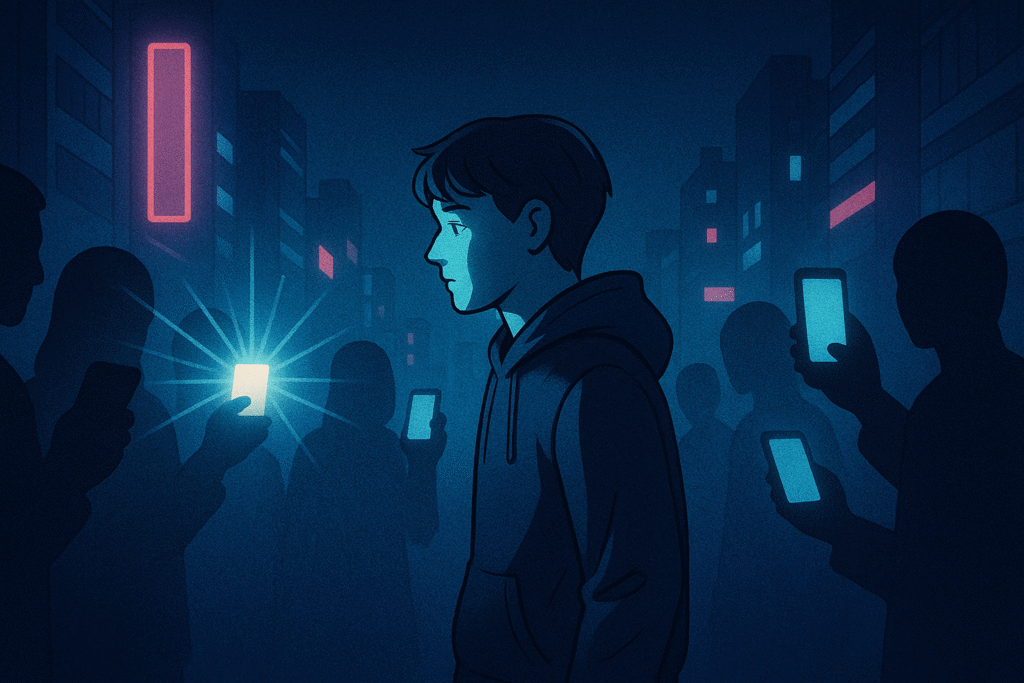
1. “If You Are Not Seen, You Feel as If You Do Not Exist”
Under the constant flash of social media, the self gradually becomes an image.
And that image, in turn, begins to define who we are.
There is a scene I often notice in cafés.
Two friends sit across from each other, yet they spend more time facing their camera screens than one another.
They adjust facial angles, background lighting, and filters—sometimes for several minutes.
Once the photo is posted, their eyes immediately turn to the numbers:
likes, comments, reactions.
Instead of conversation, the space between them fills with unspoken questions:
How do I look?
What will people think?
Our era whispers to us relentlessly:
If you are not visible, you do not exist.
If you are not visible, you are falling behind.
If you are not visible, you are no one.
At what point did self-expression stop being expression—and become self-marketing?
2. Why Does Social Media Turn Us into “Products”?
2.1 The Attention Economy: When Attention Becomes Currency
TikTok, Instagram, Reels, YouTube Shorts—
all compete for momentary attention.
In this system, we do not only sell content.
We sell ourselves along with it.
Likes resemble price tags.
Comments feel like consumer feedback.
Follower counts begin to look like brand value.
The self becomes measurable.
2.2 Self-Branding: Packaging the Self
“Knowing how to present yourself” is now treated as a skill—and an asset.
The problem is not presentation itself,
but the fact that the package increasingly matters more than the person inside it.
What was once a tool becomes a standard of worth.
2.3 Algorithms and the Logic of Exposure
Algorithms are simple:
The more stimulating something is, the more it spreads.
The more it spreads, the more it is rewarded.
Social media quietly teaches us one rule:
Reveal a little more. Then you will be remembered.
3. Why Do We Consume One Another Like Products?
3.1 Byung-Chul Han: The Performance Society
In The Burnout Society, Byung-Chul Han argues that modern individuals constantly turn themselves into projects—measured by performance and visibility.
As a result, relationships shift.
They are no longer about encountering a person,
but about consuming outcomes.
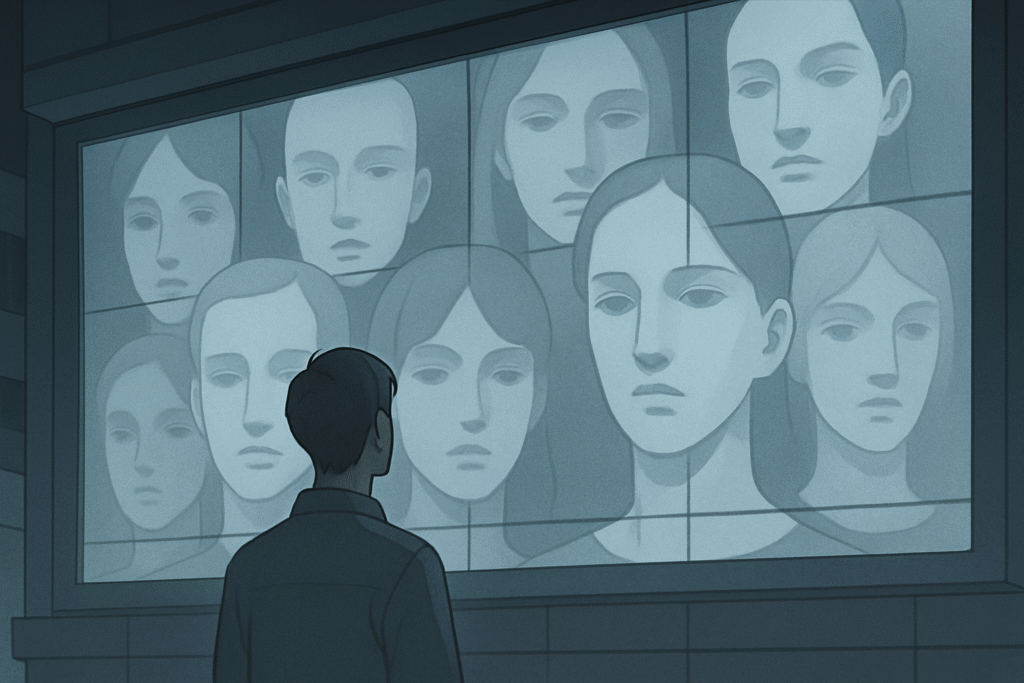
We scroll through others as content,
and others scroll through us in return.
3.2 Bourdieu: The Market of Symbolic Capital
Through Pierre Bourdieu’s framework, social media appears as a battlefield of symbolic capital.
Age, appearance, profession, taste, emotional expression—
all become resources to be evaluated and ranked.
Within this system, an unspoken rule emerges:
You must learn to sell yourself better.
3.3 Foucault: When Surveillance Becomes Internal
Michel Foucault described modern power as a system that makes individuals discipline themselves.
Social media is precisely such a space.
Before anyone else judges how we look,
we examine ourselves first.
At that moment, we are no longer simply expressing ourselves.
We become our own supervisors—
and our own editors.
4. Conclusion: Beyond Visibility, Toward Existence

The age of overexposure urges us to define ourselves by how we appear to others.
Yet visibility is not existence.
Packaging is not essence.
Exposure does not deepen relationships.
Often, it produces a more profound loneliness.
The question is no longer vague:
Do we want to be seen more,
or do we want to exist more deeply?
Returning from the “visible self” to the “lived self” requires courage—
more courage than constant exposure ever does.
And that courage does not begin with dramatic gestures,
but with a quiet permission:
Allowing ourselves moments that do not need to be shown at all.
References
Han, Byung-Chul. (2010). The Transparency Society. Stanford University Press.
→ Han analyzes how the obsession with transparency leads individuals to voluntarily overexpose themselves, participating in systems of surveillance and self-commodification. His work provides a crucial framework for understanding overexposure in the digital age.
Foucault, Michel. (1977). Discipline and Punish: The Birth of the Prison. Pantheon Books.
→ Foucault explains how modern power operates through surveillance that individuals internalize. His theory directly illuminates how social media users monitor and regulate their own self-presentation.
Bourdieu, Pierre. (1986). The Forms of Capital. Greenwood.
→ Bourdieu’s concept of symbolic capital helps explain why individuals in social media environments feel compelled to package and market their identities as competitive assets.
Goffman, Erving. (1959). The Presentation of Self in Everyday Life. Doubleday.
→ Goffman’s theory of social performance provides the foundational lens for interpreting self-branding and identity management on digital platforms.
Turkle, Sherry. (2011). Alone Together. Basic Books.
→ Turkle critiques how digital technologies create the illusion of connection while deepening isolation, reinforcing the paradox of overexposure without intimacy.