Tag: sociology

  • The Sociology of Waiting in Line

    Why Do People Willingly Queue?
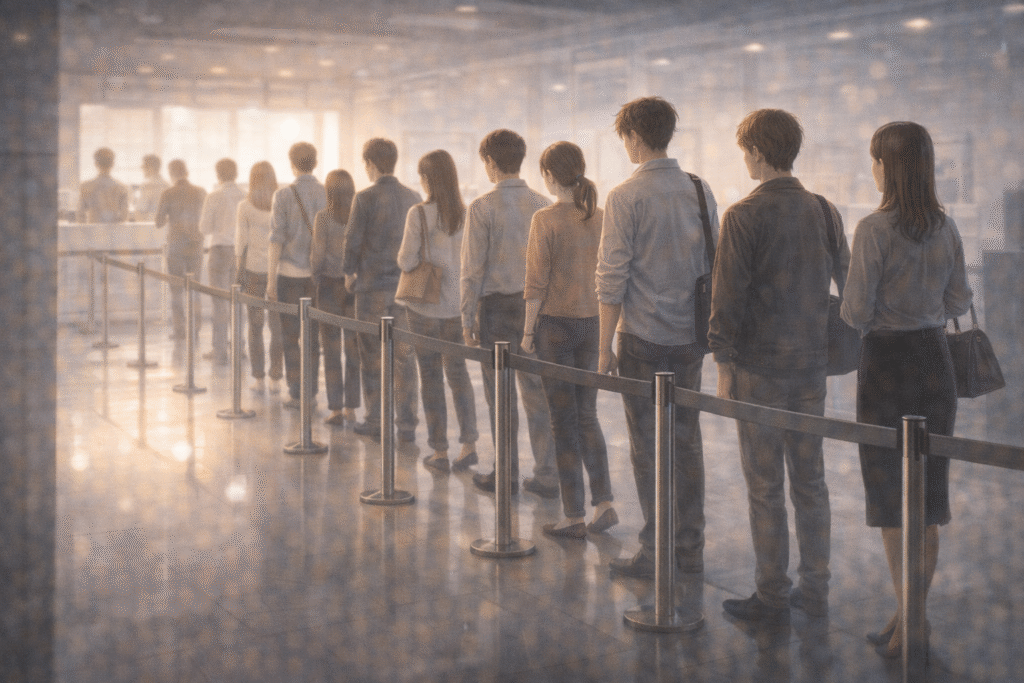
    People standing in line representing fairness and social order

    1. Why Do We Line Up So Willingly?

    We stand in lines almost every day—
    at amusement parks, popular restaurants, hospital counters, and even online shopping platforms where “waiting numbers” appear on our screens.

    At first glance, lining up looks like nothing more than inconvenient waiting.
    Yet people rarely question it. On the contrary, they often accept it willingly.
    Why do we voluntarily endure waiting instead of seeking alternatives?

    The answer lies not in patience alone, but in the social meaning embedded in queues.


    1.1. Lines as a Guarantee of Fairness

    The most fundamental function of a line is fairness.
    The rule is simple: first come, first served.

    Sociologists describe this as the first-come, first-served norm, a powerful yet easily shared social agreement.
    It reassures individuals that their turn will be respected.

    If someone cuts the line at a hospital reception desk, frustration spreads immediately.
    The anger is not about time alone—it is about the violation of fairness.
    Without lines, trust erodes quickly and social conflict intensifies.


    2. Waiting Turns Time into Meaning

    Interestingly, waiting in line does more than organize order—it reshapes experience.

    At amusement parks, waiting two hours for a roller coaster often heightens anticipation.
    People feel that the experience must be more rewarding because they invested time.

    The same applies to long restaurant lines.
    A crowded queue becomes a social signal: this place must be worth it.
    Even ordinary food can feel more valuable when framed by a visible line.
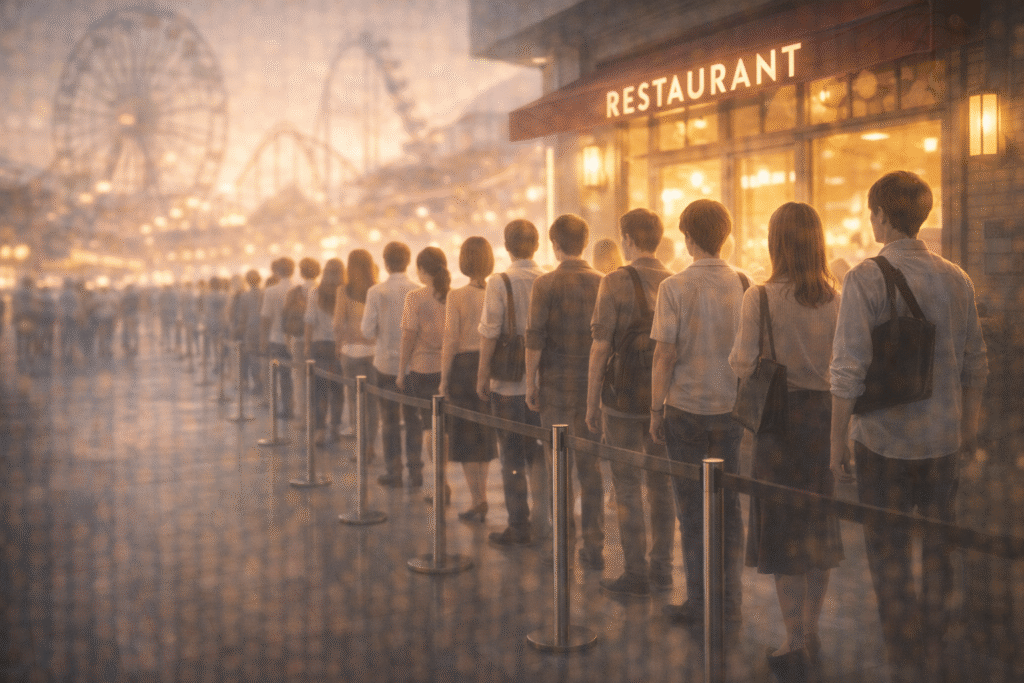
    Long queue outside a popular place signaling value and demand

    3. Lines Create Social Bonds

    Standing in line often produces a subtle sense of solidarity.
    People waiting for the same goal share space, time, and expectation.

    Fans lining up for concert tickets may begin as competitors,
    but often end up feeling like comrades.
    Small conversations, shared complaints, and mutual understanding emerge.

    Lining up is not only about waiting—it is also about belonging.


    4. Lines as Tools of Power and Control

    Despite their appearance of fairness, lines can also function as instruments of power.

    Who controls the line matters.
    VIP lanes, priority access, and exclusive queues immediately reveal inequality.

    Luxury brands deliberately create long lines to increase perceived value.
    Standing in line itself becomes a status symbol—
    a sign of inclusion in a desirable group.

    In these cases, waiting is no longer neutral; it is carefully designed.


    5. Digital Lines in the Online Age

    Lines have not disappeared in digital society—they have simply changed form.

    Online ticket platforms display messages like “You are number 10,524 in line.”
    Video games restrict access with server queues.
    Physical waiting has become virtual waiting.

    Because digital queues are invisible, trust becomes fragile.
    Platforms compensate by showing estimated wait times and live updates,
    attempting to preserve the sense of fairness that physical lines once provided.
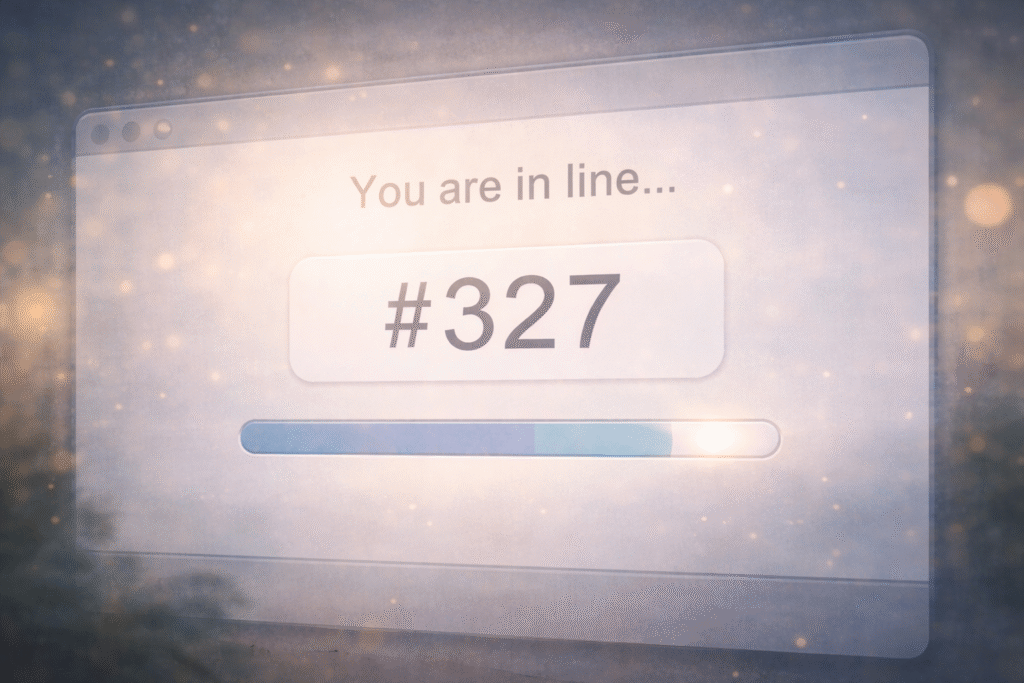

    Digital waiting queue on a screen representing online waiting

    Conclusion

    Waiting in line is far more than idle time.

    It is a social mechanism where fairness, expectation, belonging, and power intersect.
    Within the lines we casually join each day,
    the hidden order of society quietly reveals itself.


    References

    1. Mann, L. (1969). Queue Culture: The Waiting Line as a Social System.
      American Journal of Sociology, 75(3), 340–354.
      → A foundational study analyzing queues as structured social systems that sustain order and fairness.
    2. Schweingruber, D., & Berns, N. (2005). Shaping the Social Experience of Waiting.
      Symbolic Interaction, 28(3), 347–367.
      → Examines how theme parks transform waiting into a designed experience of anticipation.
    3. Maister, D. H. (1985). The Psychology of Waiting Lines.
      Harvard Business School Service Notes.
      → Explores how perceived fairness and engagement shape satisfaction during waiting.
  • The Sociology of Selfies

    How Self-Representation and the Desire for Recognition Shape Digital Identity

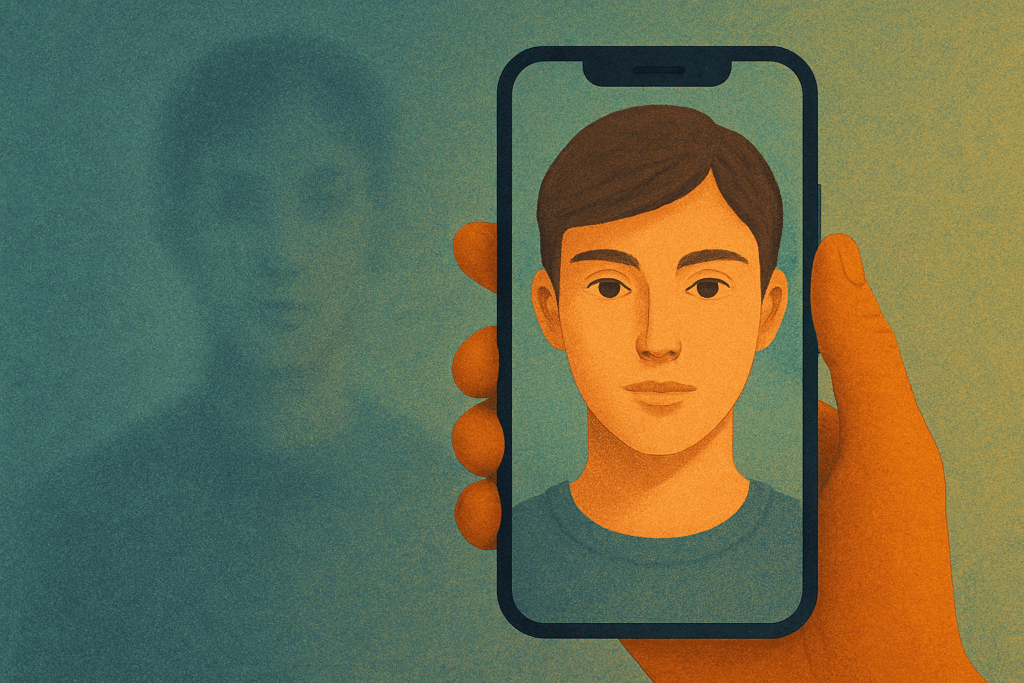
    selfie and digital identity reflection

    Introduction: A Selfie Is Not Just a Photo

    On the subway, in cafés, or while traveling, we instinctively raise our smartphones.
    In the frame, we appear slightly brighter, slightly more confident, slightly more composed.

    A selfie is not merely a record of the self.
    It is a carefully constructed moment shaped by the awareness of being seen.

    Behind this seemingly casual gesture lies a deeper social message—
    a desire for recognition and a question that quietly follows us:
    How do I want to be perceived by others?


    Selfies as a Technology of Self-Presentation

    The evolution of smartphone cameras has turned everyday users into curators of their own personal brands.

    Lighting, filters, angles, and backgrounds are not neutral choices.
    They function as symbols that communicate identity.

    A selfie taken against a scenic landscape performs freedom.
    A selfie at a desk performs discipline and diligence.

    In this sense, selfies are not simple records of reality.
    They are acts of self-presentation, or what sociologists describe as a performance of identity.


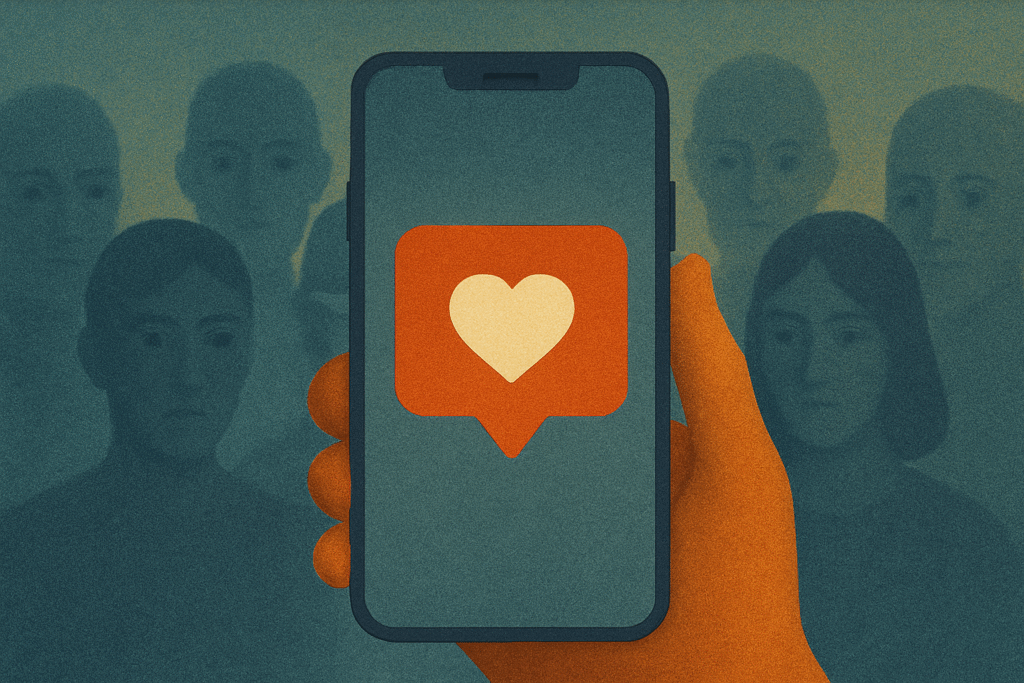
    Recognition and the Social Psychology of “Likes”

    When we upload a selfie, we are not simply waiting for numbers to increase.
    We are waiting for acknowledgment.

    Each “like” operates as a social signal that says, I see you.

    Sociologist Charles Horton Cooley famously described the looking-glass self
    the idea that individuals form their self-image through the imagined reactions of others.

    In the digital age, selfies place this mirror directly onto the smartphone screen.
    As a result, people often begin to prioritize the visible self over the experienced self.

    Self-expression becomes inseparable from social validation,
    and identity turns into a negotiation between who we are and how we are received.

    social media likes and recognition desire

    The Paradox of Freedom and Anxiety

    Selfies promise freedom.
    We choose how to present ourselves, when to post, and what to reveal.

    Yet this freedom often coexists with anxiety.

    Filters subtly reflect perceived social expectations.
    Endless streams of perfected faces invite comparison and self-doubt.

    For younger generations especially, selfies can become tools of proof—
    evidence that one is worthy, attractive, or socially accepted.

    Thus, selfie culture exists at the boundary between autonomy and control,
    where self-expression is constantly shaped by imagined audiences.


    From the Seen Self to the Lived Self

    Selfies are mirrors of contemporary society.
    They express a human desire to be acknowledged, remembered, and valued.

    But when attention shifts entirely to the seen self,
    there is a risk of losing contact with the lived self.

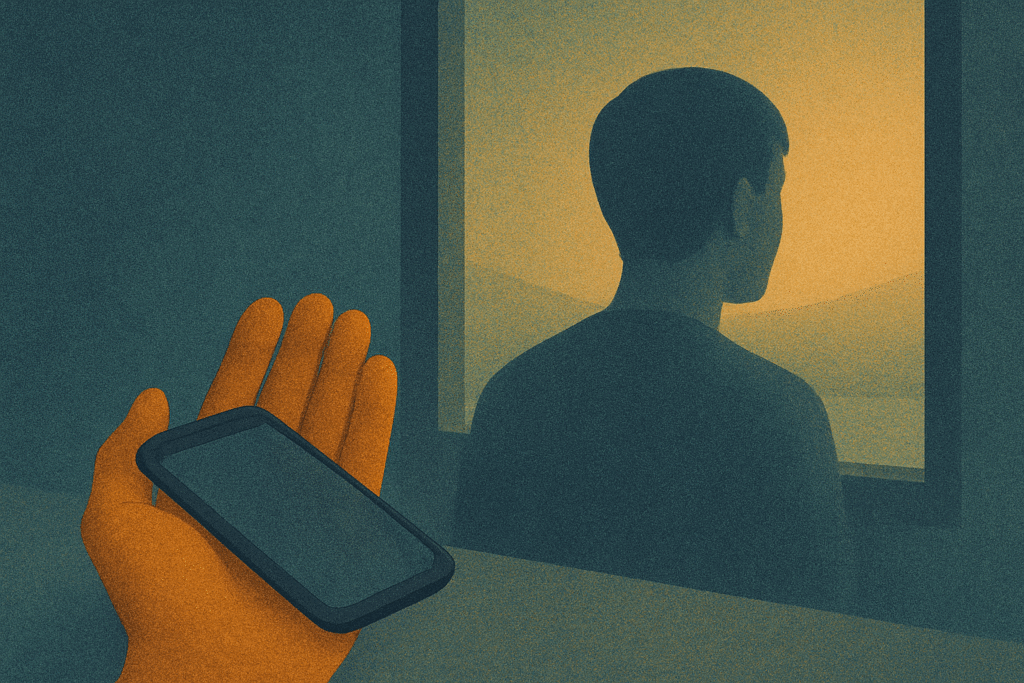
    Occasionally lowering the camera and stepping outside the frame
    allows space to reconnect with experience beyond representation.

    Only then can selfies transform from instruments of performance
    into tools of self-understanding.

    stepping away from social media reflection

    Conclusion

    Selfies are neither shallow nor inherently harmful.
    They are social languages shaped by recognition, identity, and visibility.

    The challenge is not to abandon selfies,
    but to remain aware of the difference between being seen and truly existing.

    In that awareness, digital self-representation can become
    not a performance for approval,
    but a reflection of a life genuinely lived.


    📚 References

    Senft, T. M., & Baym, N. K. (2015).
    What Does the Selfie Say? Investigating a Global Phenomenon.
    International Journal of Communication, 9, 1588–1606.
    This study frames selfies as social and communicative acts rather than trivial images, explaining how identity and recognition are negotiated through digital self-representation.

    Goffman, E. (1959).
    The Presentation of Self in Everyday Life.
    New York: Anchor Books.
    Goffman’s theory of social performance provides a foundational framework for understanding selfies as staged expressions of identity in everyday interactions.

    Marwick, A. E. (2013).
    Status Update: Celebrity, Publicity, and Branding in the Social Media Age.
    New Haven, CT: Yale University Press.
    This work explores how social media encourages self-branding and visibility-seeking behaviors, offering crucial insight into recognition economies that shape selfie culture.