Tag: social welfare

  • Social Justice and the Welfare State: How Much Should Governments Reduce Economic Inequality?

    Social Justice and the Welfare State: How Much Should Governments Reduce Economic Inequality?

    Balancing Equality, Social Protection, and Individual Freedom

    Economic inequality exists in almost every society.

    Some people inherit wealth, receive excellent education, and grow up with access to strong social networks. Others begin life with fewer opportunities, unstable housing, limited healthcare, or financial insecurity.

    The existence of inequality alone, however, does not tell us what governments should do about it.

    Should the state redistribute income through taxation? Should healthcare and education be guaranteed regardless of income? Should governments provide generous unemployment benefits and pensions? Or can too much intervention weaken individual responsibility, economic freedom, and incentives to work and invest?

    These questions lie at the heart of the debate over social justice and the welfare state.

    Supporters of a strong welfare state argue that freedom means little without basic security and genuine opportunity. Critics warn that governments can go too far, creating excessive taxation, bureaucracy, dependency, or restrictions on individual choice.

    The real debate, therefore, is not simply whether inequality should exist.

    It is how much inequality a fair society should accept—and how far governments should go to reduce it.


    1. What Is a Welfare State?

    welfare state providing education, healthcare and social protection across different stages of life

    Social Protection as a Public Responsibility

    A welfare state is a system in which government assumes significant responsibility for protecting citizens against major social and economic risks.

    These risks may include illness, unemployment, disability, poverty, old age, and lack of access to education.

    Welfare states use different combinations of public healthcare, pensions, unemployment insurance, family support, housing assistance, education, and income transfers.

    Behind these policies lies an important idea about social justice:

    A person’s life chances should not depend entirely on wealth or circumstances of birth.

    Consider education.

    Two children may possess similar abilities and motivation. But if one grows up in a wealthy family with access to excellent schools while the other grows up in poverty with limited educational opportunities, can we say that their later successes and failures result entirely from individual effort?

    Supporters of welfare provision argue that society should provide a minimum foundation from which people can develop their abilities.

    The goal does not necessarily have to be equal outcomes.

    It can instead be meaningful equality of opportunity.

    But that immediately creates another question:

    How much government intervention is necessary to create that opportunity?


    2. Why Do Supporters Believe Welfare States Reduce Inequality?

    Security Can Make Freedom More Meaningful

    Supporters of welfare states argue that severe economic inequality can eventually undermine freedom itself.

    A person without access to healthcare may technically be free to seek treatment but unable to afford it.

    A talented student from a poor household may formally be free to attend university but lack the financial means to do so.

    Someone who loses a job may be legally free to search for another one, yet immediate poverty can severely restrict the choices available.

    From this perspective, social programs do not necessarily oppose freedom.

    They can create the conditions that make freedom usable.

    This argument helps explain the development of Nordic welfare systems.

    Countries such as Sweden, Denmark, Norway, and Finland combine market economies with comparatively extensive systems of taxation and social protection. Publicly supported healthcare, education, family policies, unemployment protection, and pensions are designed to reduce some of the risks individuals face throughout life.

    Supporters argue that such systems can reduce poverty, limit extreme inequality, and increase social mobility while allowing private enterprise and market competition to continue.

    The underlying principle is that markets can generate prosperity, while public institutions can help ensure that the risks and benefits of economic life are not distributed too unevenly.


    3. What Are the Arguments Against an Expanding Welfare State?

    debate between social protection and individual economic freedom in a welfare state

    Freedom, Incentives, and the Limits of Government

    Critics do not necessarily oppose every form of social protection.

    Their concern is often how far redistribution should go.

    High taxes can reduce the amount individuals control over the income they earn. Generous benefits, critics argue, may sometimes weaken incentives to work, save, or take economic risks. Large welfare systems can also become bureaucratically complex and financially difficult to sustain.

    There is also a philosophical objection.

    If individuals have legitimately earned income through work, investment, or entrepreneurship, how much of that income should the government be entitled to redistribute?

    From this perspective, social justice includes not only equality but also individual rights, personal responsibility, and economic autonomy.

    The United States provides a useful contrast with the Nordic model, although the difference should not be exaggerated.

    The United States operates major public programs—including Social Security, Medicare, Medicaid, and unemployment insurance—but relies more heavily than Nordic countries on private provision in several areas, particularly health insurance and retirement savings.

    This reflects, in part, a stronger historical emphasis on limited government and individual choice.

    The result illustrates the trade-off at the center of the debate.

    Greater individual responsibility may preserve more private choice, but it can also expose people to greater economic insecurity.


    4. Is There a Middle Ground Between Redistribution and Individual Freedom?

    Universal Basic Income and Other Alternatives

    The debate is not limited to a choice between a large welfare state and minimal government.

    Many policy proposals attempt to combine social security with individual autonomy.

    One of the most widely discussed is Universal Basic Income (UBI)—the idea that citizens should receive a regular cash payment without traditional means testing or work requirements.

    Supporters argue that UBI could provide a basic level of security while allowing individuals greater freedom to decide how the money should be used.

    Critics question its cost, whether payments should go to everyone regardless of need, and whether it would be more effective than targeted welfare programs.

    Finland’s basic-income experiment from 2017 to 2018 became an important real-world test.

    Two thousand unemployed participants received a monthly payment without the usual conditions attached to unemployment benefits.

    The results were nuanced.

    The experiment did not produce a dramatic transformation in employment, but recipients reported improvements in several measures of well-being and perceived economic security.

    The lesson is important because welfare policies should not be judged by only one outcome.

    Employment matters.

    But so do security, health, dignity, administrative simplicity, and people’s ability to make meaningful choices.


    5. How Much Inequality Should a Fair Society Accept?

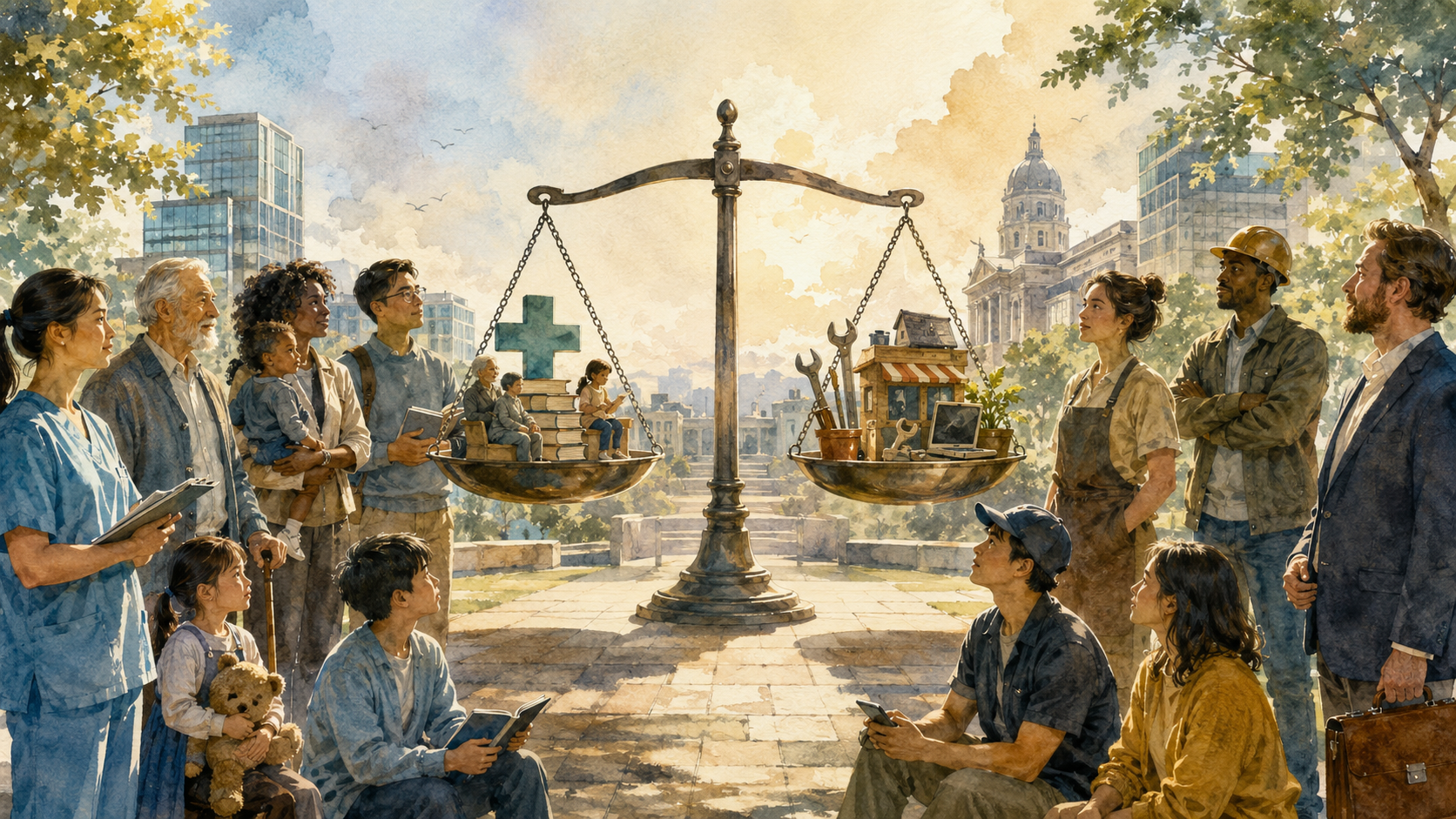
    citizens discussing fairness, social responsibility and economic inequality

    Different Ideas of Justice Lead to Different Answers

    This may be the most difficult question of all.

    Few people argue that everyone must receive exactly the same income regardless of effort, responsibility, skill, or contribution.

    At the same time, few societies are comfortable with unlimited inequality—especially when some citizens cannot meet basic needs while others accumulate extraordinary wealth.

    The real disagreement concerns the space between those extremes.

    One influential approach, associated with philosopher John Rawls, asks us to imagine choosing the rules of society without knowing what position we ourselves would occupy within it.

    Would we design the same society if we did not know whether we would be born rich or poor, healthy or disabled, privileged or disadvantaged?

    Rawls did not argue that every inequality must disappear. Rather, inequalities require justification, particularly in relation to fair opportunity and the position of the least advantaged.

    A contrasting tradition, strongly associated with Robert Nozick, emphasizes individual rights and legitimate acquisition.

    From this perspective, justice cannot be judged simply by looking at how equal or unequal the final distribution of wealth appears. We must also ask whether property was acquired and transferred legitimately.

    The contrast reveals why welfare-state debates are so persistent.

    They are not merely disagreements about tax rates.

    They reflect different understandings of what fairness itself means.

    A Citizenship Perspective

    From the perspective of citizenship education, this debate is especially important because a welfare state is not simply a mechanism for distributing money.

    It also expresses a society’s understanding of the relationship between citizens and the state.

    What may citizens reasonably expect from their political community?

    What responsibilities do citizens have toward people whose circumstances are very different from their own?

    And when does helping fellow citizens become not merely charity, but a shared civic responsibility?

    These questions have long been central to discussions of citizenship because democracy involves more than individual rights. It also requires citizens to consider how the institutions they share should treat people with different needs, resources, and opportunities.

    Seen this way, debates over welfare are also debates over what kind of citizens we believe ourselves to be—and what we owe one another as members of the same society.


    6. The Challenge Is Different in Every Society

    There Is No Universal Welfare Model

    There is no single welfare-state model that can simply be copied everywhere.

    Countries differ in economic development, demographics, political institutions, taxation, public trust, family structures, and attitudes toward individual and collective responsibility.

    South Korea illustrates some of these tensions.

    Rapid economic development created extraordinary prosperity, but contemporary debates increasingly involve housing affordability, opportunities for younger generations, population aging, pensions, social protection, and the fiscal sustainability of future welfare programs.

    Similar pressures appear elsewhere in different forms.

    European countries face the financial implications of aging populations. The United States continues to debate healthcare costs, coverage, and access. Developing economies must often expand social protection while working with much smaller tax bases.

    Cultural expectations matter as well.

    In some societies, families have traditionally carried much of the responsibility for supporting children, older adults, or relatives facing economic hardship. In others, citizens expect government institutions to assume a larger role.

    As societies modernize, age, urbanize, and become more culturally diverse, these expectations can change.

    This suggests that the central policy question is not simply:

    “Should we have more welfare or less welfare?”

    A better question is:

    “Which forms of social protection expand opportunity and security without creating costs that future generations cannot sustain?”

    That question moves the debate away from ideological extremes and toward institutional design.


    Conclusion: Justice Requires More Than Equality

    The welfare state represents one of modern society’s most ambitious attempts to reconcile two powerful values:

    social protection and individual freedom.

    Without adequate social protection, economic disadvantage can become self-reinforcing. Poverty can restrict education, poor health can limit employment, and inherited disadvantage can pass from one generation to the next.

    But government intervention also has limits.

    Taxes impose costs. Welfare programs require sustainable financing. Poorly designed policies can create bureaucracy, unintended incentives, or dependency. And individual autonomy remains an important part of a free society.

    The challenge, therefore, is not to eliminate every economic difference.

    Nor is it to assume that markets alone will always produce socially acceptable outcomes.

    A just society must continually decide which inequalities reflect legitimate differences in choice and contribution—and which inequalities become barriers that prevent people from living with dignity or having meaningful opportunities.

    From a citizenship perspective, this decision cannot belong only to economists or governments. It is also a democratic question about the kind of society citizens are willing to build together.

    Different countries—and different generations—may answer it differently.

    Perhaps the deepest question behind the welfare-state debate is therefore not simply how much wealth governments should redistribute.

    It is this:

    How much inequality can a society tolerate before unequal resources become unequal freedom?

    Reader Question

    Economic inequality may reward effort and innovation, but extreme inequality can also restrict people’s opportunities.

    At what point should reducing inequality become a responsibility of the state—and how can governments do so without unnecessarily limiting individual freedom?

    Related Reading

    If a welfare state is built on shared responsibility among citizens, what happens when different generations disagree over who should contribute more and who should receive more?

    In Aging Society and Generational Divide we examine how pensions, healthcare, housing, and demographic change are reshaping the distribution of resources between younger and older generations.

    If economic inequality influences the opportunities available to citizens, we must also ask whether demographic change itself can reshape the structure of society.

    In Population and the Course of History?, we explore how population growth, decline, aging, and migration have influenced economic and social change throughout history.

    References

    1. Rawls, John. (1971). A Theory of Justice. Harvard University Press.

    Rawls develops the influential ideas of the original position, the veil of ignorance, and principles of justice designed without knowing one’s future social position. His work provides a philosophical foundation for examining equality of opportunity, inequality, and the obligations of social institutions toward the least advantaged.

    2. Nozick, Robert. (1974). Anarchy, State, and Utopia. Basic Books.

    Nozick presents a major libertarian critique of extensive redistribution and emphasizes individual rights, property, voluntary exchange, and limited government. His argument provides an important counterpoint to Rawls and helps explain why welfare-state debates involve competing definitions of justice rather than simply different economic policies.

    3. Esping-Andersen, Gøsta. (1990). The Three Worlds of Welfare Capitalism. Princeton University Press.

    Esping-Andersen compares different welfare-state systems and demonstrates that welfare capitalism does not follow a single model. His influential framework helps explain why countries organize social protection differently depending on institutions, political traditions, labor markets, and relationships between families, markets, and governments.

    4. OECD. Society at a Glance 2024: OECD Social Indicators. OECD Publishing, 2024.

    This report provides comparative evidence on social conditions across OECD countries, including income inequality, poverty, demographics, social spending, and other indicators of well-being. It is useful for placing philosophical debates about welfare and inequality within the realities of contemporary societies.

    5. Kangas, Olli, Signe Jauhiainen, Miska Simanainen, and Minna Ylikännö, eds. (2021). Experimenting with Unconditional Basic Income: Lessons from the Finnish BI Experiment 2017–2018. Edward Elgar Publishing.

    This volume examines Finland’s basic-income experiment and its effects on employment, economic security, and well-being. The findings illustrate why welfare policies need to be evaluated through multiple dimensions rather than employment outcomes alone.

  • Aging Societies and the Generational Divide

    Aging Societies and the Generational Divide

    Who Should Bear the Cost of a Longer-Living Society?

    Living longer is one of humanity’s greatest achievements.

    Advances in medicine, nutrition, sanitation, and living standards have allowed millions of people to enjoy longer and healthier lives than previous generations could have imagined. Yet this remarkable success has created a new challenge. As people live longer and birth rates decline, many societies are becoming older at an unprecedented pace.

    The consequences reach far beyond demographics. Aging affects pensions, healthcare, taxation, housing, employment, and even political priorities. When fewer working-age people are asked to support growing numbers of retirees, difficult questions inevitably emerge.

    Who should pay for longer retirement?

    How much should younger workers contribute to pensions and healthcare? Should older people work longer? And how should governments divide limited resources between the needs of children, young adults, families, and older citizens?

    These questions sometimes create the impression of a conflict between generations.

    But perhaps the real problem is not that young and old have fundamentally opposing interests. The deeper challenge may be designing institutions that remain fair when the demographic balance of society changes.


    1. The World Is Growing Older

    A Demographic Revolution

    Population aging occurs when the proportion of older people increases relative to younger and working-age populations.

    Two developments are primarily responsible: people are living longer, while families are having fewer children.

    This transformation is occurring across much of the world. Japan and several European countries have been aging for decades, while South Korea is experiencing one of the fastest demographic transitions. Eventually, many countries that currently have relatively young populations will confront similar challenges.

    Aging should therefore not be understood simply as a problem affecting a few wealthy countries. It represents a fundamental transformation in the structure of human society.

    South Korea as a Window into the Future

    South Korea provides an especially striking example.

    Rapid economic development dramatically increased life expectancy and living standards, while fertility fell to extraordinarily low levels. As a result, the balance between working-age people and retirees is changing rapidly.

    The country therefore offers a glimpse of questions that many other societies may eventually face:

    How can pensions remain sustainable? Who will provide elderly care? Can a smaller workforce maintain economic productivity? And how should resources be divided between generations?


    2. Why Aging Can Create Generational Tension

    younger and older generations balancing pensions healthcare and public resources

    The Pension Question

    Public pension systems represent one of the clearest sources of generational tension.

    In many systems, today’s workers help finance benefits for today’s retirees. This arrangement functions relatively smoothly when there are many workers for every retired person.

    But aging changes the equation.

    As the number of retirees rises while the working-age population shrinks, governments may face several difficult choices: increasing contributions, reducing benefits, raising the retirement age, using more general taxation, or combining these measures.

    Young workers may consequently wonder whether they will receive benefits comparable to those enjoyed by previous generations.

    Older citizens, however, may reasonably respond that pensions are not gifts. Many spent decades working, paying taxes, raising families, and contributing to the societies that younger generations inherited.

    The conflict is therefore not easily reduced to one generation supporting another.

    It concerns the long-term credibility and fairness of the social contract.

    Healthcare and Long-Term Care

    Healthcare creates another challenge.

    Older populations generally require more medical treatment and long-term care. As longevity increases, governments must finance healthcare systems capable of supporting people through longer periods of old age.

    That may mean greater public expenditure.

    Yet younger generations also require investment—in education, childcare, mental health, employment support, and family formation.

    When public budgets are limited, spending priorities can easily become framed as competition:

    Should governments spend more on elderly care or childcare?

    Pensions or education?

    Long-term care facilities or affordable housing?

    Such choices can intensify perceptions that one generation benefits at another’s expense.


    3. Housing and the Generational Wealth Divide

    housing affordability and wealth differences between generations

    When Homeownership Becomes a Generational Advantage

    Housing has become another major source of intergenerational tension in many developed economies.

    Older generations who purchased homes when prices were relatively affordable may have accumulated substantial wealth as property values increased. Younger adults entering the same markets often face dramatically higher prices, larger mortgages, and delayed homeownership.

    Housing therefore influences much more than where people live.

    It affects wealth accumulation, marriage, family formation, retirement security, and inheritance.

    When property ownership becomes increasingly dependent on parental assistance, inequality can also grow within the younger generation itself. Young adults from wealthy families may receive help purchasing homes, while those without family assets fall further behind.

    The issue is therefore more complicated than “young versus old.”

    It is also about how wealth is transferred across generations and families.

    Not Every Older Person Is Wealthy

    At the same time, portraying older generations as uniformly prosperous would be misleading.

    Many elderly people have limited savings, inadequate pensions, poor health, or expensive care needs. Some own homes but have very little disposable income.

    South Korea illustrates this contradiction particularly clearly: rapid increases in property wealth have benefited some older households, while poverty among older citizens remains a serious social problem.

    Generational inequality therefore overlaps with income and wealth inequality within each generation.

    This distinction is essential.

    Otherwise, policies designed to correct generational inequality could unintentionally harm vulnerable elderly people while doing little to address concentrated wealth.


    4. Jobs, Retirement, and a Longer Working Life

    Are Older Workers Taking Jobs from the Young?

    Another common source of tension concerns employment.

    As people remain healthier for longer, many governments encourage older workers to remain economically active beyond traditional retirement ages.

    Critics sometimes argue that this reduces opportunities for younger workers.

    But economies do not contain a permanently fixed number of jobs. Experienced older employees can mentor younger workers, maintain valuable skills, create businesses, and contribute to economic demand.

    The real question is how workplaces can adapt to longer lives.

    Flexible retirement, lifelong learning, retraining, and multigenerational workplaces may provide better solutions than forcing workers into a simple choice between early retirement and full-time employment.

    The Changing Meaning of Retirement

    When pension systems were originally designed, retirement often lasted for a relatively limited period.

    Longer life expectancy has changed that assumption.

    A person might now spend twenty or thirty years in retirement.

    This raises a legitimate policy question: if people live longer and remain healthier, should retirement ages gradually increase?

    For governments, the answer may appear economically obvious.

    For individuals who have spent decades performing physically demanding work, however, extending working life may be deeply unfair.

    A sustainable retirement system therefore needs flexibility rather than a single rule applied to everyone.


    5. Is This Really a War Between Generations?

    The Danger of Generational Blame

    Public debate often describes aging through dramatic language: a “silver tsunami,” a pension crisis, or a battle between younger taxpayers and older beneficiaries.

    Such language can attract attention, but it can also distort reality.

    Generations are deeply interdependent.

    Older people provide childcare, financial assistance, knowledge, volunteer work, and family support. Younger people contribute taxes, innovation, caregiving, and new economic activity.

    Families routinely transfer resources in both directions.

    Today’s young workers will eventually become retirees, just as today’s retirees once supported previous generations.

    Turning demographic change into a moral conflict between age groups risks obscuring the structural problems that actually require reform.

    Inequality Within Generations Matters Too

    A wealthy 70-year-old homeowner and a poor 70-year-old renter may have far less in common economically than their age suggests.

    The same is true for younger people.

    A 30-year-old who expects substantial inheritance faces a very different future from someone of the same age struggling with insecure employment and high rent.

    Fair aging policy therefore cannot be based on age alone.

    Income, wealth, health, occupation, family circumstances, and access to housing must also be considered.


    6. Building a New Intergenerational Contract

    Making Pensions Sustainable and Fair

    Pension reform is unavoidable in many aging societies, but sustainability should not mean simply transferring more costs to younger workers.

    Possible reforms include gradually adjusting retirement ages, broadening contribution bases, strengthening minimum pensions for vulnerable elderly people, and encouraging longer employment for those able and willing to work.

    The goal should be both sustainability and adequacy.

    A pension system that bankrupts future generations is unsustainable, but a system that leaves elderly citizens in poverty is equally unsuccessful.

    Housing and Family Policy

    Governments must also address the conditions facing younger adults.

    Affordable housing, childcare, stable employment, and reasonable education costs are not merely “youth policies.” They influence whether people feel economically secure enough to form families and raise children.

    Supporting younger generations can therefore become part of the solution to population aging itself.

    Technology, Immigration, and Productivity

    Aging societies also have alternatives to simply demanding more from younger workers.

    Automation and artificial intelligence may help maintain productivity with smaller workforces. Immigration can ease labor shortages in some countries. Better healthcare can allow people to remain active longer.

    None of these approaches offers a complete solution, but together they can reduce demographic pressure.

    The future of aging societies will depend not only on how many workers they have, but also on how productively and inclusively societies use human and technological resources.


    7. From Generational Conflict to Generational Cooperation

    younger and older generations cooperating and supporting one another

    Perhaps the greatest challenge of population aging is not economic but social.

    If younger people believe they are paying for benefits they will never receive, trust in public institutions will decline.

    If older people feel they are being portrayed as burdens simply because they live longer, social solidarity will weaken.

    A sustainable aging society therefore requires more than pension mathematics.

    It requires a renewed understanding of intergenerational reciprocity.

    Programs that connect generations can help. Younger people can assist older citizens with digital technologies, while older people can provide mentoring, childcare, professional knowledge, and community support.

    These exchanges remind us that generations are not isolated economic groups competing for a fixed amount of wealth.

    They are parts of the same society.


    Conclusion

    Population aging is one of the defining transformations of the twenty-first century.

    It will place real pressure on pensions, healthcare systems, labor markets, housing, and government budgets. Difficult decisions about taxation, retirement, welfare, and public investment cannot be avoided.

    But describing these challenges simply as a conflict between young and old misses the deeper issue.

    The central question is not which generation should win, but how societies can distribute the benefits and costs of longer lives fairly.

    Older generations deserve dignity, healthcare, and economic security. Younger generations deserve affordable housing, opportunities, and confidence that the social systems they support today will still exist when they need them tomorrow.

    These goals do not have to be mutually exclusive.

    A society that invests wisely in productivity, reforms pensions gradually, protects vulnerable people regardless of age, and strengthens opportunities for younger generations can transform longevity from a fiscal burden into a social achievement.

    After all, living longer is not the failure of modern society.

    It is one of its greatest successes.

    The real test is whether we can redesign our institutions so that a longer life for one generation does not mean a poorer future for the next.

    Reader Question

    As societies grow older, how should the costs of pensions, healthcare, and long-term care be divided fairly between younger workers and older citizens?

    And if inequality within each generation can be greater than inequality between generations, should public policy focus less on age and more on income, wealth, and individual need?


    Related Reading

    If aging societies depend on the changing balance between younger workers and older citizens, how much of today’s generational tension is ultimately rooted in broader demographic change?

    In Population and the Course of History: Is Demographic Change the Driving Force Behind Civilizations?, we examine how population growth, decline, migration, and changing age structures have shaped economies and societies throughout history.

    If technological progress allows societies to remain productive with smaller working-age populations, could AI and automation fundamentally change what population aging means for future generations?

    In The Future of Happiness: How Will We Define Happiness in the Age of AI and Climate Change?, we explore how artificial intelligence, technological change, sustainability, and evolving social values may reshape human well-being in the decades ahead.