Tag: social emotional learning

  • Can AI Replace Human Teachers? Why Human Interaction Still Matters in the Classroom

    Can AI Replace Human Teachers? Why Human Interaction Still Matters in the Classroom

    AI Can Personalize Learning, but Education Is Also Built on Relationships, Trust, Dialogue, and Human Growth

    Imagine a student who has just failed an important test.

    An AI tutor can immediately analyze the student’s mistakes. It may identify weak concepts, generate easier explanations, create personalized exercises, and suggest a new study plan within seconds.

    It may even say:

    Don’t be discouraged. One test does not define your ability.

    That response may sound caring.

    But is receiving an encouraging sentence the same as being encouraged by a teacher who knows the student?

    This distinction is becoming increasingly important.

    Artificial intelligence can already explain difficult concepts, answer questions, generate exercises, provide feedback, translate materials, and adapt learning activities to individual needs. As these systems become more capable, it is reasonable to ask whether some traditional functions of teachers can be automated.

    But education has never consisted only of delivering information.

    A classroom is also a place where students learn to trust, disagree, cooperate, fail, recover, take responsibility, and live with people who think differently from themselves.

    So the deeper question is not simply:

    Can AI teach?

    It is:

    What parts of education require another human being?


    1. What Can AI Teachers Do Better Than Human Teachers?
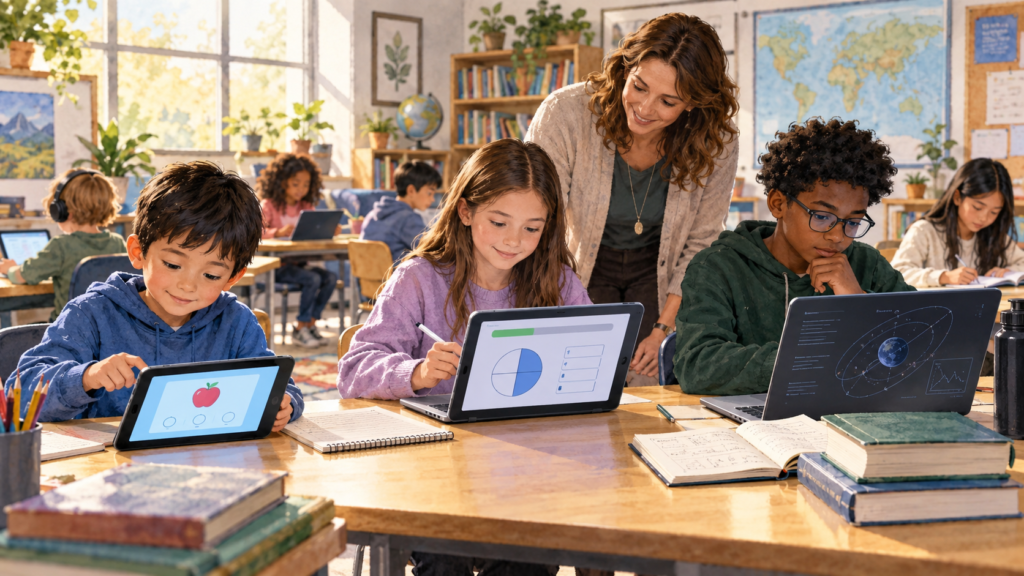
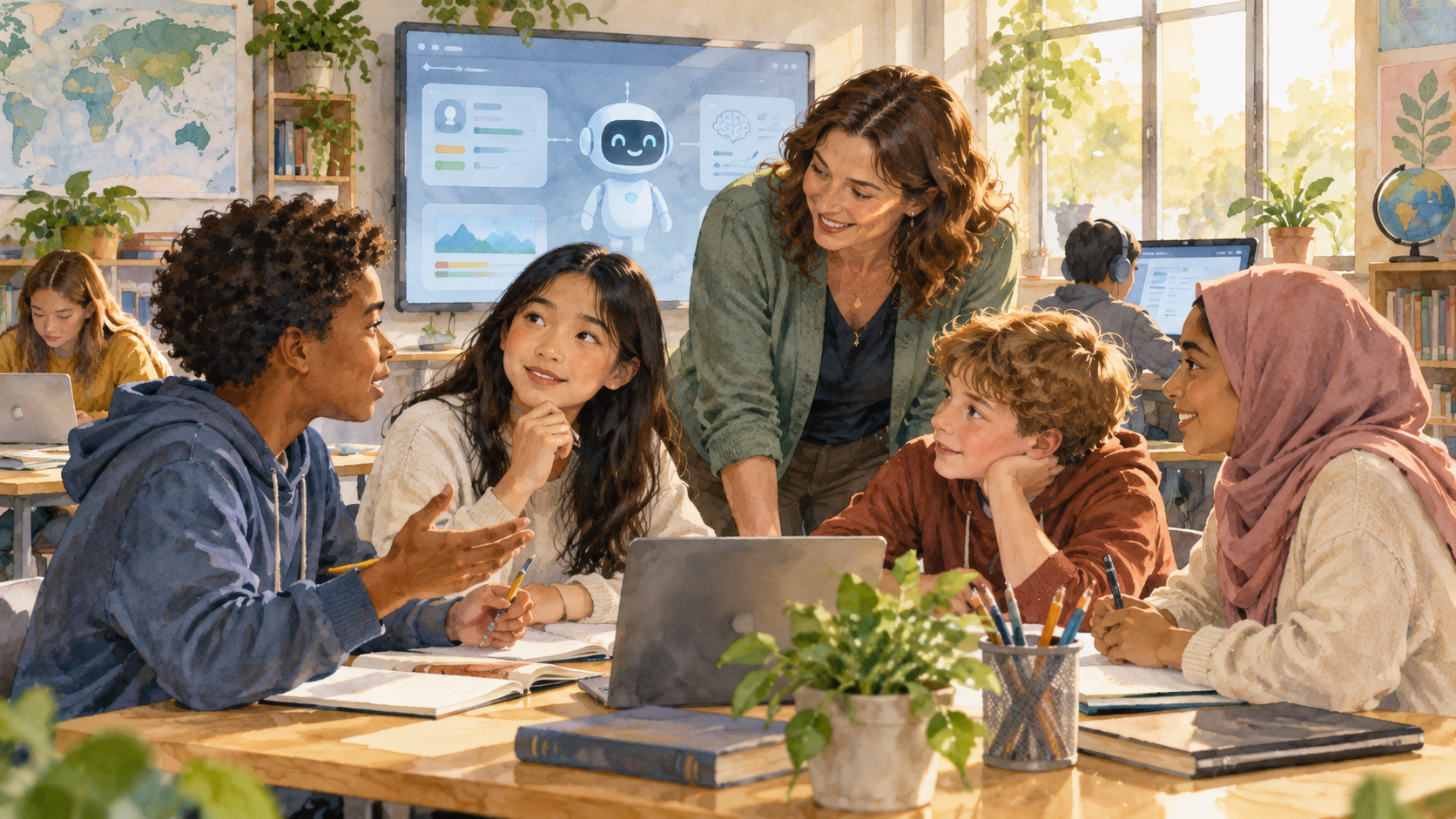
    students using AI for personalized learning while a human teacher provides support

    Personalization, Speed, and Unlimited Repetition

    AI has genuine educational strengths.

    A human teacher working with twenty or thirty students cannot always provide every learner with continuous individualized instruction.

    An AI system potentially can.

    If one student struggles with fractions while another is ready for algebra, an adaptive system can provide different material to each. It can generate additional examples, adjust difficulty, offer immediate feedback, and allow students to repeat explanations without embarrassment.

    AI also does not become impatient when asked the same question ten times.

    For students who hesitate to speak in front of classmates, an AI tutor may provide a low-pressure environment in which they can ask basic questions privately.

    Generative AI expands these possibilities further. Students can request alternative explanations, compare perspectives, practice languages, simulate conversations, or receive assistance at almost any hour.

    These capabilities should not be dismissed simply because the technology is artificial.

    Used carefully, AI could free teachers from some repetitive tasks and give them more time for the aspects of education that require human judgment and interaction.

    The important question, therefore, is not whether AI has educational value.

    It clearly does.

    The question is where that value ends.


    2. Can AI Really Understand a Student’s Emotions?

    Simulating Empathy Is Not Necessarily the Same as a Human Relationship

    Consider again the student who failed the test.

    An advanced AI system may detect discouragement in the student’s words and respond sensitively.

    It might say exactly what a supportive teacher would say.

    That matters. A helpful response can still be useful even when it comes from a machine.

    But human teachers possess something different.

    They encounter students over time.

    A teacher may notice that a usually talkative student has become quiet for several days. A student who repeatedly forgets homework may not be lazy but struggling with difficulties at home. Another may understand the material perfectly but be afraid to participate because classmates have laughed at previous mistakes.

    These judgments are not infallible. Human teachers can misunderstand students too.

    Yet education takes place within relationships built through repeated human encounters.

    A teacher remembers yesterday’s conversation.

    A facial expression may have meaning because of what happened last week.

    Silence can mean something because the teacher knows how that student normally behaves.

    Most importantly, the teacher does not merely generate an appropriate response.

    The teacher stands in a continuing relationship of care, responsibility, and accountability toward the student.

    AI may become increasingly convincing at expressing empathy.

    But the educational question is whether expressing empathy and being in a caring relationship are the same thing.


    3. Why Does Human Interaction Matter for Learning?
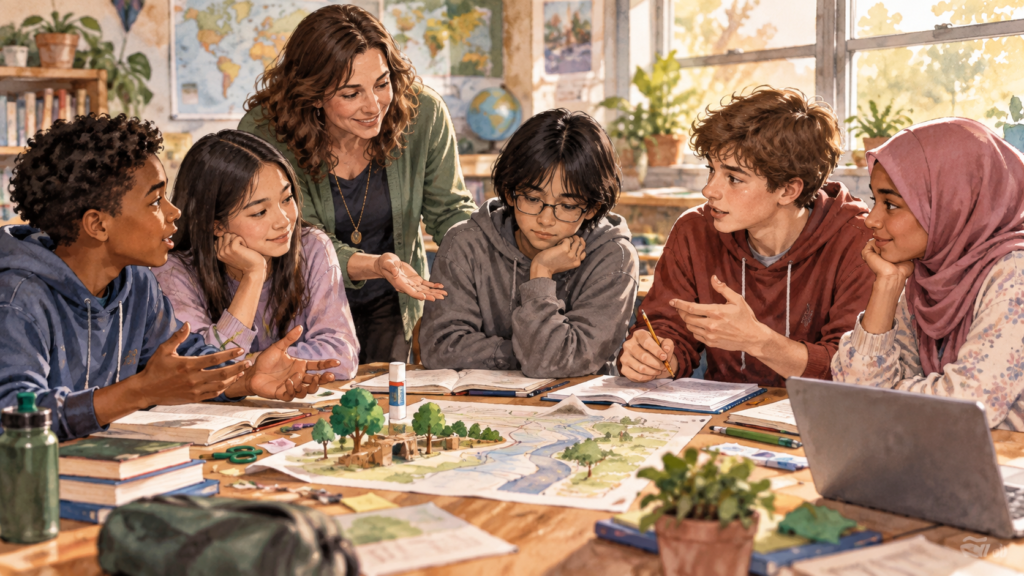
    teacher helping students develop cooperation, dialogue and empathy through classroom interaction

    Students Learn With and Through Other People

    Classrooms are not simply information-delivery systems.

    They are social environments.

    When students work together on a project, they encounter problems that cannot be solved by knowing the correct answer.

    Who will lead?

    Who will listen?

    What happens when two people disagree?

    How should the group respond when one member contributes less than expected?

    Can students criticize an idea without humiliating the person who proposed it?

    These experiences teach cooperation, communication, negotiation, patience, and responsibility.

    Consider a group of students creating a mural.

    The educational value does not lie only in the finished artwork.

    One student may want blue while another insists on red. Someone may dominate the discussion. A quieter student may have an excellent idea but hesitate to speak.

    A skilled teacher observes these interactions and sometimes intervenes.

    “Have we heard everyone’s idea?”

    “Why don’t you explain why you disagree?”

    “Can you find a solution that uses elements of both proposals?”

    What students are learning at that moment cannot easily be reduced to academic content.

    They are learning how to live and work with other people.


    4. Education Is Also Learning to Live With Difference

    This social dimension becomes especially important when we think about education as preparation for citizenship.

    Students will eventually live in societies filled with people who have different values, identities, interests, cultures, and political opinions.

    Democratic societies cannot function simply because citizens possess information.

    Citizens must also learn to listen, argue without violence, consider evidence, recognize other perspectives, negotiate disagreements, and sometimes accept outcomes they did not prefer.

    The classroom is one of the first public spaces where these capacities can develop.

    From this perspective, discussion is not wasted time between lessons.

    The discussion is sometimes the lesson.

    An AI tutor can help a student construct an argument.

    But a real classmate can disagree with it.

    An AI system can simulate multiple perspectives.

    But another student can surprise, frustrate, challenge, misunderstand, forgive, or persuade us.

    Those encounters matter because society itself consists of real people whom we cannot simply customize to our preferences.

    One danger of highly personalized education is therefore worth considering.

    If technology becomes extremely good at adapting everything to the individual learner, could education lose some of its function as a place where students learn to adapt to one another?

    Personalization is valuable.

    But education also requires encountering difference.


    5. What Happens When a Student Needs Judgment Rather Than an Answer?

    Many educational situations have no objectively correct response.

    Suppose two students accuse each other of bullying.

    A student submits an essay that may have been largely produced by AI.

    A teenager expresses a disturbing political opinion during a discussion.

    A student wants to abandon a difficult course.

    A parent demands a higher grade.

    These are not simply information problems.

    They involve context, fairness, trust, values, institutional responsibility, and sometimes moral judgment.

    Teachers themselves will not always make the right decision.

    But they can be questioned.

    They can explain their reasoning.

    Parents, students, colleagues, and administrators can hold them accountable.

    As AI becomes more involved in assessment and educational decision-making, responsibility becomes more complicated.

    If an algorithm recommends that a student be placed in a lower academic track, who is responsible for that decision?

    The developer?

    The school?

    The teacher?

    The algorithm cannot assume moral responsibility for the consequences.

    This is one reason human judgment remains central to education.

    Efficiency can be automated more easily than responsibility.


    6. Should AI Replace Teachers—or Give Teachers More Time to Be Human?
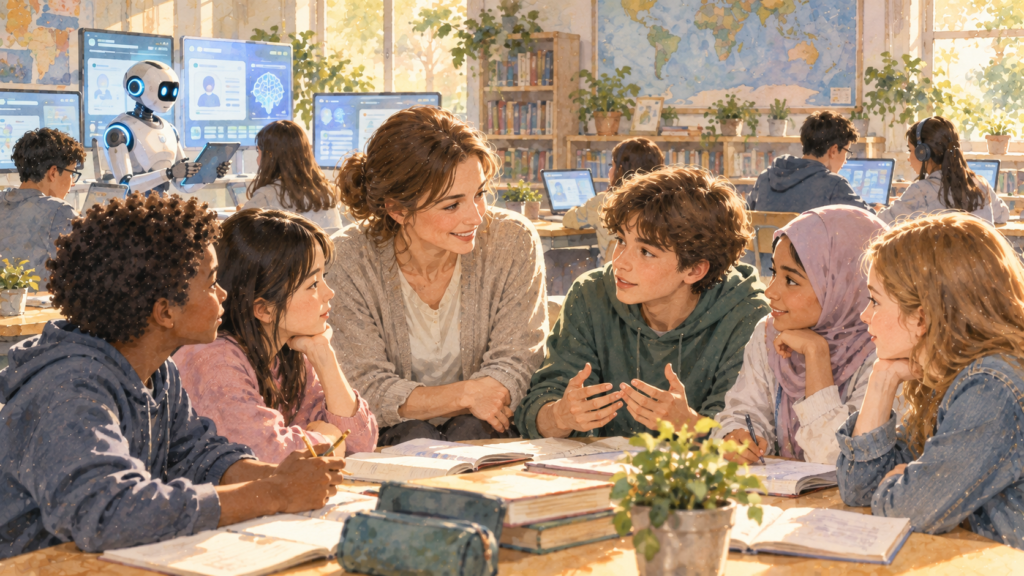
    AI handling routine educational tasks while a teacher focuses on mentoring and human relationships

    Perhaps we are asking the wrong question when we ask whether AI will replace teachers.

    A better question might be:

    Which tasks should AI perform so that teachers can devote more attention to the work only humans can meaningfully do?

    AI could assist with routine exercises, initial feedback, lesson preparation, translation, accessibility, administrative work, and some forms of individualized practice.

    Teachers could then spend more time observing students, facilitating discussions, mentoring individuals, resolving conflicts, designing collaborative experiences, and creating communities in which students feel known.

    This would represent a very different vision of educational technology.

    AI would not become a cheaper substitute for human relationships.

    It would become a tool that allows schools to invest more, rather than less, in those relationships.

    Of course, this outcome is not guaranteed.

    Schools facing financial pressure might instead use AI to increase class sizes or reduce teaching staff.

    That is why the future of AI in education is not determined by technology alone.

    It will depend on the choices institutions and societies make about what education is for.


    Conclusion: The More Powerful AI Becomes, the More Clearly We Must Define the Teacher’s Role

    AI will almost certainly become a normal part of education.

    That need not be feared.

    A student who receives a clear explanation from an AI tutor has learned something. A teacher who saves hours of repetitive administrative work may have more energy for students. Personalized tools may help learners who would otherwise fall behind.

    The mistake would be to assume that because AI can perform more teaching tasks, the human relationship becomes less important.

    It may become more important.

    When information is abundant, teachers help students judge it.

    When answers are instantaneous, teachers help students learn how to ask better questions.

    When education becomes increasingly personalized, teachers create spaces where students encounter people unlike themselves.

    And when a student fails, struggles, withdraws, disagrees, or changes, a teacher does something more difficult to measure:

    the teacher notices.

    Education is not only about what a student knows at the end of a lesson.

    It is also about what kind of person the student is becoming—and how that person learns to live with others.

    AI can become an extraordinarily powerful educational partner.

    But perhaps the best future classroom is not one in which artificial intelligence makes teachers unnecessary.

    It is one in which technology handles more of what machines do well, so that teachers have more time to do what education has always needed humans to do.

    And that leaves us with a question that may become more important as AI improves:

    If an AI can explain almost anything, what should we still need a teacher for?

    Reader Question

    AI may eventually become better than many humans at explaining concepts, generating personalized exercises, and providing immediate academic feedback.

    If AI becomes capable of teaching almost any subject effectively, which parts of a teacher’s role should we still insist remain human—and why?

    Related Reading

    If AI becomes a normal part of education, will it help close generational gaps in digital learning—or make those differences even more visible?

    In The Digital Generation Gap: Is Technology Bringing Generations Together—or Driving Them Apart?, we explore how rapid technological change affects different generations and why digital inclusion and intergenerational learning are becoming increasingly important.

    But even if AI can improve learning, what happens when access to powerful educational technologies is distributed unequally?

    In The New Inequality of the AI Age: The Rise of Digital Refugees, we examine how unequal access to AI and digital skills may create new forms of exclusion—and why technological progress must be accompanied by social and educational inclusion.

    References

    1. UNESCO. (2023). Guidance for Generative AI in Education and Research. UNESCO.

    This guidance examines the opportunities and risks created by generative AI in education and emphasizes a human-centered approach to its use. It is particularly relevant to the article’s argument that AI should support educational goals and human agency rather than simply replace human roles because automation is technically possible.

    2. UNESCO. (2024). AI Competency Framework for Teachers. UNESCO.

    UNESCO’s framework identifies the knowledge, skills, and values teachers need as artificial intelligence becomes increasingly integrated into education. Rather than treating teachers as obsolete, it presents AI competence as part of an evolving professional role in which teachers remain responsible for pedagogical judgment and the human dimensions of learning.

    3. OECD. (2021). Beyond Academic Learning: First Results from the Survey of Social and Emotional Skills. OECD Publishing.

    This report examines social and emotional skills such as cooperation, empathy, persistence, emotional regulation, and curiosity. It supports the article’s broader argument that education involves more than academic knowledge and that schools are important environments for students’ social and emotional development.

    4. Vygotsky, L. S. (1978). Mind in Society: The Development of Higher Psychological Processes. Harvard University Press.

    Vygotsky’s work emphasizes the social foundations of learning and the importance of interaction in cognitive development. His perspective provides a foundational theoretical basis for understanding why dialogue, collaboration, guidance, and relationships remain central to education even when powerful technological learning tools are available.

    5. Biesta, G. J. J. (2015). Good Education in an Age of Measurement: Ethics, Politics, Democracy. Routledge.

    Biesta challenges approaches that reduce educational quality to measurable learning outcomes alone. His work is particularly relevant to the article’s argument that education also concerns judgment, responsibility, democratic participation, and the development of students as persons—not simply the efficient acquisition of information.
  • Why Music Education Matters: More Than Learning to Play an Instrument

    Why Music Education Matters: More Than Learning to Play an Instrument

    How Music Can Support Children’s Cognitive, Emotional, Social, and Creative Development

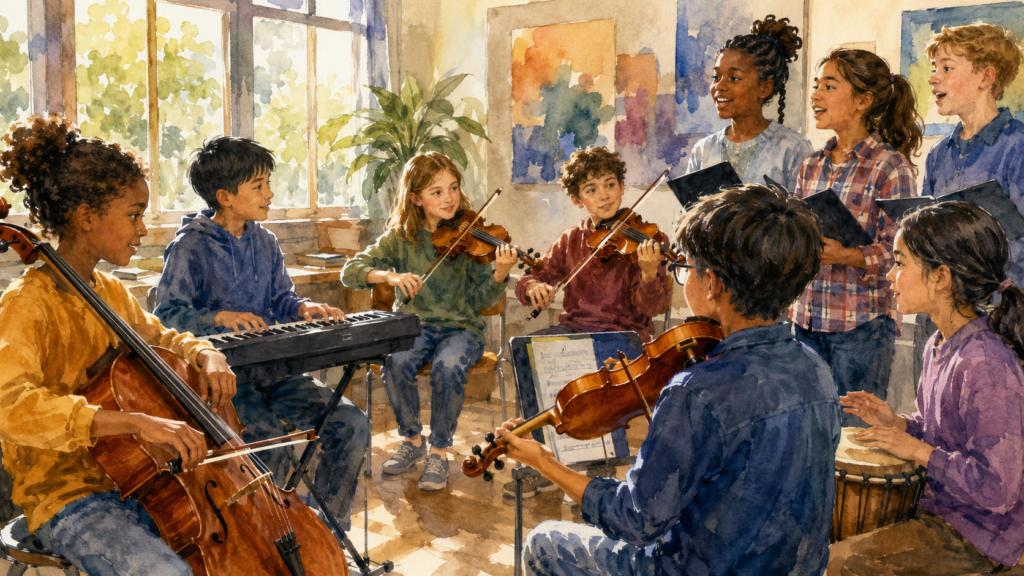
    A child sits at a piano and struggles to play a simple melody. Another sings in a school choir, listening carefully to the voices around her. Somewhere else, several children are trying to keep the same rhythm in a classroom ensemble.

    At first glance, they are simply learning music.

    But something more is happening.

    They are listening, remembering, coordinating movement, responding to other people, expressing emotion, dealing with mistakes, and gradually discovering that practice can turn something difficult into something possible.

    This is why music education is about much more than producing musicians.

    Not every child who learns the piano will become a pianist. Not every student in a school orchestra will continue performing as an adult. Yet the experience of making music can still become a meaningful part of a child’s education.

    Research has associated musical training with various aspects of cognitive, emotional, and social development, although we should be cautious about claiming that music automatically makes children more intelligent or guarantees higher academic achievement.

    The strongest case for music education may actually be broader.

    Music gives children another way to think, feel, communicate, create, and participate in a community.


    1. How Can Music Education Support Children’s Development?

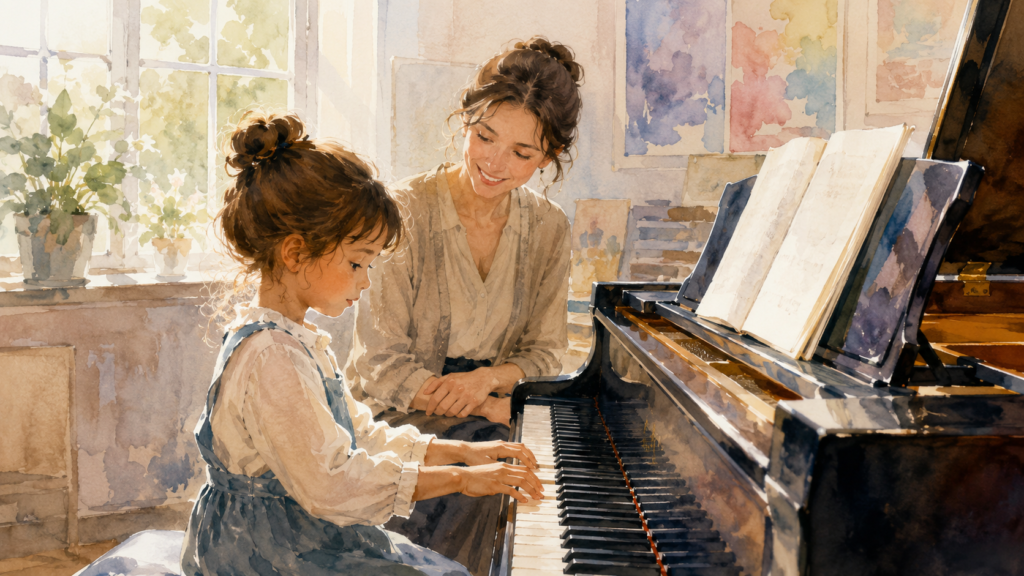
    child developing attention and emotional expression through music education

    Learning music is a remarkably complex activity.

    When children sing or play an instrument, they may need to listen carefully, recognize patterns, remember sequences, coordinate movement, follow timing, and respond to other performers—all within a single activity.

    Cognitive Development

    Musical training can exercise attention, auditory discrimination, memory, motor coordination, and pattern recognition.

    Learning an instrument, for example, requires children to connect what they see, hear, and physically do. Reading musical notation may involve recognizing patterns and translating visual information into precisely timed movements.

    These experiences have led researchers to investigate connections between music education and other cognitive abilities.

    However, an important distinction is necessary.

    Children who receive music education sometimes also perform well in areas such as language or mathematics, but this does not necessarily mean that music lessons alone caused those differences. Family background, educational opportunities, motivation, and other factors can also influence outcomes.

    Music education therefore should not be promoted with an overly simple promise such as:

    Learn music and your mathematics scores will rise.

    Its educational value is richer than that.

    Music provides sustained practice in attention, listening, memory, coordination, and structured learning—abilities that can be valuable across many areas of life.

    Emotional Development

    Children do not always have the vocabulary to explain what they feel.

    Music offers another language.

    A melody can communicate sadness without saying “I am sad.” Rhythm can express excitement or tension. Singing can turn an emotion that feels private into something that can be shared.

    Through listening and performing, children encounter different emotional qualities and learn that feelings can be recognized, expressed, transformed, and communicated.

    Music can also provide enjoyment and emotional release.

    For some children, practicing an instrument or listening closely to music creates a quiet space away from the pressures of everyday life.

    The goal is not to claim that music is a substitute for psychological care. Rather, it can be one of the ordinary cultural resources through which children explore and regulate their emotional worlds.


    2. Why Is Making Music With Others Important?

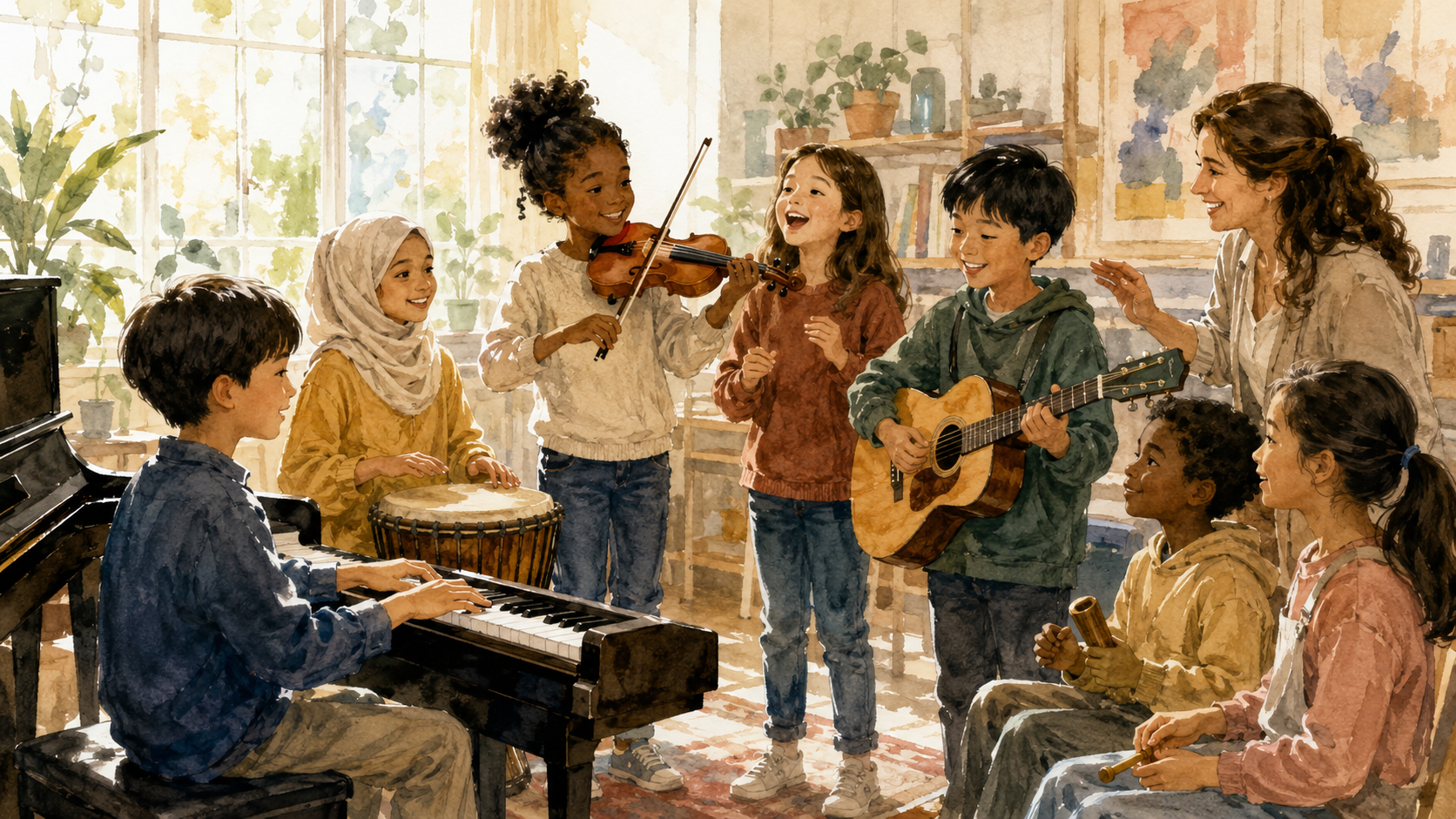
    children learning cooperation and teamwork through group music making

    Some of the most valuable musical experiences happen not alone but with other people.

    A choir cannot succeed if every singer ignores everyone else.

    An ensemble requires each player to perform an individual part while remaining aware of the whole group.

    That is an unusual educational experience.

    A child must simultaneously ask:

    Am I playing my part correctly?

    and

    How does my part fit with everyone else’s?

    Learning Cooperation Through Music

    Group music requires listening, timing, patience, and adjustment.

    Sometimes one performer leads. At other moments, the same performer must support someone else.

    Children learn that being louder is not always better and that individual excellence does not automatically produce a successful collective performance.

    This makes ensemble music a practical experience of cooperation.

    It can also create a sense of belonging.

    Preparing for a concert together, overcoming difficult passages, making mistakes during rehearsal, and finally performing as a group can create shared memories and relationships.

    Music education therefore has a social dimension that is easily overlooked when we think only about technical proficiency.

    Children do not simply learn how to make sounds. They learn how to make something together.


    3. How Does Music Encourage Creativity?

    Music education is sometimes taught as if the goal were simply to reproduce the correct notes.

    Accuracy certainly matters.

    But music can also become a powerful space for creativity.

    Children can improvise rhythms, change melodies, compose simple pieces, experiment with sounds, or discover different ways of interpreting the same music.

    In these moments, there may not be only one correct answer.

    That matters educationally.

    Many school activities understandably require students to find the correct solution. Creative activities offer another kind of challenge:

    What can you create from what you already know?

    Improvisation is a particularly interesting example.

    A child must listen to what is happening, make a decision, produce a response, evaluate the result, and continue—all in real time.

    Mistakes can even become part of the creative process.

    This teaches an important lesson that extends beyond music: uncertainty does not always have to be avoided. Sometimes we learn by experimenting with it.

    Creativity in music therefore does not belong only to exceptionally talented composers.

    A young child inventing a rhythm is already discovering that music is something that can be made, not merely copied.


    4. Which Types of Music Education Are Most Effective?

    There is no single form of music education that is best for every child.

    Different learning environments serve different purposes.

    Individual Lessons

    Private instruction can be particularly useful for developing instrumental or vocal technique.

    A teacher can observe a student’s posture, sound, difficulties, and progress closely and adapt instruction to the learner’s needs.

    Individual lessons also allow students to progress at their own pace.

    But they have limitations. They can be expensive, and learning entirely alone may provide fewer opportunities for musical cooperation.

    Group Lessons and Ensembles

    Group lessons, choirs, bands, and orchestras provide experiences that private lessons cannot easily reproduce.

    Students learn to listen to others and coordinate their performance with a group.

    Peers can also provide motivation.

    A difficult piece may become more enjoyable when several students are working toward the same goal.

    Music Camps and Intensive Programs

    Music camps can provide concentrated periods of learning and exposure to unfamiliar instruments, styles, teachers, and performers.

    For some students, this can be inspiring.

    Yet such programs should be regarded as enrichment rather than the foundation of music education, particularly because cost and location may limit participation.

    School Music Programs

    School programs have a special educational role because they can potentially reach children who would never have access to private lessons.

    A child should not need parents who can afford an instrument, private instructor, or summer camp simply to discover whether music matters to them.

    This makes school music education not only an artistic issue but also a question of educational opportunity.


    5. What Are the Long-Term Benefits of Music Education?

    The value of music education does not end when childhood ends.

    Its most lasting effects may sometimes be difficult to measure with a test.

    Confidence Through Achievement

    Learning music involves repeated encounters with difficulty.

    At first, a passage may seem impossible.

    The child practices it slowly.

    Mistakes continue.

    Gradually, the hands become more comfortable, the rhythm becomes stable, and what once seemed impossible becomes playable.

    That experience can produce a genuine sense of achievement.

    Performing before others adds another dimension. A child may experience nervousness, prepare carefully, make occasional mistakes, and discover that imperfect performance can still be meaningful.

    These experiences can contribute to confidence—not because every child becomes an outstanding musician, but because children learn that improvement can emerge from sustained effort.

    A Lifelong Relationship With Music

    Perhaps one of the most underestimated outcomes of music education is remarkably simple:

    a child may learn to love music.

    Someone who learned the guitar at twelve may still play at sixty.

    Another person may stop performing but continue listening to classical music, jazz, folk traditions, popular music, or music from other cultures with greater understanding.

    Music can accompany people through celebration, loneliness, work, friendship, aging, and memory.

    Education does not always have to produce an economic or academic return to be valuable.

    Sometimes giving a person something meaningful to enjoy throughout life is itself an important educational achievement.


    6. Can Music Education Help Children Understand Other Cultures?

    children discovering different cultures and musical traditions through music education

    Every society makes music, but societies do not make music in exactly the same way.

    Musical traditions carry histories.

    They reflect languages, religions, migrations, celebrations, conflicts, environments, and encounters between cultures.

    A child who encounters only one musical tradition may easily assume that familiar ways of organizing rhythm, melody, instruments, or performance are simply “normal.”

    Exposure to different musical traditions can challenge that assumption.

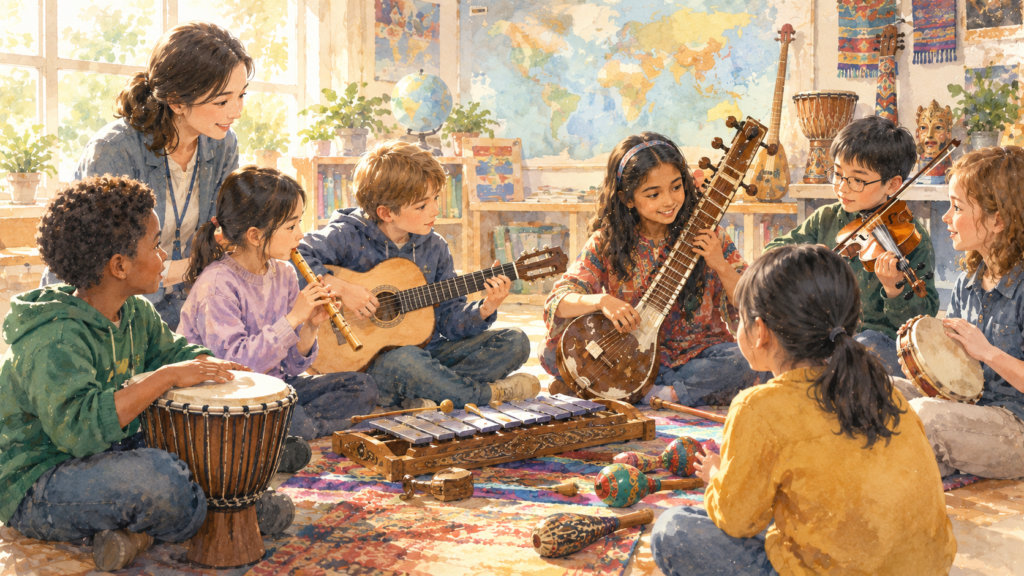
    Students might encounter West African rhythmic traditions, Indian classical music, Indonesian gamelan, European orchestral traditions, Korean traditional music, jazz, blues, Latin American music, or countless other forms.

    The purpose should not be to reduce cultures to a collection of exotic sounds.

    Good music education places musical forms within their historical and cultural contexts and encourages students to approach unfamiliar traditions with curiosity and respect.

    This is particularly important in increasingly multicultural societies.

    Music cannot by itself eliminate prejudice or create intercultural understanding. But it can provide one meaningful way for young people to encounter the fact that human beings have created remarkably different—and equally meaningful—ways of expressing experience.

    Music education can therefore help students hear difference not simply as something unfamiliar, but as something worth understanding.


    Conclusion: Music Education Is Education for the Whole Person

    The importance of music education should not depend on proving that children who play instruments receive higher mathematics scores.

    If music contributes to attention, memory, or other areas of learning, those benefits are welcome.

    But they are not the whole argument.

    Music gives children opportunities to listen carefully, express emotion, cooperate with others, create something new, persist through difficulty, experience achievement, and encounter cultures beyond their own.

    Some children will become professional musicians.

    Most will not.

    That does not make their musical education unsuccessful.

    A student who learns to appreciate a symphony, sing confidently with others, improvise a melody, understand a musical tradition from another culture, or return to an instrument decades later has gained something that cannot easily be reduced to a score.

    This is why access matters.

    If music is part of a well-rounded education, it should not become an experience reserved primarily for children whose families can afford private lessons and expensive instruments.

    Schools and communities have an important role in making meaningful musical experiences available more widely.

    Ultimately, music education asks us to think about a larger question:

    What do we believe education is for?

    If education exists only to prepare children for examinations and employment, music may appear secondary.

    But if education is also about helping young people develop their minds, emotions, creativity, relationships, and understanding of the human world, music belongs much closer to the center.

    Music education does more than teach children how to perform music. It gives them another way to experience, understand, and participate in life.

    A Question for Readers

    We often judge education by what can be measured through grades and examinations, yet music can offer children experiences that are much harder to quantify.

    If music helps children create, cooperate, express emotions, and discover something they may enjoy throughout life, should music education be considered an essential part of every child’s education rather than an optional subject?

    Related Reading

    Music education reminds us that learning is not only about acquiring practical skills or improving academic performance; it can also help people develop creativity, expression, and a deeper understanding of culture. A similar relationship between function and human expression is explored in The Functions and Aesthetics of Fashion: Why We Wear More Than Clothes, which examines how clothing evolved beyond practical necessity to become a language of beauty, identity, and cultural meaning.

    As technology transforms classrooms, the question of what education should ultimately provide becomes even more important. This challenge is explored further in The Paradox of AI Education, which considers how artificial intelligence may expand educational possibilities while also raising questions about the role of teachers, human judgment, creativity, and the meaning of learning.


    References

    1. McPherson, Gary E., and Graham F. Welch, eds. The Oxford Handbook of Music Education, Volume 1. Oxford University Press, 2012.

    This comprehensive handbook examines music learning and teaching from developmental, psychological, cultural, and educational perspectives. It supports the article’s central argument that music education should be understood not simply as instrumental training, but as a broader educational experience involving musical development, creativity, participation, and learning across different stages of life.

    2. McPherson, Gary E., and Graham F. Welch, eds. The Oxford Handbook of Music Education, Volume 2. Oxford University Press, 2012.

    The second volume extends the discussion to diverse educational settings, including schools, communities, and inclusive approaches to music learning. It is particularly relevant to the article’s discussion of access to music education and the importance of providing meaningful musical experiences beyond private lessons available only to families who can afford them.

    3. Sala, Giovanni, and Fernand Gobet. “Cognitive and Academic Benefits of Music Training with Children: A Multilevel Meta-Analysis.” Memory & Cognition, vol. 48, 2020, pp. 1429–1441.

    This meta-analysis critically examines claims that music training produces broad improvements in children’s cognitive abilities and academic achievement. Its findings provide an important basis for the article’s caution against justifying music education primarily through claims that learning music automatically improves mathematics, reading, or general intelligence.

    4. Hallam, Susan. “The Power of Music: Its Impact on the Intellectual, Social and Personal Development of Children and Young People.” International Journal of Music Education, vol. 28, no. 3, 2010, pp. 269–289.

    Hallam reviews evidence concerning the relationship between active engagement with music and children’s intellectual, social, and personal development. The article is particularly useful for understanding the possible connections between sustained musical participation and areas such as language, social skills, confidence, creativity, and personal development, while also recognizing the complexity of establishing causal relationships.

    5. Váradi, Judit. “A Review of the Literature on the Relationship of Music Education to the Development of Socio-Emotional Learning.” SAGE Open, vol. 12, no. 1, 2022.

    This review examines research connecting music education with social and emotional learning, including emotional awareness, cooperation, empathy, and interpersonal development. It provides useful support for the sections of this article that discuss music as a means of emotional expression and group music-making as an experience of listening, cooperation, and shared responsibility.