Tag: social comparison

  • When Experience Becomes Competition

    Travel, Hobbies, and the Rise of Experiential Capital

    We no longer ask, “Did you enjoy your trip?”
    We ask, “Where have you been?”

    We no longer ask, “Do you like your hobby?”
    We ask, “How good are you at it?”

    Somewhere along the way, experience stopped being something we felt and became something we performed. What once belonged to memory now belongs to visibility.

    This shift is not simply psychological. It is sociological.
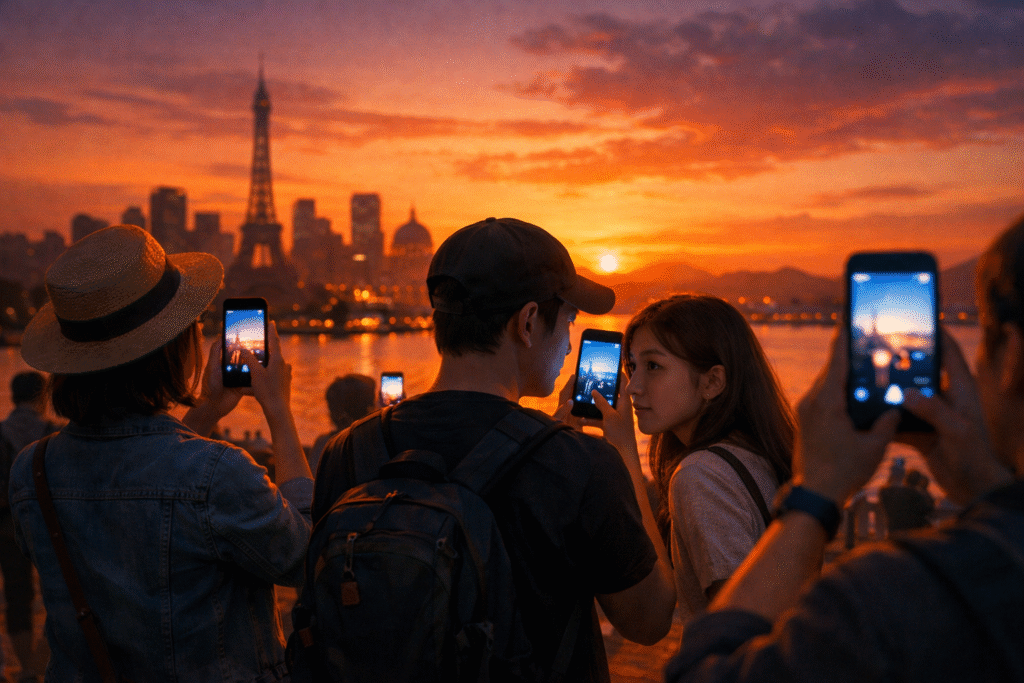
    People photographing a scenic landmark for social media

    1. From Cultural Capital to Experiential Capital

    French sociologist Pierre Bourdieu argued that society is structured not only by economic capital, but also by cultural capital — taste, education, manners, aesthetic preferences.

    Today, we might add another layer: experiential capital.

    • The countries you have visited
    • The art exhibitions you have attended
    • The lifestyle activities you practice
    • The stories you can tell

    Experiences increasingly function as social signals. They communicate mobility, refinement, exposure, or privilege.

    Travel destinations, hobbies, and lifestyle choices appear personal. Yet they often reflect structural access to time, resources, and networks.

    Experience becomes symbolic currency.


    2. The Experience Society

    German sociologist Gerhard Schulze described modern Western societies as an “experience society” (Erlebnisgesellschaft).

    In earlier eras, survival and stability defined a good life.
    Today, intensity and uniqueness define it.

    A meaningful life is no longer one that is secure, but one that is rich in experiences.

    But when experience becomes central to identity, it also becomes competitive.

    Ordinary moments are rarely shared.
    Moderate experiences rarely trend.
    Subtle satisfaction rarely goes viral.

    Platforms amplify what is exceptional, spectacular, or emotionally intense.
    Gradually, we internalize this logic.

    We do not simply experience life.
    We curate it.


    3. The Platform Effect: Visibility and Comparison
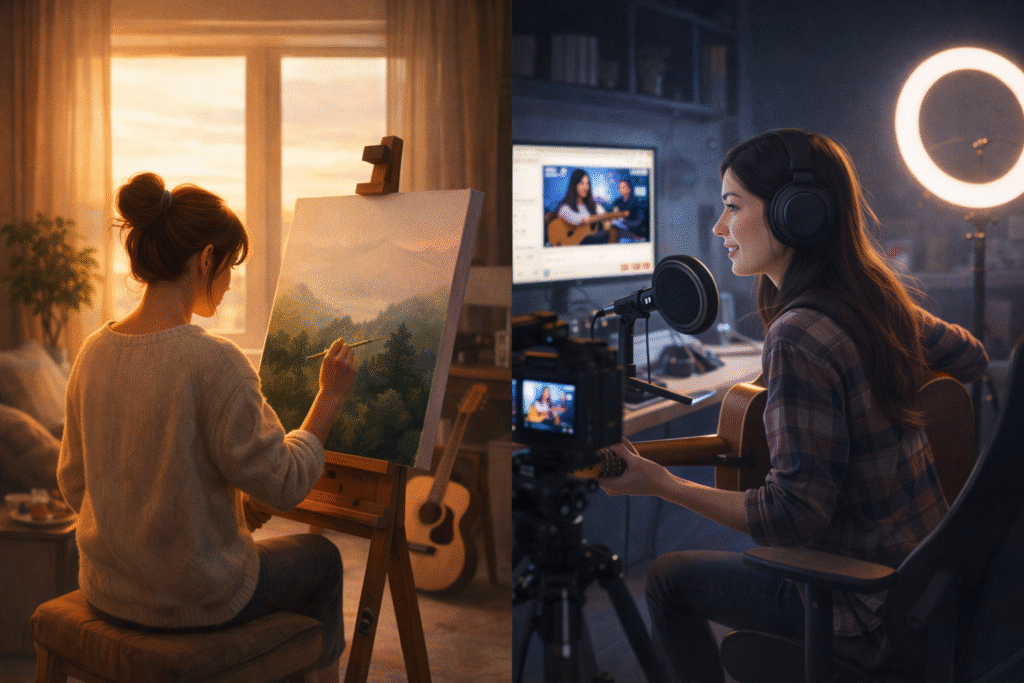
    Contrasting private hobby and public performance culture

    Social media has not created comparison, but it has industrialized it.

    Experiences are quantified:

    • Followers
    • Likes
    • Views
    • Places visited
    • Certifications earned

    Numbers appear neutral.
    But they quietly produce hierarchy.

    We compare our everyday reality with someone else’s highlight reel.

    The more visible experiences become, the harder satisfaction becomes.


    4. The Marketization of Feeling

    In the experience economy, what is sold is not a product but a feeling.

    “Authentic travel.”
    “Transformative retreat.”
    “Elite hobbyist culture.”

    Emotion becomes designed, packaged, and sold.

    This is where Bourdieu and Schulze meet:
    Experiences are both cultural capital and emotional commodities.

    We do not just consume goods.
    We consume identities.


    5. What Are We Losing?

    When experience becomes capital, depth can be replaced by accumulation.

    We visit more places but stay less deeply.
    We try more hobbies but master fewer.
    We share more moments but inhabit fewer.

    The competition for intensity produces quiet anxiety:
    Am I living fully enough?

    Yet the anxiety may not come from personal failure,
    but from structural comparison.

    Person resting quietly without using smartphone at sunset

    Conclusion: Reclaiming Experience as Presence

    Understanding the structure changes the question.

    Instead of asking:

    • Is my experience impressive enough?

    We might ask:

    • Is it meaningful to me?
    • Would it matter if no one saw it?
    • Does it deepen me, or merely display me?

    Experience does not have to function as capital.

    It can return to what it originally was:
    a lived sensation, not a performed asset.

    Perhaps the rarest luxury today is not an exotic destination,
    but an unshared moment.

    When comparison pauses, experience becomes personal again.

    And when experience becomes personal,
    it stops being competition.

    Related Reading

    The psychology behind curated lifestyles and digital self-presentation is further explored in The Standardization of Experience — How Modern Systems Shape Everyday Life, where personal moments gradually become structured performances within invisible social frameworks.

    At a deeper technological and existential level, the transformation of human identity under algorithmic influence is examined in AI Beauty Standards and Human Diversity — Does Algorithmic Beauty Threaten Us?, where digital norms begin to redefine what it means to be human.

    References

    1. Bourdieu, P. (1984). Distinction: A social critique of the judgement of taste. Harvard University Press.
      → Bourdieu demonstrates that taste and lifestyle choices are socially structured rather than purely individual. His concept of cultural capital explains how travel, hobbies, and aesthetic experiences function as markers of social distinction, making “experience” a form of symbolic capital in modern societies.
    2. Pine, B. J., & Gilmore, J. H. (1999). The experience economy: Work is theatre & every business a stage. Harvard Business School Press.
      → Pine and Gilmore argue that advanced economies increasingly sell memorable experiences rather than goods or services. Their framework clarifies how emotions and staged experiences become economic commodities within contemporary consumer culture.
    3. Schulze, G. (1992). Die Erlebnisgesellschaft: Kultursoziologie der Gegenwart. Campus Verlag.
      → Schulze introduces the idea of the “experience society,” in which individuals pursue intensity, uniqueness, and emotional stimulation as central life goals. His analysis helps explain the cultural shift from stability-oriented values to experience-driven identity formation.
    4. Festinger, L. (1954). A theory of social comparison processes. Human Relations, 7(2), 117–140.
      → Festinger’s foundational theory explains how individuals evaluate themselves through comparison with others. In digital environments, this mechanism becomes amplified as experiences are constantly visible and quantifiable.
    5. Goffman, E. (1959). The presentation of self in everyday life. Doubleday.
      → Goffman conceptualizes everyday interaction as a form of performance. His dramaturgical framework offers a powerful lens for interpreting social media culture, where experiences are curated and identities are staged before an imagined audience.

  • How Social Media Amplifies Feelings of Lack and Comparison

    Scrolling through social media has become a daily ritual for many people.
    We wake up, reach for our phones, and are immediately greeted by images of vacations, promotions, fitness routines, and seemingly perfect lives.

    Yet instead of feeling inspired, many of us experience an unexpected emotional dip.
    The reason is simple: social media largely presents highlights, not everyday reality.
    As a result, we begin to compare our ordinary lives with carefully curated moments—and a subtle sense of lack begins to grow.

    Person scrolling social media and comparing life to others

    1. The Psychology of Comparison: “Am I Falling Behind?”

    People tend to share their happiest and most successful moments online—weddings, travels, career milestones, or idealized lifestyles. These posts create the illusion that others are constantly thriving.

    Psychologists describe this tendency as social comparison theory. We unconsciously evaluate our own worth by measuring ourselves against others. On social media, however, this comparison becomes distorted.

    A single vacation photo, taken once a year, may appear repeatedly on our feed. Over time, it can feel as though others are always living better lives, reinforcing the belief that we are somehow falling behind.


    2. The Highlight Effect and Selective Exposure

    Social media content is not neutral—it is selected, edited, and optimized for attention.
    A quiet morning coffee rarely competes with a sunset photo taken on a tropical beach.

    Platforms dominated by visual content, such as Instagram or TikTok, intensify this effect. Users become increasingly aware of aesthetics, filters, and perfection. In comparison, our own daily routines may start to feel dull or insufficient, deepening psychological dissatisfaction.


    3. Algorithms as Emotional Amplifiers

    Algorithm-driven social media images amplifying comparison and lack

    Social media platforms are designed to keep users engaged. Algorithms learn what captures our attention and deliver more of it.

    If you interact with luxury travel, fitness influencers, or high-end dining content, similar posts will appear more frequently. Gradually, your feed becomes filled with images of “better” lives—carefully selected to provoke interest, admiration, and often envy.

    In this way, social media does not merely reflect reality; it magnifies what we are most likely to compare ourselves against.


    4. FOMO and Emotional Fatigue

    This persistent comparison often leads to FOMO (Fear of Missing Out)—the anxiety that others are experiencing meaningful moments without us.

    A peaceful weekend at home can suddenly feel empty when confronted with group photos from a trip or event. When such experiences accumulate, they can result in emotional exhaustion, reduced self-esteem, and even depressive feelings.

    Research suggests that adolescents and young adults are particularly vulnerable, as repeated exposure can foster the belief that their lives are less exciting or less valuable.


    5. Using Social Media Without the Sense of Lack

    Social media itself is not inherently harmful. The key lies in how we use and interpret it.

    • Intentional use: Log in with a purpose—learning, inspiration, or connection—rather than endless scrolling.
    • Reality awareness: Remember that posts represent fragments, not complete lives.
    • Time boundaries: Setting daily limits can significantly reduce emotional fatigue.

    When approached mindfully, social media can shift from a source of deficiency to a tool for motivation and insight.


    Conclusion

    Person stepping away from social media comparison for mental clarity

    Social media functions like a distorted mirror—one that reflects only the brightest moments of others while obscuring the full picture. When we mistake highlights for reality, we risk undervaluing our own lives.

    The challenge is not to reject social media entirely, but to reclaim perspective.
    By recognizing the difference between curated images and lived experience, we can transform social media from a space of comparison into one of connection and self-awareness.


    Related Reading

    The social economy of validation and recognition is analyzed more explicitly in The Praise-Driven Society: Recognition and Self-Worth in the Digital Age.

    These everyday emotional dynamics mirror a broader existential concern explored in Solitude in the Digital Age: Recovery or a Deeper Loss?

    References

    Vogel, E. A., Rose, J. P., Roberts, L. R., & Eckles, K. (2014). Social comparison, social media, and self-esteem. Psychology of Popular Media Culture, 3(4), 206–222.
    → This study empirically examines how social comparison on social media affects self-esteem, highlighting the role of upward comparison in feelings of inadequacy.

    Chou, H. T. G., & Edge, N. (2012). “They are happier and having better lives than I am”: The impact of using Facebook on perceptions of others’ lives. Cyberpsychology, Behavior, and Social Networking, 15(2), 117–121.
    → Demonstrates how social media users systematically overestimate others’ happiness, reinforcing perceived personal deficiency.

    Tandoc Jr., E. C., Ferrucci, P., & Duffy, M. (2015). Facebook use, envy, and depression among college students. Computers in Human Behavior, 43, 139–146.
    → Explores the link between social media use, envy, and depressive symptoms, offering insight into long-term emotional consequences.

  • Is Freedom an Expansion of Choice — or an Expansion of Anxiety?

    The Paradox of Modern Freedom and Its Psychological Burden

    Person standing at crossroads facing multiple choices

    1. “Why Does More Choice Make Us Feel More Anxious?”

    From the moment we begin our day, we are confronted with countless choices.

    What to wear, what to eat, what to watch, which platform to use.

    Modern society tells us that the wider our range of choices becomes, the freer we are.
    Yet strangely, as choices multiply, what arrives more often is not lightness or ease, but a quiet and persistent anxiety.

    Perhaps the expansion of choice is not the expansion of freedom,
    but the expansion of responsibility — and anxiety.

    If so, what does freedom really mean in contemporary society?
    Is it truly the freedom we believe it to be?


    2. Why Anxiety Grows as Choice Expands

    2.1 Choice Grants Freedom — and Assigns Responsibility

    As options increase, so does the pressure of a single message:

    “The outcome is entirely your responsibility.”

    In a world where both success and failure are framed as personal results,
    choice becomes less a form of freedom and more a psychological burden.


    2.2 The Fear of Missing Out (FOMO)

    Psychological research suggests that as the number of choices increases, satisfaction often decreases.

    Before choosing, we worry that something better might exist.
    After choosing, we wonder whether we made the right decision.

    This is known as FOMO (Fear of Missing Out) — the anxiety of potential loss.
    Choice, instead of liberating us, traps us between anticipation and regret.

    Overwhelming digital choices creating social pressure

    2.3 Expanded Choice as a Market Strategy

    Diversity appears to empower consumers, but it also functions as a strategy through which responsibility is transferred.

    Under the logic of “free choice,” corporations distance themselves from outcomes.
    Dissatisfaction, regret, and failure are returned to the individual consumer.

    What looks like freedom often masks a redistribution of responsibility.


    2.4 Choice in the Age of Social Media

    In the era of social media, comparison is unavoidable.

    Online spaces are filled with people who appear to have made better, faster, more efficient choices.
    Against this backdrop, our own decisions begin to feel insufficient.

    Freedom of choice gradually turns into a prison of comparison.


    3. What Is Freedom — and Why Does It Become a Paradox?

    3.1 Existential Freedom: “Freedom Is Heavy”

    Existentialist philosopher Jean-Paul Sartre argued that human beings are fundamentally free — but not in a comforting sense.

    “We are condemned to be free,” he wrote.

    Freedom implies choice.
    Choice implies responsibility.
    Responsibility inevitably produces anxiety.

    As freedom expands, anxiety does not disappear — it grows alongside it.


    3.2 Zygmunt Bauman: Freedom as a Structure of Anxiety

    According to Bauman, modern society systematically shifts responsibility onto individuals.

    Under the banner of personal choice, corporations, states, and institutions withdraw their obligations.
    Although choices seem to increase, the social foundations needed to sustain them weaken.

    The result is a paradox:
    freedom expands, while stability erodes.


    3.3 Isaiah Berlin: The Difference Between Choosing and Living Freely

    Berlin distinguished between two forms of freedom:

    • Negative freedom: freedom from external interference
    • Positive freedom: the ability to shape one’s life with meaning and purpose

    Modern society focuses heavily on expanding negative freedom by multiplying options.
    But without positive freedom — self-understanding and direction — more choice can actually diminish freedom.

    Choice is external.
    Freedom is internal.


    4. Freedom Is Not a Question of Choice — but of Criteria

    We often overlook a more fundamental issue than choice itself:

    By what criteria do we choose?

    No matter how many options exist, without internal values and standards, choice leads only to anxiety.

    Freedom does not emerge from the number of options available,
    but from the ability to orient oneself within them.


    5. Conclusion: True Freedom Begins with the Depth of One’s Criteria

    Modern society tells us:

    “The more choices you have, the freer you are.”

    Yet as choices expand, anxiety deepens and stability weakens.
    The expansion of choice often enlarges uncertainty rather than freedom.

    Quiet reflection on inner criteria and freedom

    So where does genuine freedom begin?

    Not in the breadth of options,
    but in personal values, inner standards, and a sense of direction.

    Choice belongs to the external world.
    Freedom belongs to the inner one.

    In an age of limitless options, freedom becomes less about choosing more —
    and more about understanding oneself.

    Only those who possess clear criteria for their lives can remain free, even amid uncertainty.


    References

    1. Schwartz, B. (2004). The Paradox of Choice: Why More Is Less. New York: HarperCollins.
      Schwartz argues that an excess of choice increases anxiety and regret rather than freedom. His work provides a foundational psychological explanation for why modern societies experience the paradox of choice.
    2. Fromm, E. (1941). Escape from Freedom. New York: Farrar & Rinehart.
      Fromm explains that freedom involves responsibility and fear, leading individuals to flee from it. His analysis offers deep insight into why expanded choice can generate insecurity rather than empowerment.
    3. Bauman, Z. (2000). Liquid Modernity. Cambridge: Polity Press.
      Bauman describes a social condition where constant change undermines stable identity. His concept of liquid modernity explains how freedom and anxiety become structurally intertwined.
    4. Han, B.-C. (2010). The Burnout Society. Berlin: Matthes & Seitz.
      Han critiques modern society’s culture of unlimited possibility, arguing that excessive self-choice leads to exhaustion and self-exploitation rather than liberation.
    5. Taylor, C. (1989). Sources of the Self. Cambridge, MA: Harvard University Press.
      Taylor explores how modern identity is formed through moral frameworks and self-interpretation. His work clarifies why freedom cannot be reduced to mere choice, but must involve meaningful self-orientation.