Tag: semiotics

  • Why Do Emojis Convey Emotion Better Than Words?

    — The Psychology of Visual Language
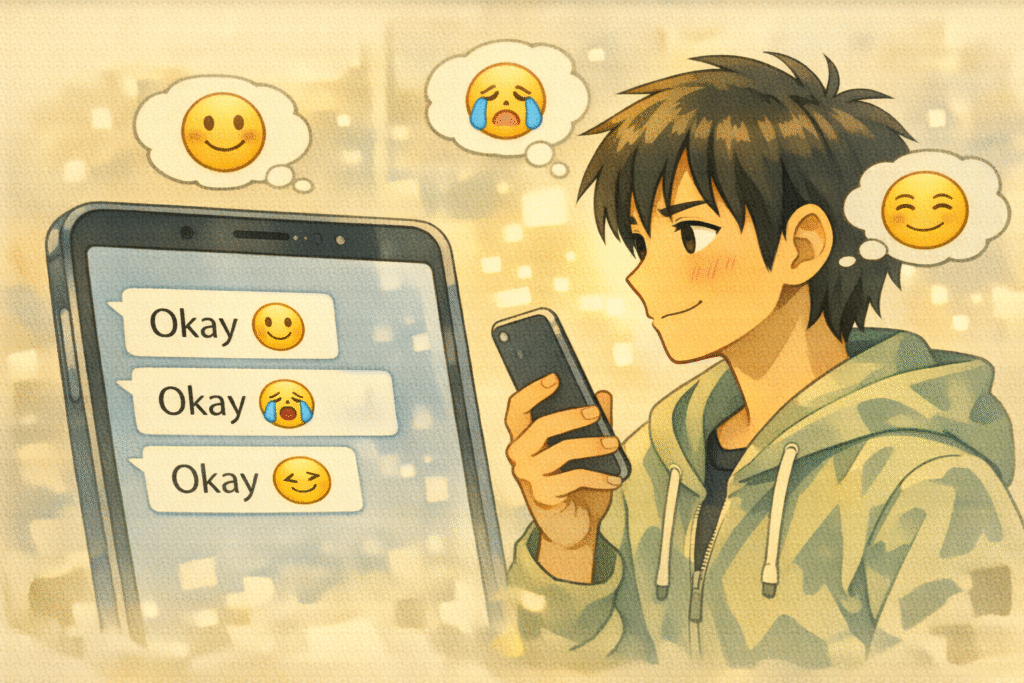
    Same text message showing different emotions with emojis

    “Okay.”

    “Okay 🙂”

    “Okay 😭”

    The word is the same.
    But the feeling changes completely.

    In an age where most conversations happen on screens,
    emojis are no longer decoration.
    They are emotional tools.

    Sometimes, a tiny icon communicates more clearly than a full sentence.

    So why does a small visual symbol carry such powerful emotional weight?


    1. Emojis Replace Lost Facial Expressions

    Emoji replacing facial expression in digital communication

    Human communication is deeply nonverbal.

    In face-to-face conversations,
    tone of voice, facial expression, eye movement, and gestures
    all shape meaning.

    But digital text strips these cues away.

    Emojis step in as substitutes for facial expressions.

    🙂 softens a statement.
    😅 signals nervous humor.
    🙃 suggests irony.

    They restore emotional nuance that plain text cannot easily provide.


    2. Emojis Compress Emotion Efficiently

    Psychology suggests that symbols can compress complex information into simple forms.

    Instead of writing:
    “I support you even if I cannot say much,”
    we might simply send:

    💪✨

    A single emoji can carry encouragement, warmth, and solidarity.

    Emojis allow emotional richness without slowing conversation.

    They are efficient containers of feeling.


    3. Emojis Clarify Intent

    Digital text is highly ambiguous.

    “Nice job.”
    Is it sincere? Sarcastic? Passive-aggressive?

    Add an emoji:

    “Nice job 😍” → Genuine praise
    “Nice job 😏” → Playful teasing
    “Nice job 🤨” → Suspicion

    Emojis reduce misinterpretation by signaling intent.

    They act as emotional safety devices in fragile digital spaces.


    4. Emojis as a Global Emotional Language

    Words differ across cultures.
    Smiles do not.

    😊 👍 ❤️

    These symbols transcend linguistic boundaries.

    In cross-cultural communication, emojis often bridge emotional gaps faster than translated sentences.

    They represent a new shared visual vocabulary of empathy.


    Conclusion: A Quiet Evolution of Language
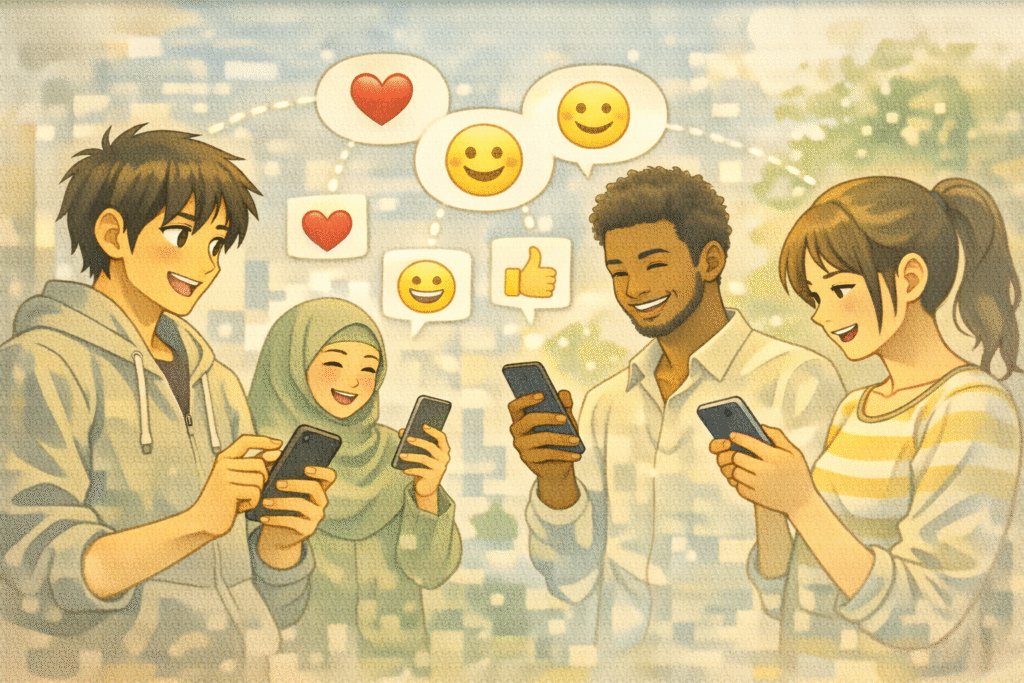
    Emojis connecting people across cultures

    Emojis are not replacing language.
    They are expanding it.

    They compensate for the emotional limitations of text-based communication.

    They make digital interaction warmer, softer, and more human.

    Next time you send a message,
    ask not only what you want to say,
    but how you want it to feel.

    Sometimes, a symbol speaks before the sentence does.

    Related Reading

    The transformation of communication and identity is further explored in The Sociology of Selfies, which investigates how digital expression reshapes social presence.
    On a political and structural level, Automation of Politics: Can Democracy Survive AI Governance? considers how algorithmic systems increasingly mediate human interaction and decision-making.

    References

    1. Evans, V. (2017). The Emoji Code: The Linguistics Behind Smiley Faces and Scaredy Cats. Picador.
    → This book frames emoji as an evolutionary stage of digital language. Evans argues that emoji function as pragmatic emotional markers, restoring tone and nuance lost in text-only communication.

    2. Danesi, M. (2016). The Semiotics of Emoji: The Rise of Visual Language in the Age of the Internet. Bloomsbury Academic.
    → Danesi explores emoji through semiotics, showing how visual symbols increasingly operate as meaningful linguistic units rather than decorative elements in digital discourse.

    3. Crystal, D. (2008). Txtng: The Gr8 Db8. Oxford University Press.
    → Crystal’s work on digital language provides theoretical grounding for understanding how abbreviated forms, emoticons, and emoji reshape emotional and pragmatic communication online.

  • The Politics of Empty Space

    How Absence Shapes Power in Advertising and Design

    Minimal composition showing power of empty space in design

    1. White Space as Silent Communication

    1.1. Visual Silence That Commands Attention

    When we look at advertisements or posters, our eyes are usually drawn to bold images and striking slogans.
    Yet many designers argue the opposite: empty space, or white space, often carries the strongest message.

    White space functions like silence in conversation.
    It appears to say nothing, yet that very absence forces the viewer to pause, slow down, and focus.

    1.2. Less Information, Stronger Impact

    Apple’s advertising offers a clear example.
    A single product is placed at the center, surrounded by vast empty space.
    Nothing distracts the viewer—attention naturally converges on the object itself.

    In poster design, the same principle applies.
    By intentionally removing excess elements, the remaining message becomes sharper and more memorable.
    White space, then, is not “nothing”; it is a strategic choice for emphasis.


    2. Cultural Meanings of White Space

    2.1. East Asian Aesthetics: Emptiness as Possibility

    Perceptions of white space differ across cultures.
    In East Asian aesthetics, empty space has long been treated as an essential artistic element.

    In ink painting, wide blank areas do not represent absence or lack.
    They invite imagination, symbolize nature, and allow meaning to emerge indirectly.
    Here, emptiness is not deficiency—it is potential.

    2.2. Western Design and the Rediscovery of Minimalism

    Western commercial design historically favored filling space with information.
    More text, more images, more explanation were believed to increase persuasion.

    Today, however, global visual culture has shifted.
    Minimalist layouts and generous white space now signal refinement, confidence, and sophistication.
    White space has become a shared visual language across cultures.


    3. White Space as a Language of Power

    3.1. The Authority of Not Explaining

    The ability to use white space often reflects privilege.
    Leaving large areas empty—especially in expensive advertising spaces—signals the freedom to waste resources.

    White space suggests a position where explanation is unnecessary.
    It communicates confidence: this needs no justification.

    White space used as a symbol of authority and power

    3.2. Luxury Branding and Symbolic Distance

    Luxury brands frequently display a single product against a blank background.
    The message is subtle but powerful:
    “We do not need to persuade you—our value is self-evident.”

    In this sense, white space operates not only as a design technique but as a symbol of status and authority.


    4. White Space in the Digital Age

    4.1. Information Overload

    Smartphone screens, social media feeds, and digital ads bombard users with endless content.
    The result is cognitive fatigue and fragmented attention.

    4.2. White Space as Psychological Relief

    In this environment, white space becomes a form of relief.
    Google’s minimal homepage or clean interface designs demonstrate how emptiness can restore calm.

    Amid digital excess, white space signals clarity, trust, and stability.
    It functions as a psychological pause, not merely a visual one.


    5. From Design to Everyday Life

    5.1. White Space Beyond Graphics

    The logic of white space extends beyond design:

    • White space in conversation: allowing silence instead of constant speech
    • White space in time: leaving unscheduled moments in daily life
    • White space in relationships: accepting distance without anxiety

    5.2. The Question of What to Remove

    White space ultimately asks a deeper question—not about what to add, but what to remove.
    It challenges the assumption that fullness equals value.


    Empty space as visual pause in digital overload

    Conclusion

    White space is not absence—it is a deliberate strategy and a form of power.
    In advertising and graphic design, it sharpens messages, signals authority, and reflects cultural values.

    In an age of digital overload, white space becomes more than a visual choice.
    It offers psychological balance and social meaning.

    The politics of white space ultimately asks us one simple question:

    What must we remove for what truly matters to become visible?

    References

    1. Lupton, E. (2014). Graphic Design Thinking: Beyond Brainstorming.
      Explores how reduction, simplicity, and empty space function as tools for visual thinking and strategic communication in design.
    2. Heller, S., & Vienne, V. (2012). 100 Ideas That Changed Graphic Design.
      Traces major turning points in graphic design history, including the rise of white space as a powerful visual principle.
    3. Hollis, R. (2001). Graphic Design: A Concise History.
      Provides historical context for minimalism and the evolving role of empty space in modern visual culture.