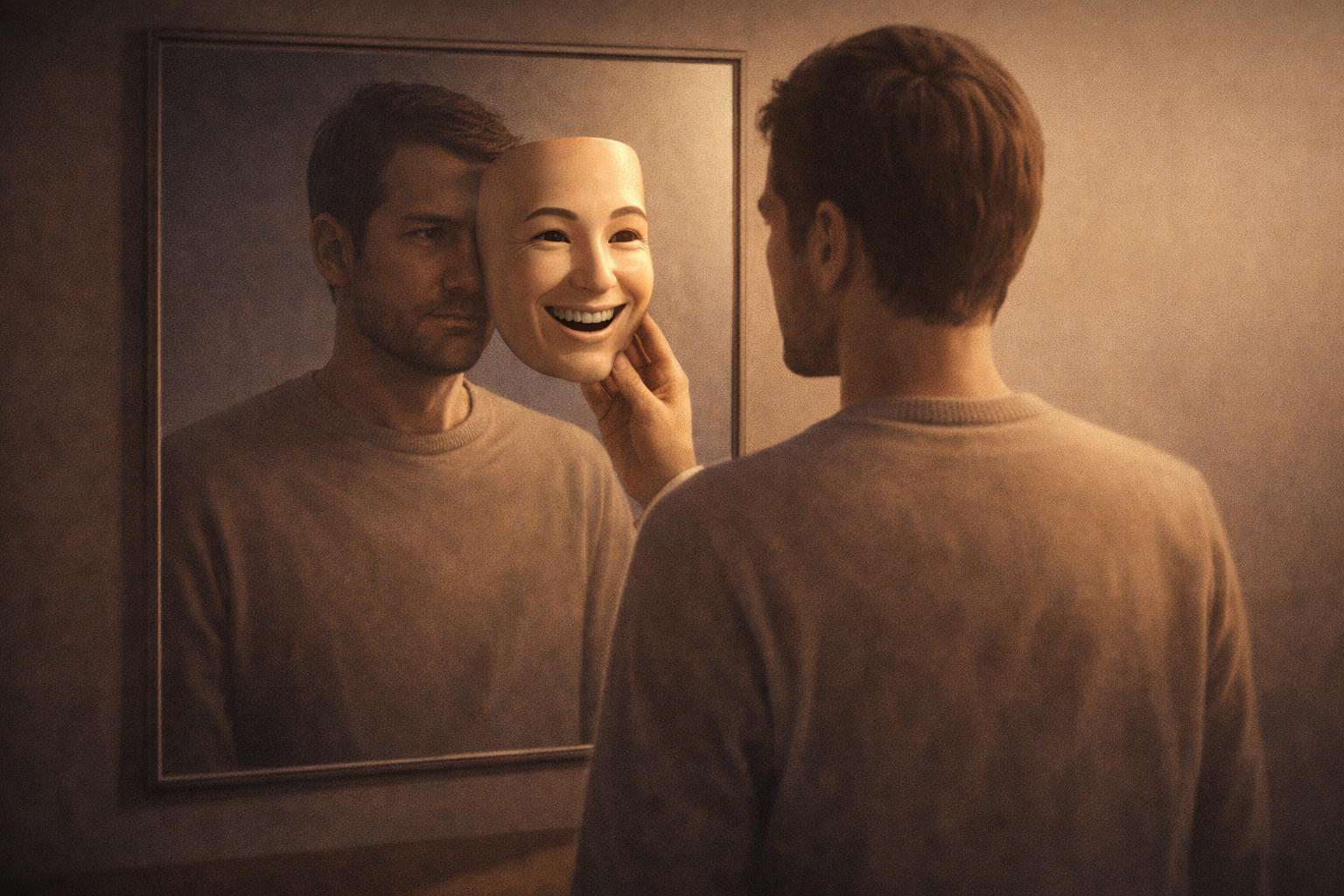
— Social Masks in the Age of Social Media
Hypocrisy is something most people dislike.
We criticize politicians whose promises differ from their actions.
We question celebrities whose charity work turns out to be a marketing strategy.
And we feel uncomfortable when acquaintances show sympathy in public but criticize behind someone’s back.
Yet hypocrisy is not simply someone else’s problem.
In modern society, it may be more accurate to say that everyone lives under the shadow of hypocrisy in one way or another. Interestingly, hypocrisy is not always a simple moral failure—it can also function as a complex social survival strategy.
1. Hypocrisy Is Not a New Problem
1.1 The Discomfort We Feel
When we hear the word “hypocrisy,” our instinctive reaction is often negative.
We tend to associate it with dishonesty, manipulation, or moral weakness. But hypocrisy has existed throughout human history. Social norms, expectations, and reputations have always shaped how people present themselves to others.
1.2 More Than a Moral Flaw
What makes hypocrisy complicated is that it often emerges from the tension between who we are and who we believe we should be.
Modern life constantly places individuals in situations where ideals and reality do not perfectly match. In this gap between the ideal self and the real self, hypocrisy often appears.
2. Everyday Hypocrisy: How Honest Can We Really Be?

Hypocrisy often appears in very ordinary situations.
Someone carries a reusable tumbler to show concern for the environment but uses disposable cups during a busy company dinner.
Someone advises a colleague that “health is the most important thing,” yet continues to work excessive overtime while coping with stress through unhealthy habits.
On social media, people promote the idea of “being authentic,” while carefully selecting filters, editing captions, and crafting the most appealing version of themselves.
These examples may feel familiar.
Most people constantly balance between who they want to be and who they actually are. Hypocrisy often emerges in that balancing act.
Importantly, this does not always mean malicious intent.
3. Social Media: A Mirror That Produces Hypocrisy

In modern society, one of the places where hypocrisy appears most frequently is social media.
Platforms that promise freedom of self-expression also create an environment of constant comparison and performance.
For example:
- A post saying “I’m happy with my life as it is” may appear alongside dozens of carefully edited travel photos.
- Messages encouraging people to “love their true selves” often coexist with metrics such as follower counts and “likes.”
These structures encourage people to live for the audience, not just for themselves.
Psychologists sometimes describe this phenomenon as mask culture—a social environment in which individuals construct an idealized version of themselves online while feeling a growing distance from their real identities.
4. The Social Consequences of Hypocrisy
The real problem emerges when hypocrisy becomes widespread.
Repeated exposure to inconsistency between words and actions can gradually erode social trust.
People may begin to distrust political promises.
Corporate social responsibility initiatives may be dismissed as public relations strategies.
Even genuine kindness from acquaintances may be interpreted as calculated behavior.
This dynamic creates what some scholars call moral fatigue—a growing sense of exhaustion and cynicism toward ethical claims.
If hypocrisy becomes normalized, sincerity itself may be treated with suspicion. In such a society, truly honest people may appear naïve or unrealistic.
5. What Can We Do About It?

Completely eliminating hypocrisy is probably impossible.
Human beings are emotional, contextual, and imperfect. No one can remain perfectly consistent at all times.
However, it is possible to reduce the influence of hypocrisy in everyday life through small practices:
- asking ourselves whether we can truly live up to what we say
- avoiding the need to appear perfect
- reflecting on our own contradictions before criticizing others
- recognizing that apparent hypocrisy may sometimes reflect a person’s attempt to grow or change
Understanding hypocrisy as part of the complexity of human life allows us to approach it with self-awareness rather than denial.
Conclusion
Hypocrisy is a shadow that quietly follows modern life.
Social media often intensifies it, encouraging people to present carefully constructed versions of themselves. Yet the presence of hypocrisy does not necessarily mean that sincerity has disappeared.
Reducing hypocrisy does not require perfection.
It begins with reflection—recognizing the contradictions within ourselves and choosing honesty whenever possible.
Perhaps the simple effort to be a little more sincere today than yesterday is where genuine authenticity begins.
Related Reading
The psychological mechanisms behind how people judge themselves and others are explored further in Why We Excuse Ourselves but Blame Others: Understanding the Actor–Observer Bias, where differences in perspective reveal why individuals often justify their own behavior while criticizing the actions of others. These cognitive patterns help explain why social hypocrisy can persist even when people believe they are acting consistently with their values.
At a broader societal level, similar questions about public behavior and digital identity appear in Clicktivism in Digital Democracy: Participation or Illusion?, where debates about online activism examine whether digital participation reflects genuine civic engagement or merely symbolic expression. In an era of social media visibility, the boundaries between authentic action and performative behavior become increasingly blurred.
Question for Readers
Do you think hypocrisy is an unavoidable part of modern life?
Or do you believe people can live authentically even within social expectations?
Share your thoughts in the comments.
References
Goffman, E. (1959). The Presentation of Self in Everyday Life. New York: Anchor Books.
→ This classic sociological work analyzes how individuals present themselves in everyday interactions. Goffman compares social life to theatrical performance, suggesting that people adopt different roles depending on the expectations of their audience. The concept helps explain why individuals often wear “social masks” and why hypocrisy can emerge as part of impression management.
Turkle, S. (2011). Alone Together: Why We Expect More from Technology and Less from Each Other. New York: Basic Books.
→ Turkle explores how digital technologies and social media reshape human relationships. She argues that online platforms encourage individuals to construct curated identities while simultaneously increasing feelings of loneliness and social distance. Her analysis helps explain why modern communication environments can intensify performative behavior and perceived hypocrisy.
Baumeister, R. F. (1984). Choking Under Pressure: Self-consciousness and Paradoxical Effects of Incentives on Skillful Performance. Journal of Personality and Social Psychology, 46(3), 610–620.
→ Baumeister’s research examines how heightened self-consciousness and external expectations can undermine natural behavior and performance. The study highlights how social evaluation pressures influence human actions, offering insight into why individuals sometimes engage in impression management or contradictory behavior in public settings.