Tag: self-awareness

  • Why Emotions Matter

    Why Emotions Matter

    How Feelings Shape the Way We Think, Decide, and Live

    Emotions are among the most fundamental aspects of being human. From the moment we wake up until we fall asleep, our lives are guided by a constantly changing landscape of feelings—joy, sadness, fear, anger, surprise, gratitude, love, disappointment, and hope.

    For centuries, emotions were often viewed as obstacles to clear thinking. Today, however, psychology and neuroscience tell a different story. Emotions are not simply irrational reactions that interfere with reason. They are essential biological and psychological signals that help us survive, build relationships, make decisions, and understand ourselves.

    Whether pleasant or uncomfortable, every emotion carries valuable information. Learning to recognize and understand our emotions is one of the most important steps toward living a healthier, wiser, and more meaningful life.


    1. What Are Emotions?

    An emotion is our mind and body’s immediate response to an event, situation, or experience. It involves not only thoughts but also physical changes such as increased heart rate, facial expressions, hormonal responses, and behavioral reactions.

    Imagine hearing a loud noise behind you while walking alone at night. Before you consciously analyze the situation, your heart begins beating faster and your muscles become tense. This rapid response is an emotion preparing your body to react.

    Psychologists often distinguish between emotions, feelings, and moods.

    An emotion is an immediate biological and psychological response to a stimulus.

    A feeling is our conscious awareness and interpretation of that emotional response.

    A mood is a more general emotional state that may last for hours or even days without a single obvious cause.

    Although these terms are often used interchangeably in everyday conversation, understanding their differences helps us better understand ourselves.

    Emotions are not random events. They evolved because they improved our ancestors’ chances of survival and social cooperation.


    2. Basic and Complex Emotions

    people expressing basic human emotions

    Researchers have identified several basic emotions that appear across cultures.

    Psychologist Paul Ekman proposed six universal emotions:

    • Happiness
    • Sadness
    • Fear
    • Anger
    • Surprise
    • Disgust

    These emotions appear early in life and are recognized through similar facial expressions across many cultures.

    Each serves an important purpose.

    Fear encourages us to avoid danger.

    Anger motivates us to defend ourselves against injustice or threats.

    Sadness helps us process loss and encourages support from others.

    Joy reinforces behaviors that improve our well-being and strengthen social bonds.

    Surprise prepares us to pay attention to unexpected events.

    Disgust protects us from contamination and harmful substances.

    As people mature, emotions become increasingly complex.

    Feelings such as guilt, pride, jealousy, embarrassment, gratitude, nostalgia, and compassion combine multiple emotional experiences with personal values and social understanding.

    For example, guilt often combines sadness with responsibility, while jealousy may involve fear, sadness, and anger simultaneously.

    These complex emotions play essential roles in maintaining relationships and navigating society.


    3. Why Positive and Negative Emotions Both Matter

    Many people naturally prefer positive emotions.

    Happiness, love, gratitude, curiosity, and hope make life enjoyable and strengthen psychological well-being.

    Research in positive psychology shows that positive emotions broaden our thinking, improve creativity, strengthen resilience, and encourage cooperation with others.

    When people regularly experience gratitude or optimism, they often become more flexible in solving problems and more capable of adapting to life’s challenges.

    Positive emotions also contribute to better physical health by reducing stress and supporting the immune system.

    However, this does not mean negative emotions are harmful or unnecessary.

    Fear warns us about danger.

    Anger signals that something feels unfair or threatens our values.

    Sadness gives us time to recover after disappointment or loss.

    Even anxiety can encourage careful preparation before important events.

    Modern psychology increasingly views emotions as information rather than labels of “good” or “bad.”

    Every emotion asks a different question.

    Fear asks,

    “Am I safe?”

    Anger asks,

    “Has something crossed an important boundary?”

    Sadness asks,

    “What have I lost?”

    Joy asks,

    “What makes life meaningful?”

    Understanding these messages is often more valuable than trying to suppress them.


    4. How Emotions Shape Our Daily Lives

    human emotions influencing everyday life and relationships

    Whether we realize it or not, emotions influence almost every decision we make.

    They affect how we interpret situations, communicate with others, solve problems, and remember important experiences.

    A person who feels confident before an interview is more likely to communicate clearly.

    Someone overwhelmed by anxiety may struggle to think objectively even when fully prepared.

    Emotions also influence memory.

    Events connected with strong emotions—such as graduation, marriage, the birth of a child, or the loss of a loved one—often remain vivid for many years.

    This close relationship between emotion and memory helps explain why emotionally meaningful experiences shape our personal identities.

    Relationships are also deeply influenced by emotions.

    Empathy, trust, compassion, and forgiveness allow people to build meaningful social connections.

    Without emotional understanding, even excellent communication skills become less effective.

    Our emotional lives shape not only how we experience the world but also how we connect with one another.


    5. Emotional Intelligence: Understanding Rather Than Controlling Emotions

    Many people believe emotional maturity means never becoming angry, sad, or afraid.

    In reality, emotional intelligence is something quite different.

    Psychologist Daniel Goleman describes emotional intelligence as the ability to recognize, understand, manage, and appropriately express emotions while also understanding the emotions of others.

    Emotionally intelligent people do not eliminate negative emotions.

    Instead, they learn how to respond wisely.

    Rather than reacting impulsively, they pause, reflect, and choose actions that align with their long-term values.

    Simple habits can strengthen emotional intelligence.

    Taking a few moments to identify what we are feeling, listening carefully to others, practicing gratitude, and reflecting before reacting all help us build healthier emotional habits.

    Emotional intelligence is therefore less about controlling emotions than about learning from them.


    6. Every Emotion Has Something to Teach Us

    One of the greatest misconceptions about emotions is that some should be welcomed while others should be avoided.

    In reality, every emotion serves a purpose.

    Without fear, we might ignore genuine dangers.

    Without sadness, we might never fully appreciate love or meaningful relationships.

    Without anger, injustice might go unchallenged.

    Without joy, life would lose much of its motivation and hope.

    Emotions are not obstacles to wisdom.

    They are guides that help us understand both ourselves and the world around us.

    The challenge is not to eliminate difficult emotions but to respond to them thoughtfully.

    When we become curious about our emotions instead of judging them, they become valuable teachers rather than overwhelming enemies.


    Conclusion: Listening to What Our Emotions Tell Us

    person reflecting on emotions and personal growth

    Emotions are far more than temporary feelings. They influence our decisions, shape our relationships, and help define how we experience the world. Whether joyful or painful, every emotion offers valuable insight into our needs, values, and experiences.

    Learning to understand our emotions does not mean avoiding sadness, fear, or anger. Instead, it means recognizing that every emotion has a purpose and learning how to respond with awareness rather than impulse.

    Perhaps emotional well-being is not about feeling happy all the time. It is about learning to listen to what our emotions are trying to tell us—and allowing that understanding to guide us toward wiser decisions, stronger relationships, and a richer, more meaningful life.

    A Question for Readers

    Think about an emotion you experienced recently—whether it was joy, anger, fear, or sadness.

    Instead of asking whether it was a “good” or “bad” emotion, what might it have been trying to teach you about yourself or your situation?


    Related Reading

    Our emotions influence not only how we feel but also how we remember our experiences and build our identity over time. This connection is explored further in Can AI Remember Like Humans?, which examines how human memory is shaped by emotion, experience, and meaning in ways that differ fundamentally from artificial intelligence.

    At the same time, emotions also affect the way we interpret information and make important decisions. This psychological perspective continues in Confirmation Bias in Investing, which shows how feelings, past experiences, and cognitive biases often shape our judgments more than we realize.

    References

    1. Goleman, Daniel. Emotional Intelligence: Why It Can Matter More Than IQ. Bantam Books, 1995.

    A groundbreaking book that introduced the concept of emotional intelligence (EQ) to a global audience. Goleman explains how recognizing and managing emotions contributes to better decision-making, stronger relationships, and greater success in both personal and professional life.


    2. Ekman, Paul. Emotions Revealed: Recognizing Faces and Feelings to Improve Communication and Emotional Life. 2nd ed., Times Books, 2007.

    Ekman explores the science of universal human emotions and facial expressions. His research demonstrates that basic emotions are shared across cultures and play essential roles in communication and survival.


    3. Fredrickson, Barbara L. Positivity. Crown Publishers, 2009.

    Based on the Broaden-and-Build Theory, Fredrickson explains how positive emotions expand our thinking, strengthen resilience, and improve creativity, relationships, and long-term psychological well-being.


    4. Damasio, Antonio. Descartes’ Error: Emotion, Reason, and the Human Brain. G. P. Putnam’s Sons, 1994.

    Damasio challenges the traditional belief that reason and emotion operate separately. Through neuroscience, he demonstrates that emotions are essential for rational thinking and effective decision-making.


    5. Barrett, Lisa Feldman. How Emotions Are Made: The Secret Life of the Brain. Houghton Mifflin Harcourt, 2017.

    Barrett presents a modern view of emotion, arguing that emotions are actively constructed by the brain rather than simply triggered automatically. The book offers a fresh perspective on how emotions influence perception, memory, and behavior.


  • Why Do Humans Seek Perfection While Knowing They Are Incomplete?

    Why Do Humans Seek Perfection While Knowing They Are Incomplete?

    The Endless Tension Between Imperfection and the Desire for Wholeness

    Standing in front of a mirror at the start of the day, we often notice small misalignments—
    a crooked button, unruly hair, a detail slightly out of place.
    They seem trivial, yet they quietly invite a deeper question:
    Why can’t I ever be completely right?

    Human life is filled with such imperfections.
    What is striking, however, is that these flaws rarely end in resignation.
    Instead, we continue to imagine better versions of ourselves and strive toward a more complete life.
    Perhaps the moment we recognize imperfection is precisely the moment our pursuit of perfection begins.


    1. Philosophical Perspectives — Imperfection as an Ontological Trigger

    Human figure confronting imperfection through self-awareness

    Lack as the Origin of Aspiration

    In Symposium, Plato explains human desire through the concept of lack.
    We seek beauty, goodness, and truth not because we possess them, but because we do not.
    Imperfection, in this sense, is not a weakness—it is the very condition that gives rise to longing and growth.

    Aristotle similarly described humans as rational animals, whose reason enables them to recognize deficiency and move toward excellence (arete).
    To be human, then, is not to be complete, but to strive.

    Modern Reflections on Human Fragility

    Blaise Pascal famously called humans “thinking reeds.”
    We are fragile and finite, yet capable of contemplating infinity.
    This paradox—weakness combined with reflection—makes imperfection not merely a flaw, but the source of human dignity.


    2. Religious Perspectives — Perfection as an Unreachable Ideal

    Theological Limits of Human Completion

    In Christian theology, humans are marked by original sin and cannot achieve perfection without divine grace.
    Yet the moral task is not to become perfect, but to move toward holiness.
    The value lies in direction, not arrival.

    Spiritual Practice and Acceptance of Limits

    Buddhist traditions likewise emphasize human entanglement in ignorance and attachment.
    Enlightenment is not achieved by becoming flawless, but by recognizing impermanence and letting go of rigid ideals.
    Here, perfection functions as orientation rather than destination.


    3. Psychological Perspectives — Perfectionism and Self-Awareness

    The Double Edge of Perfectionism

    Psychology describes the tension between imperfection and aspiration through perfectionism.
    At its best, perfectionism motivates growth and discipline.
    At its worst, it produces anxiety, self-criticism, and chronic dissatisfaction.

    Social Recognition and the Fear of Exposure

    Modern research shows that perfectionism is deeply connected to social evaluation.
    We are aware of our flaws, yet we fear revealing them to others.
    The desire to appear flawless often reflects not self-confidence, but vulnerability.

    Human striving toward perfection despite visible limitations

    4. Evolutionary Perspectives — Imperfection as a Survival Strategy

    Biological Limits and Human Innovation

    From an evolutionary standpoint, human imperfection has always demanded compensation.
    Lacking physical strength or speed, humans developed tools, language, and cooperation.
    Our awareness of limitation fueled creativity and adaptation.

    Progress Through Dissatisfaction

    The pursuit of “better” weapons, safer shelters, and more accurate knowledge emerged from recognizing what was insufficient.
    Perfection, here, is not an illusion—it is a guiding pressure that shaped survival itself.


    5. Cultural Perspectives — The Aesthetics of Imperfection

    Celebrating the Incomplete

    Some cultures embrace imperfection as beauty.
    Japanese wabi-sabi aesthetics find meaning in irregularity and transience, while Renaissance art idealized proportion and harmony.
    Each reflects a different response to the same human tension.

    Contemporary Myths of Perfection

    In the age of social media, flawless images circulate endlessly.
    At the same time, movements emphasizing self-acceptance and authenticity are gaining ground.
    Modern culture oscillates between hiding imperfection and reclaiming it.


    Conclusion — Moving Toward Perfection Without Denying Imperfection

    Embracing imperfection as a foundation for human growth

    Humans are imperfect beings who know they are imperfect—and still strive for perfection.
    This pursuit may never reach its endpoint.
    Yet growth does not depend on arrival, but on movement.

    To acknowledge imperfection without abandoning aspiration may be the most human stance of all.
    Perfection, then, is not a final state, but a horizon—
    one that gives direction, meaning, and momentum to an incomplete life.

    Reader Question

    If imperfection is an essential part of being human, should we continue striving for perfection—or learn to embrace our limits?

    Related Reading

    The pursuit of perfection naturally leads to a deeper question about the meaning of happiness and human flourishing. Can Happiness Ever Be Measured Objectively? explores whether a fulfilling life can truly be evaluated through external standards, or whether happiness ultimately depends on personal meaning, values, and lived experience. Together, these discussions suggest that the search for perfection may be less important than the search for a meaningful life.

    The tension between human limitation and the pursuit of ideal standards becomes particularly visible in technological contexts, as explored in AI Beauty Standards and Human Diversity, where algorithmic definitions of perfection challenge the diversity and imperfection inherent in human identity. Together, these discussions invite reflection on whether imperfection is not a flaw to eliminate, but an essential part of what makes us human.

    References

    1. Aristotle. (1999). Nicomachean Ethics. Translated by T. Irwin. Indianapolis: Hackett Publishing.
      This foundational work explores human flourishing (eudaimonia) as a process grounded in recognizing limitations and cultivating virtue through practice. Aristotle’s account highlights how imperfection motivates ethical striving rather than signaling failure.
    2. Frankl, V. E. (2006). Man’s Search for Meaning. Boston: Beacon Press.
      Frankl argues that human beings seek meaning precisely within conditions of suffering, finitude, and incompleteness. The book offers a psychological and existential account of how imperfection becomes the ground for purpose rather than despair.
    3. Plato. (2002). Symposium. Translated by Alexander Nehamas and Paul Woodruff. Indianapolis: Hackett Publishing.
      In this dialogue, Plato presents desire (eros) as arising from lack, positioning imperfection as the source of humanity’s pursuit of beauty, truth, and goodness. The text provides a classical philosophical foundation for understanding aspiration as rooted in incompleteness.
    4. Pascal, B. (1995). Pensées. Translated by A. J. Krailsheimer. London: Penguin Classics.
      Pascal famously describes humans as fragile yet reflective beings, emphasizing the paradox of weakness combined with the capacity for infinite thought. His reflections illuminate how imperfection and greatness coexist at the core of human identity.
    5. Hewitt, P. L., & Flett, G. L. (1991). “Perfectionism in the Self and Social Contexts: Conceptualization, Assessment, and Association with Psychopathology.” Journal of Personality and Social Psychology, 60(3), 456–470.
      This influential psychological study distinguishes different forms of perfectionism and examines their emotional and social consequences. It provides empirical insight into how awareness of imperfection can lead either to growth or psychological distress.
  • Walking as a Way of Thinking

    How a simple walk becomes a quiet conversation with the self.

    How a simple walk becomes a quiet conversation with the self

    Opening – A Walk That Slows the Mind

    For centuries, philosophers, writers, and artists have discovered that walking is more than physical movement. It creates a rhythm that allows thoughts to settle, emotions to unfold, and new perspectives to emerge. Even today, a simple walk remains one of the most accessible ways to reconnect with ourselves.

    Walking has a quiet power.
    It doesn’t force answers, yet it softens the questions we carry.

    Some paths slow us down just enough to hear the thoughts we’ve been ignoring.
    Today’s walk was one of those rare moments when movement becomes reflection.


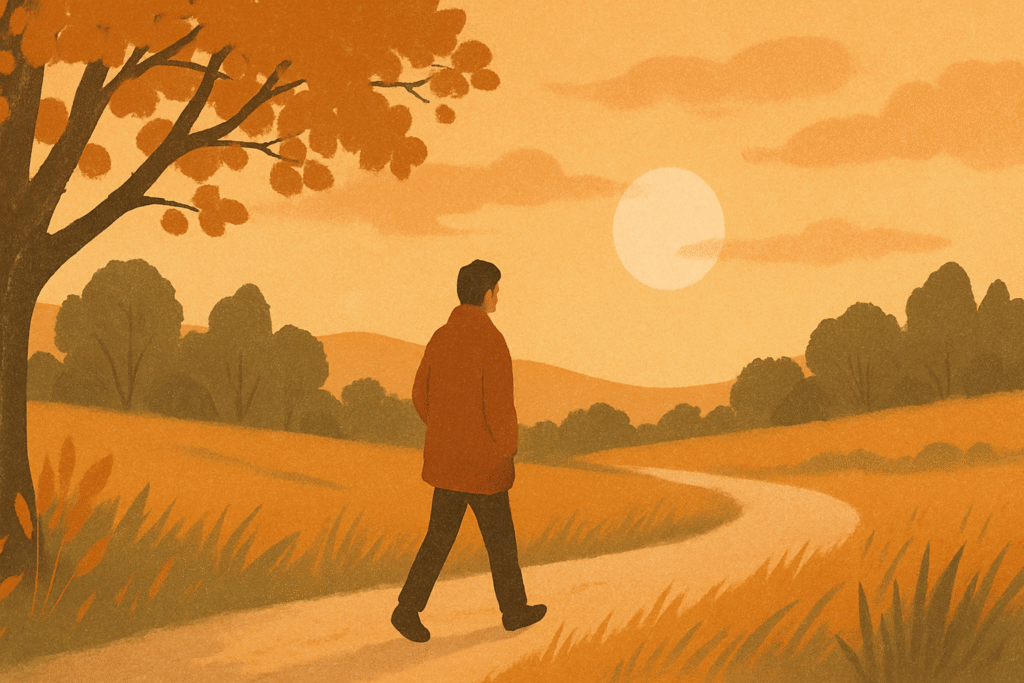
    Sunlit forest path winding through a quiet autumn field

    A Small Moment of Humor

    “When a good idea comes to me while walking… is that exercise, or is it studying?”

    Maybe it’s both.
    Walking might be the only workout that strengthens the heart and clears the mind at the same time.


    When Thoughts Begin to Walk Too

    With each steady step, the inner noise began to fade.
    Not because solutions arrived, but because the questions felt less urgent—
    as if they finally had space to breathe.

    Walking never demands a conclusion.
    It simply offers a quieter place for thoughts to wander.

    Sometimes the ideas that surface mid-stride
    are the ones we’ve postponed the longest.
    Today felt like the right day to let them speak.


    A Simple Practice for the Day

    The 10-Minute Reflective Walk
    Take a short walk with no destination.
    Choose one guiding question:

    • What thought has been weighing on me?
    • What emotion does this path bring up?
    • If I could choose freely, where would I go next?

    If one clear sentence emerges, capture it before it drifts away.


    A Moment of Presence

    A soft breeze brushed the face.
    Light filtered gently through the leaves.
    Breathing slowed.

    Walking is not merely moving forward—
    it is quietly returning to oneself.


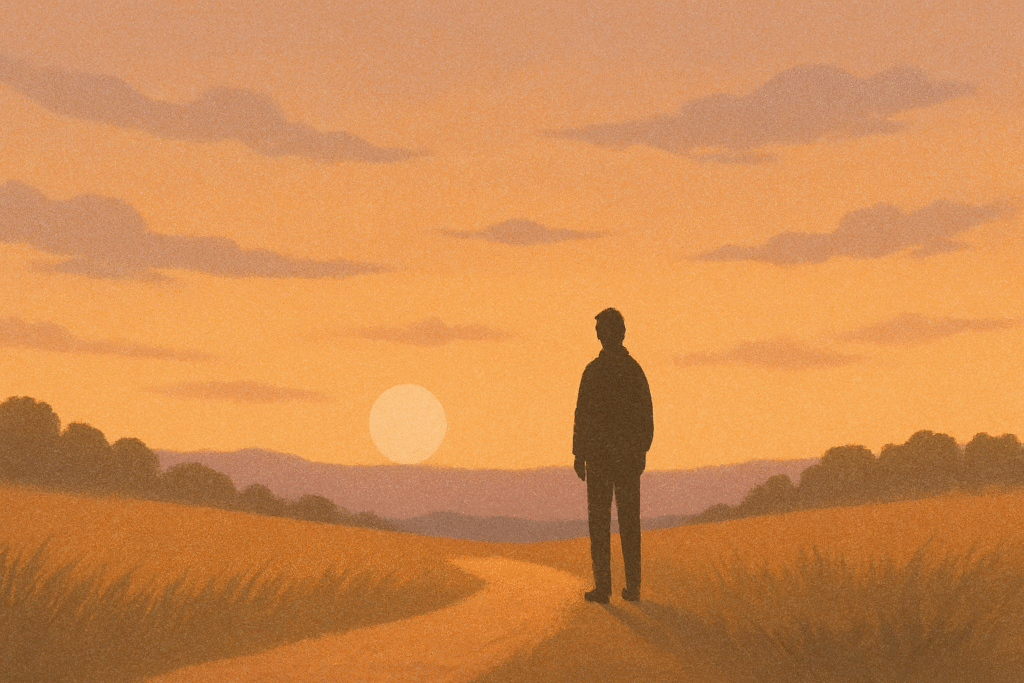
    A lone figure facing a calm sunset horizon

    Quote of the Day

    All truly great thoughts are conceived while walking.
    — Friedrich Nietzsche


    Closing Insight

    In the rhythm of our steps, we rediscover the rhythm of our thoughts.

    Walking clears space without demanding effort—
    a small ritual,
    a mental reset,
    a return to clarity.


    Today’s Insight (Science Notes)

    Studies from Stanford and the American Psychological Association highlight that walking significantly boosts divergent thinking and emotional clarity.

    Neuroscientific research shows that walking:

    • increases activity in the prefrontal cortex,
    • boosts creativity and emotional regulation,
    • reduces stress hormones,
    • and raises serotonin levels.

    This is why ideas often arrive precisely when we aren’t trying to find them.


    Summary Sentence

    “Walking is not a physical act, but a quiet conversation with the mind.”