Tag: quiet moments

  • Nipper and the Art of Listening

    Nipper and the Art of Listening

    What an Old Belt Buckle Reminded Me About Truly Hearing Others

    Sometimes an old object does more than bring back a memory.

    Sometimes it asks us a question.

    While rearranging my bookshelf one day, my fingers touched something cold and heavy between the books.

    It was an old metal belt buckle I had almost forgotten.

    I picked it up and looked again.

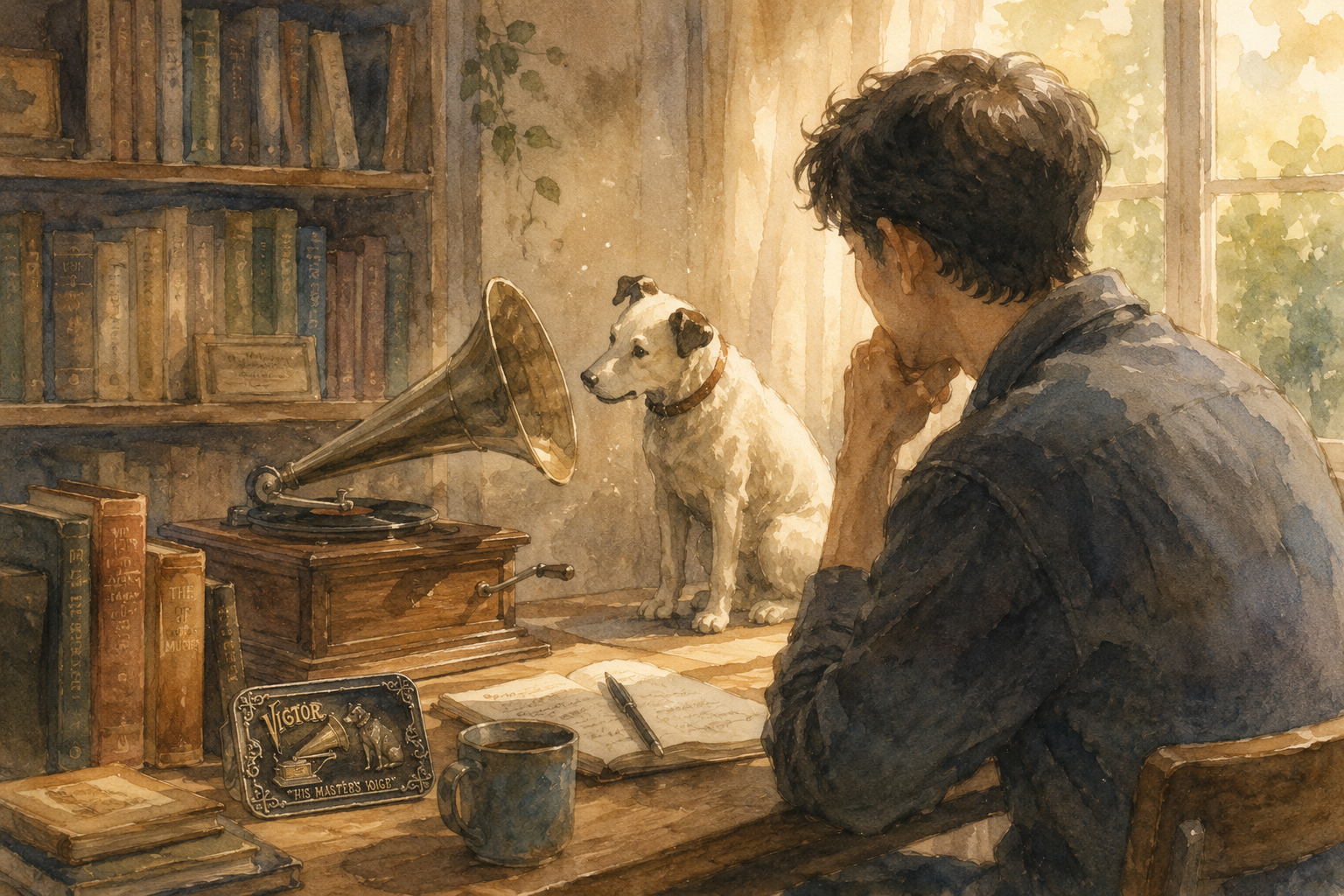
    On its surface was a familiar scene: a small dog sitting beside a gramophone, his head slightly tilted as he listened intently to the sound coming from its horn.

    The words were familiar too:

    His Master’s Voice.

    And the dog had a name.

    Nipper.

    vintage Victor belt buckle featuring Nipper listening to a gramophone

    The Dog Who Was Listening

    The image of Nipper listening to a gramophone became one of the most recognizable symbols in the history of recorded music.

    But as I held the buckle in my hand, I was less interested in its commercial history than in something much simpler.

    I kept looking at the dog.

    His head was tilted.

    His ears were attentive.

    His entire body seemed focused on one thing.

    Listening.

    There was something strangely moving about his posture.

    He was not speaking.

    He was not explaining.

    He was not preparing an answer.

    He was simply listening.

    close-up of Nipper listening attentively to a gramophone

    And suddenly, that small image felt surprisingly modern.


    A World Full of Voices

    We live surrounded by sound.

    Messages arrive constantly.

    News updates appear before we have finished reading the previous ones.

    Videos begin automatically.

    Conversations compete with notifications.

    Everyone seems to be speaking, explaining, reacting, and responding.

    Yet amid all this communication, genuine listening can sometimes feel strangely rare.

    Looking at Nipper, I began to wonder whether listening has become one of the quiet skills we are slowly losing.

    To listen to someone without preparing our reply.

    To follow a page without checking a screen.

    To hear an entire piece of music without skipping ahead.

    To notice rain against a window without needing to photograph it.

    These are small acts.

    But perhaps they require more attention than ever.


    Listening With More Than Our Ears

    There was a time when listening to recorded music required a different kind of ritual.

    A record had to be chosen.

    Placed carefully on a turntable.

    A needle lowered.

    Then came the music.

    There was no endless stream waiting to replace it a few seconds later.

    Perhaps the technology was limited by today’s standards, but the act itself invited attention.

    That thought brought back another realization.

    Listening is not simply something the ears do.

    Sometimes we listen with patience.

    Sometimes with curiosity.

    Sometimes with compassion.

    And sometimes the most important thing we can offer another person is not advice at all.

    It is our attention.


    The Angle of the Heart

    I looked again at the little dog on the buckle.

    His head was still tilted toward the gramophone.

    And a phrase came to me:

    Listening is not only about the direction of our ears.
    It is about the angle of the heart.

    Perhaps that is what I had been seeing all along.

    When someone speaks, do I really hear what they are trying to say?

    When I read, do I allow the words enough time to reach me?

    When music plays, do I stay with it long enough to hear what exists between the notes?

    And when the natural world speaks in wind, rain, birdsong, or silence, do I still notice?

    The world may have been speaking all along.

    Perhaps I had simply become too busy to listen.


    A Small Reminder on the Bookshelf

    That day, I did not put the buckle back between the books.

    Instead, I placed it where I could see it.

    vintage Victor Nipper belt buckle beside a computer keyboard

    Now, when writing becomes difficult, when I find myself speaking too much, or when I am tempted to judge someone before hearing the whole story, I sometimes look at Nipper.

    And for a moment, I try to do what he does.

    I stop.

    I turn my attention toward what is in front of me.

    And I listen.

    The old buckle has not taught me anything complicated.

    Only something easy to forget:

    Listening does not always solve another person’s problems.

    It does not necessarily give us the right answer.

    But being truly heard can make someone’s day feel a little less lonely.

    And perhaps a little warmer.

    So the small dog remains on my bookshelf, his head forever tilted toward an old gramophone.

    And every now and then, without saying a word, he reminds me to tilt my heart a little too.

    Reader Question

    When was the last time you truly listened—to a person, a piece of music, or even the quiet sounds around you—without thinking about what to say or do next?

    Related Reading

    The quiet attention embodied by Nipper is echoed in The Rhythm of Wood, The Tempo of My Mind, where the simple act of working with wood reveals how slowing down can restore attention, patience, and a deeper awareness of the present moment.

    A similar journey through sound and memory unfolds in The Sound of Stairs in an Old Building – Where Past Memories Meet Present Footsteps, where the creak of an old wooden staircase becomes a doorway between memory, time, and the quiet act of noticing what we usually pass by.

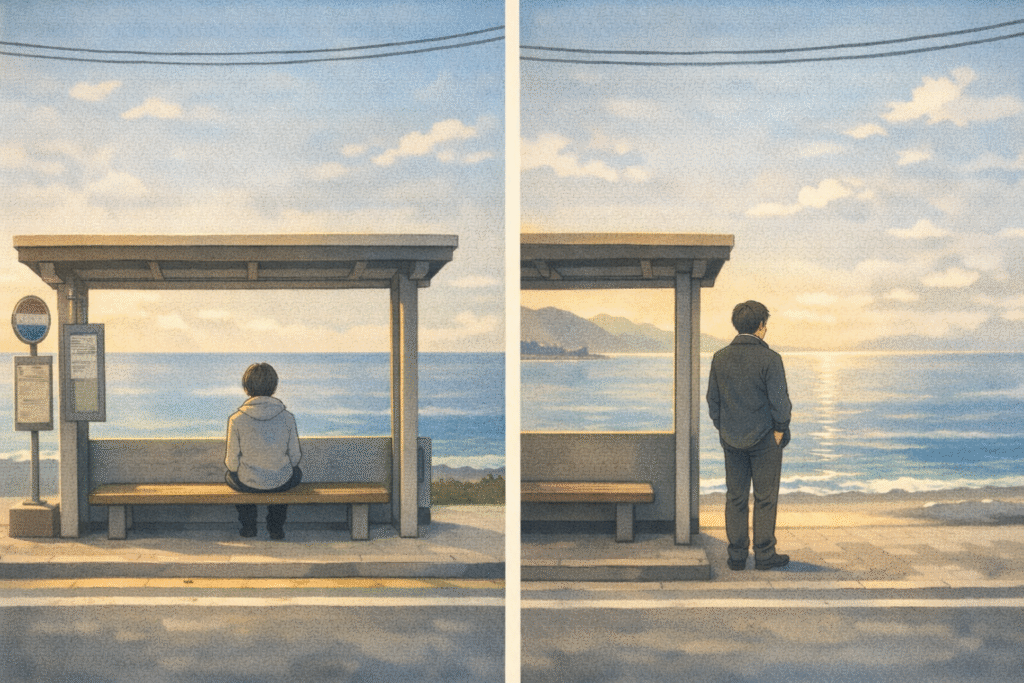
  • A Seaside Bus Stop – The Landscape of Waiting

    A Seaside Bus Stop – The Landscape of Waiting

    Practicing stillness in the same place, at the same hour

    At a seaside bus stop,
    waiting quietly becomes a form of daily meditation.

    People arrive at the same hour,
    sit in the same seats,
    and slowly empty their minds.


    The Bus Stop by the Sea

    Quiet seaside bus stop with a person waiting by the sea

    The seaside bus stop holds the same scene every day.

    Waves roll in and retreat without urgency.
    An old bench catches the shadow of a passing seagull.
    The rhythm never changes, yet the meaning always does.

    Each morning, different people arrive.
    Some are on their way to work.
    Others come simply to sit and think.

    The sea repeats the same movement beneath their feet,
    but the hearts standing above it are never quite the same.


    The Comfort of Repetition

    People quietly waiting together at a seaside bus stop

    Those who sit there regularly begin to recognize one another
    without saying much.

    “Here again today.”

    The greeting is brief,
    but it carries an unexpected sense of reassurance.

    Repetition can feel dull,
    yet within it lives a quiet strength.

    The same hour.
    The same place.
    The same sound of waves.

    These ordinary repetitions form the rhythm
    that gently holds our days together.


    What Waiting Really Means

    Waiting for the bus is not an empty pause.

    It is a short moment of reflection—
    a small meditation tucked into daily life.

    Perhaps we are not waiting for transportation at all.
    Perhaps we are waiting for calm.

    When impatience gives way to gratitude—
    “At least I get to see the sea right now”
    waiting becomes rest.


    A Brief Encounter

    Some days, a stranger sits beside you.

    No introductions.
    No conversation.

    Just two people sharing the same view
    as the wind passes between them.

    In that silence, warmth travels without words.

    Simply standing in the same place,
    at the same time,
    creates a quiet bond.

    Waiting slowly makes us resemble one another.


    Conclusion: Where Waiting Turns into Healing

    Evening light at a seaside bus stop as waiting becomes healing

    When the bus arrives, everyone leaves
    in different directions.

    But the bus stop remains.

    For one person, it was a place of transit.
    For another, a moment of rest.

    Like the sea breeze,
    our waiting passes through someone else’s day
    and leaves behind a small, unnoticed comfort.


    One quiet truth to carry:
    Waiting does not always delay us.
    Sometimes, it gently puts us back together.

    Reader Question

    Have you ever found unexpected peace while waiting somewhere?

    Or is there a place in your daily life that has quietly become a space for reflection?

    Related Reading

    Some places become meaningful not because of dramatic events, but because memories quietly gather there over time.
    The Old Clock Tower in the Park explores how ordinary places can hold waiting, memory, and the feeling of time slowing down.

    Waiting can become a form of emotional shelter when we learn to stay open without being overwhelmed.
    The transparent Umbrella reflects on protection, connection, and the quiet strength of remaining present in the world.

  • Walking as a Way of Thinking

    How a simple walk becomes a quiet conversation with the self.

    How a simple walk becomes a quiet conversation with the self

    Opening – A Walk That Slows the Mind

    For centuries, philosophers, writers, and artists have discovered that walking is more than physical movement. It creates a rhythm that allows thoughts to settle, emotions to unfold, and new perspectives to emerge. Even today, a simple walk remains one of the most accessible ways to reconnect with ourselves.

    Walking has a quiet power.
    It doesn’t force answers, yet it softens the questions we carry.

    Some paths slow us down just enough to hear the thoughts we’ve been ignoring.
    Today’s walk was one of those rare moments when movement becomes reflection.


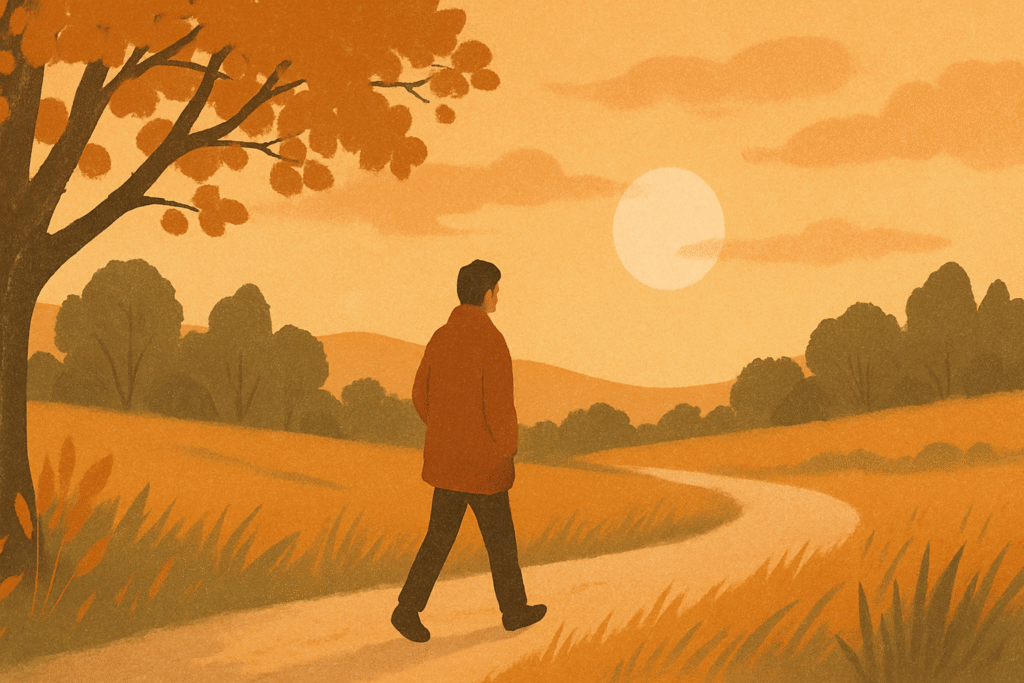
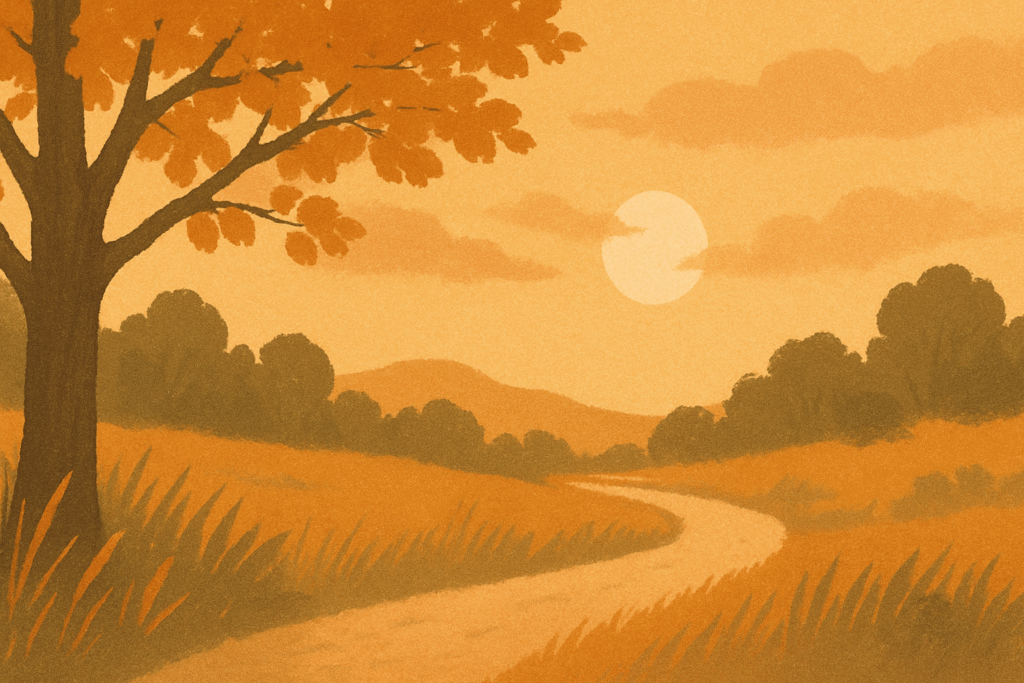
    Sunlit forest path winding through a quiet autumn field

    A Small Moment of Humor

    “When a good idea comes to me while walking… is that exercise, or is it studying?”

    Maybe it’s both.
    Walking might be the only workout that strengthens the heart and clears the mind at the same time.


    When Thoughts Begin to Walk Too

    With each steady step, the inner noise began to fade.
    Not because solutions arrived, but because the questions felt less urgent—
    as if they finally had space to breathe.

    Walking never demands a conclusion.
    It simply offers a quieter place for thoughts to wander.

    Sometimes the ideas that surface mid-stride
    are the ones we’ve postponed the longest.
    Today felt like the right day to let them speak.


    A Simple Practice for the Day

    The 10-Minute Reflective Walk
    Take a short walk with no destination.
    Choose one guiding question:

    • What thought has been weighing on me?
    • What emotion does this path bring up?
    • If I could choose freely, where would I go next?

    If one clear sentence emerges, capture it before it drifts away.


    A Moment of Presence

    A soft breeze brushed the face.
    Light filtered gently through the leaves.
    Breathing slowed.

    Walking is not merely moving forward—
    it is quietly returning to oneself.


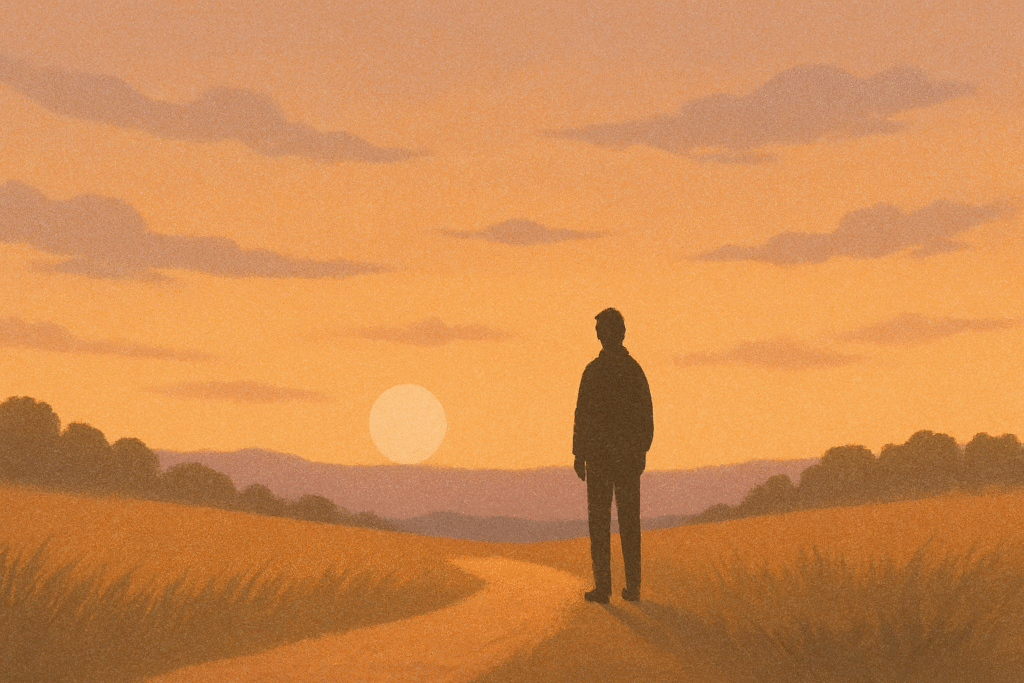
    A lone figure facing a calm sunset horizon

    Quote of the Day

    All truly great thoughts are conceived while walking.
    — Friedrich Nietzsche


    Closing Insight

    In the rhythm of our steps, we rediscover the rhythm of our thoughts.

    Walking clears space without demanding effort—
    a small ritual,
    a mental reset,
    a return to clarity.


    Today’s Insight (Science Notes)

    Studies from Stanford and the American Psychological Association highlight that walking significantly boosts divergent thinking and emotional clarity.

    Neuroscientific research shows that walking:

    • increases activity in the prefrontal cortex,
    • boosts creativity and emotional regulation,
    • reduces stress hormones,
    • and raises serotonin levels.

    This is why ideas often arrive precisely when we aren’t trying to find them.


    Summary Sentence

    “Walking is not a physical act, but a quiet conversation with the mind.”